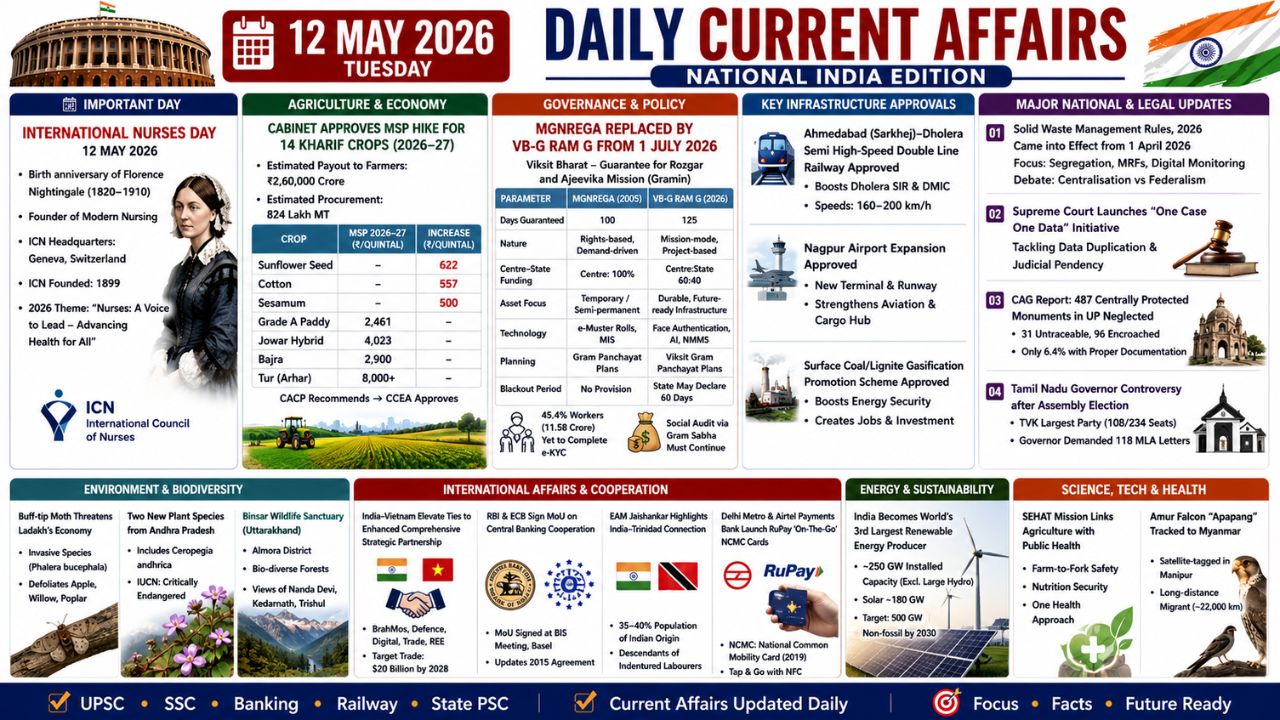
12 May 2026 Current Affairs is one of the most policy-heavy editions of the month — and a goldmine for UPSC Prelims just 12 days away. The biggest story of the day is the Union Cabinet approving MSP hike for 14 Kharif crops for 2026–27, with the highest increase going to Sunflower Seed at ₹622/quintal. Alongside this, the government officially notified that MGNREGA will be replaced by VB-G RAM G from July 1, 2026 — one of the most significant rural policy shifts in decades.
The Solid Waste Management Rules 2026 came under sharp debate over centralisation vs federalism. The Ahmedabad–Dholera Semi High-Speed Rail project got Cabinet clearance. Nagpur Airport expansion was approved. India and Vietnam elevated ties to Enhanced Comprehensive Strategic Partnership. International Nurses Day was observed globally. The SEHAT Mission linking agriculture with public health came into focus. And the Supreme Court launched its "One Case One Data" initiative to reduce pendency. Let's get into every story.
Important Day — International Nurses Day, May 12
International Nurses Day 2026 — Florence Nightingale's Legacy Lives On
May 12 is celebrated globally as International Nurses Day to recognise the dedication and contribution of nurses in healthcare services.
Why May 12? May 12 is the birth anniversary of Florence Nightingale (1820–1910) — the British social reformer and statistician who is widely considered the founder of modern nursing. During the Crimean War (1853–1856), Nightingale dramatically reduced mortality rates at British military hospitals through rigorous sanitation practices — transforming nursing from an informal occupation into a trained, evidence-based profession.
International Nurses Day — key facts:
Fact | Detail |
|---|---|
Observed on | May 12 (Florence Nightingale's birthday) |
Established by | International Council of Nurses (ICN) |
ICN headquarters | Geneva, Switzerland |
ICN founded | 1899 — world's first international organisation for healthcare professionals |
2026 Theme | "Nurses: A Voice to Lead — Advancing Health for All" |
India's nursing sector in context: India is one of the world's largest exporters of nurses — with over 2 million registered nurses and a massive training infrastructure. However, India's nurse-to-population ratio remains below the WHO recommended standard of 3 nurses per 1,000 population. Nursing reforms — including the Indian Nursing Council (INC) Act 1947 revisions — have been under discussion to upgrade training standards and professional recognition.
Florence Nightingale's statistical contribution: Beyond clinical care, Nightingale was a pioneer of data visualisation — she created the famous polar area diagram (coxcomb chart) to illustrate the causes of mortality among British soldiers, convincing the War Office to implement sanitation reforms. This makes her as significant in the history of statistics and public health data as in nursing itself.
International Nurses Day = May 12. Florence Nightingale's birthday (1820–1910). Founded modern nursing. Crimean War experience. ICN = International Council of Nurses, Geneva, founded 1899. 2026 Theme = "Nurses: A Voice to Lead — Advancing Health for All." India has ~2 million registered nurses. WHO recommends 3 nurses per 1,000 population. Nightingale invented polar area diagram (coxcomb chart) for data visualisation.
Agriculture & Economy
Cabinet Approves MSP Hike for 14 Kharif Crops — Sunflower Gets Highest Increase of ₹622/Quintal
This is the single most data-rich agriculture story of May 2026 — and a near-certain UPSC Prelims MCQ.
The Cabinet Committee on Economic Affairs (CCEA) approved an increase in Minimum Support Prices (MSP) for 14 Kharif Crops for Marketing Season 2026–27. The estimated payout to farmers will be ₹2,60,000 crore. An estimated over 824 lakh metric tonnes of crops will be procured in the season.
MSP hike details for all 14 Kharif crops:
Crop | MSP 2026–27 (₹/quintal) | Increase (₹/quintal) |
|---|---|---|
Sunflower Seed | — | ₹622 (highest) |
Cotton | — | ₹557 (2nd highest) |
Sesamum | — | ₹500 (3rd highest) |
Grade A Paddy | ₹2,461 | — |
Jowar Hybrid | ₹4,023 | — |
Bajra | ₹2,900 | — |
Tur (Arhar) | ₹8,000+ | — |
What is MSP? The Minimum Support Price is the price at which the government guarantees to purchase crops from farmers, regardless of market price — protecting farmers from distress selling during bumper harvests. MSP is recommended by the Commission for Agricultural Costs and Prices (CACP) — an advisory body under the Ministry of Agriculture and Farmers Welfare — and approved by the CCEA.
14 Kharif crops covered under MSP: Paddy, Jowar, Bajra, Maize, Ragi, Tur (Arhar), Moong, Urad, Groundnut, Sunflower Seed, Soybean, Sesamum, Nigerseed, and Cotton.
CACP's pricing methodology: CACP considers multiple cost concepts:
A2: Actual paid-out costs (seeds, fertilisers, pesticides, irrigation, hired labour)
A2+FL: A2 + imputed value of family labour
C2: Comprehensive cost including imputed rental value of owned land + interest on fixed capital
The government's commitment is to set MSP at at least 1.5 times A2+FL cost — following the Swaminathan Commission (2006) recommendation. However, critics argue that MSP should be set at C2+50% for true remuneration.
Why Sunflower gets the highest hike: India imports approximately 60–65% of its edible oil requirements — primarily palm oil (from Indonesia and Malaysia) and sunflower oil (from Ukraine and Russia). The West Asian and Eastern European geopolitical instability has sharply raised global sunflower oil prices. The high MSP hike for sunflower is designed to incentivise domestic cultivation and reduce India's edible oil import dependence — directly linking to PM Modi's appeal to reduce edible oil consumption made just the previous day.
MSP for 14 Kharif crops approved (CCEA). Highest hike: Sunflower Seed (₹622/q). Then Cotton (₹557/q), Sesamum (₹500/q). Grade A Paddy = ₹2,461/q. Bajra = ₹2,900/q. Jowar Hybrid = ₹4,023/q. CACP recommends MSP. CCEA approves. Swaminathan Commission (2006) = recommended C2+50%. India imports 60–65% of edible oil. Estimated farm payout = ₹2,60,000 crore. 824 lakh MT procurement target.
VB-G RAM G — MGNREGA Replaced from July 1, 2026 — Complete Framework
This is one of the most important policy stories of the year — directly relevant to UPSC, SSC, State PSC, and Banking exams alike.
The Union Government notified that from July 1, 2026, all rules, notifications, schemes, orders and guidelines under MGNREGA, 2005 will stand repealed and replaced by VB-G RAM G, signalling a major restructuring of rural employment policy.
VB-G RAM G — full form and background: VB-G RAM G stands for Viksit Bharat – Guarantee for Rozgar and Ajeevika Mission (Gramin). The Viksit Bharat-G RAM G Act, 2025 was passed by Parliament in December 2025 and comes into force on July 1, 2026. The Mahatma Gandhi National Rural Employment Guarantee Act (MGNREGA), 2005 will stand repealed.
MGNREGA vs VB-G RAM G — the complete comparison:
Parameter | MGNREGA (2005) | VB-G RAM G (2026) |
|---|---|---|
Days guaranteed | 100 days/household/year | 125 days/household/year |
Nature | Rights-based, demand-driven | Mission-mode, project-based |
Centre-State funding | Centre paid 100% of wages | 60:40 (Centre:State) |
Asset focus | Temporary/semi-permanent assets | Durable, future-ready infrastructure |
Technology | e-muster rolls, MIS | Face authentication, AI, NMMS attendance |
Planning | Gram Panchayat plans | Viksit Gram Panchayat Plans (VGPPs) |
Agricultural season | No blackout provision | States may declare 60-day blackout period |
Constitutional basis | Article 41 + Article 43 (DPSPs) | Same DPSPs — but implementation changed |
Consultation | Extensive pre-legislative process in 2005 | No pre-legislative public consultation |
Key concerns raised by experts:
MGNREGA functioned as a legal right enforceable by workers, whereas VB-G RAM G appears more programme-oriented, with greater executive discretion over budget and implementation. States will now bear a larger fiscal burden, increasing ownership but also potentially straining poorer States. e-KYC gap: 11.58 crore workers (45.4%) yet to complete e-KYC as of May 7, 2026 — creating risk of exclusion during transition. A 60-day blackout period may weaken labour bargaining strength by forcing workers into low-paid farm work during peak agricultural seasons.
What VB-G RAM G improves: Key features include thematic public works, tech-enabled governance with face authentication and AI, participatory planning via Viksit Gram Panchayat Plans, and a statutory 125-day employment guarantee. The Act mandates prompt wage payments with penalties for delays and unemployment allowances. Existing e-KYC verified MGNREGA Job Cards shall remain valid until Gramin Rozgar Guarantee Cards are issued.
Constitutional dimension:
MGNREGA was rights-based under Article 41 DPSP (Right to Work) and Article 43 (Living Wage). Social Audit — a mandatory mechanism under MGNREGA through Gram Sabha-based review of works and expenditure — must be retained under VB-G RAM G. VB-G RAM G's project-based approach may weaken the rights-based character.
MGNREGA's legacy — why it mattered: Enacted under the UPA government in 2005 — MGNREGA was hailed as the world's largest employment guarantee scheme. At its peak, it provided employment to over 15 crore rural households annually. It was directly responsible for:
Reducing rural distress migration during droughts
Raising rural wages — the MGNREGA wage floor created upward pressure on private sector rural wages
Creating rural infrastructure — water conservation, roads, afforestation
Empowering women — 52%+ of MGNREGA workers were women at peak implementation
Providing a automatic stabiliser during economic downturns (COVID-19 in 2020–21)
VB-G RAM G = Viksit Bharat – Guarantee for Rozgar and Ajeevika Mission (Gramin). Passed Parliament December 2025. Effective July 1, 2026. MGNREGA 2005 = repealed. Days: 100 → 125. Funding: Centre 100% → 60:40. 45.4% workers (11.58 crore) yet to do e-KYC. 60-day blackout period for agricultural seasons. Article 41 DPSP = Right to Work. Article 43 = Living wage. Social Audit via Gram Sabha must continue. NMMS = National Mobile Monitoring System (attendance tracking).
Ahmedabad (Sarkhej)–Dholera Semi High-Speed Double Line Railway — Cabinet Approves
The Cabinet approved the Ahmedabad (Sarkhej)–Dholera Semi High-Speed Double Line project — described as a landmark in India's rail modernisation journey.
Why Dholera matters: Dholera Special Investment Region (SIR) — located in Gujarat's Ahmedabad district — is India's first and largest greenfield smart city being developed under the Delhi-Mumbai Industrial Corridor (DMIC). It spans approximately 920 sq. km and is designed to be a global manufacturing and services hub. The rail link to Ahmedabad will:
Connect Dholera to India's broader rail network for the first time
Enable worker commuting between Ahmedabad and Dholera
Support industrial logistics for the Special Investment Region
Boost real estate and investment appetite in Dholera
Semi high-speed: The line is designed for speeds of 160–200 km/hour — faster than conventional rail but not full high-speed (which requires 250+ km/hour). This classification is increasingly being used for India's upgraded intercity rail corridors.
Delhi-Mumbai Industrial Corridor (DMIC): A flagship infrastructure project spanning 1,483 km along the Western Dedicated Freight Corridor (WDFC) — covering Delhi, Haryana, Rajasthan, Gujarat, Maharashtra, and Madhya Pradesh. It aims to develop industrial townships (Investment Regions and Industrial Areas) along the freight corridor — with Dholera being the most advanced node.
Ahmedabad (Sarkhej)–Dholera = semi high-speed double line railway (Cabinet approved May 2026). Dholera SIR = India's first greenfield smart city under DMIC. Dholera = ~920 sq km, Gujarat. DMIC = 1,483 km, along Western DFC. Semi high-speed = 160–200 km/hour.
Nagpur Airport Expansion — Cabinet Approves New Terminal + Runway
The Cabinet approved the Nagpur Airport expansion project — underscoring that it will accelerate the airport's emergence as a key aviation and cargo hub, strengthening connectivity and boosting regional economic development.
Why Nagpur Airport is strategically significant:
Dr. Babasaheb Ambedkar International Airport, Nagpur is located near India's geographical centre — making it ideal as a transit hub for cross-country flights
MIHAN (Multi-modal International Cargo Hub And Airport at Nagpur) — one of India's largest SEZ and aviation hub projects — surrounds the airport
Nagpur is also a key MRO (Maintenance, Repair and Overhaul) hub — Boeing's India MRO facility is located here
The expansion will add terminal capacity, cargo facilities, and a new runway — positioning Nagpur to handle significantly larger passenger and cargo volumes
Nagpur Airport = Dr. Babasahaar Ambedkar International Airport. MIHAN = Multi-modal International Cargo Hub and Airport at Nagpur. India's geographical centre = Nagpur. MRO hub. Cabinet approved expansion May 2026.
Surface Coal/Lignite Gasification Promotion Scheme — Cabinet Approved
The Cabinet approved the Scheme for Promotion of Surface Coal/Lignite Gasification Projects — which PM Modi said will further energy security, boost investment and create job opportunities.
Building on the National Coal Gasification Mission news from May 8 — this specific scheme creates a financial incentive structure for surface (above-ground) coal gasification, complementing the Underground Coal Gasification (UCG) provisions already announced. Lignite — also called "brown coal" — is a low-grade, younger form of coal with high moisture content. India has significant lignite reserves in Tamil Nadu (Neyveli), Rajasthan, and Gujarat. Lignite gasification unlocks energy value from these reserves without the air quality problems of direct lignite combustion.
Coal/Lignite Gasification Promotion Scheme = Cabinet approved. Lignite = brown coal (low grade, high moisture). India lignite reserves = Tamil Nadu (Neyveli), Rajasthan, Gujarat. Surface gasification = above-ground process. Complements Underground Coal Gasification (UCG) policy.
Governance & Law
VB-G RAM G — Constitutional and Social Justice Analysis
Already covered in detail above. Key additional point for UPSC Mains aspirants:
Article 41 of the Constitution — a Directive Principle of State Policy (DPSP) — directs the State to make effective provision for the right to work, to education, and to public assistance in cases of unemployment, old age, sickness, and disablement. Social Audit — the Gram Sabha-based review mechanism mandated under MGNREGA — must be preserved under VB-G RAM G.
The shift from a demand-driven to a supply-driven/project-based model has profound implications:
Under MGNREGA, any rural household could demand work and the government was legally bound to provide it within 15 days or pay an unemployment allowance
Under VB-G RAM G, work is tied to pre-approved projects — if no project is running in an area, the employment guarantee may become difficult to enforce
The 60:40 funding change means poorer states (like UP, Bihar, Jharkhand, Odisha — which have the highest MGNREGA utilisation) now face higher fiscal pressure to fund rural employment
MGNREGA demand-driven = any household can demand work. VB-G RAM G = project-based (work depends on approved projects running). 60:40 funding = poorer states bear more burden. Article 41 DPSP = State must provide right to work. SDG 1 (No Poverty) + SDG 8 (Decent Work) linkages. Unemployment allowance = must be preserved.
Solid Waste Management Rules 2026 — Centralisation vs Federalism Debate
The Solid Waste Management Rules, 2026 came into effect from April 1, 2026, replacing the 2016 Rules. They aim to improve source segregation, scientific processing, landfill reduction, and digital monitoring. Core pillars include: mandatory multi-stream source segregation, obligations for bulk waste generators, expansion of Material Recovery Facilities (MRFs), time-bound legacy dumpsite remediation, and centralised reporting through the Central Pollution Control Board (CPCB) portal.
The federalism concern: Waste management is a highly local function — it depends on geography, population density, local economy, land availability, citizen behaviour, and informal waste-worker networks. A model suitable for a megacity may not suit a coastal panchayat, tribal hamlet, or pilgrimage town. Many Gram Panchayats lack staff, sanitation experts, waste vehicles, digital capacity and adequate funds. Hence, complex compliance requirements may result in paper reporting rather than cleaner villages.
Constitutional framework: The Environment (Protection) Act, 1986 — enacted after the 1972 Stockholm Conference — derives authority from Article 253, allowing Parliament to implement international obligations. This permits national environmental standards but does not justify operational micromanagement of State and local functions.
The subsidiarity principle: It emphasises that decisions should be made by those closest to the particular circumstances of time and place, utilising local knowledge, household behaviour, and informal waste worker networks to manage waste effectively.
India's waste crisis in numbers:
India generates approximately 62 million tonnes of municipal solid waste annually — projected to reach 165 million tonnes by 2030
Only 22–28% is currently processed scientifically
Ghazipur landfill (Delhi) — one of India's most infamous — is taller than the Qutub Minar and continues to grow despite remediation attempts
2024 Kochi and Delhi landfill fires resulted in toxic smoke affecting millions
Landfills are major sources of methane — a greenhouse gas 80 times more potent than CO₂ over a 20-year period
The way forward: The Centre should set minimum environmental standards, while States should design context-specific models. Local bodies need funds, staff, vehicles, training and technical support. Rural areas should focus on composting, periodic collection, and cluster-level dry-waste management.
SWM Rules 2026 = in effect from April 1, 2026 (replace 2016 Rules). Under Environment Protection Act 1986 (Article 253). CPCB = Central Pollution Control Board. MRF = Material Recovery Facility. India generates 62 million tonnes municipal waste/year. Ghazipur landfill = taller than Qutub Minar. Subsidiarity principle = local governance for local problems. 74th Amendment + 12th Schedule = ULBs responsible for solid waste. Federalism vs centralisation = core tension.
Supreme Court "One Case One Data" Initiative — Tackling Pendency with Data Integrity
The Supreme Court launched the "One Case One Data" initiative to address the chronic problem of data duplication and inconsistency in judicial records — where the same case may appear with different identifiers across different court information systems, inflating the apparent pendency figures and making case tracking unreliable.
India's judicial pendency crisis — numbers:
Over 5 crore cases pending across all courts in India
Supreme Court: 92,000+ cases (as noted earlier — the reason for the judge strength increase from 34 to 38)
High Courts: ~60 lakh cases
District and Subordinate Courts: ~4.4 crore cases
Average time to resolve a civil case in Indian courts: 13–15 years
The "One Case One Data" initiative: The initiative creates a unified case identifier that travels with a case throughout its entire lifecycle — from filing to disposal — across all court systems. This prevents the same case from appearing multiple times in pendency statistics and enables:
Accurate real-time pendency data
Better judicial resource allocation
Faster identification of long-pending cases
Improved litigant tracking and access to case status
Companion initiatives:
NJDG (National Judicial Data Grid): Real-time database of cases in district and subordinate courts — already operational
e-Courts Phase III: ₹7,210 crore scheme for digital transformation of all courts
Virtual Courts and Video Conferencing: For traffic challan payment and minor cases
SC "One Case One Data" initiative = unique case identifier across all court systems. India total pendency = 5+ crore cases. SC = 92,000+. HC = 60 lakh. District = 4.4 crore. NJDG = National Judicial Data Grid. e-Courts Phase III = ₹7,210 crore. Average civil case resolution = 13–15 years.
Women's Safety in Telangana — SHE Teams, POCSO, and Cyber Harassment
The current affairs focus on women's safety in Telangana highlighted cyber harassment, POCSO cases, and initiatives like SHE Teams. The road to delivering women's safety in Telangana requires bridging the gap between the narrative of action and actual legal outcomes. By tackling both street harassment and coordinated digital trolling, the state can set a national benchmark for justice.
SHE Teams — Telangana's flagship initiative: Launched in 2014 under the Hyderabad City Police, SHE Teams are plain-clothes women police officers deployed in public spaces — markets, colleges, bus stands, cinema halls, and public transport — to catch and address eve-teasing and sexual harassment on the spot. The offender is counselled or arrested depending on severity, and a "Wall of Shame" was created to publicise offenders' faces and names — a powerful deterrent mechanism.
POCSO Act — key facts: The Protection of Children from Sexual Offences (POCSO) Act, 2012 — amended in 2019 — protects children (persons under 18) from sexual assault, sexual harassment, and pornography. It mandates:
Special Courts for POCSO cases
Child-friendly investigation procedures
Time-bound trials (ideally within one year)
Stringent punishments — including death penalty for aggravated penetrative sexual assault (2019 amendment)
Cyber harassment and IPC/BNS provisions: With the replacement of the Indian Penal Code (IPC) 1860 by the Bharatiya Nyaya Sanhita (BNS) 2023 — effective July 1, 2024 — cyber harassment is now governed under BNS provisions. Key sections covering digital crimes against women include provisions on stalking (Section 78 BNS), voyeurism (Section 77), and criminal intimidation through digital means.
SHE Teams = Telangana (Hyderabad Police, 2014). Plain-clothes women officers. POCSO Act 2012 (amended 2019). Children = under 18. Special Courts for POCSO. Death penalty possible for aggravated assault (2019 amendment). BNS 2023 replaced IPC 1860 (effective July 1, 2024). Cyber harassment = BNS Section 78 (stalking) + Section 77 (voyeurism).
International Affairs
India–Vietnam Elevate Ties to Enhanced Comprehensive Strategic Partnership
India and Vietnam elevated their bilateral ties to an Enhanced Comprehensive Strategic Partnership during Vietnamese President Tô Lâm's visit to India in May 2026.
The partnership evolution:
Year | Status |
|---|---|
2007 | Strategic Partnership |
2016 | Comprehensive Strategic Partnership |
2026 | Enhanced Comprehensive Strategic Partnership |
Key pillars of the Enhanced partnership:
Defence: BrahMos missile discussions, naval cooperation, joint patrol in South China Sea approaches
Digital economy: Cooperation on digital infrastructure, UPI-based payment systems in Vietnam
Critical minerals: Rare Earth Elements — Vietnam has the world's 2nd largest REE reserves (after China) — making it a strategic partner for India's semiconductor and EV supply chain
Trade: Bilateral trade at $16.5 billion (2025 record) — target to reach $20 billion by 2028
Education and people-to-people: IIT and university partnerships
Why Vietnam's REE reserves matter for India: Vietnam's Rare Earth Elements (REEs) — including Cerium, Lanthanum, Neodymium, Dysprosium — are critical for EV motors, wind turbines, smartphones, and defence electronics. China currently controls approximately 85% of global REE processing. India's partnership with Vietnam directly supports the goal of reducing critical mineral dependence on China.
India-Vietnam = Enhanced Comprehensive Strategic Partnership (2026). Earlier = Comprehensive Strategic Partnership (2016). Vietnam = world's 2nd largest REE reserves. BrahMos discussions ongoing. Bilateral trade = $16.5 billion target → $20 billion by 2028. Vietnam in ASEAN — part of India's Act East Policy.
Delhi Metro–Airtel Payments Bank Launch RuPay 'On-The-Go' Cards — NCMC
In May 2026, Delhi Metro Rail Corporation (DMRC) partnered with Airtel Payments Bank to launch co-branded RuPay 'On-The-Go' National Common Mobility Cards (NCMC) for seamless digital payments and metro travel across India.
About NCMC: The National Common Mobility Card is India's interoperable transport card — allowing users to pay for metro, bus, parking, retail, and other transit-related payments with a single card. It operates on the RuPay payment network — India's domestic card payment network developed by NPCI (National Payments Corporation of India). NCMC was launched in 2019 under the Ministry of Housing and Urban Affairs.
What makes 'On-The-Go' special: These are wearable payment cards — embedded in wristbands, keychains, or stickers — that work on NFC (Near Field Communication) technology. The user simply taps the wearable on the reader to pay — no need to carry a physical card or unlock a phone. This reduces transaction time at metro gates from seconds to milliseconds.
DMRC at a glance:
India's largest metro network by ridership
Operational since December 2002 (first line: Shahdara–Tis Hazari)
Total network: ~390 km across Delhi-NCR
Daily ridership: approximately 60–65 lakh passengers
Awards: Won multiple Green Building and Energy Efficiency awards; operates on renewable energy
DMRC + Airtel Payments Bank = RuPay On-The-Go NCMC cards. NCMC = National Common Mobility Card = launched 2019 = under MoHUA. RuPay = NPCI's domestic card network. NFC = Near Field Communication (tap-to-pay). DMRC = India's largest metro; operational since December 2002.
PM Modi Inaugurates PM MITRA Park — India's First Functional Mega Textile Park
On 10 May 2026, PM Modi inaugurated India's first functional Pradhan Mantri Mega Integrated Textile Region and Apparel (PM MITRA) Park in Warangal, Telangana. He also dedicated projects worth around ₹9,400 crore in Hyderabad and participated in the Art of Living's 45th anniversary celebrations in Bengaluru, including the 70th birthday of Gurudev Sri Sri Ravi Shankar.
About PM MITRA: Pradhan Mantri Mega Integrated Textile Region and Apparel (PM MITRA) scheme was approved by Cabinet in October 2021. It aims to establish 7 mega textile parks across India — creating world-class, plug-and-play infrastructure for the entire textile value chain from fibre to fabric to fashion to foreign (the 5F vision — same framework as the Cotton Productivity Mission). Key features:
Each PM MITRA park = approximately 1,000 acres of developed land
Provides common infrastructure: testing labs, incubation centres, worker hostels, common effluent treatment
Expected to generate ~1 lakh direct + 2 lakh indirect jobs per park
7 parks approved in: Tamil Nadu (Virudhunagar), Telangana (Warangal), Karnataka (Kalaburagi), Gujarat (Navsari), Madhya Pradesh (Dhar), Uttar Pradesh (Lucknow), Maharashtra (Amravati)
Warangal PM MITRA is significant as the first to become functional — a milestone for India's textile sector revival ambitions.
PM MITRA = Pradhan Mantri Mega Integrated Textile Region and Apparel. Cabinet approved October 2021. 7 parks across India. First functional = Warangal, Telangana. Each park ~1,000 acres. 5F = Fibre→Fabric→Fashion→Foreign. ~1 lakh direct jobs per park. States with PM MITRA: TN, Telangana, Karnataka, Gujarat, MP, UP, Maharashtra.
Environment & Biodiversity
SEHAT Mission — Linking Agriculture with Public Health
The SEHAT Mission (Sustainable Ecosystem Health and Agriculture Transformation) linking agriculture with health came into focus in policy discussions.
What is the SEHAT Mission? SEHAT (a Hindi word meaning "health") is a convergence framework that recognises the deep interdependence between agricultural practices and public health outcomes. The mission's core argument: the same chemical-intensive farming that boosts short-term yields is creating long-term public health crises — through pesticide residues in food, antibiotic resistance from livestock overuse of antibiotics, and declining soil microbiome diversity that affects nutritional quality of crops.
The three convergence pillars of SEHAT:
Farm to Fork Safety: Reducing pesticide residue in food through Integrated Pest Management (IPM) and natural farming
Nutrition Security: Promoting millets, traditional crops, and biofortified varieties to address micronutrient deficiencies
One Health Approach: Integrating human, animal, and environmental health — recognising that 60% of infectious diseases are zoonotic (animal-origin)
One Health Framework: Launched globally by WHO, FAO, and UNEP — One Health recognises that human health, animal health, and ecosystem health are deeply interconnected. India's National Action Plan for One Health (NAPH) coordinates across the Ministries of Health, Agriculture, and Environment.
SEHAT Mission = Sustainable Ecosystem Health and Agriculture Transformation. Links farm practices with public health. Three pillars: Farm-to-Fork Safety + Nutrition Security + One Health. One Health = WHO + FAO + UNEP framework. Zoonotic diseases = 60% of infectious diseases. India NAPH = National Action Plan for One Health.
Binsar Wildlife Sanctuary — Mapping in Focus
Binsar Wildlife Sanctuary was highlighted in current affairs mapping discussions.
About Binsar Wildlife Sanctuary:
Located in Almora district, Uttarakhand — in the Kumaon Himalayas
Altitude: 2,412 metres at the highest point (Zero Point)
Known for: Panoramic views of the Himalayan peaks — Kedarnath, Chaukhamba, Trishul, Nanda Devi, Panchachuli
Flora: Dense mixed oak forests — Banj Oak, Buransh (Rhododendron), Deodar
Fauna: Leopard, Himalayan Bear, Barking Deer, Goral, over 200 bird species
Historical significance: Served as the summer capital of the Chand Rajas of Kumaon
Established: 1988
Managed by: Uttarakhand Forest Department
Unique: No large-scale tourist infrastructure — known for its pristine, undisturbed character
Binsar WLS = Almora, Uttarakhand. Kumaon Himalayas. Altitude = 2,412m (Zero Point). Established 1988. Flora = Banj Oak, Rhododendron, Deodar. Views of Kedarnath, Nanda Devi, Trishul, Panchachuli. Historical = Chand Rajas' summer capital. 200+ bird species.
National Jute Board — Jute Crop Information System (JCIS) with ISRO
The National Jute Board expanded the implementation of the Jute Crop Information System (JCIS) — a technology-driven platform developed with ISRO to modernise crop monitoring.
About the National Jute Board: The National Jute Board is the apex body under the Ministry of Textiles, responsible for the overall development of the jute sector. It is governed by the National Jute Board Act, 2008, formally enacted on February 12, 2009.
What is JCIS? The Jute Crop Information System uses ISRO's satellite remote sensing data — particularly from the ResourceSat series of satellites — to provide real-time information on:
Jute crop acreage (area under cultivation)
Crop growth stages and health
Yield forecasting
Flood and drought impact assessment on jute fields
Why jute matters: India is the world's largest producer of raw jute — accounting for approximately 60–70% of global production, primarily in West Bengal (leading state), Bihar, Assam, Odisha, and Andhra Pradesh. Jute is one of the most eco-friendly natural fibres — biodegradable, carbon-sequestering, and versatile. It is classified as the "Golden Fibre" of India.
Key jute legislation:
Jute Packaging Materials (Compulsory Use in Packing Commodities) Act, 1987 — mandates use of jute bags for certain commodities (foodgrains, sugar) to support jute farmers
National Jute Board = under Ministry of Textiles. NJB Act 2008. JCIS = Jute Crop Information System with ISRO's ResourceSat. India = world's largest raw jute producer (60–70% global share). West Bengal = leading state. Jute = "Golden Fibre." Jute Packaging Act 1987 = mandatory jute bags for foodgrains + sugar.
Non-Tariff Barriers (NTBs) in Global Trade — India's Farm Exports Despite Trump Tariffs
Policy discussions on May 12 highlighted how India's farm exports have grown despite Trump tariffs — largely due to product diversification and non-tariff advantage in certain markets — while flagging the broader problem of Non-Tariff Barriers (NTBs) in international trade.
What are Non-Tariff Barriers? Non-Tariff Measures (NTMs) are policy measures other than ordinary customs tariffs that can affect international trade in terms of quantity, price, or both. They include:
SPS (Sanitary and Phytosanitary) Measures: Food safety and plant/animal health standards — the most common NTBs affecting Indian agricultural exports
TBT (Technical Barriers to Trade): Product standards, labelling requirements, testing procedures
Quotas and Import Licensing: Quantity restrictions
Subsidies: Export subsidies that distort competition
Anti-dumping measures
India's farm export performance: Despite US tariffs and global trade headwinds, India's agricultural exports have shown resilience — growing through:
Basmati Rice: Premium niche with limited competition globally
Spices: India controls ~40% of global spice trade
Marine products: Shrimp and seafood exports to the US, EU, Japan
Fruits and vegetables: Mangoes, grapes, onions to Gulf and European markets
WTO framework: NTMs are governed by the WTO Agreement on Sanitary and Phytosanitary Measures (SPS Agreement) and the Agreement on Technical Barriers to Trade (TBT Agreement) — both requiring that measures be based on scientific evidence and not create unnecessary trade barriers.
NTMs = Non-Tariff Measures. Types: SPS, TBT, quotas, subsidies, anti-dumping. SPS = food safety standards (most common NTB for Indian farm exports). Governed by WTO SPS Agreement + TBT Agreement. India farm exports grew despite Trump tariffs through diversification. India = ~40% global spice trade.
Economy & Finance
Mann Ki Baat — 133rd Episode
PM Modi addressed the 133rd episode of Mann Ki Baat — his monthly radio programme.
Mann Ki Baat — key facts:
Mann Ki Baat is PM Modi's monthly radio address to the nation — broadcast on All India Radio (AIR) and Doordarshan on the last Sunday of every month
First episode: October 3, 2014
Broadcast in: 22 scheduled languages of India + English + multiple regional dialects
Focus: Positive citizen stories, government achievements, social awareness, inspiration
133rd episode = continuing the series that began in October 2014
Prasar Bharati: Both AIR and Doordarshan are under Prasar Bharati — India's public broadcaster. Prasar Bharati was established under the Prasar Bharati (Broadcasting Corporation of India) Act, 1990 and became operational in 1997.
Mann Ki Baat = PM Modi's monthly radio address on AIR. 133rd episode = May 2026. First episode = October 3, 2014. Broadcast on last Sunday of every month. 22 scheduled languages + English. AIR and Doordarshan = under Prasar Bharati (Act 1990, operational 1997).
RBI–ECB MoU — Signed on BIS Meeting Sidelines in Basel
Sanjay Malhotra, Governor of RBI, and Christine Lagarde, President of ECB, signed the MoU on the sidelines of the Bank for International Settlements (BIS) meetings held in Basel, Switzerland. The newly signed MoU updates the previous agreement signed in 2015 and establishes a framework for regular exchange of information, policy dialogue, and technical cooperation between the two institutions.
Bank for International Settlements (BIS) — key facts:
Founded: 1930 — the world's oldest international financial institution
Headquarters: Basel, Switzerland
Called: "Central bank for central banks"
Members: 63 central banks worldwide, representing ~95% of world GDP
Key role: Facilitates cooperation among central banks, hosts the Basel Committee on Banking Supervision — which sets global banking regulatory standards (Basel I, II, III norms)
Basel III: The current global banking regulatory framework — setting capital adequacy, leverage, and liquidity standards for banks
RBI Governor = Sanjay Malhotra. ECB President = Christine Lagarde. MoU signed at BIS meeting, Basel, Switzerland. BIS = founded 1930, Basel = "central bank for central banks." 63 member central banks. Basel Committee on Banking Supervision = sets Basel I/II/III norms. Capital adequacy standards = CRAR (Capital to Risk-weighted Asset Ratio).
FAQs — 12 May 2026 Current Affairs
Q. Why is International Nurses Day observed on May 12?
May 12 is the birthday of Florence Nightingale (1820–1910) — the founder of modern nursing who transformed healthcare through sanitation reforms during the Crimean War. The International Council of Nurses (ICN), founded in 1899 and headquartered in Geneva, officially established this observance. The 2026 theme is "Nurses: A Voice to Lead — Advancing Health for All."
Q. Which kharif crop received the highest MSP increase for 2026–27?
Sunflower Seed received the highest increase of ₹622 per quintal, followed by Cotton (₹557/quintal) and Sesamum (₹500/quintal). The CCEA approved MSP hikes for all 14 Kharif crops based on CACP recommendations. The estimated payout to farmers is ₹2,60,000 crore.
Q. What is VB-G RAM G and how is it different from MGNREGA?
VB-G RAM G (Viksit Bharat – Guarantee for Rozgar and Ajeevika Mission Gramin) replaces MGNREGA from July 1, 2026. Key changes: employment guarantee increased from 100 to 125 days; funding shifted from Centre-100% to 60:40 (Centre:State); approach changed from demand-driven rights-based to project-based mission mode; states can declare a 60-day blackout period; attendance tracked via face authentication and NMMS. 45.4% of workers (11.58 crore) are yet to complete mandatory e-KYC.
Q. What are the Solid Waste Management Rules 2026 and what is the key concern?
SWM Rules 2026 came into effect April 1, 2026, replacing the 2016 Rules. They mandate multi-stream source segregation, Material Recovery Facilities, digital CPCB reporting, and legacy dumpsite remediation. The key concern is that the centralised, uniform approach may be impractical for rural panchayats and small towns that lack staff, equipment, and digital capacity — violating the subsidiarity principle and principles of cooperative federalism.
Q. What is the PM MITRA scheme and where is its first functional park?
PM MITRA (Pradhan Mantri Mega Integrated Textile Region and Apparel) was approved by Cabinet in October 2021 to set up 7 mega textile parks across India, each providing integrated fibre-to-fashion infrastructure. The first functional PM MITRA Park was inaugurated by PM Modi in Warangal, Telangana in May 2026.
Q. What is the BIS and why was the RBI-ECB MoU signed there?
The Bank for International Settlements (BIS), founded in 1930 and headquartered in Basel, Switzerland, is the world's oldest international financial institution — called the "central bank for central banks." It hosts the Basel Committee on Banking Supervision (which sets Basel I/II/III norms) and facilitates meetings of global central bank governors. RBI Governor Sanjay Malhotra and ECB President Christine Lagarde signed the updated MoU on its sidelines.
Q. What is the India-Vietnam Enhanced Comprehensive Strategic Partnership?
India and Vietnam elevated their bilateral ties to Enhanced Comprehensive Strategic Partnership in May 2026 — the third upgrade since 2007. Key pillars include defence (BrahMos discussions), digital economy, critical minerals (Vietnam has world's 2nd largest REE reserves after China), and trade (target $20 billion by 2028). It is part of India's Act East Policy.
Q. What is the Jute Crop Information System (JCIS)?
JCIS is a technology-driven crop monitoring platform developed by the National Jute Board (under Ministry of Textiles) in partnership with ISRO. It uses satellite remote sensing (ResourceSat) data to provide real-time information on jute crop acreage, growth health, yield forecasts, and natural disaster impact — helping India plan jute procurement and support for the ~60–70% of global jute production that India accounts for.
Written by
Koti Deva
Digital Marketing Specialist
Koti is a Digital Marketing Specialist with over 10 years of experience and the co-founder of MCQ Orbit — a free exam prep platform built for Indian competitive exam aspirants.
With strong personal knowledge in Quantitative Aptitude, Logical Reasoning, and Mathematics, Koti has a deep understanding of what it takes to crack exams like SSC CGL, IBPS PO, SBI Clerk, UPSC Prelims, NEET, and JEE. Having followed these exams closely for years, he understands the exact topics, patterns, and shortcuts that matter most.
MCQ Orbit was born from a simple desire — to build a platform where every aspirant in India can practice quality MCQs, read reliable current affairs, and prepare confidently, without paying a rupee. Koti combines his digital expertise with his passion for competitive exams to create content that is accurate, practical, and genuinely useful for students.
His mission is straightforward: if the right guidance had been freely available earlier, more students would have cracked their dream exams. MCQ Orbit is his way of making that happen.
Comments
No comments yet.