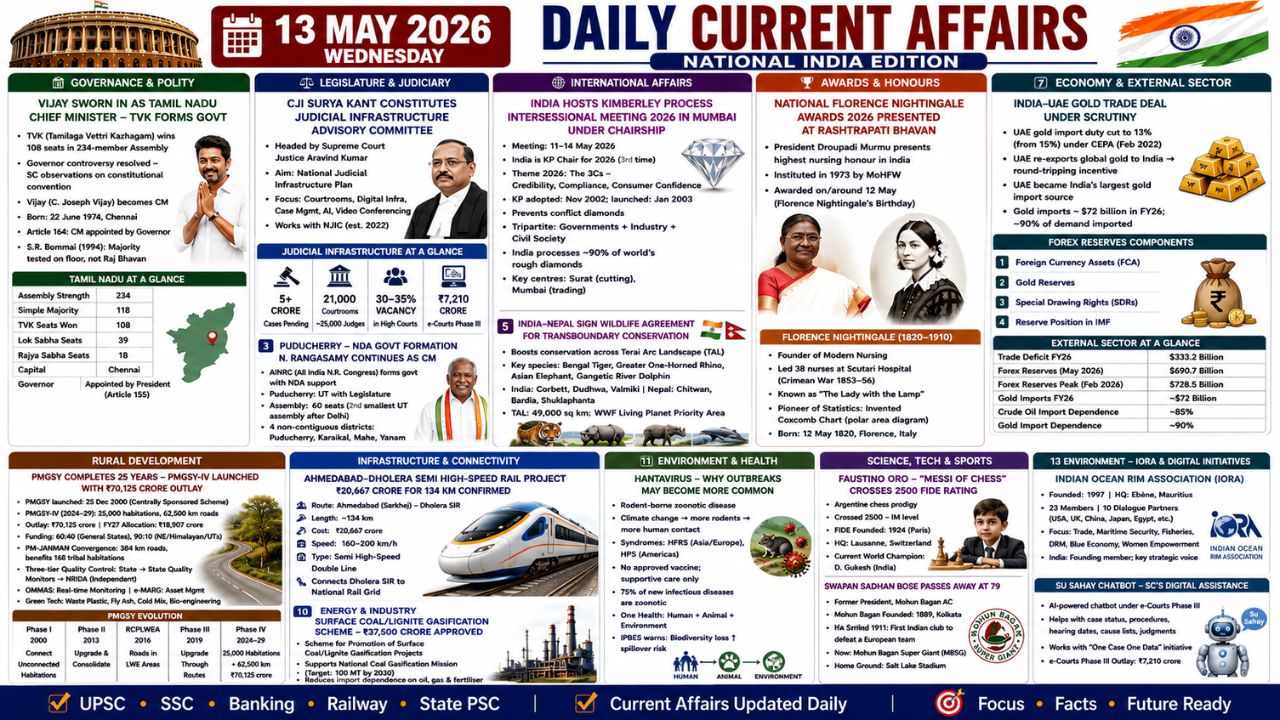
13 May 2026 Current Affairs is a must-read for every aspirant — with UPSC Prelims just 11 days away on May 24. Today's edition is headlined by India hosting the Kimberley Process Intersessional Meeting 2026 in Mumbai under its Chairship — the first time in years India has held this prestigious global diamond governance role. PMGSY completes 25 years — and PMGSY-IV was formally launched with a ₹70,125 crore target to connect 25,000 rural habitations.
President Droupadi Murmu presented the National Florence Nightingale Awards 2026 at Rashtrapati Bhavan. CJI Surya Kant constituted the Judicial Infrastructure Advisory Committee to overhaul India's court infrastructure. Vijay was sworn in as Tamil Nadu's Chief Minister — ending the Governor controversy. India and Nepal signed a landmark Wildlife Agreement for transboundary conservation. The Ahmedabad–Dholera Semi High-Speed Rail Project's financial details were officially confirmed at ₹20,667 crore for 134 km. And the India-UAE gold trade deal came under scrutiny for potentially worsening India's import bill despite PM Modi's gold restraint appeal. Let's get into every story.
Governance & Polity
Vijay Sworn In as Tamil Nadu Chief Minister — TVK Forms Government, Governor Controversy Resolved
One of the most watched political developments of 2026 reached its constitutional conclusion on May 13.
TVK Government Formation 2026: Vijay Becomes Tamil Nadu CM — ending the constitutional standoff that had gripped Tamil Nadu since election results were declared.
How the standoff was resolved: Following sustained public pressure, Supreme Court observation that Governors must respect democratic mandates, and a near-unanimous political consensus that the Governor's demand for 118 pre-oath MLA letters had no constitutional basis, the Governor of Tamil Nadu administered the oath of office to C. Joseph Vijay — making him Tamil Nadu's Chief Minister as leader of the single largest party (TVK with 108 seats).
C. Joseph Vijay — quick profile:
Full name: Chandrasekhar Joseph Vijay — widely known simply as Vijay
Born: June 22, 1974 in Chennai
One of Tamil cinema's biggest superstars — known for blockbusters spanning three decades
Founded TVK (Tamilaga Vettri Kazhagam) in 2024 — contesting its first-ever election in 2026
Became CM without a prior political or administrative background — a first in modern Tamil Nadu's history
The constitutional lesson from this episode: The TN Governor controversy validated two constitutional principles:
Article 164: The Governor appoints the CM — but convention mandates that the leader of the single largest party or coalition commanding majority confidence is invited first
S.R. Bommai vs Union of India (1994): The Supreme Court clearly held that majority must be tested on the floor of the House — not in the Raj Bhavan through letter collection
Tamil Nadu at a glance:
234-member Legislative Assembly
Simple majority = 118 seats
TVK won 108 seats (single largest but short of majority)
Tamil Nadu sends 39 MPs to Lok Sabha and 18 to Rajya Sabha
Capital: Chennai (formerly Madras)
Governor: Appointed by the President under Article 155
Vijay (C. Joseph Vijay) = new Tamil Nadu CM (sworn in May 13, 2026). TVK = Tamilaga Vettri Kazhagam. First election in 2026. TVK = 108 seats. TN Assembly = 234 seats. Simple majority = 118. Governor controversy resolved — pre-oath letter demand = unconstitutional. Article 164 = CM appointed by Governor. S.R. Bommai 1994 = floor test, not Raj Bhavan test. Tamil Nadu has 39 LS + 18 RS MPs.
CJI Surya Kant Constitutes Judicial Infrastructure Advisory Committee
Chief Justice of India Surya Kant constituted a high-powered Judicial Infrastructure Advisory Committee headed by Supreme Court Justice Aravind Kumar.
The Judicial Infrastructure Advisory Committee is a high-level expert panel formed to overhaul the physical and digital landscape of the Indian judiciary. It comprises senior judges from the Supreme Court and various High Courts, along with top administrative and technical officials. The primary aim is to address chronic infrastructural gaps in the Indian court system by creating a comprehensive roadmap for the 21st century.
India's judicial infrastructure crisis — the numbers:
Over 5 crore cases pending across all courts
India has approximately 21,000 courtrooms for roughly 25,000 judges — many courts share rooms or operate in dilapidated colonial-era buildings
Vacancy rate among judges: approximately 30–35% across High Courts
Computer penetration in lower judiciary: improved significantly under e-Courts Phase I and II — but still patchy
e-Courts Phase III (₹7,210 crore) is underway — but physical infrastructure remains the bottleneck
The committee's mandate:
Develop a National Judicial Infrastructure Plan — district-wise courtroom requirements, digital connectivity, digital case management
Standardise court design — accessible buildings, separate waiting areas for victims, child-friendly court facilities
Technology integration — video conferencing infrastructure for testimony and hearings, AI-assisted case scheduling
Fast-track court expansion — particularly for POCSO, NDPS, and economic offence cases
National Judicial Infrastructure Corporation (NJIC): Established in 2022 by the Supreme Court, NJIC is the institutional mechanism for coordinating judicial infrastructure development across Centre, States, and High Courts. The new Advisory Committee will work alongside NJIC.
CJI = Justice Surya Kant. Judicial Infrastructure Advisory Committee = headed by Justice Aravind Kumar. India = 5+ crore pending cases. 21,000 courtrooms, ~25,000 judges. e-Courts Phase III = ₹7,210 crore. NJIC = National Judicial Infrastructure Corporation (est. 2022). Committee's goal = National Judicial Infrastructure Plan for 21st century.
Puducherry — NDA Government Formation
N. Rangasamy was in news in the context of NDA Government Formation in Puducherry.
About Puducherry:
Union Territory of India — but has a Legislative Assembly (not all UTs have one)
60-member Legislative Assembly — making it the second-smallest UT assembly after Delhi (70 seats)
The Union Territory is governed under Article 239 — with a Lieutenant Governor (LG) appointed by the President as the administrator
The Chief Minister and Council of Ministers are responsible to the Legislative Assembly
N. Rangasamy leads the All India N.R. Congress (AINRC) — a regional party allied with NDA in Puducherry
Puducherry has a unique feature: it consists of 4 non-contiguous districts — Puducherry (main territory near Tamil Nadu), Karaikal (near Tamil Nadu), Mahe (on Kerala coast), and Yanam (near Andhra Pradesh)
Puducherry = UT with Legislature. 60-member assembly. LG = administrator (Article 239). CM responsible to assembly. AINRC = All India N.R. Congress (N. Rangasamy's party). Puducherry = 4 non-contiguous districts: Puducherry, Karaikal, Mahe, Yanam.
International Affairs
India Hosts Kimberley Process Intersessional Meeting 2026 — Mumbai
This is a high-probability UPSC Prelims question — and today's most internationally significant story.
India inaugurated the Kimberley Process (KP) Intersessional Meeting 2026 in Mumbai under its Chairship, bringing together representatives from participating countries, industry bodies and civil society organisations. The four-day meeting is being held from May 11 to May 14, 2026, focusing on strengthening monitoring mechanisms, compliance systems, and consumer confidence in the global natural diamond value chain.
The Kimberley Process — complete exam framework:
The Kimberley Process Certification Scheme (KPCS) was adopted in November 2002 and launched in January 2003. Its primary aim is to prevent conflict diamonds — rough diamonds used by rebel movements to finance wars against legitimate governments — from entering the mainstream market. It ensures that diamond purchases do not fund violence or human rights abuses.
Current Chair (2026): India (assuming office on January 1, 2026). This is the third time India has held the Chairship. The Chairship is rotated annually among member states.
India's 2026 KP Theme: The 3Cs 3Cs: Credibility + Compliance + Consumer Confidence
How the KPCS works:
Statutory Certificate: Every shipment of rough diamonds exported across an international border must be transported in a tamper-resistant container and accompanied by a government-validated Kimberley Process Certificate. Trade Restrictions: Member states are prohibited from trading rough diamonds with any non-member or any country that does not satisfy the scheme's minimum requirements. National Legislation: Each participant must establish national laws and internal controls to prevent conflict diamonds from being smuggled into the legal supply chain.
Blockchain and Digitalisation: Under India's 2026 Chairship, there is a push to modernise the scheme using digital, tamper-proof certificates and blockchain-based traceability to further reduce fraud.
India's diamond industry — why this chairship matters: India is the world's largest diamond cutting and polishing centre — processing approximately 90% of the world's rough diamonds by volume. The industry is concentrated in:
Surat, Gujarat — India's diamond capital, home to thousands of polishing units
Mumbai — India's diamond trading and export hub
India's diamond exports were approximately $23–25 billion annually before recent global market slowdowns. The KP Chairship gives India direct influence over global diamond certification standards — protecting its export-dependent industry while contributing to conflict diamond prevention.
The tripartite structure of KP: The Kimberley Process is a tripartite international initiative involving: Governments, the global diamond industry, and civil society groups.
Criticism of the Kimberley Process: Despite its achievements, KP has faced criticism for:
Its narrow definition of "conflict diamonds" — covering only diamonds financing rebel groups, not state-sponsored violence or human rights abuses
Weak enforcement mechanisms — KP relies on self-reporting and peer review rather than independent monitoring
Zimbabwe Marange controversy (2011): When Zimbabwe's Marange diamond fields — where serious human rights abuses were documented — were still allowed to sell through KP, several civil society groups withdrew from the process
Kimberley Process = adopted November 2002, launched January 2003. Prevents conflict diamonds. India = KP Chair 2026 (third time). India's 2026 theme = 3Cs: Credibility + Compliance + Consumer Confidence. KP = tripartite: Governments + Industry + Civil Society. Blockchain push under India's 2026 chairship. India processes ~90% of world's rough diamonds. Surat = diamond cutting capital. Mumbai = KP Intersessional host.
India-Nepal Wildlife Agreement — Transboundary Conservation Boost
India and Nepal signed a landmark Wildlife Agreement for Transboundary Conservation — a major boost for biodiversity and endangered species protection across the India-Nepal border region.
Why India-Nepal transboundary conservation matters: The India-Nepal border runs along some of the most biodiverse landscapes in South Asia — the Terai Arc Landscape (TAL) — a 49,000 sq km mosaic of grasslands, forests, and wetlands stretching across the foothills of the Himalayas. Wildlife does not respect national borders — tigers, elephants, rhinos, and dozens of other species regularly cross between:
India's protected areas: Corbett National Park (Uttarakhand), Dudhwa National Park (UP), Valmiki Tiger Reserve (Bihar), Shuklaphanta Wildlife Reserve borders
Nepal's protected areas: Chitwan National Park (UNESCO World Heritage Site), Bardia National Park, Shuklaphanta National Park
Key species that benefit from transboundary conservation:
Bengal Tiger: The Terai Arc hosts one of the world's most significant tiger meta-populations — transboundary corridors allow genetic exchange between isolated tiger populations
Greater One-Horned Rhinoceros: Found primarily in Chitwan (Nepal) and Kaziranga (India) — corridors support population dispersal
Asian Elephant: Migratory herds regularly cross the India-Nepal border
Gangetic River Dolphin: India's National Aquatic Animal — the Karnali and Gandaki river systems connecting Nepal and India are critical habitat
The Terai Arc Landscape — key facts:
One of the world's 13 Living Planet priority areas (WWF designation)
Hosts >1,000 Bengal tigers, ~400 Greater One-Horned Rhinos, ~3,000 Asian Elephants
Identified as a Tiger Conservation Landscape under TX2 (the global effort to double wild tiger numbers)
Managed through the India-Nepal Joint Technical Committee on forestry and wildlife
India-Nepal Wildlife Agreement = transboundary conservation (May 13, 2026). Terai Arc Landscape (TAL) = 49,000 sq km. Key species = Bengal Tiger, Greater One-Horned Rhino, Asian Elephant, Gangetic Dolphin. Chitwan NP (Nepal) + Corbett, Dudhwa, Valmiki (India) = connected landscape. TAL = WWF Living Planet priority area. India's National Aquatic Animal = Gangetic River Dolphin.
Awards & Honours
National Florence Nightingale Awards 2026 — President Droupadi Murmu Presents Honours
President of India Smt. Droupadi Murmu presented the National Florence Nightingale Awards for 2026 to nursing personnel at Rashtrapati Bhavan.
The National Florence Nightingale Award is the highest national honour bestowed upon a nurse in India. It recognises nursing professionals who have rendered meritorious services to society through their compassion, devotion to duty, and tireless efforts in patient care. Established: The awards were instituted in 1973 by the Ministry of Health and Family Welfare, Government of India. The primary aim is to recognise and reward the exemplary service of Registered Nurses, Midwives (ANMs), and Lady Health Visitors.
Annual Recognition: Presented every year on May 12 (or in the days following) to coincide with the birth anniversary of Florence Nightingale.
Florence Nightingale — complete profile: Florence Nightingale (1820–1910) was a British social reformer, statistician, and the founder of modern nursing. Known as "The Lady with the Lamp" for her habit of making rounds at night to tend to wounded soldiers, she transformed nursing from an untrained job into a highly respected medical profession. Born on May 12, 1820, in Florence, Italy, into an affluent British family. Despite opposition from her family, she believed she had a divine calling to serve the sick and began her nursing training in Germany in 1851. During the Crimean War (1853–1856), she led a team of 38 nurses to the military hospital in Scutari. She drastically reduced the death rate by improving sanitation, hygiene, and nutrition. As a statistical innovator, she developed the Coxcomb (polar area diagram) to illustrate that most soldiers died from preventable diseases rather than battle wounds.
India's nursing sector context: India has approximately 2 million registered nurses — but the distribution is heavily skewed toward urban areas and private hospitals. The Indian Nursing Council (INC) — established under the Indian Nursing Council Act, 1947 — is the statutory body regulating nursing education and practice standards nationally. The National Florence Nightingale Award serves the critical function of recognising unsung heroes in rural, tribal, and public sector healthcare settings.
National Florence Nightingale Award = highest nursing honour in India. Instituted 1973 by MoHFW. Presented by President at Rashtrapati Bhavan. Awarded on or around May 12. Florence Nightingale = "Lady with the Lamp." Born May 12, 1820, Florence, Italy. Crimean War (1853–56) = 38 nurses at Scutari hospital. Coxcomb chart = her statistical innovation. Indian Nursing Council = INC Act 1947.
Infrastructure & Rural Development
PMGSY Completes 25 Years — PMGSY-IV Launched with ₹70,125 Crore Outlay
This is one of the most important rural infrastructure stories of 2026 — and a near-certain exam question.
Pradhan Mantri Gram Sadak Yojana (PMGSY) was launched in 2000. It is a Centrally Sponsored Scheme. Its main objective is to provide all-weather road connectivity to unconnected rural habitations. The programme marked 25 years of PMGSY.
Complete PMGSY evolution — all four phases:
PMGSY Phase-I (2000): Focused on providing all-weather road connectivity to previously unconnected habitations. PMGSY Phase-II (2013): Focused on upgrading and consolidating existing rural routes to improve connectivity with rural markets and service hubs. RCPLWEA (2016): Focused on road connectivity in Left Wing Extremism affected areas — aimed to improve both security mobility and socio-economic development. PMGSY Phase-III (2019): Focused on upgrading "Through Routes" to connect habitations with agricultural markets, hospitals, and higher secondary schools.
PMGSY Phase-IV (2024–2029): Focuses on providing all-weather road connectivity to 25,000 unconnected rural habitations. It proposes construction of 62,500 km of rural roads. The total financial outlay is ₹70,125 crore. It covers unconnected habitations based on Census 2011 population criteria.
Financial allocation announced: A symbolic allocation of ₹18,907 crore was announced for PMGSY for the financial year 2026–27. Out of this, ₹830 crore was allocated for Madhya Pradesh.
PM-JANMAN convergence: Road projects under PM-JANMAN were also approved. These projects cover more than 384 km and are expected to directly benefit 168 backward habitations.
About PM-JANMAN: PM Janjati Adivasi Nyaya Maha Abhiyan (PM-JANMAN) — launched in November 2023 — specifically targets the 75 Particularly Vulnerable Tribal Groups (PVTGs) with basic infrastructure including roads, housing, clean drinking water, education, and health facilities. Its convergence with PMGSY-IV is significant — many of India's most road-deprived villages are tribal habitations.
PMGSY funding pattern: The usual fund-sharing ratio between the Centre and States is 60:40 for plain areas. For North-Eastern States, Himalayan States and Union Territories, the fund-sharing ratio is generally 90:10.
Quality control mechanism: PMGSY follows a three-tier quality control system: First tier: Quality control by the State executing agency. Second tier: Independent monitoring by State Quality Monitors. Third tier: Independent National Quality Monitors appointed by NRIDA. OMMAS provides real-time monitoring of physical and financial progress.
PMGSY's 25-year impact:
Over 7 lakh km of rural roads constructed
Connected over 1.78 lakh habitations
Over 1.24 lakh km have used green technologies
Direct impact on farmer market access, school attendance, maternal mortality reduction (hospital access), and rural wage levels
e-MARG (Electronic Management of Road Assets and Grievances): Digital asset management portal for PMGSY roads
Green technologies in PMGSY-IV: Green technologies such as waste plastic, fly ash, cold mix technology, and bio-engineering can make rural roads more sustainable.
PMGSY launched December 25, 2000. Centrally Sponsored Scheme. Phase I (2000), Phase II (2013), RCPLWEA (2016 — LWE areas), Phase III (2019), Phase IV (2024–29). PMGSY-IV: 25,000 habitations + 62,500 km + ₹70,125 crore. FY27 allocation = ₹18,907 crore. Funding: 60:40 (general states), 90:10 (NE/Himalayan). NRIDA = quality monitor. OMMAS = real-time monitoring. PM-JANMAN convergence = 384 km + 168 tribal habitations. Green tech: waste plastic, fly ash, cold mix.
Ahmedabad–Dholera Semi High-Speed Rail — ₹20,667 Crore for 134 km Confirmed
India approved the Ahmedabad (Sarkhej)–Dholera Semi High-Speed Double Line project on 13 May 2026. The project is estimated at about ₹20,667 crore and will add around 134 km of new rail line.
Key project details:
Parameter | Detail |
|---|---|
Route | Ahmedabad (Sarkhej) to Dholera SIR |
Length | ~134 km |
Project cost | ₹20,667 crore |
Speed | Semi high-speed (160–200 km/h) |
Type | Double line (bidirectional) |
Purpose | Connects Dholera SIR to national rail grid |
Why this project is strategically significant: Dholera Special Investment Region (SIR) — being developed as India's first greenfield industrial smart city under the Delhi-Mumbai Industrial Corridor (DMIC) — currently lacks rail connectivity. The 134 km rail link solves a fundamental infrastructure gap, making Dholera genuinely accessible for industrial workers, businesses, and logistics. Without the rail link, Dholera's smart city ambitions would remain dependent on road connectivity alone.
India's rail modernisation context: India's railway modernisation has three distinct tracks running simultaneously:
High-speed rail (Bullet train): Mumbai-Ahmedabad Bullet Train (NHSRCL project, Japan Shinkansen technology)
Semi high-speed rail (Vande Bharat corridors): 160–200 km/h upgraded tracks for Vande Bharat Express trains
Dedicated Freight Corridors (DFCs): Eastern DFC and Western DFC for freight separation
Ahmedabad (Sarkhej)–Dholera rail = ₹20,667 crore, ~134 km, semi high-speed double line. Dholera SIR = India's first greenfield industrial smart city under DMIC. DMIC = along Western DFC. Semi high-speed = 160–200 km/h.
Surface Coal/Lignite Gasification — ₹37,500 Crore Scheme Confirmed
The Union Cabinet approved a ₹37,500 crore Scheme for Promotion of Surface Coal/Lignite Gasification Projects on 13 May 2026. The scheme covers coal and lignite gasification projects.
This confirms and expands the coal gasification news from May 8 and May 12. With ₹37,500 crore committed, this is one of India's largest single energy security investments in recent years.
The full energy security logic: India's energy vulnerability has three pillars:
Crude oil: ~85% imported (Gulf, Russia)
Natural gas (LNG): ~50% imported
Fertiliser feedstocks (ammonia): ~45% of urea imported
Coal gasification addresses all three simultaneously — India's abundant coal reserves can produce synthetic natural gas (SNG), ammonia (for fertilisers), and chemical feedstocks — reducing import dependence across multiple sectors.
Coal/Lignite Gasification Scheme = ₹37,500 crore (Cabinet approved). National Coal Gasification Mission target = 100 MT by 2030. First coal gasification fertiliser plant = Talcher, Odisha (Dec 2027). JSPL Angul = only current commercial plant. UCG = underground in-situ process. India coal reserves = 4th largest globally (~319 billion tonnes).
Economy & External Sector
India-UAE Gold Trade Deal — Did It Worsen India's Import Bill?
The India-UAE gold trade deal came under scrutiny — with analysis suggesting it may have made India's import bill concerns worse.
What is the India-UAE CEPA gold provision? Under the India-UAE CEPA (Comprehensive Economic Partnership Agreement) — signed in February 2022 and implemented from May 2022 — the UAE was given preferential tariff treatment for several goods exported to India, including gold. The import duty on UAE-origin gold was reduced from 15% to 13% — a 2 percentage point differential.
The unintended consequence:
UAE does not produce gold — it imports refined gold from international markets and re-exports
The preferential tariff created a round-tripping incentive: gold from global suppliers flows through Dubai (UAE) and is re-exported to India at the preferential rate
This made UAE India's largest source of gold imports — even though the gold often originated in Switzerland, South Africa, or other major gold-producing nations
India's gold imports from UAE surged dramatically post-CEPA — worsening the import bill precisely when PM Modi was urging gold restraint
India's gold import dependency: India imports most of its gold — household gold purchases increase dollar demand and can widen the current account deficit. Gold imports have risen sharply, reaching nearly $72 billion in 2025–26.
Components of India's Forex Reserves: Foreign Currency Assets (FCA): US Treasury bonds, deposits in foreign banks, and other currencies. Gold Reserves: Physical gold held domestically and abroad. Special Drawing Rights (SDRs): IMF reserve assets based on a currency basket. Reserve Position in IMF: India's contribution and rights within the IMF.
India-UAE CEPA = February 2022. UAE gold preferential duty = 13% (vs 15% standard). Round-tripping = global gold re-exported via UAE to India at lower duty. India gold imports = ~$72 billion FY26. India imports ~90% of gold demand. Forex reserves = FCA + Gold + SDRs + IMF Reserve Position. India forex = $690.7 billion (May 2026). CAD widened = $333.2 billion trade deficit.
PM Modi's Austerity Appeal — Macroeconomic Analysis Deepens
India's external sector is facing pressure due to falling forex reserves, high crude oil prices, rising gold imports, FII outflows, and high foreign travel spending.
Currency Stability: RBI uses reserves to manage rupee volatility by selling or buying dollars. Import Cover: Ensures India can pay for essential imports like crude oil and gold. India imports over 80% of crude oil and 90% of gold demand. Crude oil is another major vulnerability.
PM Modi's appeal — economic impact analysis:
Short-term reduction in jewellery demand may affect firms such as Titan Company and other organised jewellers. Reduced fuel use may lower import dependence and emissions. Balanced fertiliser use and natural farming can improve soil health, but abrupt transitions may affect productivity. Domestic tourism could gain if international travel declines. Gold remains deeply embedded in Indian savings and cultural traditions, limiting the impact of appeals. EV adoption and public transport expansion require time and infrastructure. Essential imports cannot be compressed without affecting production and welfare.
India's external sector vulnerability — quick summary:
Indicator | Value |
|---|---|
Trade Deficit FY26 | $333.2 billion |
Forex Reserves (May 2026) | $690.7 billion |
Forex Reserves Peak (Feb 2026) | $728.5 billion |
Gold Imports FY26 | ~$72 billion |
Crude Oil Import Dependence | ~85% of requirement |
Gold Import Dependence | ~90% of demand |
Current Account Deficit concern | Rising due to oil + gold + travel |
PM Modi's 7 appeals (May 11) = nudge governance to address CAD pressure. India trade deficit = $333.2 billion FY26. Forex reserves declined $37.8 billion from peak to May 2026. UAE CEPA gold loophole = unintended consequence worsening imports. Titan Company = major organised jeweller impacted by gold restraint appeal.
Environment & Science
Hantavirus — Why Outbreaks Like This May Become More Common
Hantavirus is a warning: Why outbreaks like this may become more common — a detailed policy analysis emerged on May 13.
The climate-disease nexus — why Hantavirus outbreaks are increasing: Hantavirus is rodent-borne — and rodent populations are directly linked to ecological conditions. Climate change is altering these conditions in three key ways:
Increased precipitation variability: Wetter conditions boost plant growth → more food → rodent population boom → more human-rodent contact
Habitat disruption: Deforestation and land-use change force rodents into human settlements
Warmer winters: Reduced winter mortality among rodent populations → larger breeding populations in spring
This dynamic — where climate change drives animal population changes that spill over into human disease outbreaks — is called ecological cascade and is central to the One Health framework (WHO + FAO + UNEP) covered in May 12's current affairs.
Global Hantavirus situation (2026): Cases have been reported in South America (Chile, Argentina — primarily HPS), Central Asia (Kazakhstan, China — primarily HFRS), and sporadic cases in Europe. India has recorded limited Hantavirus cases — primarily in South India — but the WHO's updated 2026 protocols signal heightened global vigilance.
The broader zoonotic disease trend:
75% of new infectious diseases in the past three decades have been zoonotic (animal-origin)
Major examples: COVID-19 (2019), SARS (2003), MERS (2012), Ebola, Nipah, Monkeypox — all zoonotic
IPBES (Intergovernmental Science-Policy Platform on Biodiversity and Ecosystem Services) warns that biodiversity loss — by disrupting animal population dynamics — increases zoonotic spillover risk
Hantavirus = rodent-borne zoonosis. Climate change → more rodents → more Hantavirus. Two syndromes: HFRS (Asia/Europe) and HPS (Americas). No approved vaccine. One Health = human + animal + environmental health. 75% of new infectious diseases = zoonotic. IPBES = global biodiversity policy body. Ecological cascade = climate → animal population change → human disease.
Sports
Faustino Oro — "Messi of Chess" Crosses 2500 FIDE Rating
Faustino Oro — nicknamed the "Messi of Chess" — broke global milestones and crossed 2500 FIDE rating.
About Faustino Oro:
Argentine chess prodigy — considered one of the most remarkable young talents in the history of chess
Crossed 2500 FIDE rating at an exceptionally young age — putting him in the International Master (IM) and approaching Grandmaster (GM) territory
Nicknamed "Messi of Chess" due to his Argentine origin and extraordinary talent
FIDE rating system — quick explainer:
Rating Range | Title |
|---|---|
2500+ | International Master (IM) threshold |
2500+ (with norms) | International Master (IM) |
2500+ (with 3 GM norms) | Grandmaster (GM) |
2700+ | "Super Grandmaster" (informal) |
2800+ | World elite level |
~2850 (peak) | Magnus Carlsen (world's highest-rated player) |
FIDE — key facts:
Fédération Internationale des Échecs (FIDE) — the international chess governing body
Founded: 1924 in Paris
Headquarters: Lausanne, Switzerland
FIDE World Chess Champion 2024–present: D. Gukesh (India) — the youngest ever World Chess Champion, defeating China's Ding Liren at the 2024 World Championship in Singapore
Faustino Oro = Argentine chess prodigy = "Messi of Chess." Crossed 2500 FIDE rating. FIDE = Fédération Internationale des Échecs. Founded 1924. HQ = Lausanne, Switzerland. Current World Chess Champion = D. Gukesh (India) — youngest ever. Magnus Carlsen = highest-rated player (peak ~2882).
Swapan Sadhan Bose — Former Mohun Bagan President Passes Away at 79
Swapan Sadhan Bose, former Mohun Bagan President, passed away at 79.
About Mohun Bagan AC:
One of India's oldest and most celebrated football clubs — founded in 1889 in Kolkata
Historic moment: Mohun Bagan's IFA Shield win in 1911 — the first Indian club to defeat a European team — became a symbol of the Indian independence movement
Merged with ATK to form ATK Mohun Bagan (ATKMB) in 2020 — later renamed Mohun Bagan Super Giant (MBSG) in 2023 for the ISL (Indian Super League)
Home ground: Salt Lake Stadium (Vivekananda Yuba Bharati Krirangan) — India's largest stadium by capacity (~85,000)
Mohun Bagan holds the distinction of being the first Indian football club to win an international tournament (IFA Shield, 1911)
Mohun Bagan founded 1889, Kolkata. IFA Shield 1911 = first Indian club to beat a European team. Now = Mohun Bagan Super Giant (MBSG) in ISL. Salt Lake Stadium = India's largest (~85,000 capacity). Swapan Sadhan Bose = former president, died at 79.
Environment — Indian Ocean Rim Association (IORA)
The Indian Ocean Rim Association (IORA) — formerly called IOR-ARC (Indian Ocean Rim Association for Regional Cooperation) — was highlighted in international affairs discussions. The organisation aims to strengthen regional economic cooperation among Indian Ocean countries. Members include: Africa, Sri Lanka, Tanzania, Thailand, UAE, United Kingdom, and the United States among others.
IORA — complete exam profile:
Fact | Detail |
|---|---|
Founded | 1997 |
Headquarters | Ebène, Mauritius |
Secretariat | Port Louis, Mauritius |
Members | 23 member states |
Dialogue Partners | 10 (including USA, UK, China, Japan, Egypt) |
India's role | Founding member; major strategic voice |
Focus areas | Trade facilitation, maritime security, fisheries, disaster risk management, academic & science, tourism, women's economic empowerment, blue economy |
Why IORA matters for India: The Indian Ocean accounts for approximately 70% of global oil trade and one-third of the world's bulk cargo traffic. India's dominant geographic position in the Indian Ocean — surrounded by key IORA member states — makes IORA a critical platform for maritime diplomacy, blue economy cooperation, and strategic influence.
IORA's linkage with India's strategic doctrines:
SAGAR (Security and Growth for All in the Region): India's Indian Ocean vision articulated by PM Modi in 2015 — emphasising cooperative maritime security
MAHASAGAR: India's 2025 updated maritime engagement vision for the Indian Ocean Region
Project Mausam: India's cultural heritage initiative to revive ancient maritime connections across the Indian Ocean
IORA = Indian Ocean Rim Association. Founded 1997. HQ = Ebène, Mauritius. 23 member states + 10 dialogue partners. India = founding member. SAGAR = India's 2015 Indian Ocean vision. MAHASAGAR = updated 2025 framework. Project Mausam = cultural heritage initiative. Indian Ocean = 70% of global oil trade.
Education & Research
Su Sahay Chatbot — Supreme Court's Digital Assistance Initiative
The "Su Sahay" Chatbot was highlighted alongside the "One Case One Data" initiative as part of the Supreme Court's digital reform agenda.
About Su Sahay: Su Sahay (meaning "good assistance" in Hindi) is an AI-powered chatbot developed under the e-Courts Phase III initiative to help litigants, lawyers, and the general public:
Track case status in real time
Understand court procedures in simple language
Find information about next hearing dates
Access cause lists and judgments
Get guidance on filing procedures
This is part of India's broader Legal Technology push — combining the SC's "One Case One Data" initiative (unique case identifiers) with AI-powered public-facing assistance to reduce the information asymmetry that makes India's courts inaccessible to ordinary citizens.
Su Sahay = SC AI chatbot for case tracking and legal information. Part of e-Courts Phase III. Works alongside "One Case One Data" initiative. e-Courts Phase III = ₹7,210 crore. Aim = reduce information asymmetry + improve access to justice.
FAQs — 13 May 2026 Current Affairs
Q. Who is Vijay and what makes his becoming Tamil Nadu CM historically significant?
C. Joseph Vijay is a Tamil film superstar who founded TVK (Tamilaga Vettri Kazhagam) in 2024 and contested his first election in 2026 — winning 108 seats to become the single largest party in the 234-member Tamil Nadu assembly. His swearing in as CM is historically significant as it represents a first-time political party winning a state election and a film actor becoming CM without prior administrative experience — the latest chapter in Tamil Nadu's film-politics tradition (MGR, Jayalalithaa, now Vijay).
Q. What is the Kimberley Process and why is India hosting its 2026 meeting?
The Kimberley Process Certification Scheme (adopted November 2002, launched January 2003) prevents conflict diamonds — rough diamonds used by rebel groups to finance wars — from entering the mainstream market. India assumed KP Chairship on January 1, 2026 — its third time. India hosted the KP Intersessional Meeting in Mumbai (May 11–14). India's 2026 theme is the 3Cs: Credibility, Compliance, and Consumer Confidence. India processes ~90% of the world's rough diamonds, primarily in Surat.
Q. What are the key features of PMGSY-IV?
PMGSY-IV (2024–2029) aims to connect 25,000 unconnected rural habitations through construction of 62,500 km of rural roads with a total outlay of ₹70,125 crore. Funding ratio is 60:40 (general states) and 90:10 (NE, Himalayan states). It converges with PM-JANMAN for tribal habitations. Green technologies (waste plastic, fly ash, cold mix, bio-engineering) are mandated. NRIDA monitors implementation through OMMAS and a three-tier quality control system. PMGSY completed 25 years in 2026.
Q. What is the India-Nepal Transboundary Wildlife Agreement about?
The agreement strengthens conservation cooperation across the Terai Arc Landscape (TAL) — a 49,000 sq km mosaic spanning India-Nepal border foothills. It benefits Bengal Tigers, Greater One-Horned Rhinos, Asian Elephants, and Gangetic River Dolphins — species that regularly cross national borders. India's protected areas (Corbett, Dudhwa, Valmiki) and Nepal's (Chitwan, Bardia, Shuklaphanta) are connected through this landscape.
Q. What did India's Judicial Infrastructure Advisory Committee aim to achieve?
Constituted by CJI Surya Kant and headed by Justice Aravind Kumar, the committee aims to create a comprehensive National Judicial Infrastructure Plan — addressing chronic gaps in courtroom facilities, digital infrastructure, and case management systems across India's 5+ crore pending case backlog. It will work alongside the National Judicial Infrastructure Corporation (NJIC, est. 2022).
Q. What is the problem with India-UAE gold CEPA provision?
Under India-UAE CEPA (February 2022), UAE-origin gold gets a preferential 13% import duty vs 15% standard rate. Since UAE re-exports globally-sourced gold, this created a round-tripping incentive — global gold flows through Dubai into India at lower duty. UAE became India's largest gold import source, worsening the import bill to ~$72 billion in FY26 — directly contradicting PM Modi's gold restraint appeal.
Q. What is IORA and why is it important for India?
IORA (Indian Ocean Rim Association) was founded in 1997 and is headquartered in Mauritius with 23 member states. It focuses on maritime security, blue economy, trade facilitation, and disaster management across Indian Ocean nations. India is a founding member. The Indian Ocean handles ~70% of global oil trade. India's SAGAR vision (2015) and MAHASAGAR framework (2025) operate within this broader IORA cooperation architecture.
Q. What makes D. Gukesh relevant alongside Faustino Oro news?
D. Gukesh became the youngest-ever World Chess Champion in 2024 when he defeated China's Ding Liren in Singapore — a landmark for Indian chess. Faustino Oro of Argentina crossing 2500 FIDE rating (the IM threshold) on May 13, 2026 represents the next generation of chess prodigies. FIDE, the governing body, was founded in 1924 and is headquartered in Lausanne, Switzerland.
Written by
Koti Deva
Digital Marketing Specialist
Koti is a Digital Marketing Specialist with over 10 years of experience and the co-founder of MCQ Orbit — a free exam prep platform built for Indian competitive exam aspirants.
With strong personal knowledge in Quantitative Aptitude, Logical Reasoning, and Mathematics, Koti has a deep understanding of what it takes to crack exams like SSC CGL, IBPS PO, SBI Clerk, UPSC Prelims, NEET, and JEE. Having followed these exams closely for years, he understands the exact topics, patterns, and shortcuts that matter most.
MCQ Orbit was born from a simple desire — to build a platform where every aspirant in India can practice quality MCQs, read reliable current affairs, and prepare confidently, without paying a rupee. Koti combines his digital expertise with his passion for competitive exams to create content that is accurate, practical, and genuinely useful for students.
His mission is straightforward: if the right guidance had been freely available earlier, more students would have cracked their dream exams. MCQ Orbit is his way of making that happen.
Comments
No comments yet.