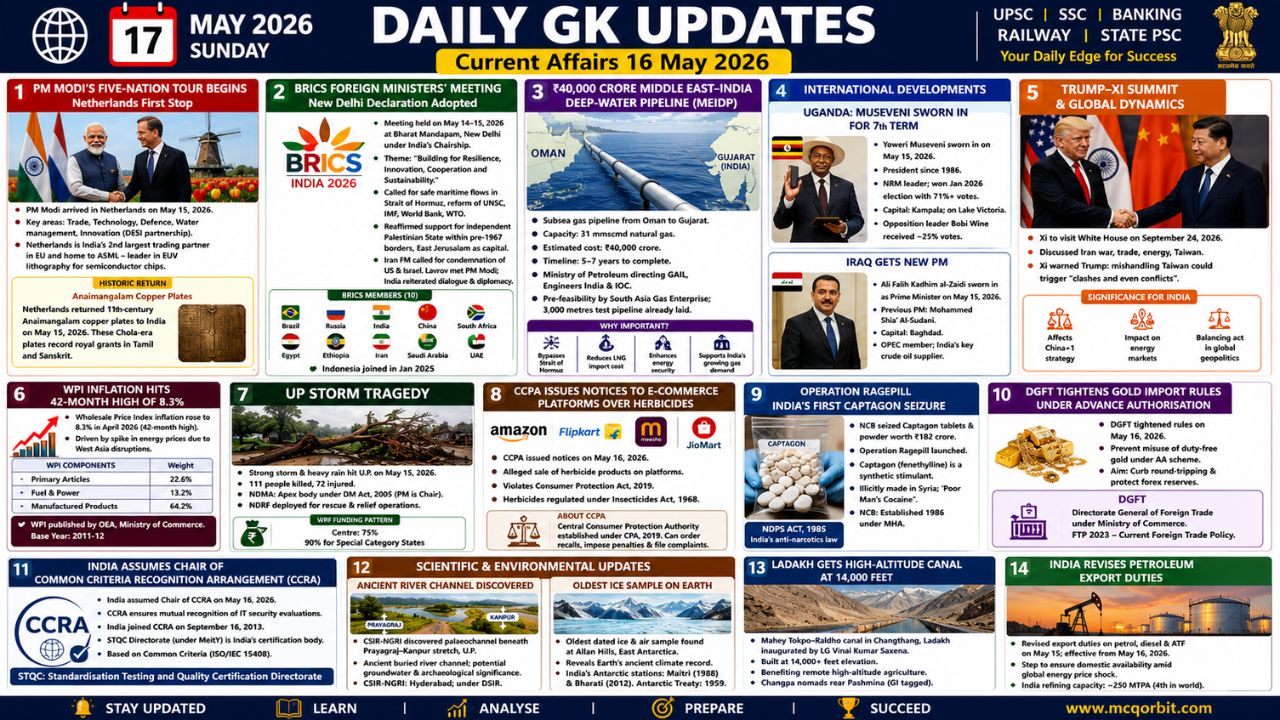
16 May 2026 Current Affairs is headlined by some of the most strategically important stories of the month — with UPSC Prelims just 8 days away on May 24. Today's biggest stories: PM Modi departed on a landmark five-nation tour beginning with the Netherlands — where India received back the 11th-century Anaimangalam copper plates in a historic repatriation. India announced plans for a ₹40,000 crore Middle East-India Deep-water Pipeline (MEIDP) from Oman to Gujarat — one of the most ambitious energy infrastructure projects ever conceived.
Uganda's Yoweri Museveni was sworn in for a seventh presidential term. Iraq got a new PM — Ali Falih Kadhim al-Zaidi. CCPA issued notices to Amazon, Flipkart, Meesho, and JioMart over herbicide product sales. India recorded its first-ever seizure of Captagon under Operation Ragepill — ₹182 crore worth. DGFT tightened gold import rules under the Advance Authorisation scheme. Scientists discovered an ancient underground river channel beneath the Prayagraj-Kanpur stretch. India assumed chair of the Common Criteria Recognition Arrangement. Ladakh got a high-altitude canal at 14,000 feet. And India revised petroleum export duties. Let's get into every story.
International Affairs & Diplomacy
PM Modi's Five-Nation Tour Begins — Netherlands First Stop, Anaimangalam Copper Plates Returned
PM Modi's five-nation visit began with the Netherlands — marking a new chapter in India-Netherlands relations.
India-Netherlands relations — why the Netherlands matters: The Netherlands is one of India's most important European partners — and the relationship goes far beyond tulips and windmills:
Trade: The Netherlands is India's second-largest trading partner in Europe (after Germany) and the largest destination for Indian exports in the EU — largely due to Rotterdam being Europe's largest port (goods enter Europe through the Netherlands before distribution)
Investment: The Netherlands is one of the top sources of FDI into India — primarily through Dutch holding companies of multinational corporations
Technology: Dutch companies like ASML — which holds a near-monopoly on extreme ultraviolet (EUV) lithography machines essential for advanced semiconductor manufacturing — are critical for India's semiconductor ambitions
Water management: The Netherlands is the world leader in water management, flood control, and delta engineering — directly relevant to India's coastal and riverine challenges
DESI partnership: India and the Netherlands collaborate on Defence, Energy, Space, and Innovation
The ASML significance: ASML's EUV machines are indispensable for manufacturing chips below 7nm — the cutting edge of semiconductor technology. No country can build advanced chips without ASML machines. India's semiconductor mission requires either ASML collaboration or technology access — making the Netherlands a geopolitically critical partner for India's chip ambitions.
Historical connection: The Dutch East India Company (VOC — Vereenigde Oost-Indische Compagnie) was one of the first European commercial enterprises to engage with India — establishing trading posts in Surat, Cochin, Masulipatnam, and Bengal in the 17th century. This makes India-Netherlands commercial ties one of the oldest European-Indian relationships.
Netherlands Returns Anaimangalam Copper Plates — Historic Cultural Repatriation
The Netherlands returned the 11th-century Anaimangalam copper plates to India on 15 May 2026.
About the Anaimangalam Copper Plates:
Dated to the 11th century CE — during the Chola dynasty period
Copper plates were the primary medium for recording royal grants, land donations, and administrative orders in medieval South India — written in Tamil and Sanskrit
The plates likely record a land grant or temple endowment — typical of Chola administrative documentation
They had been acquired by a Dutch collection (likely during the colonial period) and were repatriated following diplomatic negotiations between India and the Netherlands
India's cultural repatriation momentum: This repatriation is part of a growing global trend of returning cultural artefacts to their countries of origin:
Year | Artefact/Collection | Returned by |
|---|---|---|
2022 | 105 antiquities | USA (Biden administration) |
2023 | Nataraja idol | Australia |
2024 | Hemis Manuscripts | Multiple countries |
2026 | Anaimangalam Copper Plates | Netherlands |
India's legal framework for repatriation:
Antiquities and Art Treasures Act, 1972: Governs export and import of antiquities in India
Archaeological Survey of India (ASI): The nodal agency for cultural heritage protection and repatriation negotiations
India is a member of UNESCO's 1970 Convention on prohibiting illicit import/export/transfer of cultural property
The Chola dynasty — quick recap: The Chola dynasty (9th–13th century CE) was one of the longest-ruling dynasties in world history — dominating South India from their capital at Thanjavur (Tanjore). Key rulers: Rajaraja Chola I (built the Brihadeeswarar Temple — a UNESCO World Heritage Site) and Rajendra Chola I (who led naval expeditions to Southeast Asia — one of history's most remarkable maritime campaigns). The Nataraja (Dancing Shiva) bronze sculpture is one of the most iconic Chola art forms.
Anaimangalam Copper Plates = 11th century CE Chola era. Returned by Netherlands on May 15, 2026. Copper plates = medium for recording royal grants in medieval South India. Chola dynasty = Thanjavur. Brihadeeswarar Temple = UNESCO WHS. Rajaraja Chola I + Rajendra Chola I = key rulers. Antiquities and Art Treasures Act 1972 = India's governing law. ASI = nodal agency for repatriation. UNESCO 1970 Convention = cultural property protection.
₹40,000 Crore Middle East-India Deep-Water Pipeline (MEIDP) — Oman to Gujarat
India is planning to construct a ₹40,000 crore subsea gas pipeline connecting Oman and Gujarat to strengthen long-term energy security. The Ministry of Petroleum is directing GAIL, Engineers India, and Indian Oil Corporation to prepare a detailed feasibility report for the ₹40,000 crore Middle East-India Deep-water Pipeline (MEIDP). This follows a pre-feasibility study by South Asia Gas Enterprise, which has already laid 3,000 metres of test pipeline to assess seabed conditions. The project, if approved, could take five to seven years to complete and would deliver 31 mmscmd of natural gas directly to Gujarat.
Why MEIDP is a landmark project: This would be one of the world's longest subsea gas pipelines — traversing the Arabian Sea from Oman's coast to Gujarat's coastline. The strategic logic is compelling:
India's energy import dependency:
India imports approximately 85% of crude oil and approximately 50% of natural gas (LNG) requirements
LNG imports are expensive — LNG must be liquefied, shipped in cryogenic tankers, and regasified at India's terminals before use — adding significant cost at every step
A pipeline connection bypasses this entire chain — delivering gas directly at significantly lower cost
The Strait of Hormuz connection: The MEIDP's urgency has been dramatically amplified by the Strait of Hormuz blockade — which has disrupted LNG tanker movements from the Gulf. A subsea pipeline bypasses the Strait — following a route that goes around or under potential conflict zones, providing a more secure supply channel. Oman is located outside the Strait of Hormuz (on the Arabian Sea coast rather than the Persian Gulf) — making Omani gas exports less vulnerable to Hormuz blockades.
Technical details:
31 mmscmd (million metric standard cubic metres per day): A substantial volume — sufficient to significantly supplement India's domestic gas production (~90 mmscmd) and reduce LNG import dependence
3,000 metres of test pipeline: Already laid to assess seabed geology, pressure conditions, and pipeline laying feasibility in deep Arabian Sea waters
5–7 year completion: Reflects the extraordinary engineering challenge of deep-water pipeline construction
Agencies: GAIL (Gas Authority of India Limited) — India's largest gas transmission company; Engineers India Ltd (EIL) — engineering consultancy; Indian Oil Corporation (IOC) — refining and marketing
Previous attempt — the Qatari pipeline: India had earlier explored a subsea pipeline from Qatar — but the route was deemed more difficult due to greater depth, seabed complexity, and geopolitical risks. The Oman route is considered more feasible.
India-Oman relations:
Oman is one of India's most important Gulf partners — historically connected through ancient maritime trade
Approximately 750,000 Indians live and work in Oman
India-Oman bilateral trade exceeds $12 billion annually
Oman's strategic location outside the Strait makes it a preferred energy partner for supply chain security
MEIDP = Middle East-India Deep-water Pipeline. Oman to Gujarat. ₹40,000 crore. 31 mmscmd gas capacity. 5–7 years to complete. Ministry of Petroleum directing GAIL + EIL + IOC. Pre-feasibility by South Asia Gas Enterprise. 3,000 metres test pipeline laid. Bypasses Strait of Hormuz. Oman = outside Strait of Hormuz (Arabian Sea coast). GAIL = Gas Authority of India. One of world's longest subsea pipelines if built.
Uganda's Yoweri Museveni Sworn In for Seventh Presidential Term
Yoweri Museveni, leader of the National Resistance Movement (NRM), was sworn in as the President of Uganda for a seventh term after winning the January 2026 presidential election. He took the oath of office at the Kololo Independence Grounds in Kampala, Uganda, in a ceremony featuring fly-pasts of Russian-made Sukhoi fighter jets. Museveni first came to power in 1986 as a rebel leader and has since won seven presidential elections, making him one of Africa's longest-serving leaders. In the January 2026 election, Museveni secured over 71% of the vote, while opposition leader Bobi Wine received nearly 25% of the votes.
Uganda — complete exam profile:
Fact | Detail |
|---|---|
Capital | Kampala |
President | Yoweri Museveni (since 1986) |
Currency | Ugandan Shilling |
Lake | Located on shores of Lake Victoria (world's largest tropical lake) |
River | Source of the White Nile — at Jinja on Lake Victoria |
Neighbours | Kenya, Tanzania, Rwanda, DRC, South Sudan, Sudan |
UN membership | Since 1962 (independence from UK) |
Constitution | Amended in 2017 to remove presidential age limit — enabling Museveni to continue |
Why Museveni's 7th term matters for exams:
Museveni has been in power since 1986 — one of the world's longest-serving non-royal heads of state
His main challenger: Bobi Wine (real name Robert Kyagulanyi) — a reggae musician turned politician who represents Uganda's youth-led opposition movement
The Ugandan constitution's 2017 age limit removal amendment is a significant governance example — showing how democratic safeguards can be legislatively dismantled
Russia-Africa military ties: The Sukhoi fighter jet fly-past at the inauguration is symbolically significant — signalling Uganda's continued military relationship with Russia even as the West Africa region sees Russian private military company (Wagner Group successor) activity.
Museveni = 7th term (January 2026 election). President since 1986. NRM = National Resistance Movement. Bobi Wine = main opposition (25% votes). Kampala = capital. Uganda on Lake Victoria shores. White Nile source = Jinja. Age limit removed 2017 (constitutional amendment). Sukhoi jets = Russia-Uganda military tie.
Iraq Gets New Prime Minister — Ali Falih Kadhim al-Zaidi
PM Modi congratulated Ali Falih Kadhim al-Zaidi on assuming office as the Prime Minister of Iraq on 16 May 2026. Al-Zaidi took office after being sworn in.
Iraq — key facts for exams:
Fact | Detail |
|---|---|
Capital | Baghdad |
Currency | Iraqi Dinar |
New PM | Ali Falih Kadhim al-Zaidi (sworn in May 2026) |
Previous PM | Mohammed Shia' Al-Sudani |
Religion | Predominantly Islam (Shia majority) |
Oil production | OPEC member — world's 2nd largest proven oil reserves |
Significance | Located at confluence of Tigris and Euphrates rivers |
Why Iraq matters for India:
Iraq is one of India's top crude oil suppliers — regularly 2nd or 3rd position
India-Iraq bilateral trade exceeds $25 billion annually — overwhelmingly oil
Approximately 9 lakh Indians live and work in Iraq
Iraq's political stability directly affects global oil prices and Indian energy security
The West Asian conflict — involving Iraq's neighbours Iran and Israel — has direct implications for Iraqi stability
The Tigris-Euphrates civilisation: Iraq is the site of ancient Mesopotamia — one of humanity's earliest civilisations (along with Egypt, Indus Valley, and Yellow River). Key ancient sites: Ur (birthplace of Abraham in religious tradition), Babylon (King Nebuchadnezzar), Nineveh (Assyrian Empire), and the ancient Sumerian city-states.
New Iraq PM = Ali Falih Kadhim al-Zaidi (sworn in May 2026). Capital = Baghdad. Iraq = OPEC member. India-Iraq trade = $25 billion+ (mostly crude oil). 9 lakh Indians in Iraq. Iraq = ancient Mesopotamia (Tigris + Euphrates). PM Modi congratulated al-Zaidi on May 16.
BRICS FM Meeting — Palestine Declaration and Palestinian State Support
BRICS foreign ministers met in New Delhi on 15 May 2026 and reaffirmed support for an independent and viable State of Palestine within the pre-1967 borders, with East Jerusalem as its capital.
The Palestinian statehood question — key facts:
Parameter | Detail |
|---|---|
Date of UN General Assembly recognition | November 29, 2012 (upgraded to "Non-member Observer State") |
Countries recognising Palestine | Over 145 countries |
Pre-1967 borders | West Bank, Gaza Strip, East Jerusalem (captured by Israel in 1967 Six-Day War) |
Two-state solution | Proposed framework: Israel + Palestine as two sovereign states |
Oslo Accords | 1993 and 1995 — first direct Israel-PLO peace agreements |
India's position | Supports two-state solution; recognised Palestinian state in 1988 |
Why May 15 is significant for Palestine: May 15 is observed as Nakba Day (Arabic for "catastrophe") — commemorating the displacement of approximately 700,000 Palestinian Arabs during the 1948 Arab-Israeli War. The word "Nakba" describes what Palestinians call the destruction of their society and homeland during Israel's establishment.
India's nuanced Palestine position: India has historically supported Palestinian statehood while simultaneously maintaining strong bilateral relations with Israel — a balancing act that reflects India's strategic autonomy doctrine in the Middle East:
Recognised Palestinian state in 1988 — one of the earliest recognitions
Strong bilateral ties with Israel (defence, agriculture, water technology, intelligence cooperation)
Supported UN Resolution ES-10/21 calling for humanitarian ceasefire in Gaza
Condemned terrorism while calling for civilian protection
BRICS reaffirmed Palestinian state = pre-1967 borders + East Jerusalem capital. India recognised Palestine in 1988. UNGA upgraded Palestine to observer state = November 29, 2012. Two-state solution = India's position. Oslo Accords = 1993/1995. Nakba Day = May 15. Gaza + West Bank = Palestinian territories. India supports Palestine + maintains Israel ties = strategic autonomy.
Energy & Infrastructure
India Revises Petroleum Export Duties — Covering Petrol, Diesel, ATF
India revised export duties on petroleum products on 15 May 2026, and the changes took effect from 16 May 2026. The revision covered petrol, diesel, and Aviation Turbine Fuel (ATF).
What are petroleum export duties? India imposes export duties on petroleum products — primarily to ensure domestic availability during periods of high global demand or price spikes. When global crude and fuel prices are high, Indian refiners find it more profitable to export — potentially creating domestic shortages and price pressures. Export duties make exports less attractive, incentivising refiners to prioritise domestic supply.
The current West Asia context: The Strait of Hormuz disruption has pushed global crude prices higher — making Indian fuel exports very profitable. The export duty revision is a price management tool — keeping Indian fuel available domestically at controlled prices while allowing some export at adjusted duty rates.
Key petroleum products and their uses:
Product | Use |
|---|---|
Petrol (Motor Spirit) | Passenger vehicles (petrol engines) |
Diesel (HSD) | Commercial vehicles, agriculture (pump sets), railways |
ATF (Aviation Turbine Fuel) | Commercial aviation (jet fuel) |
LPG | Household cooking fuel |
Naphtha | Petrochemical feedstock |
India's refining capacity: India has a refining capacity of approximately 250 million tonnes per annum (MTPA) — the 4th largest in the world. Key refineries: Jamnagar (Reliance Industries — world's largest single-location refinery complex), Koyali, Mathura, Haldia, Visakhapatnam (public sector IOC, BPCL, HPCL refineries).
Petroleum export duty revised May 15, 2026; effective May 16. Covers petrol + diesel + ATF. Export duty = keeps fuel available domestically during high global prices. India = 4th largest refining capacity (~250 MTPA). Jamnagar (Reliance) = world's largest single-location refinery. ATF = Aviation Turbine Fuel.
Ladakh Gets High-Altitude Canal at 14,000 Feet — Mahey Tokpo–Raldho Canal
Lieutenant Governor of Ladakh Vinai Kumar Saxena inaugurated the Mahey Tokpo–Raldho irrigation canal in the remote Changthang region of Ladakh. The canal has been constructed at an elevation of more than 14,000 feet, making it a significant engineering achievement in the Himalayan region.
About the Mahey Tokpo–Raldho Canal:
Located in Changthang — the high-altitude plateau region of eastern Ladakh, bordering China and Tibet
Changthang (meaning "northern plateau" in Tibetan) is one of the world's highest inhabited plateaus — home to the Changpa nomadic community who herd Pashmina goats (source of the world's finest Pashmina/Cashmere wool)
At 14,000+ feet elevation, construction faced extreme challenges — sub-zero temperatures for most of the year, permafrost, high winds, and difficult terrain
The canal will provide irrigation water for agriculture in a region where water availability is extremely limited — currently dependent on snowmelt from glaciers
Why this is strategically significant: Changthang borders the Line of Actual Control (LAC) with China — making agricultural development and civilian habitation in this region a matter of both humanitarian and strategic interest. A more habitable and agriculturally viable Changthang helps sustain India's civilian presence in this strategically sensitive border zone.
Ladakh — administrative context: Following the reorganisation of Jammu and Kashmir on August 5–6, 2019, Ladakh became a Union Territory without a legislature — directly administered by the Centre through a Lieutenant Governor. The LG of Ladakh is currently Vinai Kumar Saxena — who also serves concurrently as the LG of Delhi (a dual appointment).
About Changpa community and Pashmina: The Changpa (or Champa) are semi-nomadic pastoralists who inhabit Changthang and breed the Changthangi goat — whose underbelly fibre is the raw Pashmina (also called Cashmere). Authentic Changthang Pashmina has a GI (Geographical Indication) tag — protecting it from imitations produced elsewhere. Pashmina fibres are typically 12–15 microns in diameter — finer than human hair (typically 70 microns).
Mahey Tokpo–Raldho canal = Changthang, Ladakh. Elevation = 14,000+ feet. Inaugurated by LG Vinai Kumar Saxena. Changthang = high-altitude plateau bordering China/Tibet. Changpa = nomadic pastoralists; Pashmina goat herders. Pashmina = GI tagged from Changthang. Ladakh = UT without legislature (August 5, 2019 reorganisation). LAC strategic significance.
Governance & Regulatory
CCPA Issues Notices to Amazon, Flipkart, Meesho, JioMart — Herbicide Product Sale
The Central Consumer Protection Authority (CCPA) issued notices to Amazon, Flipkart, Meesho and JioMart on 16 May 2026 over the alleged sale of herbicide products on their platforms.
What is the CCPA?
The Central Consumer Protection Authority was established under the Consumer Protection Act, 2019 — which replaced the older Consumer Protection Act, 1986. CCPA is India's apex consumer rights watchdog with powers to:
Issue notices to businesses for unfair trade practices
Order product recalls if a product is found unsafe
Impose penalties on companies violating consumer rights
File complaints before Consumer Commissions
Address issues of misleading advertisements and defective goods
The herbicide controversy: Herbicides — chemical weed killers — are regulated under the Insecticides Act, 1968 (which covers pesticides, fungicides, and herbicides in India). The sale of unauthorised, mislabelled, or banned herbicide formulations on e-commerce platforms violates:
Consumer Protection Act, 2019 — unfair trade practices
Insecticides Act, 1968 — sale without proper licensing/approval
Legal Metrology Act, 2009 — labelling requirements
Why e-commerce platforms are held liable: Under the E-Commerce Rules (2020) under the Consumer Protection Act — e-commerce platforms are required to:
Ensure sellers on their platforms comply with all applicable laws
Provide accurate product descriptions
Not host listings for banned or controlled substances
Maintain seller accountability records
CCPA vs other consumer bodies:
Body | Level | Jurisdiction |
|---|---|---|
CCPA | National | Regulatory authority + class action |
NCDRC | National | Consumer disputes >₹2 crore |
SCDRC | State | ₹50 lakh to ₹2 crore |
DCDRC | District | Up to ₹50 lakh |
CCPA = Central Consumer Protection Authority. Established under Consumer Protection Act 2019. Issued notices to Amazon, Flipkart, Meesho, JioMart over herbicide sales. Herbicides regulated under Insecticides Act 1968. E-Commerce Rules 2020 = platform liability. Consumer Protection Act 2019 replaced 1986 Act. NCDRC = National Consumer Disputes Redressal Commission (>₹2 crore). CCPA ≠ NCDRC — different roles.
DGFT Tightens Gold Import Rules — Advance Authorisation Scheme
The Directorate General of Foreign Trade (DGFT) tightened regulations for duty-free gold imports under the Advance Authorisation (AA) scheme for the gems and jewellery sector.
What is the Advance Authorisation Scheme? The Advance Authorisation (AA) scheme allows exporters to import inputs duty-free — on the condition that the imported material is used to manufacture and export finished goods. For the gems and jewellery sector, this means:
A jewellery exporter can import gold duty-free
Use it to manufacture jewellery
Export the finished jewellery within a specified time period
The duty exemption is reversed if export targets are not met
The misuse problem: The DGFT action follows concerns about the scheme being misused — with gold imported duty-free under the AA scheme being diverted into the domestic market instead of being exported as jewellery.
This round-tripping (similar to the UAE CEPA gold issue discussed on May 13) allows importers to access gold at below-market effective prices — undermining the government's attempts to manage India's gold import bill (which reached ~$72 billion in FY26).
Why this matters now: PM Modi's May 11 appeal to citizens to avoid buying gold is undermined if regulatory loopholes allow gold to flood the domestic market through schemes meant for exporters. The DGFT tightening is a regulatory complement to the voluntary appeal.
DGFT — about: The Directorate General of Foreign Trade operates under the Ministry of Commerce and Industry — administering India's foreign trade policy, including the Foreign Trade Policy (FTP). The current FTP was released in March 2023 (FTP 2023 — valid for 5 years).
DGFT = Directorate General of Foreign Trade = under Ministry of Commerce. Advance Authorisation scheme = duty-free import for export production. Misuse = gold imported duty-free but sold domestically. Tightening follows PM Modi's gold restraint appeal + $72 billion gold import bill. FTP 2023 = current Foreign Trade Policy (March 2023). DGFT tightening = regulatory tool vs nudge governance.
India Assumes Chair of Common Criteria Recognition Arrangement (CCRA)
India assumed the Chair of the Common Criteria Recognition Arrangement (CCRA). The portal is widely used by governments, businesses, and institutions to identify internationally trusted digital products. India joined the Common Criteria Recognition Arrangement on 16 September 2013 as a Certificate Authorising Nation. India's appointment as Chair reflects its growing expertise in cybersecurity standards, secure technology evaluation, and digital trust infrastructure at the global level. The Standardisation Testing and Quality Certification (STQC) Directorate is India's official certification body for IT security evaluations.
What is the Common Criteria Recognition Arrangement (CCRA)? The Common Criteria (formally ISO/IEC 15408) is an internationally recognised framework for evaluating the security properties of IT products — from operating systems and databases to smartcards and network equipment. The CCRA is the multilateral agreement among participating nations to mutually recognise IT security evaluations conducted by each other's national certification bodies.
How it works:
A company wants to sell a secure IT product to governments worldwide
They submit it for evaluation to an authorised national body (in India: STQC Directorate)
If the product passes the Common Criteria evaluation, it receives a CC Certificate
This certificate is recognised by all 31+ CCRA member nations — no need for separate evaluations in each country
Why India's chairship matters: India's growing role in:
Cybersecurity — protecting critical digital infrastructure
Digital payments (UPI, RuPay) — requiring internationally certified secure technology
Defence electronics — secure communication systems
Government IT procurement — ensuring only certified secure products are deployed
India chairing CCRA signals recognition of India's cybersecurity maturity and gives India a leading voice in setting global digital trust standards.
STQC — about: The Standardisation Testing and Quality Certification Directorate operates under the Ministry of Electronics and Information Technology (MeitY) — providing testing, calibration, and certification services for electronic and IT products.
CCRA = Common Criteria Recognition Arrangement. India joined CCRA = September 16, 2013 (Certificate Authorising Nation). India now = CCRA Chair. Common Criteria = ISO/IEC 15408 = IT security evaluation framework. STQC = India's certification body = under MeitY. CCRA Chair = India's growing cybersecurity global leadership role.
GDP Data Release Rescheduled — Provisional FY26 GDP on June 5, 2026
Under a revised calendar, the Provisional GDP Estimates for FY 2025–26 and Q4 GDP data for January–March 2026 will be released on 5 June 2026. The revision is part of MoS&PI's continued efforts to strengthen national accounts compilation and align India's statistical practices with international best practices.
India's GDP data release architecture: India's GDP estimates are released in multiple stages — each more refined than the previous:
Release | Timing | Data |
|---|---|---|
First Advance Estimate | January | Initial full-year estimate |
Second Advance Estimate | February | Revised estimate |
Provisional Estimate | End of May/June | More complete data |
First Revised Estimate | January (next year) | Further refined |
Final Estimate | November (next year) | Complete |
What MoS&PI does: The Ministry of Statistics and Programme Implementation (MoS&PI) publishes:
GDP estimates (through the National Statistical Office, NSO)
CPI inflation (monthly)
Index of Industrial Production (IIP) (monthly)
Annual Survey of Industries (ASI)
National Family Health Survey (NFHS)
Periodic Labour Force Survey (PLFS)
India's GDP methodology: India uses the expenditure approach (GDP = C + I + G + NX) and production/value-added approach simultaneously. The base year for GDP estimates is 2011-12 — though MoS&PI updated the GSVA base year to 2022-23 (as covered in the May 9 current affairs).
Provisional FY26 GDP + Q4 (Jan-Mar 2026) data = June 5, 2026. MoS&PI = Ministry of Statistics and Programme Implementation. NSO = National Statistical Office = publishes GDP + CPI + IIP. India GDP base year = 2011-12. GDP release sequence: First Advance (Jan) → Second Advance (Feb) → Provisional (May/June) → Revised → Final.
Science & Discovery
Ancient Underground River Channel Discovered Under Prayagraj-Kanpur — CSIR-NGRI
Scientists from the CSIR-National Geophysical Research Institute in Hyderabad have identified an ancient underground river channel beneath the Prayagraj-Kanpur stretch in Uttar Pradesh. The buried channel is described as a significant geophysical discovery.
About the Discovery: The CSIR-NGRI (National Geophysical Research Institute) in Hyderabad — India's premier institution for geophysical research — identified the palaeochannel (ancient river channel) using seismic reflection surveys and remote sensing data.
What is a palaeochannel? A palaeochannel is a remnant or fossil of an ancient river or stream channel that has been buried by sediment over geological time — typically thousands to millions of years. The buried channel beneath the Prayagraj-Kanpur stretch suggests that a river once flowed at a significantly different course than modern rivers in this region.
Scientific significance:
Groundwater potential: Palaeochannels are often excellent aquifers — ancient river gravels and sands trap and hold substantial groundwater. This discovery could identify new groundwater sources for UP's chronically water-stressed districts
Archaeological potential: Ancient rivers attracted human settlements — palaeochannels often contain buried archaeological sites from ancient civilisations
Mythological connection: The Saraswati River — a sacred river mentioned in the Vedas — is believed by many scholars to have once been a major river flowing through North India before changing course or drying up due to tectonic shifts and climate change. Palaeochannel discoveries in UP and Rajasthan are often examined in this context
The Prayagraj connection: Prayagraj (formerly Allahabad) is located at the Triveni Sangam — the confluence of the Ganga, Yamuna, and the mythical Saraswati rivers. The palaeochannel discovery adds a scientific dimension to the ancient belief in Saraswati's presence at this confluence.
CSIR-NGRI: Part of the Council of Scientific and Industrial Research (CSIR) — India's largest R&D organisation under the Department of Scientific and Industrial Research (DSIR). CSIR-NGRI specialises in seismology, groundwater studies, mineral exploration, and geophysical survey.
CSIR-NGRI = National Geophysical Research Institute, Hyderabad. Discovered palaeochannel (ancient river) under Prayagraj-Kanpur stretch. Palaeochannel = buried ancient river channel. Potential = groundwater aquifer + archaeological significance. Prayagraj = Triveni Sangam (Ganga + Yamuna + mythical Saraswati). CSIR = Council of Scientific and Industrial Research = largest Indian R&D organisation.
Oldest Ice Sample on Earth — Antarctica's Allan Hills
Scientists working in Antarctica have identified the oldest directly dated ice and air sample on Earth from the Allan Hills region of East Antarctica.
About the discovery: The Allan Hills is a region in East Antarctica where blue ice is exposed at the surface — making it accessible without deep drilling. Glaciologists use ice cores to study ancient atmospheres — trapped air bubbles within ice preserve samples of ancient atmospheric gases, providing a direct record of past climate conditions.
Why this matters:
Ice cores are the most direct record of Earth's past atmospheric composition — including CO₂ and methane concentrations
The oldest previously dated ice samples came from the EPICA Dome C project — approximately 800,000 years old
The Allan Hills sample pushes this record further back — potentially over 1 million years
Ancient atmospheric data helps climate scientists understand how Earth's climate system responded to natural CO₂ variations — providing a baseline for projecting future climate change
Antarctica governance:
Antarctic Treaty (1959): Governs Antarctica — 54 parties. Key provisions: Antarctica is used for peaceful purposes only; scientific research is freely shared; no new territorial claims; no military activities
India has two research stations in Antarctica: Maitri (1988, in the Schirmacher Oasis) and Bharati (2012, in Larsemann Hills)
India's Antarctic activities governed by the Antarctic Act, 2022 — India's first comprehensive Antarctic legislation
Oldest ice sample = Allan Hills, East Antarctica (2026 discovery). Blue ice = exposed surface ice without deep drilling needed. Ice cores = ancient atmosphere record. Previous oldest = ~800,000 years (EPICA Dome C). Antarctic Treaty = 1959; 54 parties; peaceful + scientific use only. India's stations = Maitri (1988) + Bharati (2012). India's Antarctic Act = 2022.
Internal Security
Operation Ragepill — India's First Captagon Seizure, ₹182 Crore
India recorded its first seizure of Captagon tablets and powder under Operation Ragepill, with a total value of ₹182 crore. The Narcotics Control Bureau seized the consignment.
What is Captagon?
Captagon (chemical name: fenethylline) is a synthetic stimulant drug — a compound that metabolises in the body into amphetamine and theophylline. Key facts:
Originally developed in 1961 as a pharmaceutical treatment for ADHD, narcolepsy, and depression — withdrawn from medical use by the 1980s
Now illicitly manufactured primarily in Syria — Captagon production became a massive industry during the Syrian civil war, allegedly including production by actors linked to the Assad regime
Primary market: Gulf countries — particularly Saudi Arabia, Jordan, UAE, and Lebanon
Effects: Produces euphoria, suppresses hunger and fatigue, increases aggression — reportedly used by fighters in the Syrian conflict
Street name: "The Poor Man's Cocaine" — significantly cheaper than cocaine
UN classification: Scheduled under the UN Convention on Psychotropic Substances, 1971
India's first seizure — significance: The consignment's arrival in India signals that Captagon trafficking networks are expanding beyond the Middle East into South Asian markets. The NCB's interception under Operation Ragepill — a targeted anti-drug trafficking operation — demonstrates India's growing drug intelligence capabilities and cooperation with international narcotics agencies.
Narcotics Control Bureau (NCB):
Established in 1986 under the Ministry of Home Affairs
Functions under the Narcotic Drugs and Psychotropic Substances (NDPS) Act, 1985 — India's primary anti-narcotics legislation
Coordinates with INTERPOL, DEA (US Drug Enforcement Administration), UNODC (UN Office on Drugs and Crime), and other international agencies
Captagon = fenethylline = synthetic stimulant. Originally pharmaceutical (1961), now illicit. Primarily produced in Syria. First India seizure = ₹182 crore under Operation Ragepill. Seized by NCB (Narcotics Control Bureau). NCB = established 1986, under MHA. NDPS Act 1985 = India's anti-narcotics law. UN Convention on Psychotropic Substances 1971 = international framework. Captagon = "Poor Man's Cocaine."
Oil & Gas Exploration
India Expanding Offshore Oil and Gas Exploration
India is expanding offshore oil and gas exploration through new seismic surveys, stratigraphic drilling, and bidding rounds across the Bay of Bengal and adjoining basins. The Directorate General of Hydrocarbons (DGH) is directing this expansion.
India's offshore exploration context: India's domestic oil and gas production has been declining from mature onshore fields — particularly from the giant Mumbai High (offshore) and Bombay High basin. Expanding offshore exploration is critical for:
Reducing India's 85% crude oil import dependence
Developing India's ~2.5 million sq km Exclusive Economic Zone (EEZ) — which remains largely underexplored
Capitalising on new deep-water exploration technology
Key offshore basins being explored:
Bay of Bengal: The KG Basin (Krishna-Godavari) — where Reliance Industries' KG-D6 block operates — remains India's most productive deepwater gas field. New exploration seeks to replicate this success
Andaman Sea: Largely unexplored — potentially very rich
Arabian Sea: Beyond Mumbai High — deep water exploration
OALP (Open Acreage Licensing Policy): The Open Acreage Licensing Policy — launched in 2017 — allows companies to identify and bid for exploration blocks in India's sedimentary basins at any time (unlike the earlier system of periodic bidding rounds). This "open door" policy has attracted interest from BP, ONGC, Reliance Industries, Vedanta, and international majors.
DGH — about: The Directorate General of Hydrocarbons operates under the Ministry of Petroleum and Natural Gas — regulating upstream oil and gas exploration and production in India.
India expanding offshore exploration = Bay of Bengal + adjoining basins. DGH = Directorate General of Hydrocarbons = under Ministry of Petroleum. KG Basin (KG-D6) = India's productive deepwater gas field. India EEZ = ~2.5 million sq km. OALP = Open Acreage Licensing Policy (2017). Seismic surveys + stratigraphic drilling + bidding rounds.
Sports & Personalities
Akash Ambani — TIME100 Next 2022 Alumni, Mumbai Indians Co-owner
Akash Ambani is the co-owner of Mumbai Indians, a five-time IPL champion franchise, and also promotes football through the Indian Super League (ISL). He was featured in the TIME100 Next 2022 list by TIME magazine, recognising him as one of the world's rising leaders shaping the future through contributions to technology and business.
About Akash Ambani:
Son of Mukesh Ambani (Chairman, Reliance Industries)
Chairperson of Jio Platforms — India's largest digital services company
Co-owner of Mumbai Indians (MI) — IPL franchise with 5 championships (2013, 2015, 2017, 2019, 2020)
Promotes ISL (Indian Super League) football through Mumbai City FC
Mumbai Indians at a glance:
5-time IPL champions — the most successful franchise in IPL history
Home ground: Wankhede Stadium, Mumbai
IPL commenced: 2008 (founded by BCCI; IPL first season April 2008)
Akash Ambani = Jio Platforms Chairman. Co-owner Mumbai Indians (5-time IPL champions). TIME100 Next 2022. Mumbai City FC = ISL football. Mumbai Indians home = Wankhede Stadium. IPL started 2008.
FAQs — 16 May 2026 Current Affairs
Q. What is the Middle East-India Deep-water Pipeline (MEIDP) and why is it strategically important?
MEIDP is a proposed ₹40,000 crore subsea natural gas pipeline from Oman to Gujarat — planned to deliver 31 mmscmd of gas over 5–7 years of construction. It is being directed by the Ministry of Petroleum through GAIL, Engineers India, and IOC. Strategically, it bypasses the Strait of Hormuz — Oman being on the Arabian Sea coast rather than the Persian Gulf. It would directly reduce India's LNG import costs and improve energy security amid the ongoing Strait of Hormuz blockade. South Asia Gas Enterprise has already laid 3,000 metres of test pipeline for seabed assessment.
Q. What are the Anaimangalam Copper Plates and why was their return significant?
The Anaimangalam Copper Plates are 11th-century CE artefacts from the Chola dynasty period — recording royal grants or temple endowments in Tamil and Sanskrit. The Netherlands returned them to India on May 15, 2026 as part of the PM Modi five-nation tour diplomatic outcomes. India's cultural repatriation momentum has been growing — with 105 antiquities returned by the USA in 2022 and a Nataraja idol from Australia in 2023. India's governing law is the Antiquities and Art Treasures Act 1972, administered by ASI.
Q. Who is Yoweri Museveni and what is significant about his 7th term?
Yoweri Museveni, leader of Uganda's National Resistance Movement (NRM), was sworn in for a 7th presidential term at Kololo Independence Grounds in Kampala after winning the January 2026 election with 71%+ votes. He has been in power since 1986 — making him one of Africa's longest-serving leaders. His continuation was enabled by a 2017 constitutional amendment removing presidential age limits. His main challenger was Bobi Wine (Robert Kyagulanyi) who received ~25% of votes.
Q. What is the Common Criteria Recognition Arrangement and why does India chairing it matter?
The CCRA is a multilateral arrangement for mutual recognition of IT security evaluations — based on the Common Criteria framework (ISO/IEC 15408). If a product is certified by one member nation's authority, all 31+ member nations recognise it. India joined CCRA on September 16, 2013 as a Certificate Authorising Nation. India's STQC Directorate (under MeitY) is the national certification body. India chairing CCRA signals global recognition of India's cybersecurity maturity and strengthens India's voice in setting international digital trust standards.
Q. What is Captagon and why is India's first seizure significant?
Captagon (fenethylline) is a synthetic stimulant drug — originally a pharmaceutical (1961) but now illicitly manufactured primarily in Syria for the Gulf market. It metabolises into amphetamine and theophylline. India's NCB made the country's first-ever Captagon seizure (₹182 crore) under Operation Ragepill — signalling the drug's trafficking networks are expanding into South Asia. NCB operates under the MHA and the NDPS Act 1985.
Q. What did scientists discover beneath the Prayagraj-Kanpur stretch?
Scientists from CSIR-NGRI (National Geophysical Research Institute, Hyderabad) identified an ancient buried river channel (palaeochannel) beneath the Prayagraj-Kanpur stretch in Uttar Pradesh using seismic surveys. Palaeochannels can be excellent groundwater aquifers and often contain archaeological significance. The discovery near Prayagraj — site of the mythical Saraswati river confluence (Triveni Sangam with Ganga and Yamuna) — adds scientific depth to ancient textual references.
Q. What is the significance of the Mahey Tokpo–Raldho canal in Ladakh?
Inaugurated by LG Vinai Kumar Saxena, the canal in Changthang, Ladakh is built at over 14,000 feet — a significant high-altitude engineering achievement. It provides irrigation in one of India's most remote border regions, which also has strategic importance as it borders China's LAC. The Changthang plateau is home to Changpa nomads who herd Pashmina (Changthangi) goats — whose GI-tagged wool is among the world's finest. Ladakh became a UT without legislature on August 5, 2019.
Q. What action did the CCPA take against major e-commerce platforms on May 16?
The Central Consumer Protection Authority — established under the Consumer Protection Act 2019 — issued notices to Amazon, Flipkart, Meesho, and JioMart over the alleged sale of herbicide products on their platforms. Herbicides are regulated under the Insecticides Act 1968. Under E-Commerce Rules 2020, platforms are responsible for ensuring seller compliance with applicable laws. CCPA can order product recalls, impose penalties, and file complaints before consumer commissions.
Written by
Koti Deva
Digital Marketing Specialist
Koti is a Digital Marketing Specialist with over 10 years of experience and the co-founder of MCQ Orbit — a free exam prep platform built for Indian competitive exam aspirants.
With strong personal knowledge in Quantitative Aptitude, Logical Reasoning, and Mathematics, Koti has a deep understanding of what it takes to crack exams like SSC CGL, IBPS PO, SBI Clerk, UPSC Prelims, NEET, and JEE. Having followed these exams closely for years, he understands the exact topics, patterns, and shortcuts that matter most.
MCQ Orbit was born from a simple desire — to build a platform where every aspirant in India can practice quality MCQs, read reliable current affairs, and prepare confidently, without paying a rupee. Koti combines his digital expertise with his passion for competitive exams to create content that is accurate, practical, and genuinely useful for students.
His mission is straightforward: if the right guidance had been freely available earlier, more students would have cracked their dream exams. MCQ Orbit is his way of making that happen.
Comments
No comments yet.