
NASA Names Artemis III Crew: Meet the Astronauts Headed Back to the Moon
NASA Names Artemis III Crew
Meet the Four Astronauts Headed Back Toward the Moon
On June 9, 2026, NASA stood four astronauts on a stage at Johnson Space Center in Houston and gave them a job that hasn't been handed to anyone in more than fifty years: get the agency ready to put boots back on the Moon. The Artemis III crew — commander Randy Bresnik, pilot Luca Parmitano, and mission specialists Frank Rubio and Andre Douglas will fly a mission that, on paper, sounds modest. They're not landing on the Moon. They're not even leaving Earth orbit. But what they're doing is, in NASA's own words, one of the most complex things the agency has ever attempted.
Here's who's flying, what the mission actually involves, and why a flight that never leaves Earth orbit is the thing standing between NASA and a 2028 Moon landing.
Who Is on the Artemis III Crew?
The Artemis III crew is a mix of seasoned spaceflight veterans and one astronaut who has never left the ground. NASA also named a backup crew member, astronaut Bob Hines, who will train alongside the primary crew.
Randy Bresnik — Commander
Bresnik leads the mission as commander. He's a Marine Corps veteran and former test pilot who flew on the Space Shuttle's STS-129 mission in 2009 and later commanded an Expedition aboard the International Space Station. He was also the lead astronaut on the closeout crew for STS-135, the final flight of the Space Shuttle program the team that sealed the hatch and sent the crew on their way.
Luca Parmitano — Pilot
Parmitano, an Italian astronaut with the European Space Agency, will serve as pilot. He's flown two long-duration missions to the International Space Station and is rated to fly more than twenty types of military aircraft. His presence on the crew also makes Artemis III an international mission, reflecting NASA's increasing reliance on partner space agencies as the Artemis program scales up.
Frank Rubio — Mission Specialist
Rubio holds the U.S. record for the longest single spaceflight by an American astronaut: 371 days aboard the International Space Station between 2022 and 2023, after his original return flight was delayed by a coolant leak on his Soyuz spacecraft. That kind of patience under changed plans is exactly the temperament NASA wants on a mission built around precise, repeatable docking maneuvers.
Andre Douglas — Mission Specialist
Douglas is the rookie of the group Artemis III will be his first spaceflight. A Coast Guard reserve officer and systems engineer with a doctorate from George Washington University, he previously served as a backup crew member for Artemis II, the mission that sent astronauts around the Moon. “Got Artemis! Go NASA!” he told the crowd at the announcement, visibly thrilled to be moving from backup to the primary crew.
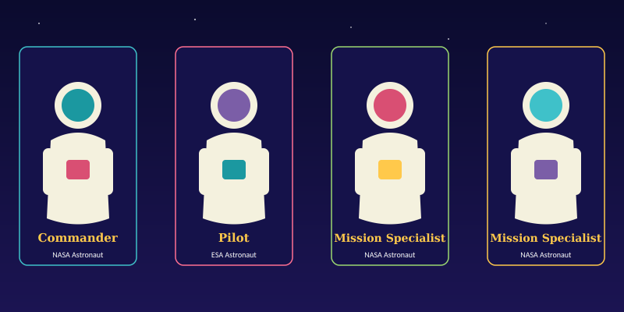
The Artemis III crew roles: commander, pilot, and two mission specialists.
What Exactly Is the Artemis III Mission?
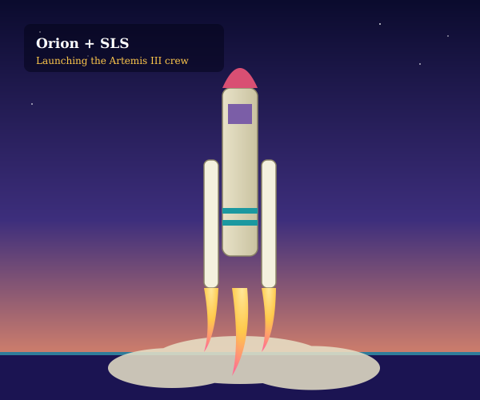
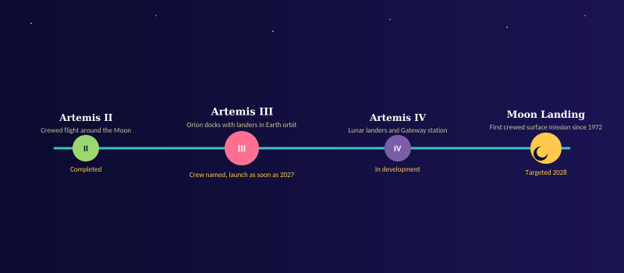
This is the part that surprises people: Artemis III will not land on the Moon. The mission will fly the Orion spacecraft into low Earth orbit, where the crew will practice rendezvous and docking with one or both of the commercial Human Landing System vehicles being built by SpaceX and Blue Origin.
Think of it as a dress rehearsal for the hardest part of a Moon landing lining up two spacecraft and connecting them precisely done close to home, where it's far easier to recover if something doesn't go to plan. “We are doing flight tests on every single flight, incrementally determining the flight envelope, expanding it, proving out capabilities, and making the operational procedures that we have more and more precise,” Bresnik told the crowd at the announcement.
• Launch vehicle: the Space Launch System (SLS) rocket, carrying the crew inside the Orion capsule.
• Primary objective: rendezvous and docking between Orion and the SpaceX and Blue Origin landers.
• Orbit: low Earth orbit the mission does not travel to the Moon or lunar orbit.
• Mission length: roughly two weeks, according to NASA's mission planning.
• Why it matters: the same docking procedure has to happen in lunar orbit before any astronaut can set foot on the Moon.
When Will Artemis III Launch?
NASA is targeting a launch as soon as late 2027, though dates on the Artemis program have shifted before and could shift again. The agency has been clear that the schedule depends on how testing of the SpaceX and Blue Origin landers progresses, since Artemis III can't fly until those vehicles are ready to be docked with.
Why This Mission Matters: NASA's Race Back to the Moon
NASA last put astronauts on the lunar surface in December 1972, during Apollo 17. The agency now wants to land astronauts on the Moon again by the end of 2028 not as a one-time visit, but as the opening move in building a lasting presence there. The Artemis program plans a series of robotic landers and lunar satellites alongside the Artemis IV and V missions, followed by roughly two crewed landings per year after that.
There's also a competitive backdrop to all of this. China's space program has its own publicly stated goal of landing taikonauts on the Moon before the end of the decade. NASA officials have repeatedly framed Artemis as a way to keep the United States in the lead on lunar exploration, much as the original Apollo program did during the space race of the 1960s.
FAQ: Artemis III Crew and Mission Questions
Who is on the Artemis III crew?
The Artemis III crew is commander Randy Bresnik, pilot Luca Parmitano of the European Space Agency, and mission specialists Frank Rubio and Andre Douglas, all of NASA. Astronaut Bob Hines was named as backup crew.
Will Artemis III land on the Moon?
No. Artemis III is a low Earth orbit test flight focused on rendezvous and docking between the Orion spacecraft and the SpaceX and Blue Origin lunar landers. The actual crewed Moon landing is targeted for a later Artemis mission, as soon as 2028.
When is the Artemis III launch date?
NASA has targeted a launch as soon as late 2027, though Artemis program dates have shifted in the past and may shift again depending on lander readiness.
What rocket and spacecraft will Artemis III use?
The crew will launch aboard the Orion spacecraft, carried by NASA's Space Launch System (SLS) rocket.
Why is NASA testing in Earth orbit before going to the Moon?
Testing rendezvous and docking procedures in low Earth orbit lets NASA validate the hardware and operations close to home, where problems are easier to diagnose and recover from, before attempting the same maneuvers in lunar orbit during an actual landing mission.
For now, the Artemis III crew has a lot of training ahead of them simulators, docking rehearsals, and months of preparation before they ever sit inside Orion. But the announcement itself marks something real: after years of hardware delays and shifting timelines, NASA has put names and faces to the mission that stands between where the Artemis program is today and an astronaut Moon landing for the first time since 1972. Whether that happens on schedule in 2028 is still an open question. Who's flying the test flight that gets them there is not.
Comments
No comments yet.