The New Space Race Is Here And This Time, It's Bigger Than the Moon
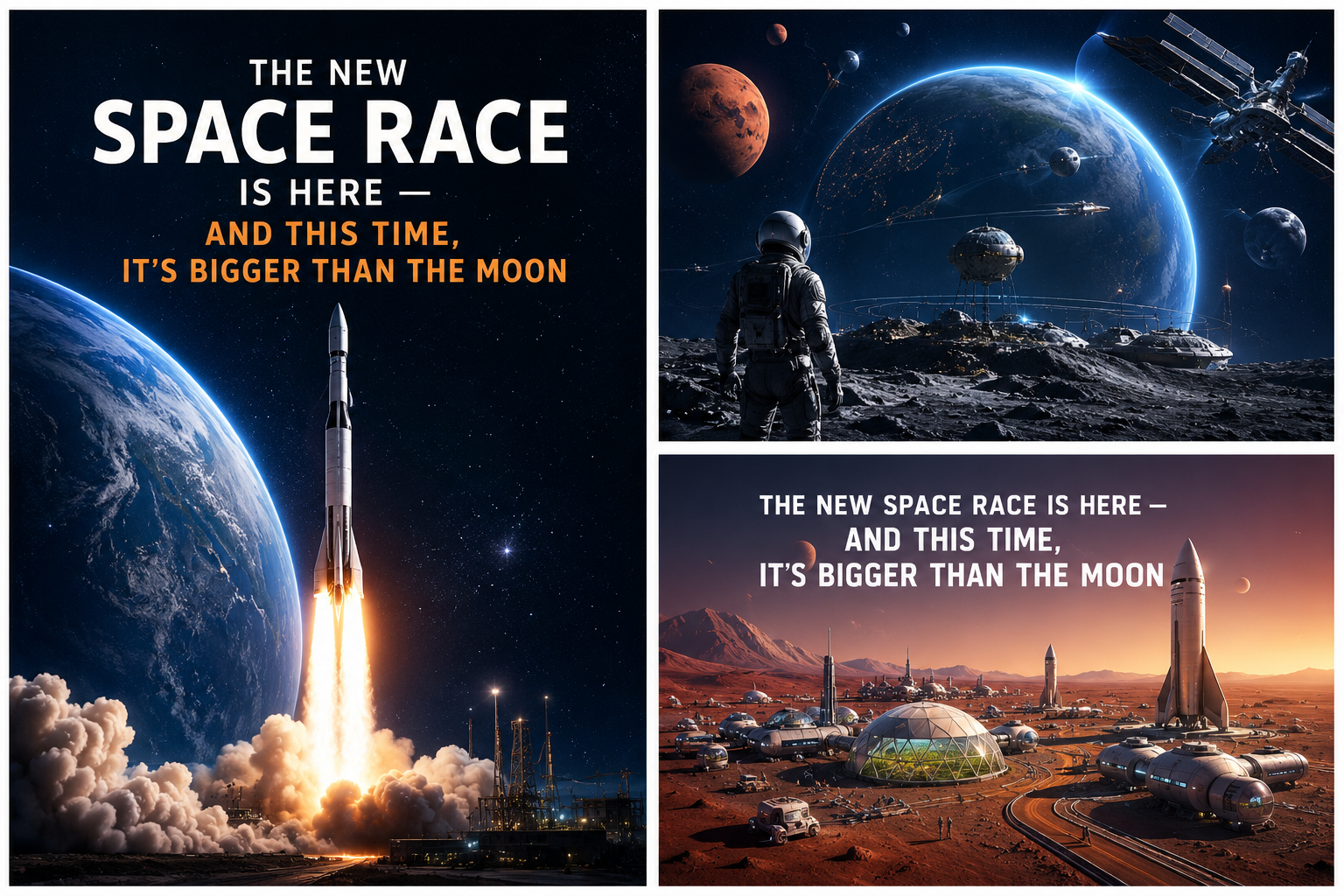
If you grew up watching grainy footage of Apollo 11 and dreaming about what came next, 2026 is your payoff. We are living through the most consequential stretch of space exploration since Neil Armstrong left his bootprint in lunar dust and this time, the stakes, the players, and the technology are almost unrecognizable compared to what came before.
This is not hyperbole. In April 2026, NASA's Artemis II mission swept four astronauts around the far side of the Moon the first human beings to travel beyond low Earth orbit in more than fifty years. That alone would be enough to mark this year in the history books. But Artemis II is just one headline in a cascade of developments reshaping how humanity thinks about, uses, and profits from outer space.
To understand where we are, you need to understand how fast things have moved. A decade ago, a single rocket launch cost hundreds of millions of dollars and was treated like a cathedral event. Today, SpaceX's Falcon 9 boosters land themselves back on drone ships in the Atlantic, get refueled, and fly again within weeks. The economics of getting to orbit have changed so fundamentally that it has unlocked an entirely new era of possibility one where space is not just a destination for astronauts, but a platform for commerce, data, defense, and eventually, permanent human settlement.
Artemis II: Humans Beyond Earth Orbit, Again
Let's start with the mission that stopped the world in April. Artemis II carried Reid Wiseman, Victor Glover, Christina Koch, and Jeremy Hansen on a trajectory that took them around the lunar far side the side of the Moon that never faces Earth, a place bathed in eerie silence and crater shadows that no human eye had seen directly since Apollo 17 in 1972.
What made this mission remarkable was not just the distance traveled. NASA spent two years training these astronauts to read the Moon like field geologists. They studied impact rocks in Labrador, volcanic ash formations in Iceland, and satellite imagery of the lunar surface until they could describe its colors, textures, and geological history with the confidence of a scientist standing in the field. When they finally gazed down at the Moon from their Orion capsule, they were not just passengers they were observers equipped with real scientific judgment.
This shift in how astronauts are trained signals something important about what comes next. Artemis III, already in planning, will land humans on the lunar surface specifically near the south pole, where permanently shadowed craters are believed to hold deposits of water ice. That water is not just scientifically interesting. It is rocket fuel. It is life support. It is the key to building a sustainable presence on the Moon, and eventually, a launching pad for missions to Mars.
"The Moon is not the destination. It is the proving ground for everything humanity will eventually do across the solar system."
SpaceX Starship: The Rocket That Could Change Everything
While Artemis grabbed the cultural spotlight, the vehicle that may ultimately define this era of space exploration is SpaceX's Starship a fully reusable, stainless-steel behemoth that stands nearly 40 stories tall and is designed to carry more payload to orbit than any rocket in history.
Starship has had a bumpy road to operational status, but that is almost to be expected with engineering at this scale. The real story is what happens when it works reliably. Analysts estimate that Starship could reduce the cost of sending a kilogram of payload to orbit by up to 90 percent compared to current options. For context, that is the difference between space being accessible to a handful of governments and becoming a genuine commercial frontier open to thousands of companies and institutions.
The implications cascade in every direction. Cheaper launches mean more satellites. More satellites mean better global connectivity, more precise Earth observation, and faster climate monitoring. SpaceX is already planning to use Starship to deploy its next generation of Starlink internet satellites a constellation that already exceeds 10,000 active satellites and delivers broadband to users in over 30 countries, including remote areas where laying fiber cable would take decades and billions of dollars.
Beyond Starlink, Starship is central to NASA's plans for returning astronauts to the lunar surface. It has been selected as the Human Landing System for Artemis III, which means the vehicle that could soon be delivering internet to rural Kenya is also the one that will set humans down on the Moon's south pole. The convergence is dizzying.
The Satellite Economy: From Niche to Backbone
If you have used your smartphone in a place where you previously had zero bars, there is a reasonable chance a Low Earth Orbit satellite is to thank. The quiet revolution happening in satellite connectivity is one of the least-discussed but most consequential technology shifts of the decade.
SpaceX's Starlink is the name everyone knows, but the space is getting crowded fast. Amazon's Project Kuiper is planning to deploy over 3,000 satellites. OneWeb, now backed by significant investment, is building its own global network. Meanwhile, direct-to-device technology which allows standard smartphones to connect to satellites without any special hardware is moving from pilot programs to commercial rollout. Major carriers like T-Mobile and Verizon began offering these services in 2025, and 2026 is the year those services start generating serious revenue.
The numbers are staggering when you zoom out. Research forecasts suggest the number of satellite direct-to-consumer users could grow from roughly 585 million in 2024 to 2.6 billion by 2035. That is not a niche market. That is the backbone of the next generation of global communication infrastructure.
For businesses, this means supply chains that can be tracked in real-time from anywhere on Earth. For humanitarian organizations, it means the ability to coordinate disaster relief in regions where cell towers have been flattened. For individuals, it means the end of the coverage dead zone the quiet, frustrated reality that billions of people have lived with for as long as mobile phones have existed.
Space-Based Data Centers: Science Fiction Meets Venture Capital
One of the more surprising conversations happening in the space industry right now involves moving computing infrastructure off the Earth entirely. SpaceX has floated plans for orbital data centers that would process and store data using solar power collected above the atmosphere where sunlight is constant, cooling is abundant, and the land use concerns that plague terrestrial data centers simply do not apply.
The demand driver is artificial intelligence. The computational appetite of large AI models is growing faster than the power grid and real estate capacity of Earth-based facilities can comfortably handle. Space-based computing, while still early-stage and expensive, represents a genuine long-term solution to a problem that is only going to get more acute.
Whether orbital data centers become mainstream in five years or twenty is genuinely uncertain. But the fact that serious engineers and serious investors are running the numbers on this idea tells you something about how fundamentally the conversation around space has shifted. A decade ago, this would have been the premise of a science fiction novel. Today, it is a line item in a corporate strategy presentation.
The Roman Space Telescope: A New Eye on the Universe
Not everything happening in space in 2026 is about commerce and competition. Some of it is pure science the kind that expands what humanity knows about the universe we inhabit.
NASA's Nancy Grace Roman Space Telescope arrived at Kennedy Space Center in June 2026 for final pre-launch preparations ahead of a planned liftoff later this summer. Roman is designed to be a survey telescope of extraordinary capability where the Hubble Space Telescope captured deep, narrow views of the cosmos, Roman will capture panoramic images covering enormous swaths of sky at comparable resolution. Its primary missions include mapping dark matter and dark energy, surveying exoplanets through gravitational microlensing, and helping astronomers understand the large-scale structure of the universe.
Dark matter and dark energy are two of the biggest open questions in physics. Together, they account for roughly 95 percent of everything that exists, yet we have never directly detected either one. Roman will not solve the mystery overnight, but the sheer volume and quality of data it collects will give cosmologists their best-ever dataset to work with and science often advances in exactly this way, through mountains of high-quality data that eventually yield patterns no one expected to find.
A Galaxy Unlike Anything Ever Seen
Speaking of unexpected discoveries: just days ago, astronomers announced the discovery of a galaxy so strange that the researcher who found it, after 25 years studying these objects, said he had never seen anything like it. Named RAD-BAARG, it is falling supersonically into a distant cluster of galaxies, plowing through intergalactic gas and throwing up a glowing arc of radio plasma stretching nearly 1.8 million light years a structure shaped eerily like a bow and arrow.
The object offers the clearest view ever of a bow shock, a phenomenon long predicted in theory but almost never observed directly. What makes the story even better: the first person to spot it was not a professional astronomer working in a well-funded lab. It was a student, combing through telescope data from a remote hillside in the Himalayas. Space exploration in 2026 is not just happening on launchpads and in mission control centers. It is happening wherever curious people have access to data and increasingly, that means almost everywhere.
Why This Moment Matters
It is easy to scroll past space news. Rockets launch. Telescopes orbit. Scientists find things. The cycle repeats. But occasionally, history compresses itself into a short stretch of years where the pace of change is genuinely different where the decisions being made, the technologies being proven, and the infrastructure being built will shape everything that follows for generations.
We are in one of those moments right now. The combination of reusable rockets dropping launch costs toward commodity levels, a returning human presence near the Moon, satellite connectivity reaching the last billion people on Earth, and scientific instruments of unprecedented capability coming online all at once, all in 2026 is not coincidence. It is the payoff of decades of incremental progress reaching a tipping point.
The new space race is here. And unlike the original, it is not just about flags and footprints. It is about infrastructure, commerce, science, and the long, slow, serious work of becoming a species that lives and works beyond the planet it was born on.
The Moon is close enough to see with the naked eye on a clear night. In a few years, there will be people living there. That is worth stopping to think about.
Tags: space exploration 2026, NASA Artemis II lunar mission, SpaceX Starship reusable rocket, Nancy Grace Roman Space Telescope, satellite internet connectivity, commercial space economy, RAD-BAARG galaxy discovery, direct-to-device satellite, space data centers, low Earth orbit satellites

Written by
Nithin Pallepati
Subject Matter Expert
Nithin Pallepati — Pharmaceutical Scientist, Math Expert & Co-Founder of MCQ Orbit
Nithin Pallepati did not set out to build an exam prep platform. He set out to get things right.
With 12 years in pharmaceutical and scientific research, accuracy is not a habit for Nithin, it is a discipline he lives by. Every article, question set, and topic on MCQ Orbit goes through his personal review: fact-checked, cross-referenced against real exam patterns, and held to a researcher's standard before it ever goes live.
His passion for Mathematics and Quantitative Aptitude runs deep, and so does his understanding of what Indian competitive exam aspirants from SSC CGL and IBPS PO to NEET and JEE actually need to succeed.
MCQ Orbit is completely free. No paywalls. No shortcuts on quality. Just reliable preparation built on one simple belief: every student deserves content that is honest, accurate, and worth their time.
Comments
No comments yet.