
Current Affairs 27 April 2026 | 27th April 2026 Current Affairs | Daily GK Updates
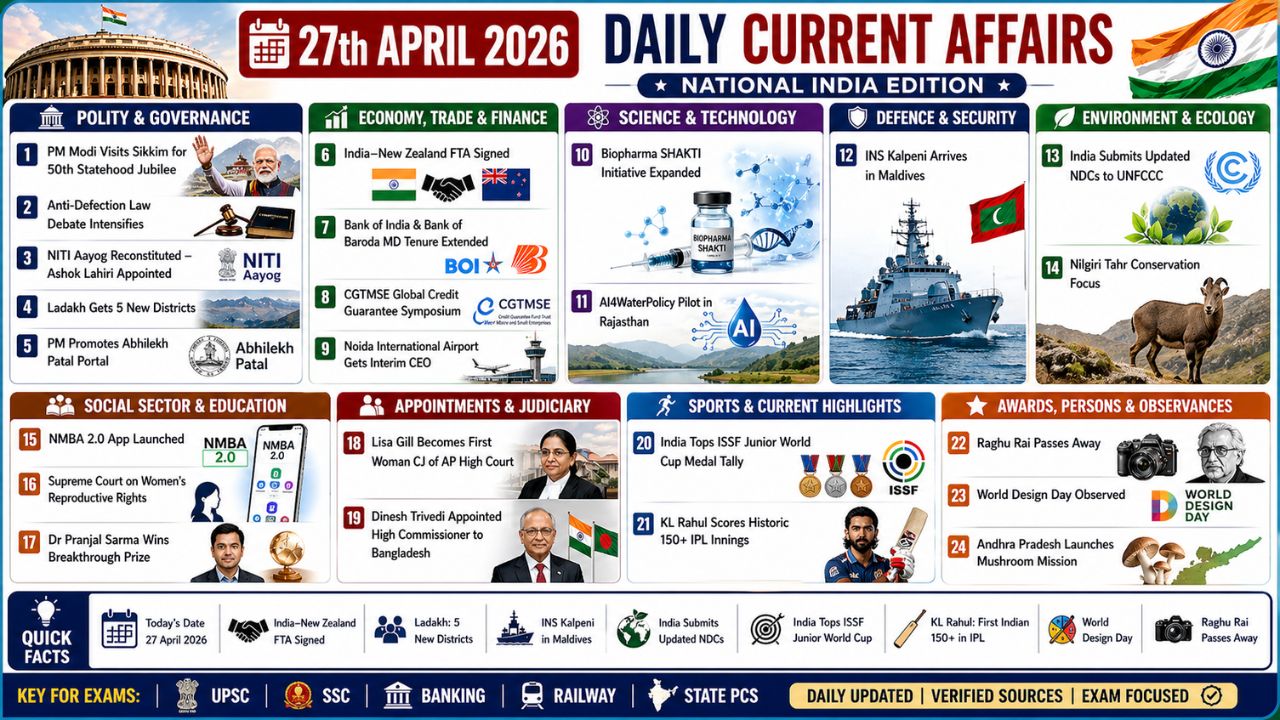
Stay up-to-date with the most important current affairs of India for 27th April 2026, essential for aspirants preparing for UPSC, SSC, Banking, Railway, and State Exams. Our daily GK updates are based on verified government sources, national newspapers, and official press releases. With a focus on national politics, governance, economics, environment, science & technology, defence, sports, and more, this compilation offers the insights you need for exam success.
Polity & Governance
1. PM Modi Visits Sikkim for 50th Year of Statehood — Golden Jubilee Celebrations
Prime Minister Narendra Modi began a two-day visit to Sikkim on 27 April 2026, arriving in Gangtok at around 3 PM after landing at Libing helipad, followed by a roadshow to Lok Bhawan. He participated in the closing ceremony of Sikkim's Golden Jubilee (50th year) of statehood, held at Paljor Stadium, Gangtok.
Sikkim became the 22nd state of India in 1975 under Chief Minister Kazi Lhendup Dorji, and its integration into the Indian Union was facilitated through a referendum. The Golden Jubilee celebrations marked five decades of this historic event. PM Modi had originally been scheduled to attend the opening ceremony of the year-long celebrations in 2025, but could not reach due to inclement weather and addressed the gathering via video conferencing from Bagdogra, West Bengal.
During the visit, PM Modi inaugurated, launched, and laid foundation stones for multiple development projects worth over ₹4,000 crore spanning infrastructure, connectivity, healthcare, education, power, urban development, environment, tourism, and agriculture. Key projects included: a 100-bedded Ayurveda Hospital at Yangang, Namchi district; a 30-bedded Integrated Sowa Rigpa Hospital at NIT Deorali; and two hinged double-lane steel arch bridges over River Teesta at Sirwani and Lower Samdong connecting Namchi and Gangtok districts.
PM Modi also visited the Swarnajayanti Maitri Manjari Park (Orchidarium) — a world-class Orchid Experience Centre developed at the Orchidarium in Gangtok to showcase Sikkim's ecological and floral heritage. The PM highlighted the rapid growth of the bamboo sector in the Northeast, encouraging citizens to purchase bamboo products from the region and describing the Northeast as "Ashtalakshmi" — symbolising its eight-fold potential. Notably, bamboo was removed from the category of "trees" under the Indian Forest Act in 2017, which significantly eased restrictions on its harvesting and transport and boosted bamboo-based industries in the Northeast.
2. 10th Schedule (Anti-Defection Law) — Renewed Debate Following Political Developments
The 10th Schedule of the Indian Constitution, popularly known as the Anti-Defection Law, came under renewed public and legal scrutiny on 27 April 2026 following recent political shifts in certain states. The debate focused particularly on legal loopholes related to party mergers and the process of disqualification.
The 10th Schedule was introduced through the 52nd Constitutional Amendment Act, 1985, with the aim of curbing the "Aaya Ram Gaya Ram" phenomenon — a term that became popular after Haryana legislator Gaya Lal switched party affiliations three times in a single day in 1967. The law was inserted by Rajiv Gandhi's government to bring political stability to legislatures.
Under the 10th Schedule, an MP or MLA is disqualified on grounds of: (1) voluntarily giving up membership of their political party; (2) voting against or abstaining from voting contrary to the party whip without prior permission; (3) joining a political party (for independent members) after election; and (4) joining a political party within six months of taking a seat (for nominated members). The Speaker or Chairman of the respective house is the authority to decide disqualification petitions, a power that itself has been subject to significant controversy and Supreme Court scrutiny.
The key exception is the Merger Clause: a member is protected from disqualification if the original political party merges with another party at the organisational level, provided at least two-thirds of the members of the legislature party agree to the merger. Critics argue this provision is often misused to engineer artificial splits.
3. NITI Aayog Reconstituted — Ashok Kumar Lahiri Appointed New Vice Chairperson
The Government of India reconstituted the NITI Aayog (National Institution for Transforming India), appointing former Chief Economic Advisor (CEA) Ashok Kumar Lahiri as the new Vice Chairperson, succeeding Suman K. Bery. Lahiri, an economist from West Bengal and a sitting MLA in the state, has previously served as the Chief Economic Adviser to the Government of India and as a member of the 15th Finance Commission. The Vice Chairperson of NITI Aayog holds the rank of a Cabinet Minister.
NITI Aayog was established on 1 January 2015 through a Cabinet Resolution. It replaced the Planning Commission, which had operated for 65 years since 1950. Unlike its predecessor, which followed a top-down, centralised planning model, NITI Aayog operates on a "bottom-up" cooperative federalism approach, involving states in the national policy-making process. It is a non-constitutional and non-statutory body — meaning it is not mentioned in the Constitution and was not created by an Act of Parliament, but by a simple executive resolution.
NITI Aayog's structure includes the Prime Minister as Chairperson, the Vice Chairperson (nominated by the PM), a Governing Council comprising Chief Ministers of all States and UTs with Legislatures, full-time members, part-time members, and special invitees. Its primary functions include policy design, knowledge sharing, monitoring and evaluation of government schemes using indices like the SDG India Index, and driving cross-sector reforms to improve Ease of Living for citizens.
4. Ladakh Gets 5 New Districts — LG Vinai Kumar Saxena Approves Expansion
Ladakh Lieutenant Governor Vinai Kumar Saxena approved the creation of five new districts in the Union Territory of Ladakh, marking a significant administrative restructuring of the region. The move fulfils a long-pending demand of various communities in Ladakh and is expected to improve governance, service delivery, and administrative efficiency in the vast and strategically sensitive UT.
Ladakh was carved out as a separate Union Territory (without a legislature) on 31 October 2019 from the erstwhile state of Jammu & Kashmir under the Jammu and Kashmir Reorganisation Act, 2019. It comprises two original districts — Leh and Kargil — spread across approximately 59,000 sq km, making it the largest district by area in India (Leh). The addition of new districts will bring administration closer to remote communities, particularly in border areas which hold significant importance for national security.
5. PM Modi Promotes 'Abhilekh Patal' Portal — Access to 7 Million Historical Records
Prime Minister Narendra Modi urged citizens to explore the 'Abhilekh Patal' portal for a deeper understanding of India's historical legacy. The portal is a full-featured web-based digital repository curated by the National Archives of India (NAI), providing access to NAI's reference media and digitised collections over the internet.
The portal contains an astounding 7 million records, covering public records transferred from various Ministries and Departments of the Government of India, spanning centuries of administrative and historical documentation. Its mission is to ensure effortless accessibility of historical records to a diverse global community, cutting across geographical boundaries. The collections include official records, gazetteers, treaties, maps, private papers, and documents from the colonial era and post-independence India. The portal serves as an important tool for researchers, historians, students, and civil services aspirants seeking primary sources on India's socio-political history.
Economy, Trade & Finance
6. India–New Zealand Free Trade Agreement (FTA) Signed on 27 April 2026
India and New Zealand formally signed a Free Trade Agreement (FTA) on 27 April 2026, marking a landmark step in deepening bilateral economic relations between the two countries. The agreement is aimed at boosting duty-free trade in goods and services and facilitating investment flows between the two nations. The deal covers areas including merchandise trade, services, investment, and intellectual property rights.
From New Zealand's perspective, the FTA is part of its broader strategic objective to diversify trade partnerships across the Asia-Pacific region, reducing dependence on a few large trading partners. For India, the agreement adds to a growing network of bilateral and multilateral trade treaties and is expected to benefit key Indian export sectors such as pharmaceuticals, textiles, IT services, and agricultural products. Bilateral trade between India and New Zealand has historically been modest but the FTA is expected to significantly expand this relationship. The deal had been under negotiation for several years, with both sides resolving differences on tariff schedules, rules of origin, and service sector access.
7. Bank of India & Bank of Baroda MDs Get 3-Year Extension
The Appointments Committee of the Cabinet (ACC) granted three-year extensions to the Managing Directors and CEOs of two major public sector banks: Rajneesh Karnatak of Bank of India and Debadatta Chand of Bank of Baroda. The extensions were approved based on proposals from the Department of Financial Services under the Ministry of Finance.
This decision ensures leadership continuity at two of India's largest public sector banks during a period of ongoing financial sector reforms. Bank of India and Bank of Baroda are both Scheduled Commercial Banks listed on Indian stock exchanges. The ACC, chaired by the Prime Minister, is the apex authority for appointments of senior officials in government and public sector undertakings. Leadership stability in public sector banks is considered critical for maintaining operational efficiency, implementing digital banking reforms, and strengthening their financial health after the NPA resolution cycle of the previous decade.
8. CGTMSE Hosts Global Symposium on Credit Guarantees
The Credit Guarantee Fund Trust for Micro and Small Enterprises (CGTMSE) hosted a Global Symposium on Credit Guarantees, bringing together policymakers, bankers, and international organisations to discuss best practices in credit guarantee mechanisms for small businesses.
CGTMSE was established in 2000 and is jointly set up by the Ministry of Micro, Small and Medium Enterprises (MSME) and the Small Industries Development Bank of India (SIDBI). Its primary objective is to facilitate and promote access to institutional credit for micro and small enterprises (MSEs) that often lack collateral. By providing guarantee cover to lending institutions, CGTMSE enables banks and NBFCs to extend collateral-free loans to MSEs. The scheme plays a critical role in India's economic fabric, given that the MSME sector contributes approximately 30% to India's GDP, employs over 110 million people, and accounts for nearly 45% of total exports.
9. Nitu Samra Appointed Interim CEO of Noida International Airport
Nitu Samra was appointed as the Interim Chief Executive Officer of Noida International Airport (Jewar Airport), located in Gautam Buddha Nagar, Uttar Pradesh. The appointment came following regulatory requirements set by the Bureau of Civil Aviation Security (BCAS), which mandates that the CEO of an Indian airport must be an Indian national.
Samra had been serving as the Chief Financial Officer (CFO) of the airport since October 2021, bringing substantial financial and administrative experience to the role. Noida International Airport is being developed as a greenfield airport under a Public-Private Partnership (PPP) model. It is designed to serve as a second international airport for the Delhi-NCR region, decongesting Indira Gandhi International Airport. The airport is one of the largest infrastructure projects in northern India and is expected to significantly expand the region's passenger and cargo handling capacity once fully operational.
Science, Technology & Space
10. Biopharma SHAKTI Initiative — India Eyes Global Hub Status for Biologics
India's Biopharma SHAKTI initiative, announced in the Union Budget 2026–27, continued to receive policy attention in April 2026 as part of India's strategy to position itself as a global hub for biologics and biosimilars. The initiative is closely linked with the Anusandhan National Research Foundation (ANRF), which oversees a ₹50,000 crore fund designed to boost industry-academia research and development intensity in India.
This builds upon the earlier National Biopharma Mission, launched in 2017, which supports the development of indigenous vaccines, biosimilars, and medical devices with 50% co-funding from the World Bank. India is already the world's largest vaccine manufacturer by volume, and the Biopharma SHAKTI initiative aims to strengthen its position in the high-value biologics and biosimilars market, which is expected to be worth hundreds of billions of dollars globally by 2030. Biologics include complex molecules like monoclonal antibodies, cell and gene therapies, and recombinant proteins, which require advanced manufacturing capabilities.
11. AI4WaterPolicy Pilot Demonstrates AI's Role in Rajasthan's Water Governance
A pilot project called AI4WaterPolicy, conducted in Sirohi and Pali districts of Rajasthan, demonstrated how artificial intelligence can strengthen water resilience and last-mile governance by listening to communities and improving institutional responsiveness. The project was conducted across 50 villages over 6 months and involved 352 interviews.
The AI chatbot held 20-minute WhatsApp conversations in Hindi and local dialects with Pani Mitras (community water volunteers), Panchayat leaders, and frontline staff. Conversations captured local ground realities — including women's double burden in water collection, delays in Panchayat approvals, and community pride in water conservation achievements. The findings were then fed into policy feedback mechanisms. This project highlights how AI is being deployed not just for technical efficiency but for inclusive governance and community participation, an emerging area in GS-III (Science and Technology) for competitive exams.
Defence & Security
12. INS Kalpeni Arrives in Maldives — Deepening India-Maldives Maritime Engagement
Indian Navy fast attack craft INS Kalpeni arrived at Gan in the Addu Atoll, Maldives, marking a significant step in the ongoing maritime engagement between India and the Maldives. The visit is part of India's broader "Neighbourhood First" and SAGAR (Security and Growth for All in the Region) policy, which emphasises strengthening maritime security cooperation with Indian Ocean island nations.
INS Kalpeni belongs to the Fleet Car Nicobar class Waterjet Fast Attack Craft (FAC) series — a fleet of 10 such vessels built by Garden Reach Shipbuilders and Engineers (GRSE), Kolkata. It was commissioned into the Indian Navy on 14 October 2010 and is named after Kalpeni Island in the Lakshadweep group of islands. The ship is based at Kochi under the Southern Naval Command and specialises in coastal surveillance, anti-smuggling operations, Vessel Boarding Search & Seizure (VBSS), and Search and Rescue (SAR). It uses waterjet propulsion for superior manoeuvrability in shallow waters, can attain speeds over 35 knots, and carries a 30 mm CRN-91 naval gun, Igla surface-to-air missiles, and 11 machine guns.
Environment & Ecology
13. India Submits Updated NDCs for 2031–35 to UNFCCC Under Paris Agreement
India formally submitted its new Nationally Determined Contributions (NDCs) for the 2031–35 period to the United Nations Framework Convention on Climate Change (UNFCCC), fulfilling its obligations under the Paris Agreement. The updated climate pledges focus on accelerating India's clean energy transition, reducing emissions intensity of its GDP, and enhancing carbon sinks through forest and tree cover.
NDCs are the climate action plans that each country is required to submit under the Paris Agreement (adopted in 2015), outlining how it will contribute to limiting global warming. India's earlier NDC targets — including achieving 50% of cumulative electric power capacity from non-fossil fuel-based sources by 2030 and reducing emissions intensity of GDP by 45% (compared to 2005 levels) — were updated in 2022. The submission of NDCs for 2031–35 represents India's forward-looking climate planning. India, as one of the world's fastest-growing economies, plays a critical role in global climate negotiations, and its NDC commitments are closely watched by international stakeholders, multilateral institutions, and G20 partners.
14. Nilgiri Tahr — Conservation in Focus for Western Ghats' Endangered Mountain Ungulate
The Nilgiri Tahr (Nilgiritragus hylocrius) — the only mountain ungulate found in southern India — remained in the conservation and policy spotlight. It is one of 12 wild ungulate species found in India and serves as a keystone indicator species for the health of the Western Ghats' high-altitude ecosystems.
The species inhabits open montane grassland habitats at elevations between 1,200 and 2,600 metres above sea level. Its geographic range is currently restricted to a narrow 400 km stretch of the Western Ghats, from the Nilgiris in the north to the Kanyakumari hills in the south. The largest population is found in Eravikulam National Park, Kerala, with other significant populations in the Nilgiris and Anamalai hills. While Nilgiri Tahr historically spanned much of the Western Ghats, they are now found only in small, fragmented pockets due to habitat loss from tea and coffee plantations, invasive species like Lantana camara, and climate change. The species is listed as Endangered on the IUCN Red List and receives protection under Schedule I of the Indian Wildlife (Protection) Act, 1972, affording it the highest level of legal protection in India.
Social Sector, Health & Education
15. NMBA 2.0 App Launched — Strengthening the Nasha Mukt Bharat Abhiyaan
The Government of India launched the NMBA 2.0 App — an upgraded, centralised digital platform designed to strengthen the implementation, monitoring, and reporting of the Nasha Mukt Bharat Abhiyaan (NMBA) across all districts of the country.
The original Nasha Mukt Bharat Abhiyaan was launched on 15 August 2020 by the Department of Social Justice and Empowerment under the National Action Plan for Drug Demand Reduction (NAPDDR), with the aim of creating a drug-free society through awareness, digital monitoring, and coordinated demand reduction efforts. Since its launch, the campaign has reached over 26 crore people, including youth and women, sensitised across all districts through over 8.3 lakh activities and over 28,000 Nasha Mukti Mitras (community volunteers).
The upgraded NMBA 2.0 App provides citizens with: e-Pledge functionality, IEC (Information, Education and Communication) materials, helpline support (a toll-free number for drug abuse reporting and counselling), and a locator for nearby de-addiction centres. For institutional users, Grant-in-Aid Institutions (GIAs) receive role-based access for real-time reporting of activities and transparent tracking of Anudan (grant) utilisation. This digital upgrade positions NMBA as a tech-enabled public health intervention aligned with India's broader Digital India goals.
16. Supreme Court Upholds Women's Reproductive Autonomy — MTP Act Under Scrutiny
The Supreme Court of India reaffirmed the importance of women's reproductive autonomy in a significant ruling, observing that women have the right to make independent decisions about their reproductive health. The court's observations came while hearing a case related to the Medical Termination of Pregnancy (MTP) Act, drawing attention to the systemic barriers that continue to hinder women's access to safe abortion services in India.
The MTP Act, first enacted in 1971 and significantly amended in 2021, allows women to seek abortion up to 20 weeks of pregnancy (extended to 24 weeks in special circumstances) with the approval of one or two Registered Medical Practitioners (RMPs). The court flagged concerns about medical gatekeeping — the shift of decision-making power from the woman to doctors. Wider concerns highlighted include: the rural shortage of 70–75% of obstetricians and gynaecologists; NFHS-5 data showing only 18% of women independently decide on their own health; and social stigma faced by unmarried women who are often subjected to extra-legal requirements like spousal or parental consent, despite the law requiring only the woman's consent. The ruling is relevant for GS-II Social Justice sections in UPSC and State PSC exams.
17. Dr Pranjal Sarma Receives Breakthrough Prize 2025 for CERN ALICE Experiment
Dr Pranjal Sarma, an assistant professor from Jagiroad College, Assam, received the prestigious Breakthrough Prize 2025 in Fundamental Physics for his contribution to the ALICE (A Large Ion Collider Experiment) experiment at CERN in Geneva, Switzerland. He was part of the Gauhati University research group involved in high-level particle physics research, including studies on the Higgs Boson and Quark-Gluon Plasma.
The Breakthrough Prize in Fundamental Physics is one of the world's most prestigious scientific honours, often called the "Oscars of Science". It was founded by tech entrepreneurs including Yuri Milner and Mark Zuckerberg and recognises outstanding contributions to understanding fundamental aspects of the universe. Dr Sarma's recognition is a landmark moment for Indian science, particularly for the scientific community of Assam. CERN's ALICE experiment studies the behaviour of matter under extreme conditions of temperature and energy density, recreating conditions similar to those just after the Big Bang.
Appointments & Judiciary
18. Lisa Gill Sworn In as First Woman Chief Justice of Andhra Pradesh High Court
Justice Lisa Gill was sworn in as the first woman Chief Justice of the Andhra Pradesh High Court in a historic ceremony held at Vijayawada. The oath of office was administered by Governor S. Abdul Nazeer, marking a significant milestone for women's representation in India's judiciary. The ceremony was attended by senior judges, government officials, and dignitaries. Andhra Pradesh Chief Minister N. Chandrababu Naidu also met her and extended his congratulations.
This appointment is part of a broader, though still slow, trend of increasing women's representation in India's higher judiciary. As of 2026, women continue to be underrepresented in the Supreme Court and various High Courts. India's Constitution does not impose gender-specific restrictions on judicial appointments; appointments to High Courts are made by the President of India in consultation with the concerned Governor, Chief Justice of the High Court, and the Chief Justice of India — a process governed by the Collegium system.
19. Dinesh Trivedi Appointed India's Next High Commissioner to Bangladesh
The Ministry of External Affairs announced the appointment of Dinesh Trivedi, former Union Minister, as India's next High Commissioner to Bangladesh. This is a significant diplomatic appointment given the strategic importance of India-Bangladesh bilateral relations. Dinesh Trivedi is a seasoned politician who previously served as Railway Minister of India and is a former Member of Parliament. He is known for his budget presentation in 2012 which proposed significant rail fare hikes — one of the few instances where a Railway Minister's own party reversed a budget decision mid-course.
India-Bangladesh relations encompass trade (Bangladesh is one of India's largest trading partners in South Asia), connectivity (rail, road, and water links), energy (power export from India to Bangladesh), water sharing (the Teesta river issue remains a sensitive unresolved matter), and security cooperation. The appointment of a high-profile former minister as High Commissioner underscores the importance India attaches to its relationship with Bangladesh.
Sports
20. India Tops Medal Tally at ISSF Junior World Cup 2026 in Cairo with 16 Medals
India delivered a dominant performance at the ISSF (International Shooting Sport Federation) Junior World Cup 2026 in Cairo, Egypt, concluding on 27 April 2026. India topped the overall medal tally with 16 medals — 5 gold, 6 silver, and 5 bronze. The tournament ran from 19 to 27 April 2026 and featured 284 junior athletes from 25 federations, with India fielding the largest contingent of 71 shooters competing across 18 medal events.
Notable performances included Prachi Gaikwad, who won gold in the junior women's 50m Rifle 3 Positions (3P) event with a score of 354.6, defeating Individual Neutral Athlete (AIN) Darya Chuprys by just 0.2 points. Shiva Narwal won gold in the men's 10m Air Pistol event on the opening day. Naraen Pranav won bronze in the junior men's 10m Air Rifle event. Oleg Noskov claimed gold with a junior world record score in the 50m Rifle 3 Positions event, and Hemant Burman won silver in the same category. India also secured bronze in the Trap Mixed Team event through Zuhair Khan and Addya Katyal. India's strong performance at this level points to a deep talent pipeline for senior international competitions including the Olympics.
21. KL Rahul Becomes First Indian Batsman to Score 150+ in an IPL Innings
KL Rahul created history in IPL 2026 by becoming the first Indian batsman to score 150 or more runs in a single IPL innings, cementing his status as one of India's most explosive white-ball batsmen. This historic knock added his name to an elite list of T20 batting achievements and demonstrated the evolution of power-hitting in modern cricket.
KL Rahul (Kannur Lokesh Rahul) has been one of India's most consistent performers across all formats. In IPL, he has been a prolific run-scorer and has previously captained Punjab Kings and Lucknow Super Giants. His 150+ score surpassed the previous benchmarks set by overseas players in the IPL and is a milestone not just for Indian cricket but for the tournament's record books. The Indian Premier League, launched in 2008 under the aegis of the Board of Control for Cricket in India (BCCI), remains the world's most-watched T20 cricket league and a key platform for identifying international talent.
Awards, Persons in News & Observances
22. Raghu Rai — India's Iconic Photographer Passes Away at 83
Raghu Rai, one of India's most celebrated photographers and a global icon of photojournalism, passed away at the age of 83. His death marks the end of an era in Indian visual journalism. Raghu Rai is remembered for his extraordinary ability to capture the human condition in India across several decades.
He is particularly renowned for his powerful documentation of the Bangladesh refugee crisis (1971), capturing images that brought international attention to the humanitarian catastrophe. He also created some of the most haunting visual records of the Bhopal gas tragedy (1984), one of the world's worst industrial disasters, which claimed thousands of lives. His portfolio also includes intimate portraits of global leaders, Indian spiritual figures, and everyday life across the subcontinent. Raghu Rai was associated with the prestigious Magnum Photos agency — one of the world's most respected photographic cooperatives — and was deeply inspired by the French master Henri Cartier-Bresson. His photographs are considered an irreplaceable visual archive of modern India and have been exhibited internationally.
23. World Design Day — Observed on 27 April to Celebrate Role of Design in Society
World Design Day (also known as International Design Day) is observed every year on 27 April to highlight the vital role of design in shaping everyday life and solving real-world problems. The day commemorates the founding of the International Council of Design (ico-D) — an international advocacy organisation representing communication design worldwide.
Each year, World Design Day is celebrated around a specific theme chosen to highlight how design thinking can address global challenges. The day promotes creativity, innovation, and sustainable solutions across fields such as technology, architecture, urban planning, product design, and communication. In India, design as a discipline has been gaining increasing importance with the expansion of design education through institutions like the National Institute of Design (NID) and numerous private design schools, as well as the growing integration of design thinking into government policy and Smart City initiatives.
24. Andhra Pradesh Launches First-Ever Mushroom Mission with ₹13,000 Crore Investment
Andhra Pradesh Chief Minister N. Chandrababu Naidu announced the state's first-ever Mushroom Mission, with an estimated investment of ₹13,000 crore, aimed at boosting large-scale mushroom production and rural income in the state. The mission seeks to leverage Andhra Pradesh's agricultural strengths and position it as a national hub for mushroom cultivation, processing, and export.
Mushroom cultivation is considered an important livelihood option for small and marginal farmers as it requires low land area, relatively modest capital investment, and can yield significant returns. India's mushroom production has been growing steadily, though it still accounts for a small fraction of global output dominated by China. The AP Mushroom Mission is expected to create rural employment, particularly for women self-help groups, and will involve the development of cold chain infrastructure, processing facilities, and market linkages. This initiative aligns with the state's broader agricultural diversification strategy following its split from Telangana in 2014 and its ongoing capital development projects.
Detailed Summary of the Key Events on 27th April 2026:
PM Modi's Visit to Sikkim: A historic visit marking the Golden Jubilee of Sikkim's statehood. PM Modi's launch of ₹4,000 crore worth development projects across healthcare, education, tourism, and infrastructure highlights the importance of regional development.
Debate Over the Anti-Defection Law: The renewed scrutiny of the 10th Schedule of the Indian Constitution following political developments across various states. This debate plays a crucial role in shaping future legislative stability.
NITI Aayog Reconstitution: The appointment of Ashok Kumar Lahiri as Vice Chairperson of NITI Aayog signals a shift in India’s economic governance structure.
Ladakh's Administrative Restructuring: The creation of 5 new districts in Ladakh aimed at improving governance in this strategically important region.
Free Trade Agreement with New Zealand: India strengthens economic ties with New Zealand through a landmark FTA, promising duty-free trade in goods and services and promoting investment.
ISSF Junior World Cup: India emerges as the top medal winner at the ISSF Junior World Cup 2026 in Cairo with a total of 16 medals, underscoring India's growing dominance in international shooting sports.
This 27th April 2026 current affairs compilation will help you prepare comprehensively for competitive exams by covering vital topics like governance, economy, and global affairs.
Why is this Important?
Stay Ahead in Competitive Exams: Current affairs are crucial for general awareness sections in exams such as UPSC, SSC CGL, IBPS, and State PSCs.
Daily GK Updates: Keep track of important national and international events that directly impact India’s social, political, economic, and cultural landscape.
In-Depth Analysis: We break down complex topics, making them easier for exam preparation.
Accurate & Reliable Information: Our information comes from reliable government sources, making it highly relevant for your exam preparation.
Whether you're preparing for the UPSC Civil Services or any other government exams, our daily current affairs updates are here to help you ace the GK section.
Written by
Koti Deva
Digital Marketing Specialist
Koti is a Digital Marketing Specialist with over 10 years of experience and the co-founder of MCQ Orbit — a free exam prep platform built for Indian competitive exam aspirants.
With strong personal knowledge in Quantitative Aptitude, Logical Reasoning, and Mathematics, Koti has a deep understanding of what it takes to crack exams like SSC CGL, IBPS PO, SBI Clerk, UPSC Prelims, NEET, and JEE. Having followed these exams closely for years, he understands the exact topics, patterns, and shortcuts that matter most.
MCQ Orbit was born from a simple desire — to build a platform where every aspirant in India can practice quality MCQs, read reliable current affairs, and prepare confidently, without paying a rupee. Koti combines his digital expertise with his passion for competitive exams to create content that is accurate, practical, and genuinely useful for students.
His mission is straightforward: if the right guidance had been freely available earlier, more students would have cracked their dream exams. MCQ Orbit is his way of making that happen.
Comments
No comments yet.