
Current Affairs 30 April 2026 | 30th April 2026 Current Affairs | Daily GK Updates
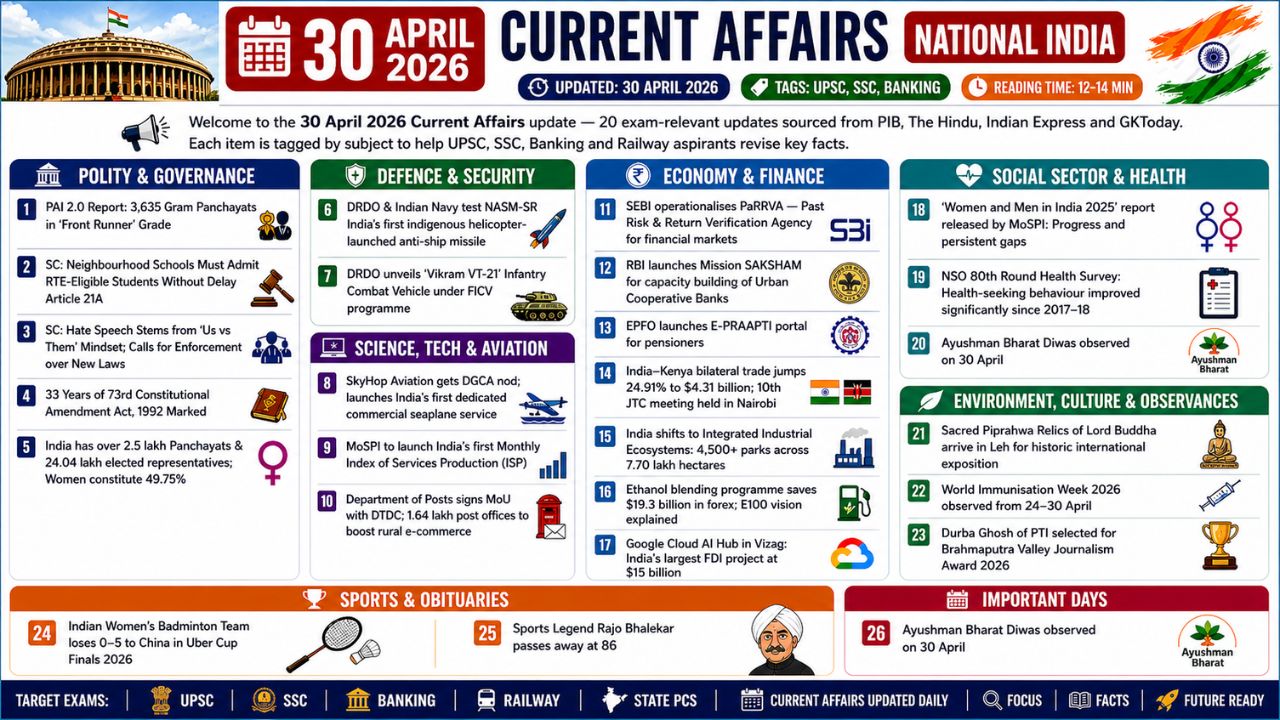
Stay updated with the most important 30 April 2026 current affairs for competitive exam preparation. This daily current affairs compilation covers significant developments in polity, governance, defence, economy, science, technology, health, environment, and sports, helping aspirants of UPSC, SSC, Banking, Railways, APPSC, TSPSC, and other government exams stay exam-ready. From the release of the Panchayat Advancement Index (PAI) 2.0 report to DRDO’s indigenous missile advancements, Supreme Court judgments, major financial reforms, and international trade updates, these carefully curated current affairs provide reliable, exam-focused insights for effective daily GK preparation.
Polity & Governance
PAI 2.0 Report Released on National Panchayati Raj Day — 3,635 Gram Panchayats in 'Front Runner' Grade
The Ministry of Panchayati Raj released the Panchayat Advancement Index (PAI) 2.0 Report for 2023–24 on the occasion of National Panchayati Raj Day (24 April 2026), which was observed to mark 33 years of the 73rd Constitutional Amendment Act, 1992. The Act came into force on 24 April 1993, granting constitutional status to Panchayati Raj Institutions (PRIs). The first National Panchayati Raj Day was celebrated in 2010 under PM Manmohan Singh.
The PAI 2.0 is India's first comprehensive, nationwide, data-driven framework designed to monitor, assess, and incentivise the performance of over 2.5 lakh Gram Panchayats (GPs) and Traditional Local Bodies (TLBs). It evaluates each Panchayat against 150 indicators and 230 data points across nine thematic areas aligned with the Localisation of Sustainable Development Goals (LSDGs): Poverty, Health, Child Welfare, Water, Environment, Infrastructure, Social Justice, Good Governance, and Women's Empowerment.
The index achieved an impressive 97.30% participation — from 2,59,867 Panchayats across 33 States and UTs — a significant rise from 80.79% in PAI 1.0. Panchayats are classified into five performance grades: Achiever (A+), Front Runner (A), Performer (B), Aspirant (C), and Beginner (D). Based on composite scores, 3,635 Gram Panchayats emerged in the prestigious Front Runner (Grade A) category. The index is prepared by the Ministry of Panchayati Raj and serves as a vital tool for evidence-based rural planning. India has over 2.5 lakh Panchayats and 24.04 lakh elected representatives, of whom women constitute 49.75%.
SC Rules Neighbourhood Schools Must Admit RTE-Eligible Students Without Delay — Article 21A
The Supreme Court of India in the case of 'Lucknow Public School vs. The State of Uttar Pradesh & Ors' held that neighbourhood schools must admit eligible students without delay under the Right to Education (RTE) Act, 2009. The Court ruled that denial of admission violates Article 21A of the Constitution — the fundamental right to free and compulsory education — and termed the implementation of RTE admissions a "national mission" for achieving equality and inclusive education.
The Court clarified that schools cannot question or review eligibility decisions made by government authorities once the list of eligible students is finalised. Article 21A was inserted into the Indian Constitution by the 86th Constitutional Amendment Act, 2002, making free and compulsory education a fundamental right for all children aged 6 to 14 years. The RTE Act, 2009, was enacted to give effect to this provision. Under Section 12(1)(c) of the RTE Act, private unaided schools must reserve 25% of their seats for children from economically weaker sections (EWS) and disadvantaged groups (DG) in their neighbourhood — this provision is one of the most litigated aspects of the Act and has far-reaching implications for school access and equity.
SC Rules Hate Speech Stems from 'Us vs Them' Mindset; Calls for Enforcement over New Laws
The Supreme Court of India, in a judgment by Justices Vikram Nath and Sandeep Mehta, held that hate speech stems from an "us vs them" mindset that undermines fraternity — a foundational value enshrined in the Preamble of the Indian Constitution. The Court refused to mandate the creation of a new standalone hate speech law, emphasising instead the need for effective enforcement of existing legal provisions rather than judicial overreach into the legislative domain.
The primary existing provision addressing hate speech is Section 196 of the Bharatiya Nyaya Sanhita (BNS), 2023 — which replaced Section 153A of the IPC — and punishes the promotion of enmity between different groups on grounds of religion, race, language, or caste. It covers spoken/written words, signs, and electronic communication, with penalties of up to three years imprisonment. The judgment highlights the constitutional importance of fraternity — often the most overlooked value in the Preamble alongside Liberty, Equality, and Justice — and signals that India must build a culture of constitutional values through institutional accountability rather than relying solely on penal legislation.
Defence & Security
DRDO & Indian Navy Successfully Test NASM-SR — India's First Indigenous Helicopter-Launched Anti-Ship Missile
DRDO (Defence Research and Development Organisation) and the Indian Navy successfully conducted the maiden salvo launch of the Naval Anti-ship Missile — Short Range (NASM-SR) from off the coast of Bay of Bengal in Odisha. This is a landmark achievement in India's defence self-reliance under the Aatmanirbhar Bharat initiative.
NASM-SR is India's first indigenous helicopter-launched anti-ship missile. It has been developed as a direct replacement for the ageing British-origin Sea Eagle missile currently used by the Indian Navy's Sea King helicopters. The missile is capable of being launched from maritime helicopters to engage and destroy enemy surface vessels. Its development marks a major shift from dependency on aging foreign-origin weapons to a fully indigenous ecosystem involving DRDO labs, start-ups, and MSMEs. The DRDO also recently unveiled the Vikram VT-21 Infantry Combat Vehicle (ICV) as a key contender under India's Futuristic Infantry Combat Vehicle (FICV) programme — another step in the indigenisation of India's armoured warfare capabilities. Anti-ship missiles are critical for India given its 7,500 km coastline and the Indian Navy's strategic role in the Indo-Pacific.
DRDO Unveils 'Vikram VT-21' Infantry Combat Vehicle Under FICV Programme
The Defence Research and Development Organisation (DRDO) unveiled the "Vikram VT-21" Infantry Combat Vehicle (ICV) as a key contender under India's Futuristic Infantry Combat Vehicle (FICV) programme. The development gains significance amid the Indian Army's ongoing modernisation push and evolving threats along the China–Pakistan borders, which require advanced, network-enabled armoured platforms.
Infantry Combat Vehicles (ICVs) are tracked or wheeled armoured platforms designed to transport infantry into battle while providing direct fire support — distinct from Main Battle Tanks (MBTs), which are heavier offensive platforms. Currently, the Indian Army's primary ICV is the BMP-2 (Sarath), a Soviet-origin vehicle inducted in the 1980s. The FICV programme aims to develop a next-generation successor with improved survivability, firepower, mobility, and C4I (Command, Control, Communications, Computers, and Intelligence) integration. The Vikram VT-21 competes with designs from Tata Advanced Systems and L&T among others under this competitive procurement programme, which is one of the largest ongoing capital acquisition projects of the Indian Army with an estimated requirement of over 2,000 vehicles.
Science, Technology & Aviation
SkyHop Aviation Gets DGCA Nod — Launches India's First Dedicated Commercial Seaplane Service in Lakshadweep
SkyHop Aviation Private Limited received its Air Operator Certificate (AOC) from the Directorate General of Civil Aviation (DGCA), Ministry of Civil Aviation, enabling it to launch India's first dedicated commercial seaplane service. SkyHop's founder and CEO is Avani Singh. Commercial operations are set to begin first in Lakshadweep, where the service will connect five islands internally and also establish links with the Indian mainland.
Operations will start with a 19-seat DHC-6 Twin Otter amphibious aircraft — a type used worldwide for water landings. Prior to receiving the AOC, SkyHop conducted successful test flights including water take-offs and landings at the Ganga Barrage and Tehri Lake in Uttarakhand. Notably, SkyHop will convert its aircraft in India (adding floats and structural modifications), making it the first time such an amphibious conversion is undertaken domestically — fitting squarely within the Make in India initiative. The service is included under the UDAN Regional Connectivity Scheme, giving it policy support for subsidised fares. For Lakshadweep — a Union Territory with limited airport infrastructure — seaplanes will dramatically cut inter-island travel times. India previously had short-lived seaplane services (notably from SpiceJet), but SkyHop will be the first standalone operator focused exclusively on seaplane services.
MoSPI to Launch India's First Monthly Index of Services Production (ISP)
The Ministry of Statistics and Programme Implementation (MoSPI) announced plans to launch India's first Monthly Index of Services Production (ISP) — a new high-frequency economic indicator to measure output trends in the services sector on a monthly basis.
Currently, India tracks industrial output through the Index of Industrial Production (IIP), which covers manufacturing, mining, and electricity. However, no equivalent monthly measure exists for the services sector. The ISP will fill this critical data gap. Coverage is planned at approximately 70% of the services sector's Gross Value Added (GVA). Excluded segments include public administration, defence, select non-market financial services, ownership of dwellings, and informal/unincorporated segments — which are harder to measure in real time. The services sector contributes nearly 55% of India's GDP and is the largest employer in the formal economy. A monthly services output index will significantly improve the timeliness and quality of India's macroeconomic data, benefiting policymakers, the RBI, investors, and international analysts.
Department of Posts Signs MoU with DTDC — 1.64 Lakh Post Offices to Boost Rural E-Commerce
The Department of Posts (DoP), under the Ministry of Communications, signed a Memorandum of Understanding (MoU) with DTDC Express Limited to strengthen India's logistics and e-commerce delivery network. The agreement was formalised at Dak Bhawan, New Delhi by Neeraj Kumar Jha (General Manager, Parcel Directorate, DoP) and Jatinder Sethi (National Channel Head, DTDC).
The partnership enables joint logistics and capacity sharing, giving DTDC access to India Post's vast network of over 1.64 lakh post offices — the world's largest postal network — to expand into rural and semi-urban markets. It also supports nationwide Cash on Delivery (COD) services in previously non-serviceable regions. Benefits include enhanced last-mile delivery reach and speed, improved network utilisation, and enabling adoption of modern logistics practices. This aligns with India's National Logistics Policy (NLP), 2022, which aims to reduce logistics costs from the current ~14% of GDP to under 8% by 2030 — comparable to global benchmarks — and positions India to become a global logistics hub. The partnership also directly supports the growth of rural e-commerce, an increasingly important driver of financial inclusion and employment in non-metro India.
Banking & Finance
SEBI Operationalises PaRRVA — Past Risk & Return Verification Agency for Financial Markets
The Securities and Exchange Board of India (SEBI) operationalised the Past Risk and Return Verification Agency (PaRRVA), which will commence full-scale operations on 4 May 2026, following a successful pilot phase that began on 8 December 2025. The framework was originally issued on 4 April 2025.
PaRRVA is a dedicated agency and data infrastructure designed to validate and authenticate past performance metrics (risk and return) of regulated market entities. CARE Ratings Limited has been recognised as the official PaRRVA, while the National Stock Exchange (NSE) will function as the PaRRVA Data Centre (PDC). The verification scope covers performance claims related to investment advisory services, research services, and algorithmic trading offerings. A key benefit: regulated entities are permitted to use PaRRVA-verified performance data in their advertisements, ensuring claims align with SEBI's regulatory provisions. This mechanism addresses a long-standing problem of unverified or misleading performance claims by SEBI-registered advisers and analysts — a major source of investor grievances and mis-selling. It enhances investor protection and improves the credibility and transparency of India's capital markets.
RBI Governor Launches Mission SAKSHAM — Capacity Building for Urban Cooperative Banks
The Reserve Bank of India (RBI) Governor launched Mission SAKSHAM (Sahakari Bank Kshamta Nirman) — a sector-wide, mission-mode capacity-building and certification framework designed for Urban Co-operative Banks (UCBs) across India.
The mission aims to enhance managerial and operational capabilities, improve compliance culture, and strengthen institutional resilience across UCBs. Target groups include board members, senior management, heads of risk, compliance and audit functions, and employees in IT and other critical areas. The participant goal is 1.40 lakh individuals across the UCB sector nationwide. India has over 1,500 Urban Co-operative Banks with combined deposits of several lakh crore rupees. UCBs play a critical role in providing financial services to small businesses, traders, and the urban middle class — particularly in states like Maharashtra, Gujarat, and Karnataka. However, the sector has faced challenges including governance failures, frauds, and NPAs (as seen in cases like PMC Bank), making SAKSHAM's focus on governance and risk management both timely and critical. UCBs are jointly regulated by the RBI (for banking operations) and State Registrars of Cooperative Societies (for administrative matters).
EPFO Launches E-PRAAPTI Portal — Digital Platform for Pensioners
The Employees' Provident Fund Organisation (EPFO) launched the E-PRAAPTI portal, a dedicated digital platform aimed at improving service delivery for its vast network of pensioners. The portal streamlines access to pension-related services, grievance redressal, and account management.
EPFO is one of the world's largest social security organisations, managing the retirement savings and pension accounts of over 7 crore active members and disbursing pensions to over 78 lakh pensioners monthly under the Employees' Pension Scheme (EPS), 1995. The E-PRAAPTI portal is part of EPFO's broader digital transformation journey, which has included reforms like Centralised Pension Payment System (CPPS), Aadhaar-based e-KYC for automatic life certificates (Jeevan Pramaan), and UAN-based online claim submissions. It aligns with the government's push under the Digital India programme to bring social security services online and reduce physical touchpoints and processing delays for beneficiaries.
Social Sector & Health
'Women and Men in India 2025' Report Released by MoSPI — Progress and Persistent Gaps
The Ministry of Statistics and Programme Implementation (MoSPI) released the 27th edition of its report, "Women and Men in India 2025", in Bhubaneswar. The report provides a comprehensive, data-rich picture of gender parity across health, education, employment, and political representation in India.
Key findings highlight both progress and persistent gaps. On the positive side: female workforce participation has shown a significant rise; women's growth in managerial roles is now doubling that of men; and government-funded health insurance coverage has tripled since 2017, now reaching 45.5% of rural and 31.8% of urban households. However, a 14.4% literacy gap between men and women persists, and health screening rates among women remain low. The report notes structural hurdles in translating positive data trends into lived realities — particularly for women in rural and tribal areas. India's Female Labour Force Participation Rate (FLFPR) which had been declining for decades has shown a notable uptick, partly attributed to increased rural female employment under schemes like MGNREGS and self-help group (SHG) programmes under DAY-NRLM. These findings are critical for GS-I (Society) and GS-II (Social Justice) sections of UPSC Mains.
NSO 80th Round Health Survey — Health-Seeking Behaviour Improved Significantly Since 2017–18
The National Statistical Office (NSO) released detailed findings from its 80th Round Survey (2025) on Household Social Consumption: Health, tracking changes in healthcare access, affordability, and disease profile in India since the last round in 2017–18.
Key findings: The proportion of persons reporting ailments (IPRA) has nearly doubled since 2017–18 — in rural areas from ~6–7% to about 12%+; in urban areas from ~9% to ~14–15%. This increase does not necessarily mean more illness — it reflects greater health awareness and willingness to seek care. Rural OPD utilisation of public healthcare rose from 28% in 2014 to 35% in 2025. Government-funded health insurance coverage tripled, reaching 45.5% of rural and 31.8% of urban households. The median out-of-pocket hospitalisation cost in government facilities stood at just ₹1,100, reflecting the subsidised nature of public healthcare. However, private hospitalisation costs remained far higher, reinforcing the need for universal health coverage. These improvements are partly attributed to schemes like Ayushman Bharat – PM Jan Arogya Yojana (AB-PMJAY), free drug distribution programmes, and expanded ASHA worker networks.
Environment, Culture & Heritage
Sacred Piprahwa Relics of Lord Buddha Arrive in Leh for Historic International Exposition
The sacred Piprahwa Relics of Tathagata (Lord) Buddha arrived in Leh, Ladakh on 29 April 2026 for a historic public exposition coinciding with Buddha Purnima 2026. The relics were accorded a ceremonial welcome led by LG Vinai Kumar Saxena, in the presence of prominent religious leaders and thousands of devotees. They were transported from Delhi in a special Indian Air Force (IAF) aircraft by Drukpa Thuksey Rinpoche and Khenpo Thinlas Chosal of Matho Monastery.
The Piprahwa Relics are a collection of sacred artefacts discovered in 1898 at the Piprahwa Stupa in Uttar Pradesh by British colonial engineer William Claxton Peppé. The site is archaeologically associated with ancient Kapilavastu — where Lord Buddha spent his early life prior to renunciation. The relics include bone fragments believed to be those of Lord Buddha, along with crystal caskets, gold ornaments, gemstones, and a sandstone coffer. An inscription in Brahmi script on one of the caskets links the relics to the Sakya clan, indicating enshrining by followers around the 3rd century BC. The relics are classified as 'AA' antiquities under Indian law, prohibiting their removal or sale. Significantly, a part of the Peppé family collection originally slated for auction in Hong Kong in May 2025 was successfully repatriated to India in 2025 through a public-private collaboration between the Government of India and the Godrej Industries Group. Union Home Minister Amit Shah visited Ladakh for the exposition, which runs from 2–10 May 2026 at Jivetsal, Leh.
World Immunisation Week 2026 — Observed from 24–30 April
World Immunisation Week is observed every year from 24 to 30 April globally, led by the World Health Organisation (WHO) across 180+ countries. The week aims to promote the use of vaccines to protect people of all ages against disease, and the 2026 theme highlights the benefits of vaccination across generations.
Vaccination is one of the most cost-effective public health interventions in history, estimated to prevent 4–5 million deaths annually worldwide. India's Universal Immunisation Programme (UIP) is one of the world's largest public health programmes, providing free vaccines to children and pregnant women at government health centres across all states and UTs. Key vaccines under UIP include those against BCG (tuberculosis), DPT, Hepatitis B, polio, MMR (measles-mumps-rubella), rotavirus, PCV (pneumococcal conjugate vaccine), and IPV (injectable polio vaccine). India's Mission Indradhanush (launched 2014) aims to accelerate full immunisation coverage for children who remain unvaccinated or partially vaccinated. India achieved polio-free status in 2014, a major public health milestone.
Economy, Trade & Industry
India–Kenya Bilateral Trade Jumps 24.91% to $4.31 Billion — 10th JTC Meeting Held in Nairobi
India and Kenya concluded the 10th Joint Trade Committee (JTC) meeting in Nairobi, reporting a significant 24.91% rise in bilateral trade, which reached $4.31 billion in 2025–26. The meeting reviewed the state of trade, investment, and economic cooperation between the two countries and identified new sectors for collaboration.
Kenya is a pivotal East African nation and India's largest trading partner in East Africa. It is situated in East Africa, bisected horizontally by the Equator. Its capital is Nairobi, and it is bordered by South Sudan and Ethiopia (north), Somalia and the Indian Ocean (east), Tanzania (south), and Lake Victoria and Uganda (west). Kenya has historically served as a vital entry point for Arabian and Asian traders to reach the African interior, and today its economy is driven by tourism (Big Five wildlife preserves), agriculture (tea and coffee exports), and a growing tech sector (Nairobi as "Silicon Savannah"). India's exports to Kenya include pharmaceuticals, machinery, vehicles, and refined petroleum; India imports tea, coffee, horticulture products, and minerals. The JTC provides a structured bilateral platform to address trade barriers and enhance economic ties.
India Shifts to Integrated Industrial Ecosystems — 4,500+ Parks Across 7.70 Lakh Hectares
India is making a strategic shift from isolated industrial zones to comprehensive Integrated Industrial Ecosystems, aimed at lowering transaction costs and strengthening supply chain reliability. According to PIB data, India has over 4,500 mapped industrial parks, covering roughly 7.70 lakh hectares of dedicated industrial land.
The manufacturing sector contributes 16–17% to India's GDP and employs over 27 million workers. The government's target is to raise this contribution to 25% of GDP by 2047 (Viksit Bharat). The MSME sector comprises 7.47 crore active enterprises and accounts for 35.4% of India's total manufacturing output. Integrated Industrial Ecosystems go beyond traditional Special Economic Zones (SEZs) or industrial estates by combining industrial production facilities with logistics hubs, housing, utilities, digital infrastructure, and skill development centres in one contiguous zone — reducing the time and cost of doing business significantly. This model is aligned with the PM GatiShakti National Master Plan, National Industrial Corridor Programme, and the broader Make in India initiative.
India's Ethanol Blending Programme — $19.3 Billion Saved in Forex; E100 Vision Explained
India's Ethanol Blending Programme (EBP) crossed a significant milestone, having already saved $19.3 billion in foreign exchange as of January 2026 through reduced crude oil import bills. Over $15 billion has been directly paid to farmers (sugarcane and grain producers) over the last decade as payment for ethanol feedstocks — making EBP a rare intersection of energy security and agricultural income support.
Every 1% increase in nationwide ethanol blending saves India approximately $200 million in annual crude oil import costs — a crucial figure given India's import dependence (over 85% of crude oil is imported). India has set a target of 20% ethanol blending by 2025 (now largely achieved in key states). The government is now working towards enabling Flex-Fuel Vehicles (FFVs) that can run on any blend from E0 to E100. Brazil is the global gold standard — 90% of new car sales in Brazil are FFVs since 2003. E100 (100% anhydrous ethanol) has 33% lower energy density than petrol, which may reduce fuel efficiency by 27–30% and require corrosion-resistant engine components. Biofuel policy in India is governed by the National Biofuel Policy, 2018 (revised) under the Ministry of Petroleum and Natural Gas.
Google Cloud AI Hub Foundation Stone Laid in Visakhapatnam — India's Largest FDI Project at $15 Billion
The foundation stone for a Google Cloud AI Hub in Visakhapatnam (Vizag), Andhra Pradesh was laid in April 2026. The project is valued at USD 15 billion, making it India's largest Foreign Direct Investment (FDI) project to date. The hub includes hyperscale data centres, subsea cables, and fibre networks, and aims to position Vizag as a global AI and cloud computing hub.
This investment is part of Google's broader commitment to invest $10 billion+ in India across its various businesses. Visakhapatnam (Vizag) is strategically located on India's eastern coast with submarine cable landing stations — making it ideal for data centre and digital connectivity infrastructure. The project will create significant direct and indirect employment, contribute to the development of India's digital infrastructure, and support the country's ambitions in AI and cloud adoption. It aligns with Andhra Pradesh's strategy to attract high-tech investments to rebuild its economy after the state's restructuring following bifurcation in 2014. This is also part of India's global positioning as a competitive destination for hyperscale cloud infrastructure against Singapore, Malaysia, and UAE.
Sports
Indian Women's Badminton Team Loses 0–5 to China in Uber Cup Finals 2026
The Indian women's badminton team suffered a 0–5 defeat against China in the Uber Cup Finals 2026 on 28 April 2026, ending their campaign in the prestigious international team championship. China, which has dominated the Uber Cup historically, proved too strong for India across all five matches.
The Uber Cup (officially the IBF World Women's Team Badminton Championships) is the premier international team badminton competition for women, held biennially alongside the Thomas Cup (men's team championship), both organised by the Badminton World Federation (BWF). India has historically struggled to match the consistent excellence of China, South Korea, and Japan in women's team badminton. However, Indian women's shuttlers have made significant strides individually — PV Sindhu is a two-time Olympic medallist and former World Champion, and a new generation of players is emerging through SAI and state badminton academies. India's performance in team championships remains a key development area for the sport in the country.
Important Days & Observances
Ayushman Bharat Diwas — Observed on 30 April
Ayushman Bharat Diwas is observed annually on 30 April to mark the anniversary of the launch of the Ayushman Bharat – Pradhan Mantri Jan Arogya Yojana (AB-PMJAY) and to promote health and wellness across India. The day also highlights India's network of Health and Wellness Centres (HWCs) — now rebranded as Ayushman Arogya Mandirs — which serve as the cornerstone of primary healthcare delivery at the grassroots level.
AB-PMJAY, often called "Modicare", was launched on 23 September 2018. It provides a health cover of ₹5 lakh per family per year for secondary and tertiary hospitalisation to approximately 12 crore poor and vulnerable families (roughly 55 crore individuals) — making it the world's largest government-funded health assurance scheme. In 2024, the scheme was expanded to cover all senior citizens aged 70 and above, regardless of income. Ayushman Bharat also encompasses the Health and Wellness Centre (HWC) initiative, which aims to convert 1.5 lakh sub-centres and primary health centres into comprehensive primary care facilities providing 12 expanded services including NCD screening, mental health, oral health, and palliative care.
Durba Ghosh of PTI Selected for Brahmaputra Valley Journalism Award 2026
Durba Ghosh, a senior journalist associated with the Press Trust of India (PTI), was selected for the prestigious Brahmaputra Valley Journalism Award 2026. The award is conferred by the Assam Rajyik Sangbadik Santha — the state-level journalists' association of Assam. Ghosh has made significant contributions to highlighting Assam-related issues at the national level. The award is to be presented on 10 May in Sonari, Charaideo district, coinciding with the foundation day celebration of the organisation.
The award recognises outstanding journalism that contributes to the people of the Brahmaputra Valley, which encompasses most of Assam — one of India's most ecologically, culturally, and linguistically diverse regions. PTI (Press Trust of India) is India's largest news agency, providing news content to virtually all major Indian print and digital media organisations. This award is significant for journalist community in Northeast India, a region that often gets limited coverage in mainstream national media despite its rich cultural heritage and complex socio-political landscape.
Written by
Koti Deva
Digital Marketing Specialist
Koti is a Digital Marketing Specialist with over 10 years of experience and the co-founder of MCQ Orbit — a free exam prep platform built for Indian competitive exam aspirants.
With strong personal knowledge in Quantitative Aptitude, Logical Reasoning, and Mathematics, Koti has a deep understanding of what it takes to crack exams like SSC CGL, IBPS PO, SBI Clerk, UPSC Prelims, NEET, and JEE. Having followed these exams closely for years, he understands the exact topics, patterns, and shortcuts that matter most.
MCQ Orbit was born from a simple desire — to build a platform where every aspirant in India can practice quality MCQs, read reliable current affairs, and prepare confidently, without paying a rupee. Koti combines his digital expertise with his passion for competitive exams to create content that is accurate, practical, and genuinely useful for students.
His mission is straightforward: if the right guidance had been freely available earlier, more students would have cracked their dream exams. MCQ Orbit is his way of making that happen.
Comments
No comments yet.