
Numbers
Let's be honest — when most students hear "number system", they think it's just boring theory they need to memorise and move on from. But here's the thing: SSC CGL, IBPS PO, and Railway NTPC papers have 4–6 questions directly from this topic every single year. And these are not hard questions. They're fast marks — if you know what you're doing.
The problem is, most students study this topic the wrong way. They memorise the definitions, forget them in two days, and then struggle on exam day. Today, we're going to do this differently. We'll build your understanding from the ground up — with real examples, proper tricks, and the exact mistakes to avoid.
By the end of this lesson, you'll be able to solve most number system questions in under 30 seconds. Let's start.
What Is the Number System?
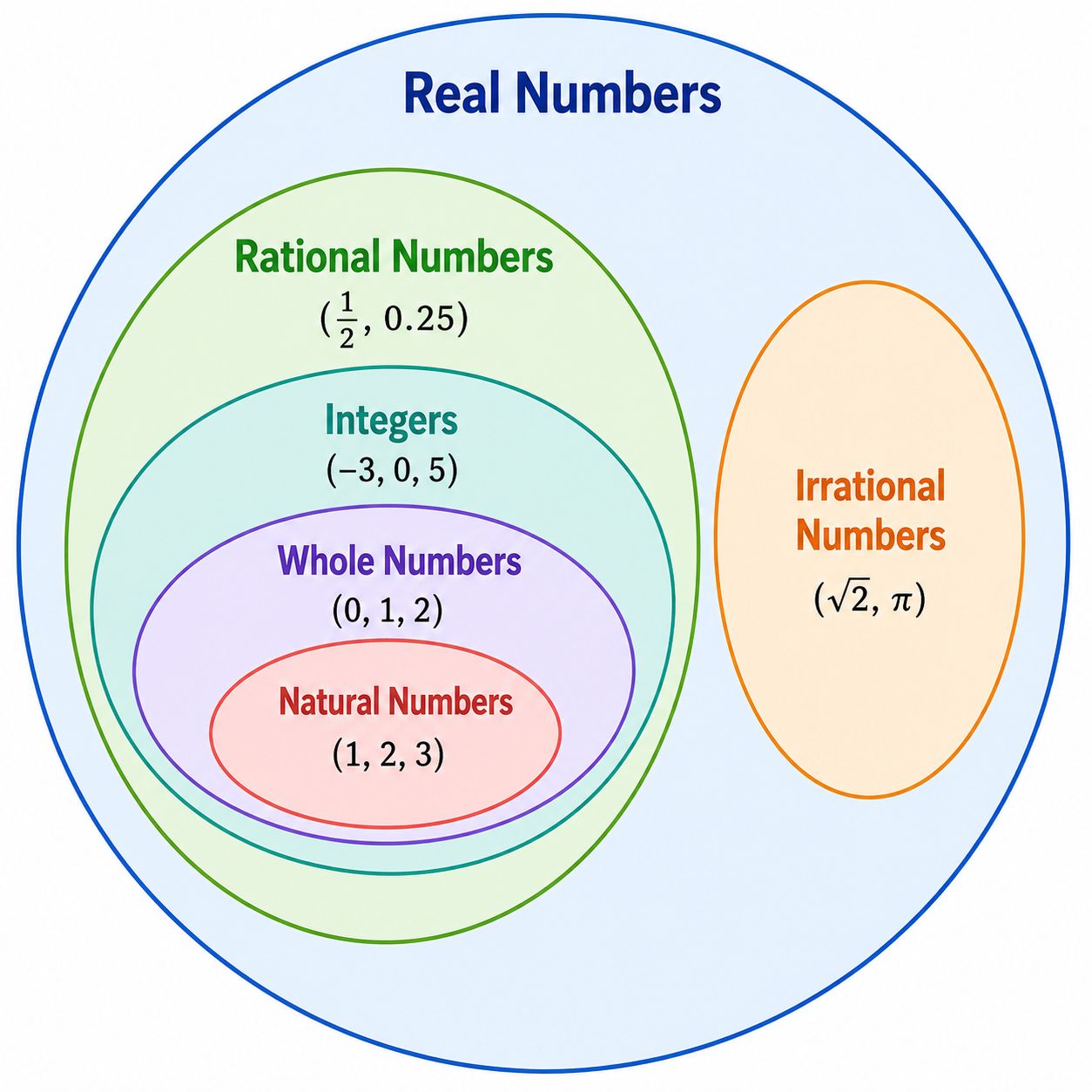
The number system is a way of classifying and organising all numbers based on their properties. Think of it like a family tree — all numbers belong to one or more groups, and each group has its own rules.
In competitive exams, you need to know: which group does a number belong to? What are its properties? And how does that help you solve the question faster?
Number System: A structured classification of all numbers — natural, whole, integer, rational, irrational, and real — based on their mathematical properties.
Classification of Numbers
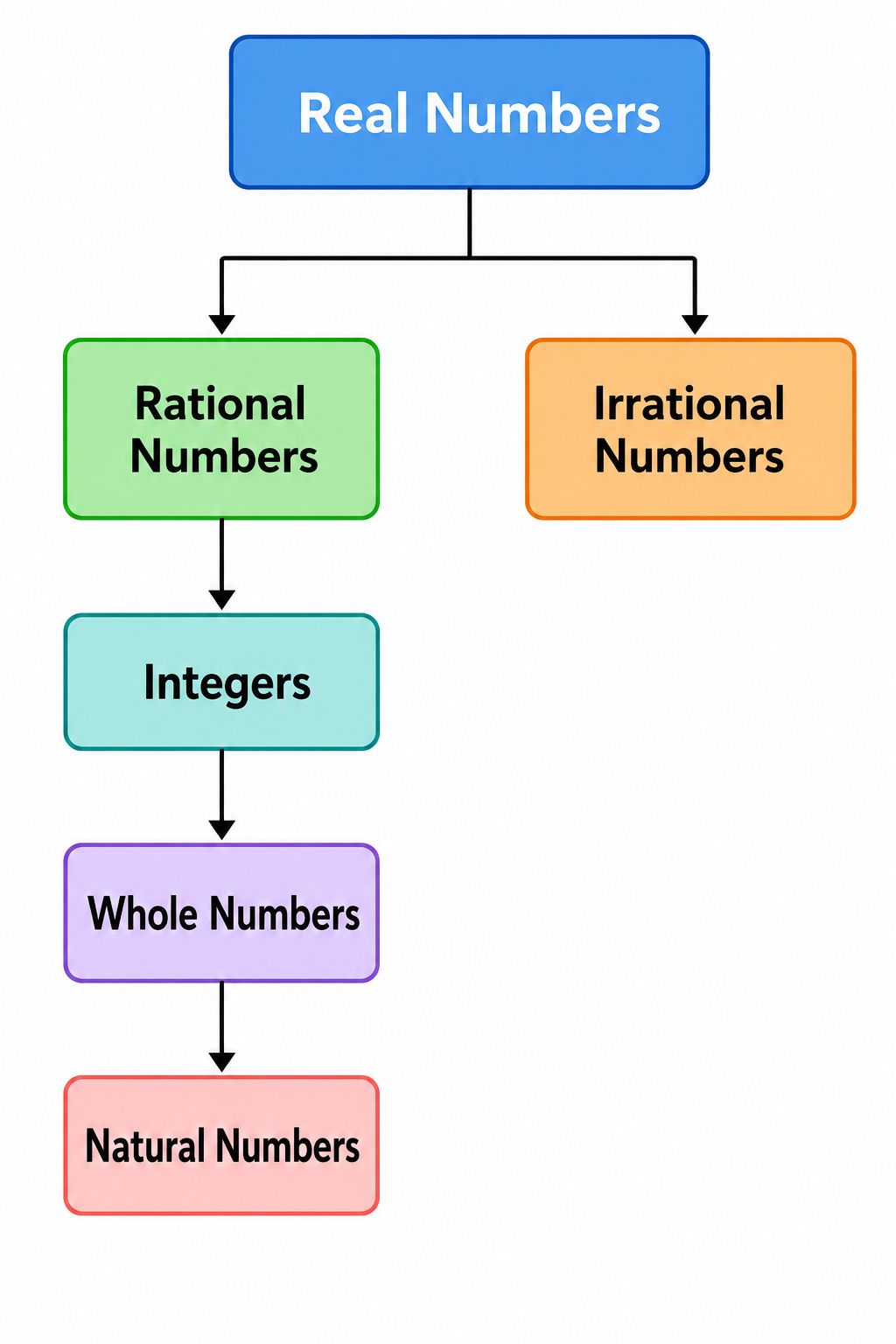
1. Natural Numbers
These are the most basic counting numbers — the ones you used as a child to count mangoes in a basket.
Natural Numbers = 1, 2, 3, 4, 5, 6 ...
They start from 1 and go on forever. Zero is NOT included. Negative numbers are NOT included. Simple as that.
Exam tip: When a question says "how many natural numbers between 10 and 20", remember — between means you exclude 10 and 20 themselves. The answer would be 9 numbers (11 to 19).
2. Whole Numbers
Whole numbers are just natural numbers with zero added.
Whole Numbers = 0, 1, 2, 3, 4, 5 ...
Whole Numbers: All natural numbers plus zero. The only difference from natural numbers is the inclusion of 0.
Think of it this way — if your friend asks "how many apples do you have?" and you have none, you say zero. That zero is what separates whole numbers from natural numbers.
3. Integers
Integers include everything: positive numbers, negative numbers, and zero.
Integers = ... −3, −2, −1, 0, 1, 2, 3 ...
A real-life example you already know: temperature. Delhi in December might be 2°C. Shimla might be −5°C. Both are integers.
Integers: The set of all whole numbers and their negatives. Fractions and decimals are NOT integers.
4. Rational Numbers
Here's where students start getting confused. Let's fix that.
A rational number is any number you can write as a fraction p/q, where p and q are both integers, and q ≠ 0.
Examples of rational numbers:
3/4 (obvious fraction)
5 (can be written as 5/1)
0.25 (= 1/4)
0.333... (= 1/3 — it repeats, but it has a pattern)
−7 (= −7/1)
The key test: if the decimal either terminates (ends) or repeats in a pattern, it's rational.
Rational Number: Any number expressible as p/q where p and q are integers and q ≠ 0. Includes all integers, fractions, terminating decimals, and repeating decimals.
5. Irrational Numbers
These are numbers that CANNOT be written as p/q — no matter how hard you try.
Their decimal form never ends AND never repeats. No pattern, ever.
Common irrational numbers you must know for exams:
√2 = 1.41421356... (never ends, never repeats)
√3 = 1.73205080...
π (Pi) = 3.14159265...
Irrational Number: A number whose decimal expansion is non-terminating and non-repeating. Cannot be written as p/q.
Exam question type: "Which of the following is irrational?" — always check if the decimal repeats or terminates. If neither, it's irrational.
6. Real Numbers
Real numbers is the big umbrella. It includes everything above — rational and irrational both.
Real Numbers = Rational Numbers + Irrational Numbers
Every number you'll encounter in SSC/Banking exams is a real number. Complex numbers (involving √−1) are not in the SSC/Banking syllabus, so we won't go into them here.
Fractions
A fraction p/q represents part of a whole. Three types you must know:
Type | Condition | Example |
|---|---|---|
Proper Fraction | Numerator < Denominator | 3/7 |
Improper Fraction | Numerator ≥ Denominator | 9/4 |
Mixed Fraction | Whole number + Proper fraction | 2¼ |
Conversion you'll need: 2¼ = (2×4 + 1)/4 = 9/4 (improper form)
Divisibility Rules
This is the section that directly gets you marks. Memorise these rules and you'll never need to do long division in an exam again.
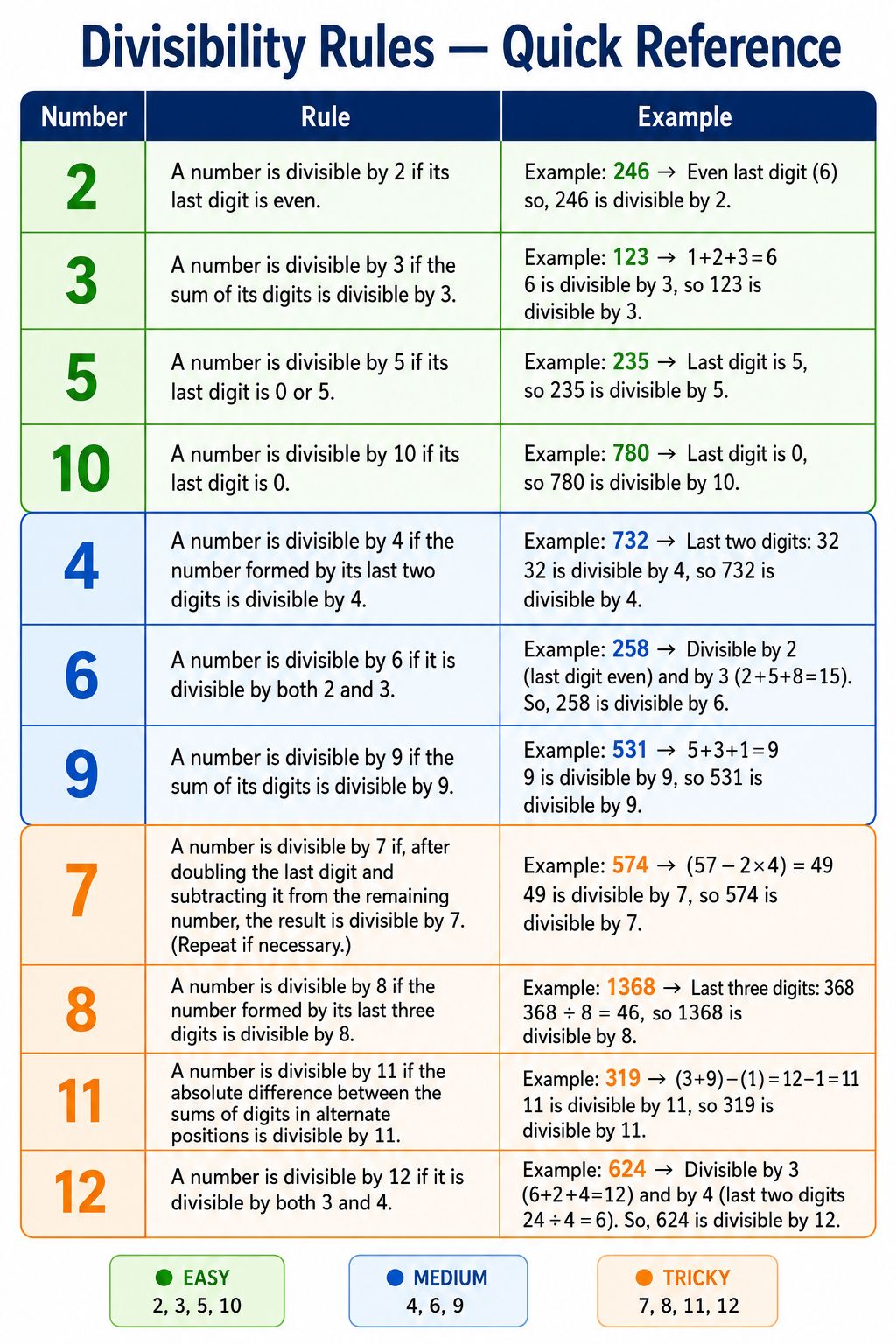
Divisible by 2:
Last digit is 0, 2, 4, 6, or 8.
Example: 348 → last digit 8 → divisible by 2
Divisible by 3:
Sum of all digits is divisible by 3.
Example: 432 → 4+3+2 = 9 → 9÷3 = 3 → divisible by 3
Divisible by 4:
Last two digits form a number divisible by 4.
Example: 1732 → last two digits = 32 → 32÷4 = 8 → divisible by 4
Divisible by 5:
Last digit is 0 or 5.
Example: 725 → last digit 5 → divisible by 5
Divisible by 6:
Must be divisible by BOTH 2 and 3.
Example: 312 → last digit 2 (div by 2) → 3+1+2=6 (div by 3) → divisible by 6
Divisible by 7:
Double the last digit, subtract from the remaining number. If the result is divisible by 7, the original number is too.
Example: 343 → double last digit: 3×2=6 → 34−6=28 → 28÷7=4 → divisible by 7
Divisible by 8:
Last three digits form a number divisible by 8.
Example: 5128 → last three digits = 128 → 128÷8=16 → divisible by 8
Divisible by 9:
Sum of all digits is divisible by 9.
Example: 2916 → 2+9+1+6=18 → 18÷9=2 → divisible by 9
Divisible by 10:
Last digit is 0.
Example: 540 → divisible by 10
Divisible by 11:
Find (sum of digits at odd positions) − (sum of digits at even positions).
If the result is 0 or a multiple of 11, it's divisible by 11. Example: 85492
Odd positions (1st, 3rd, 5th): 8, 4, 2 → sum = 14
Even positions (2nd, 4th): 5, 9 → sum = 14
Difference = 14 − 14 = 0 → divisible by 11
Divisible by 12:
Must be divisible by BOTH 3 and 4.
Example: 144 → sum 1+4+4=9 (div by 3) → last two digits 44÷4=11 (div by 4) → divisible by 12
Co-Prime Numbers
Two numbers are co-prime if the only number that divides both of them is 1. In other words, their HCF = 1.
They don't have to be prime numbers themselves — they just can't share any common factor other than 1.
Examples:
8 and 15 → factors of 8: 1,2,4,8 | factors of 15: 1,3,5,15 → only common factor: 1 → co-prime
14 and 21 → both divisible by 7 → NOT co-prime
Co-Prime Numbers: A pair of numbers whose HCF is 1. Also called "relatively prime" numbers.
Exam fact: If two numbers are co-prime, their LCM = their product. So LCM of 8 and 15 = 8×15 = 120.
Division Algorithm
Every time you divide two numbers, there's a relationship between all four values involved.
The formula: Dividend = Divisor × Quotient + Remainder
And always: 0 ≤ Remainder < Divisor (the remainder can never be bigger than or equal to the divisor)
Example: Divide 47 by 5
5 goes into 47 nine times (5×9=45)
Remainder = 47−45 = 2
So: 47 = 5 × 9 + 2
Worked Examples
Which of the following is an irrational number?
(A) 0.25 (B) √9 (C) √5 (D) 3/7
Step 1: Check each option.
0.25 = 1/4 → rational
√9 = 3 → a whole number, rational
√5 = 2.2360679... → non-terminating, non-repeating → irrational
3/7 = 0.428571... → repeating → rational
Answer: (C) √5
√9 is a trap. Many students mark it irrational because of the square root sign. Always simplify first — if it gives a clean integer, it's rational.
Is 792 divisible by 8?
Step 1: Take the last three digits: 792
Step 2: Divide by 8: 792 ÷ 8 = 99
Step 3: It divides exactly with no remainder.
Answer: Yes, 792 is divisible by 8.
You only ever need to check the last three digits — the digits before them are automatically divisible by 8 (since 1000 is divisible by 8).
When a number is divided by 13, the quotient is 7 and the remainder is 5. What is the number?
Step 1: Use the division algorithm: Dividend = Divisor × Quotient + Remainder
Step 2: Dividend = 13 × 7 + 5 = 91 + 5 = 96
Answer: 96
Division algorithm questions appear almost every year in SSC and Railways exams. The formula is always the same — plug in what you know, solve for what you don't.
What is the smallest number that must be added to 1000 to make it divisible by 7?
Step 1: Divide 1000 by 7 → 1000 = 7 × 142 + 6
Step 2: Remainder is 6. To make it divisible by 7, we need the remainder to become 0.
Step 3: We need to add (7 − 6) = 1
Step 4: Check: 1001 ÷ 7 = 143
Answer: 1
The shortcut is always: required addition = divisor − remainder. This applies to all "what must be added" questions.
Common Mistakes to Avoid
MISTAKE: Thinking zero is a natural number.
CORRECT APPROACH: Zero belongs to whole numbers, integers, and rational numbers — but NOT natural numbers. Natural numbers start from 1.
WHY IT HAPPENS: It feels intuitive that "nothing" should be part of counting numbers. But natural numbers were defined before zero was formally accepted — that's why zero gets its own special place.
MISTAKE: Marking √4, √9, √16 as irrational numbers.
CORRECT APPROACH: Always simplify square roots first. √4 = 2, √9 = 3, √16 = 4 — all rational integers.
WHY IT HAPPENS: The square root sign triggers a mental shortcut: "square root = irrational." But that's only true for non-perfect squares like √2, √3, √5, √7.
MISTAKE: Applying the divisibility rule of 11 wrong — adding all digits instead of alternating.
CORRECT APPROACH: Strictly alternate: (1st + 3rd + 5th digits) − (2nd + 4th + 6th digits). The position matters.
WHY IT HAPPENS: Students confuse the rule of 11 with the rule of 3 and 9, where you just add all digits together.
MISTAKE: Saying two numbers are co-prime just because both are odd or both are prime.
CORRECT APPROACH: Test by finding HCF. 9 and 15 are both odd — but HCF = 3, so they're NOT co-prime.
WHY IT HAPPENS: "Co-prime" sounds like "both are prime numbers." It doesn't mean that. It means HCF = 1.
MISTAKE: In division algorithm questions, ignoring the constraint that Remainder < Divisor.
CORRECT APPROACH: Always check. If a question gives you a remainder ≥ divisor, that's an error in the question or you've misread it.
WHY IT HAPPENS: Students focus on finding the dividend and forget to verify the remainder condition.
Tricks & Shortcuts
TRICK: Digit-sum shortcut for divisibility by 3 and 9 When to use:
Any time you need to check divisibility by 3 or 9 for a large number.
How it works: Keep adding the digits until you get a single digit. If it's 3, 6, or 9 → divisible by 3. If it's 9 → also divisible by 9.
Example: 987654 → 9+8+7+6+5+4 = 39 → 3+9 = 12 → 1+2 = 3 → divisible by 3, but NOT by 9.
Time saved: Saves 20–30 seconds vs trying to divide a 6-digit number.
TRICK: "What to add/subtract" shortcut When to use:
Questions asking "what is the smallest number to add/subtract to make N divisible by D?"
How it works:
To add: required = D − R (where R is the remainder when N ÷ D)
To subtract: required = R itself
Example: Make 500 divisible by 7. 500 = 7×71 + 3. To subtract: remove 3. To add: add 7−3 = 4.
Time saved: Saves 40–50 seconds of trial and error.
TRICK: Last digit test for divisibility by 4 When to use:
Any number check for divisibility by 4.
How it works: You only need to look at the last two digits — completely ignore everything before them.
Example: 1,234,567,892 → last two digits = 92 → 92÷4 = 23 → divisible by 4. Done.
Time saved: Saves 30+ seconds for large numbers.
Practice MCQs
Q1. Which of the following is NOT an integer?
(A) −5 (B) 0 (C) 3/4 (D) 7
Q2. A number when divided by 56 gives a quotient of 29 and a remainder of 37. What is the number?
(A) 1601 (B) 1661 (C) 1581 (D) 1641
Q3. Which pair is co-prime?
(A) 16 and 18 (B) 14 and 21 (C) 25 and 36 (D) 9 and 27
Q4. What least value must be added to 2395 so that the resulting number is divisible by 11?
(A) 1 (B) 2 (C) 3 (D) 4
Q5. Which of the following is an irrational number?
(A) √16 (B) 22/7 (C) 0.1010010001... (D) 0.6666...
Answer Key:
Q1 → (C) 3/4 is a fraction, not an integer.
Q2 → (B) 1661. Using Division Algorithm: 56×29 + 37 = 1624 + 37 = 1661.
Q3 → (C) 25 and 36. HCF of 25 (5²) and 36 (2²×3²) = 1.
Q4 → (D) 4. 2395 ÷ 11 = 217 remainder 8. Need to add 11−8 = 3... wait, let's verify: 2395+3=2398. 2+3+9+8=22. (2+9)−(3+8) = 11−11 = 0.
Answer is (C) 3.
Q5 → (C) 0.1010010001... — the gaps between 1s keep increasing, so it never repeats. True irrational.
Note: 22/7 is a rational approximation of π, not π itself.
Quick Revision
Natural numbers start from 1. Whole numbers include 0. Integers include negatives too.
Rational numbers can be written as p/q — decimals that terminate or repeat. Irrational numbers cannot — decimals that never end and never repeat.
Real numbers = Rational + Irrational. Everything you need for SSC/Banking is a real number.
Divisibility rules to master first: 2 (last digit), 3 (digit sum), 4 (last two digits), 9 (digit sum), 11 (alternate digit difference).
Co-prime numbers have HCF = 1. They do NOT need to be prime numbers themselves.
Division Algorithm: Dividend = Divisor × Quotient + Remainder. Remainder is always less than Divisor.
Shortcut: smallest number to add for divisibility = Divisor − Remainder.
FAQs
Q: Is zero a natural number?
No. Natural numbers start from 1. Zero belongs to whole numbers, integers, and rational numbers — but not natural numbers. Some advanced textbooks include 0 in natural numbers, but for Indian competitive exams (SSC, IBPS, Railways), zero is NOT a natural number.
Q: Is 22/7 the same as π (pi)?
No — 22/7 is only an approximation of π. The actual value of π is 3.14159265..., which is irrational. 22/7 = 3.142857142857... which repeats, so it's rational. Exam questions sometimes use this as a trap.
Q: Can a number be both rational and irrational?
No. These are mutually exclusive categories. A number is either one or the other, never both.
Comments
No comments yet.