
Power Cycle
Here's something I want you to try right now. Don't calculate — just guess.
What is the unit digit of 7⁹⁵?
Most students stare at this and think: I'd need to multiply 7 by itself 95 times. That's impossible in an exam. So they guess and move on, losing a mark they could have had.
But here's what I want you to know before we go any further: this question takes about 8 seconds once you see the pattern. Not a shortcut you memorise blindly — an actual pattern in numbers that, once you notice it, you can't unsee.
That's what this lesson is about. We'll go through unit digits, power cycles, trailing zeroes — and by the end, questions like 7⁹⁵ will genuinely feel easy. Let's start from the very beginning.
What Even Is a Unit Digit?
Simple. It's just the last digit of any number — the one sitting in the ones place.
Unit digit of 847 → 7
Unit digit of 1,293 → 3
Unit digit of 540 → 0
Now here's the important thing — and this is the foundation of everything in this lesson:
When you multiply two numbers, the unit digit of the result depends only on the unit digits of those two numbers. Nothing else. The hundreds, thousands, lakhs — completely irrelevant.
So if someone asks "find the unit digit of 3,847 × 5,293", you don't multiply those numbers. You just multiply 7 × 3 = 21, and the answer is 1.
That's it. That's the whole idea. Now let's go deeper.
Unit Digit: The digit in the ones place of any number. For any multiplication or power problem, only the unit digits of the numbers involved determine the unit digit of the result.
Simple Products
When a question involves multiplication (no powers), here's all you do:
Pick out the last digit of each number. Multiply only those. Take the last digit of that result.
Find the unit digit of 326 × 479.
Last digit of 326 = 6. Last digit of 479 = 9. Multiply: 6 × 9 = 54. Last digit of 54 = 4.
Answer: 4
You're not approximating — this is mathematically exact. Try it: 326 × 479 = 156,154. Last digit: 4. The method works every time.
Find the unit digit of 243 × 157 × 416.
Last digits: 3, 7, 6. 3 × 7 = 21 → keep only 1. Then 1 × 6 = 6.
Answer: 6
With three or more numbers, chain left to right. After each multiplication, drop everything except the last digit before moving to the next number. This keeps your working clean.
Power Cycle (Where the Real Exam Marks Are)
Now for the harder version. Powers.
When the question is something like "find the unit digit of 7⁹⁵" — you can't multiply it out. But you don't need to. Because every digit, when you raise it to increasing powers, produces a repeating pattern of last digits. That pattern is called its power cycle.
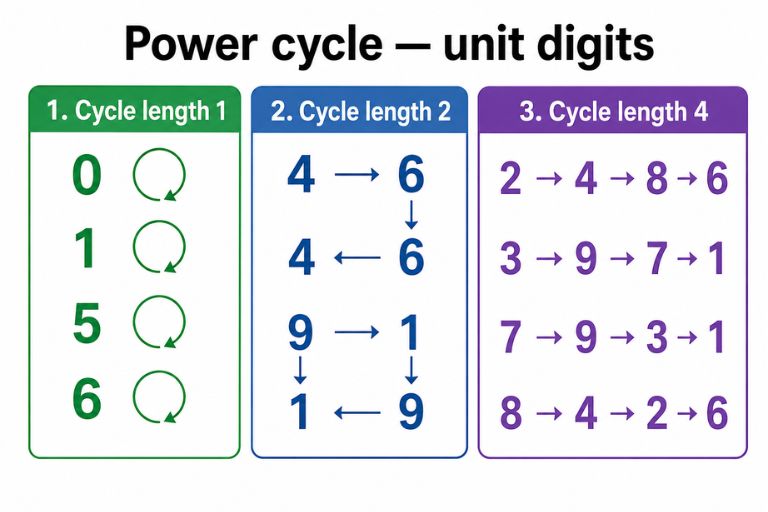
And here's the beautiful part — every digit's cycle is either 1 step, 2 steps, or 4 steps long. Once you know which group a digit belongs to, any power question becomes trivial.
Power Cycle (Cyclicity): The repeating sequence of unit digits that a number produces when raised to successive powers. Every digit from 0 to 9 has a cycle of length 1, 2, or 4.
The First Group — Digits 0, 1, 5, 6
These four are the easiest. Their unit digit never changes, no matter what power you raise them to.
5² = 25 → ends in 5. 5⁷ = 78,125 → ends in 5. 5¹⁰⁰ → ends in 5. Always.
Same for 6. 6³ = 216. 6¹⁰ = 60,466,176. Always ends in 6.
So the moment you see a base number ending in 0, 1, 5, or 6 — write the answer immediately. That digit is your answer, whatever the power.
Find the unit digit of 125⁸⁴.
Base ends in 5. Doesn't matter that the power is 84. Doesn't matter that the base is 125. Unit digit of 5 to any power = 5.
Answer: 5
The Second Group — Digits 4 and 9
These two alternate between exactly two values, repeating every 2 powers.
Let's look at 4: 4¹ = 4, 4² = 16, 4³ = 64, 4⁴ = 256, 4⁵ = 1024... Cycle: 4 → 6 → 4 → 6 → 4 → 6...
Odd power → ends in 4. Even power → ends in 6.
Now 9: 9¹ = 9, 9² = 81, 9³ = 729, 9⁴ = 6561... Cycle: 9 → 1 → 9 → 1...
Odd power → ends in 9. Even power → ends in 1.
That's all you need for 4 and 9. No formula. Just: odd or even?
Find the unit digit of 9⁸³.
83 is odd → unit digit of 9 with odd power = 9.
Answer: 9
Find the unit digit of 4⁶⁴.
64 is even → unit digit of 4 with even power = 6.
Answer: 6
The Third Group — Digits 2, 3, 7, 8
Now here's the group where most exam questions come from.
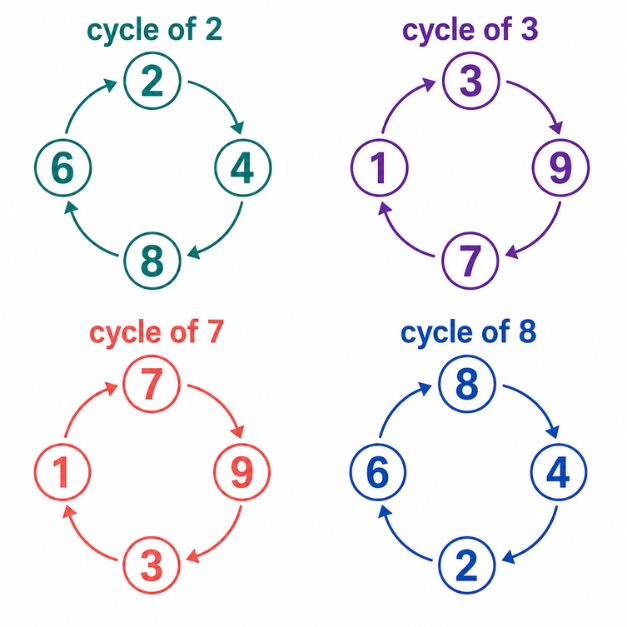
These four digits have a cycle of length 4. Let me show you what that means for digit 2, and then you'll understand all four.
2¹ = 2 → ends in 2 2² = 4 → ends in 4 2³ = 8 → ends in 8 2⁴ = 16 → ends in 6 2⁵ = 32 → ends in 2 ← back to the start
See that? After every 4 powers, it resets. The cycle is 2 → 4 → 8 → 6, and it repeats forever.
The same logic applies to 3, 7, and 8 — different sequences, same structure. Here are all four, and yes, you do need to memorise these:
Digit | Cycle (position 1 → 2 → 3 → 4) |
|---|---|
2 | 2 → 4 → 8 → 6 |
3 | 3 → 9 → 7 → 1 |
7 | 7 → 9 → 3 → 1 |
8 | 8 → 4 → 2 → 6 |
The Master Formula — Finding Your Position in the Cycle
So you know a digit's cycle. Now the question is: for a power like 7⁹⁵, which position in the cycle does 95 land on?
Here's how to find it:
Divide the power by the cycle length. The remainder is your position.
If the remainder is 1 → you're at position 1 (first value of cycle). If the remainder is 2 → position 2. If 3 → position 3.
And the one you need to be careful about: if the remainder is 0 → you're at position 4 (last value of cycle).
That last point is where most students go wrong the first time, so let me show you why it makes sense before we use it.
Think about it this way. Remainder 0 means the power divided perfectly by 4 — meaning you completed the cycle exactly. You didn't land partway through — you went all the way around and finished at the last step. For digit 2, that's 6. For digit 3, that's 1.
Check it yourself: 2⁴ ends in 6. 2⁸ ends in 6. 2¹² ends in 6. Any multiple of 4 always gives you the last value. That's not a rule to memorise in isolation — it's just what the pattern does.
Now let's use this on real questions.
Find the unit digit of 7⁹⁵.
Last digit of base: 7. Cycle of 7: 7 → 9 → 3 → 1. Cycle length: 4.
Divide the power by the cycle length: 95 ÷ 4 = 23 remainder 3.
Remainder 3 → position 3 in the cycle → cycle is 7, 9, 3, 1.
Answer: 3
So the answer to the question we started the lesson with — 7⁹⁵ ends in 3. Go back and verify your earlier guess.
Find the unit digit of 3⁴⁸.
Cycle of 3: 3 → 9 → 7 → 1. Cycle length: 4.
48 ÷ 4 = 12 remainder 0.
Remainder 0 → last value of cycle → cycle is 3, 9, 7, 1.
Answer: 1
This is the one everyone gets wrong the first time. Remainder 0 does not mean "start of cycle." It means "end of cycle." Keep this example in your head — it'll save you marks.
Find the unit digit of 2³⁷ × 3⁵³ × 7²².
Handle each term separately, then multiply the results.
Unit digit of 2³⁷: Cycle of 2: 2→4→8→6. 37 ÷ 4 = 9 rem 1 → position 1 → 2
Unit digit of 3⁵³: Cycle of 3: 3→9→7→1. 53 ÷ 4 = 13 rem 1 → position 1 → 3
Unit digit of 7²²: Cycle of 7: 7→9→3→1. 22 ÷ 4 = 5 rem 2 → position 2 → 9
Now multiply the unit digits: 2 × 3 = 6, then 6 × 9 = 54 → unit digit 4.
Answer: 4
For product of powers, never try to combine them into one expression. Solve each base independently, get its unit digit, then multiply those unit digits together at the end.
Trailing Zeroes
Trailing zeroes are the zeroes at the end of a number. 12,000 has three trailing zeroes. 500 has two.
Every trailing zero comes from a factor of 10, and 10 = 2 × 5. So every time you have one factor of 2 paired with one factor of 5 in a number's prime factorisation, you get one trailing zero.
In practice, factors of 2 almost always outnumber factors of 5. So the number of trailing zeroes equals the number of 5s — you rarely need to count the 2s.
Trailing Zeroes: The count of zeros at the end of a number, equal to the number of (2 × 5) pairs in its prime factorisation. Since 2s are almost always more abundant than 5s, count only the 5s.
Type A — Simple Products
How many trailing zeroes does 8 × 25 × 15 × 12 have?
Prime factorise everything: 8 = 2³, 25 = 5², 15 = 3 × 5, 12 = 2² × 3
Count the 2s: 3 + 2 = 5 twos. Count the 5s: 2 + 1 = 3 fives.
Pairs = min(5, 3) = 3.
Answer: 3 trailing zeroes
Once you confirm there are more 2s than 5s (almost always true), stop counting 2s. The 5s determine the answer.
Type B — Factorials (What Exams Actually Ask)
This is the type that appears most often in SSC, RRB, and Banking papers — and the type the original page on MCQ Orbit was missing entirely.
When the question is "how many trailing zeroes does 50! have?" — you can't write out 50! and count the 5s manually. You need a method.
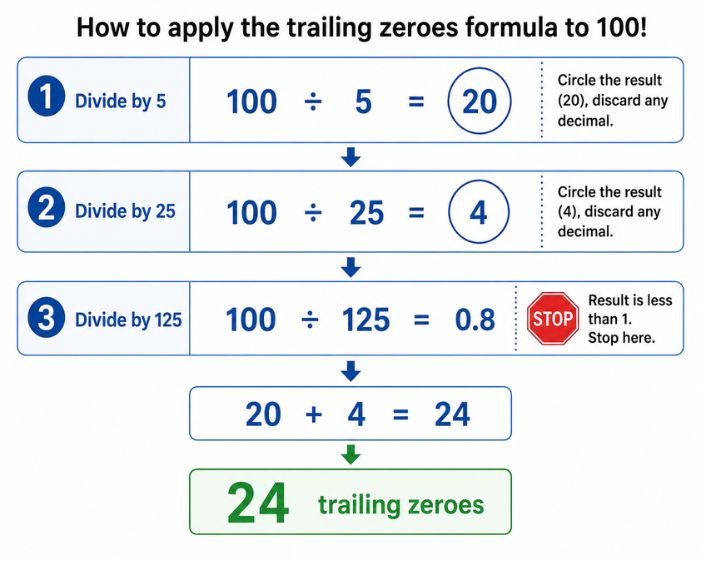
Here it is. Divide n by 5. Then divide n by 25. Then by 125. Keep going until the divisor exceeds n. Add up only the whole-number parts of each result.
Formula: Trailing zeroes in n! = ⌊n/5⌋ + ⌊n/25⌋ + ⌊n/125⌋ + ...
The ⌊ ⌋ symbol just means ignore the decimal — take the whole number only.
Why does this work?
Because 25 = 5², so every multiple of 25 in the factorial contributes two 5s, not one. Dividing by 5 catches it once. Dividing by 25 catches the extra one. Similarly 125 = 5³, so multiples of 125 need a third catch.
Find the number of trailing zeroes in 25!
25 ÷ 5 = 5 25 ÷ 25 = 1 25 ÷ 125 = 0.2 → stop.
Total = 5 + 1 = 6
Answer: 6 trailing zeroes
Find the number of trailing zeroes in 100!
100 ÷ 5 = 20 100 ÷ 25 = 4 100 ÷ 125 = 0.8 → stop.
Total = 20 + 4 = 24
Answer: 24 trailing zeroes
For factorials, never bother counting 2s. In any n!, there are always far more factors of 2 than 5. Count only the 5s using this method and you're done.
Common Mistakes to Avoid
MISTAKE: When remainder = 0, writing the first value of the cycle as the answer.
CORRECT APPROACH: Remainder 0 means the last value of the cycle. For digit 3 (cycle 3, 9, 7, 1) — remainder 0 gives 1, not 3.
WHY IT HAPPENS: It feels intuitive that "zero means the beginning." But you're not measuring from zero — you're measuring positions from 1. Completing the cycle exactly means landing on position 4.
MISTAKE: Using the remainder formula for digits 4 and 9, dividing by 4.
CORRECT APPROACH: Digits 4 and 9 have a cycle of 2, not 4. Just check odd or even. No division needed.
WHY IT HAPPENS: Students learn one formula and apply it everywhere. The odd/even check is faster and you should use it whenever you see 4 or 9.
MISTAKE: For trailing zeroes in n!, only dividing by 5 once.
CORRECT APPROACH: Keep dividing by 5, 25, 125... until the result falls below 1. Each step catches the extra 5s hiding in multiples of higher powers.
WHY IT HAPPENS: Students don't realise that 25 contributes two factors of 5, not one. So 25 ÷ 5 alone undercounts — the second division catches what the first missed.
MISTAKE: Treating a base like 347 as something complex when asking for its unit digit.
CORRECT APPROACH: Only the last digit matters. 347 ends in 7, so use the cycle of 7. Ignore the rest of the number completely.
WHY IT HAPPENS: A three-digit base feels more complicated than a single digit. It isn't. The rule works exactly the same.
MISTAKE: In a product of powers like 2³⁷ × 7²², trying to simplify or combine the bases first.
CORRECT APPROACH: Solve each base independently. Get each unit digit separately, then multiply those unit digits at the very end.
WHY IT HAPPENS: The expression looks like one multiplication problem. Students treat it as one instead of breaking it apart.
Tricks & Shortcuts
TRICK: Spot 0, 1, 5, 6 instantly
When to use:
Any time the base number ends in 0, 1, 5, or 6.
How it works: The answer is just that digit — no calculation at all.
Example: Unit digit of 736¹⁵⁷ → base ends in 6 → answer is 6. Done in 2 seconds.
Time saved: 20–30 seconds per question.
TRICK: Odd/even check for 4 and 9
When to use:
Base ends in 4 or 9.
How it works: Odd power → unit digit is 4 (or 9). Even power → unit digit flips to 6 (or 1).
Example: 9⁸³ → 83 is odd → 9. 4⁶⁴ → 64 is even → 6.
Time saved: 15–20 seconds over looking up a table.
TRICK: Divide by 4, use the remainder for 2, 3, 7, 8
When to use: Base ends in 2, 3, 7, or 8.
How it works: Divide the power by 4. The remainder gives you the position in that digit's cycle. Remainder 0 → last value of cycle.
Example: 3⁷³ → 73 ÷ 4 = 18 rem 1 → position 1 in cycle 3, 9, 7, 1 → 3.
Time saved: Solves any such question in under 12 seconds.
TRICK: Factorial trailing zeroes in three lines
When to use: Any "find trailing zeroes in n!" question.
How it works: Divide n by 5, then 25, then 125 — stop when result < 1. Add the whole-number parts.
Example: Trailing zeroes in 50! → 50÷5=10, 50÷25=2, 50÷125<1 → 12.
Time saved: The only method that works reliably for large factorials. No alternatives.
Practice MCQs
What is the unit digit of 625⁴⁷?
(A) 5 — (B) 2 — (C) 6 — (D) 0
Find the unit digit of 7⁸⁴.
(A) 7 — (B) 9 — (C) 3 — (D) 1
Find the unit digit of 2¹⁵ × 3²².
(A) 8 — (B) 6 — (C) 2 — (D) 4
How many trailing zeroes does 75! have?
(A) 15 — (B) 16 — (C) 18 — (D) 20
Find the unit digit of 4⁵⁷ + 7⁶⁸.
(A) 3 — (B) 5 — (C) 7 — (D) 9
Answers:
Q1 → (A) 5. Base 625 ends in 5. Any power of a number ending in 5 always ends in 5.
Q2 → (D) 1. Cycle of 7: 7→9→3→1. 84 ÷ 4 = 21 rem 0 → remainder 0 → last value of cycle = 1.
Q3 → (C) 2. Unit digit of 2¹⁵: 15 ÷ 4 = 3 rem 3 → position 3 in cycle 2,4,8,6 → 8. Unit digit of 3²²: 22 ÷ 4 = 5 rem 2 → position 2 in cycle 3,9,7,1 → 9. Multiply: 8 × 9 = 72 → unit digit 2.
Q4 → (C) 18. 75÷5=15, 75÷25=3, 75÷125<1. Total = 15 + 3 = 18.
Q5 → (B) 5. Unit digit of 4⁵⁷: 57 is odd → 4. Unit digit of 7⁶⁸: 68 ÷ 4 = 17 rem 0 → last value of cycle of 7 = 1. Sum: 4 + 1 = 5.
Quick Revision
Unit digit of a product depends only on the unit digits of the numbers — ignore everything else.
Digits 0, 1, 5, 6: unit digit never changes with any power. Answer in 2 seconds.
Digits 4 and 9: cycle of 2. Odd power → same digit. Even power → other digit (4↔6, 9↔1).
Digits 2, 3, 7, 8: cycle of 4. Divide power by 4. Remainder = position in cycle. Remainder 0 = last value, not first.
Trailing zeroes in products: count (2, 5) pairs. Since 2s almost always dominate, count only the 5s.
Trailing zeroes in factorials: use ⌊n/5⌋ + ⌊n/25⌋ + ⌊n/125⌋... Stop when result drops below 1.
FAQs
Q: What if the base is a big number like 2,347? Do I use the cycle of 2,347?
No. You only ever look at the last digit. 2,347 ends in 7, so use the cycle of 7. The thousands, hundreds, and tens digits play zero role in determining the unit digit of a power.
Q: The formula gives me a remainder of 0. I keep second-guessing myself — is it really the last value?
Yes, every time. Think of it this way: 2⁴ ends in 6 (last value). 2⁸ ends in 6. 2¹² ends in 6. Anytime the power is a multiple of 4, you get the last cycle value. Remainder 0 means "exactly divisible" — meaning you completed the full cycle. Last step, not first.
Q: For trailing zeroes, do I ever need to count factors of 2?
For factorials — almost never. Factorials always have far more 2s than 5s, so the 5s are always the limiting factor. For simple products of specific numbers (not factorials), you do check both, then take the smaller count.
Comments
No comments yet.