
CBSE 10th Total Marks 2026 — Is It 500 or 600? Passing Marks, Calculation & More
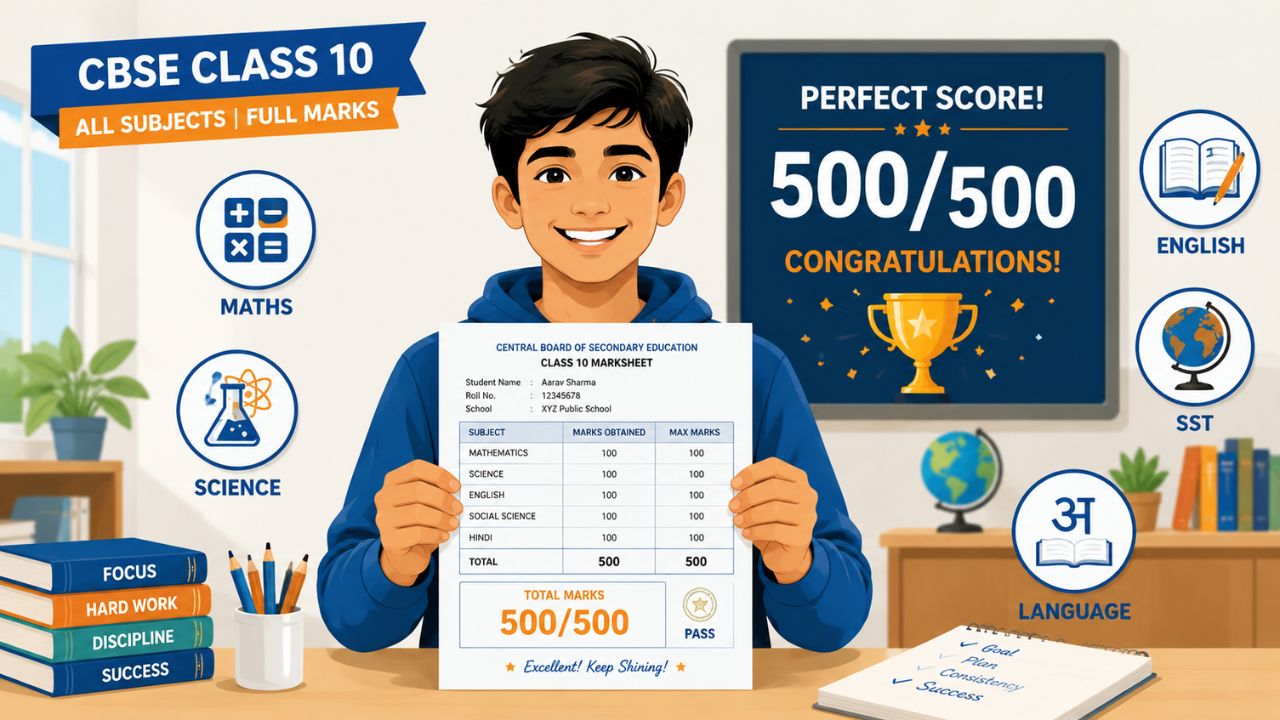
So you've been Googling "CBSE 10th total marks 500 or 600" and you're not getting a clear answer? You're not alone. Every year, lakhs of Class 10 students (and their parents) get confused about exactly how many marks the CBSE board exam is out of, what the passing marks are, and how the final result is calculated.
Let's settle this once and for all — in plain, simple language.
CBSE 10th Total Marks 2026 — 500 or 600?
Here's the straight answer: the CBSE Class 10 board exam is out of 500 marks, not 600.
CBSE evaluates your Class 10 result based on 5 subjects, each carrying a maximum of 100 marks. So:
5 subjects × 100 marks = 500 total marks
But wait — you do appear for 6 subjects in Class 10. The 6th subject is usually an additional/optional language or a skill subject. That extra subject does not count in your main result calculation. It acts as a safety net (more on that below).
So to be crystal clear:
Total subjects you sit for: 6 (5 main + 1 additional)
Total marks your result is calculated on: 500 (Best of 5)
Maximum marks per subject: 100
CBSE Class 10 Subjects and Their Marks Breakdown
Each subject in CBSE Class 10 carries 100 marks total, split between theory and internal assessment (practicals/project):
Subject | Theory Marks | Internal Assessment | Total |
|---|---|---|---|
Mathematics | 80 | 20 | 100 |
Science | 80 | 20 | 100 |
Social Science | 80 | 20 | 100 |
English (Language & Literature) | 80 | 20 | 100 |
Hindi / Second Language | 80 | 20 | 100 |
Additional Subject (6th) | 80 | 20 | 100 |
Note: Some subjects like IT/Computer Science or Vocational subjects may have a different theory-practical split, but the total remains 100 marks per subject.
What Is the "Best of 5" Rule in CBSE Class 10 (2026)?
This is the rule that confuses most students, so pay attention.
CBSE uses a "Best of 5" subjects formula to calculate your final percentage and result. Here's how it works:
English is compulsory and always included.
From the remaining 5 subjects, CBSE picks the 4 subjects in which you scored highest.
Your total score = English + best 4 other subjects = marks out of 500.
This means if you scored poorly in one subject but aced the rest, that weaker subject may get dropped from the percentage calculation — improving your overall percentage.
Example: Suppose your marks are:
English: 78
Maths: 85
Science: 72
Social Science: 88
Hindi: 65
IT (Additional): 90
CBSE will pick English (compulsory) + Maths + Science + SST + IT = 413/500 = 82.6%
Hindi (65) gets dropped because IT (90) is higher. The additional subject can replace a lower-scoring main subject in the percentage calculation — that's the beauty of the Best of 5 rule.
CBSE 10th Passing Marks 2026 — Subject-Wise
Now let's talk about what you actually need to score to pass.
Overall Passing Criteria
To pass the CBSE Class 10 board exam in 2026, you need:
Minimum 33% marks in each subject (theory + internal combined)
That means at least 33 out of 100 in every subject
Subject-Wise Passing Marks (Out of 100)
Component | Total Marks | Minimum to Pass |
|---|---|---|
Theory (written exam) | 80 | 26 marks (33% of 80) |
Internal Assessment | 20 | 7 marks (33% of 20) |
Subject Total | 100 | 33 marks |
Important: You need to pass both theory AND internal assessment separately in some subjects. Just scoring 33 combined isn't always enough — CBSE expects a minimum standard in the written exam too.
Passing Marks Out of 80 (Theory Only)
For subjects where theory is 80 marks:
Minimum passing marks in theory = 26 out of 80
For subjects where theory is different (like some vocational subjects with 60-mark theory):
Passing marks = 33% of that theory total
Passing Marks Out of 500
If we talk about the overall result:
Minimum passing marks out of 500 = 165 marks (33% of 500)
But remember — you must also pass each subject individually
What Happens If You Fail One Subject?
If you fail in one or two subjects, CBSE offers a Compartment Exam (also called the Board Compartment). You can appear for this exam and clear the subject(s) you failed.
The compartment exam passing marks are the same — 33 out of 100 per subject.
If you fail in more than two subjects, you are unfortunately not eligible for compartment and may need to repeat the year.
CBSE 10th Grading System 2026
CBSE does not just show marks — it also converts them into grades and grade points. Here's the grading scale:
Marks Range (out of 100) | Grade | Grade Point | Performance |
|---|---|---|---|
91–100 | A1 | 10 | Outstanding |
81–90 | A2 | 9 | Excellent |
71–80 | B1 | 8 | Very Good |
61–70 | B2 | 7 | Good |
51–60 | C1 | 6 | Average |
41–50 | C2 | 5 | Satisfactory |
33–40 | D | 4 | Pass |
21–32 | E1 | — | Fail (Compartment) |
00–20 | E2 | — | Fail |
If you score in the D grade (33–40), you pass, but it's the minimum. Aim for at least C1 or above if you're targeting stream selection in Class 11.
How Is the CBSE 10th Result Calculated? Step-by-Step
Here's exactly how CBSE calculates your final result:
Step 1: Add your theory marks + internal assessment marks for each subject to get subject total (out of 100).
Step 2: Identify your 5 best subjects (with English being compulsory in the selection).
Step 3: Add up the marks of those 5 subjects → that's your score out of 500.
Step 4: Divide by 500 and multiply by 100 → that's your percentage.
Formula:
Percentage = (Total of Best 5 Subjects / 500) × 100
Step 5: Convert marks to grades using the grading table above.
Step 6: CGPA (Cumulative Grade Point Average) = Sum of grade points of best 5 subjects ÷ 5
CBSE 10th Passing Percentage 2026
To pass the CBSE Class 10 exam, the minimum passing percentage is 33%.
However, for stream selection in Class 11, schools typically require:
Science stream: 60% or above (some schools demand 75%+)
Commerce stream: 50–55%
Arts/Humanities: 40–45%
So while 33% is the official passing mark, you should aim much higher if you want to secure your preferred stream.
State Board 10th Total Marks — Is It Different?
Yes! State boards often have different total marks structures:
Maharashtra SSC Board (10th): 600 marks (6 subjects × 100)
Tamil Nadu State Board: 600 marks
AP / Telangana SSC: 600 marks (6 subjects × 100)
MP Board (10th): 500 or 600 depending on subject combination
GSEB (Gujarat): 500 marks
UP Board: 600 marks
Unlike CBSE which uses the Best of 5 rule, most state boards count all 6 subjects and the exam is out of 600.
So if someone tells you "10th total marks is 600," they might be talking about a state board. For CBSE specifically, it's 500.
CBSE 10th Total Marks 2026 — Quick Summary
Question | Answer |
|---|---|
CBSE 10th total marks | 500 (Best of 5 subjects) |
Marks per subject | 100 (80 theory + 20 internal) |
Minimum passing marks per subject | 33 out of 100 |
Minimum passing marks in theory (out of 80) | 26 out of 80 |
Overall passing percentage | 33% |
Is it 500 or 600? | 500 for CBSE |
Best of 5 rule | Yes, English is compulsory |
Additional subject counted? | Only if it improves your percentage |
Grade system | A1 to E2 (grade points 10 to 0) |
Tips to Score Well in CBSE 10th Board Exam
Now that you know the marks structure, here are a few exam tips that actually help:
Don't ignore internal assessment — 20 marks per subject can be the difference between passing and failing. Submit all assignments, projects, and practicals seriously.
Focus on your weaker subjects — Remember, you need to pass each subject individually. If Maths is tough, make sure you at least score 33.
Use the additional subject strategically — If you're strong in IT or a skill subject, it can boost your percentage through the Best of 5 rule.
Practice previous year papers — CBSE follows a consistent pattern. Solving 5-10 previous year papers per subject is non-negotiable.
Don't miss easy marks — Map work in SST, diagrams in Science, and neatly solved steps in Maths carry a lot of marks. Never leave them blank.
FAQs About CBSE 10th Total Marks and Passing Marks
Q1. Is CBSE 10th out of 500 or 600? CBSE Class 10 result is calculated out of 500 marks (Best of 5 subjects). You appear for 6 subjects, but only the top 5 (with English compulsory) count.
Q2. What are the passing marks out of 100 in CBSE Class 10? You need a minimum of 33 marks out of 100 in each subject to pass. In theory (80 marks), you need at least 26 marks.
Q3. What is the passing percentage in CBSE Class 10? The minimum passing percentage is 33%. However, for good stream options in Class 11, aim for at least 60%.
Q4. Does the additional/6th subject count in CBSE 10th result? Yes — if the 6th subject improves your Best of 5 total, CBSE will include it and drop your lowest-scoring main subject.
Q5. What is the CBSE grading system for Class 10? CBSE uses grades from A1 (91–100) to E2 (0–20). A passing grade starts from D (33–40). Your CGPA is the average of grade points across the best 5 subjects.
Q6. What happens if I fail one subject in CBSE 10th? You become eligible for the Compartment Exam. If you clear it, you'll pass that academic year. You need 33 out of 100 to pass in the compartment exam as well.
Q7. What is the maximum marks in CBSE Class 10? The maximum marks in CBSE 10th is 500 (if you count Best of 5) or 600 (if you count all 6 subjects). But the official result percentage is always calculated out of 500.
Q8. What is the passing marks out of 500 in CBSE board exam? You need at least 165 marks out of 500 (33%) to pass overall — but you also need to clear each subject individually.
Q9. Is there a difference between CBSE and state board 10th total marks? Yes. Most state boards (Maharashtra, AP, Telangana, Tamil Nadu) have 10th exams out of 600. CBSE 10th is out of 500.
Q10. How to calculate CBSE 10th percentage? Add your marks in the Best 5 subjects (English compulsory). Divide by 500. Multiply by 100. That's your percentage.
Final Thoughts
Whether you're a student stressing over the upcoming boards or a parent trying to decode the marksheet — the answer is simple. CBSE 10th is out of 500 marks, and you need 33 marks per subject (33%) to pass. The Best of 5 rule works in your favour, and your additional subject can actually help boost your percentage.
The most important thing? Don't just aim to pass — aim to score well enough to get into the stream of your choice in Class 11. That sets the foundation for everything that comes next.

Written by
Koti Deva
Digital Marketing Specialist
Koti is a Digital Marketing Specialist with over 10 years of experience and the co-founder of MCQ Orbit — a free exam prep platform built for Indian competitive exam aspirants.
With strong personal knowledge in Quantitative Aptitude, Logical Reasoning, and Mathematics, Koti has a deep understanding of what it takes to crack exams like SSC CGL, IBPS PO, SBI Clerk, UPSC Prelims, NEET, and JEE. Having followed these exams closely for years, he understands the exact topics, patterns, and shortcuts that matter most.
MCQ Orbit was born from a simple desire — to build a platform where every aspirant in India can practice quality MCQs, read reliable current affairs, and prepare confidently, without paying a rupee. Koti combines his digital expertise with his passion for competitive exams to create content that is accurate, practical, and genuinely useful for students.
His mission is straightforward: if the right guidance had been freely available earlier, more students would have cracked their dream exams. MCQ Orbit is his way of making that happen.
Comments
No comments yet.