
Space Tourism: How It Will Work in the Future
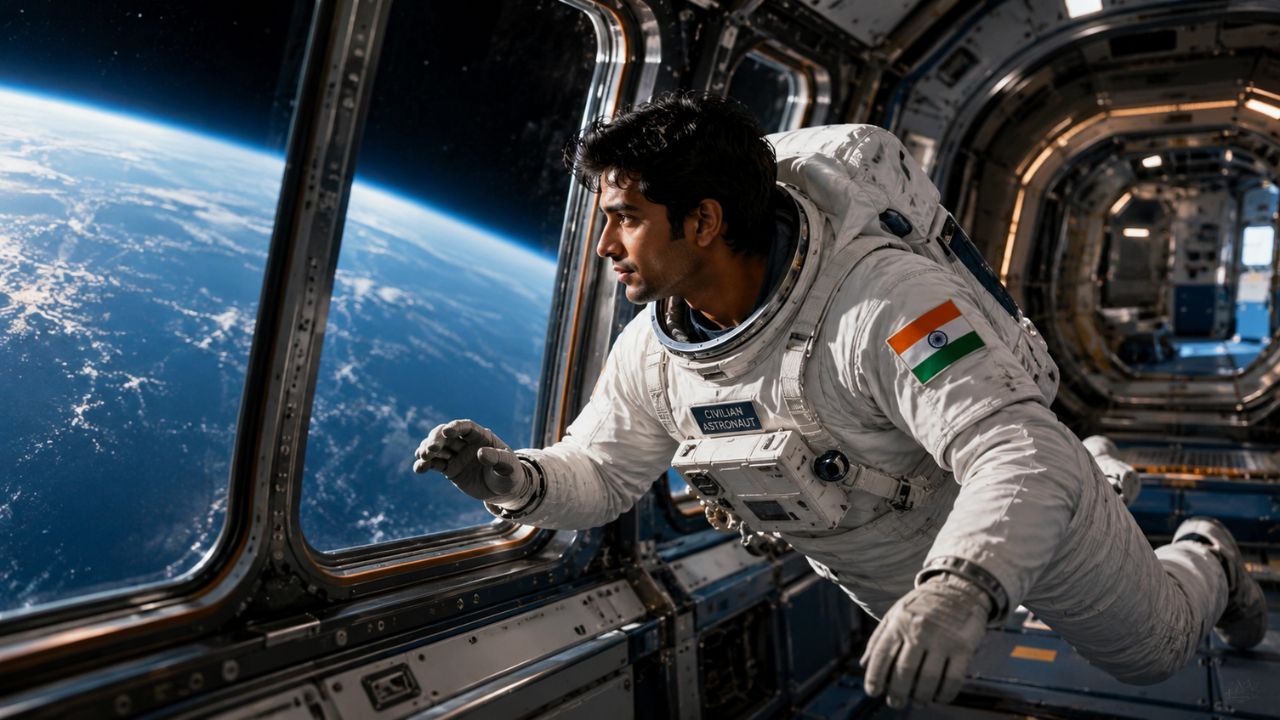
If you've been following current affairs lately, you've probably seen headlines about billionaires going to space, private rocket launches, and companies selling tickets to orbit. Space tourism is no longer a distant dream — it's happening right now, and it's becoming a regular fixture in UPSC Prelims, SSC GK sections, and State PSC current affairs papers.
So let's break it down properly. Not just what it is, but how it actually works, who the key players are, what India's role looks like, and what exam questions have come out of this topic. By the end of this guide, you'll have a solid, well-rounded understanding of space tourism — the kind that helps you answer both factual MCQs and essay-type questions confidently.
What Is Space Tourism?
Space tourism refers to human space travel for recreational, leisure, or commercial purposes — in other words, going to space not as a professional astronaut on a government mission, but as a private individual who has paid for the experience.
The idea has been around since the 1960s, but it only became reality in 2001 when American businessman Dennis Tito became the first ever space tourist. He paid around $20 million to travel to the International Space Station (ISS) aboard a Russian Soyuz spacecraft — and spent about 8 days in orbit.
Since then, the industry has grown slowly but steadily. Today, it's on the edge of a full commercial explosion.
Types of Space Tourism — Know This for Your Exam
This is one of the most commonly tested distinctions in competitive exams. Space tourism is broadly categorized into three types:
Suborbital Tourism is the most basic form. The spacecraft goes up high enough to cross the Kármán line (the boundary of space at 100 km altitude), gives passengers a few minutes of weightlessness and a stunning view of Earth's curvature, and then comes back down. Blue Origin's New Shepard and Virgin Galactic's VSS Unity are the key vehicles here. The entire trip lasts around 10–15 minutes.
Orbital Tourism is far more intense. Here, the spacecraft actually enters Earth's orbit and travels at roughly 28,000 km/h. Passengers can spend days or even weeks in space — living, eating, sleeping, and conducting activities in microgravity. SpaceX's Crew Dragon and Axiom Space missions fall in this category.
Lunar and Deep Space Tourism is the future frontier. SpaceX has already announced lunar tourism plans using its Starship vehicle. Japanese billionaire Yusaku Maezawa's dearMoon project — which planned to take a group of artists around the Moon — was a preview of what's coming, though it has faced delays.
How Space Tourism Actually Works — Step by Step
Getting Booked and Screened
Booking a space trip today isn't like booking a flight ticket. You apply through a private provider, go through detailed medical screening, and if cleared, you sign up for several weeks of pre-flight training. This training covers zero-gravity adaptation, emergency procedures, G-force tolerance, and basic spacecraft systems.
Even wealthy tourists can't skip this — spaceflight puts real physical stress on the human body, and no company can afford to send an unprepared passenger into orbit.
Launch and the Journey to Space
Tourists travel aboard reusable commercial spacecraft. SpaceX's Crew Dragon, for instance, launches atop a Falcon 9 rocket and docks with the ISS or a commercial space station within hours. The experience of launch — the acceleration, the noise, the G-forces — is something no simulation can fully replicate.
Once in orbit, the spacecraft is traveling so fast that it circles the entire Earth roughly every 90 minutes. That means passengers see approximately 16 sunrises and sunsets every single day.
Life on a Commercial Space Station
Right now, orbital tourists visit the International Space Station. But the future lies with dedicated commercial stations currently under development. Axiom Space is building the first commercial space station module, with plans for a fully independent station by the late 2020s. Orbital Reef (Blue Origin + Sierra Space) and Starlab (Nanoracks + Voyager Space) are two other major stations in development.
Life on these stations is designed with the tourist in mind — larger panoramic windows, private sleeping quarters, specially prepared meals, and entertainment options. Guests can watch Earth pass below, conduct simple science experiments, or even film content for movies and media (Tom Cruise has reportedly been in talks to film aboard the ISS).
Coming Back to Earth
The return journey is controlled but intense. The capsule detaches from the station, fires its engines to slow down, and begins atmospheric reentry. During this phase, temperatures on the heat shield can reach thousands of degrees Celsius — which is why the design of the heat shield is so critical. Parachutes deploy in the final stretch for a splashdown in the ocean or a land landing, depending on the vehicle. Recovery teams retrieve passengers, who then undergo medical checks and spend a few days readapting to gravity.
Key Players in the Global Space Tourism Industry
This section is pure gold for MCQ preparation. These names and their vehicles come up repeatedly in exam questions.
SpaceX (USA) — Founded by Elon Musk. Crew Dragon spacecraft. Already conducted multiple private orbital missions including the Inspiration4 mission in 2021, the first all-civilian orbital spaceflight in history.
Blue Origin (USA) — Founded by Jeff Bezos. New Shepard spacecraft for suborbital tourism. Bezos himself flew on the first crewed New Shepard flight in July 2021, just days after Richard Branson's flight.
Virgin Galactic (USA/UK) — Founded by Richard Branson. VSS Unity spaceplane for suborbital tourism. Branson flew on July 11, 2021, beating Bezos by nine days — a fact that made headlines worldwide.
Axiom Space (USA) — Building the world's first commercial space station. Already conducted private astronaut missions to the ISS.
Boeing (USA) — Starliner spacecraft, another crew vehicle for orbital missions (though it has faced significant technical delays).
Roscosmos (Russia) — The original space tourism facilitator via Soyuz spacecraft (Dennis Tito flew on a Soyuz). Russia has sent multiple space tourists to the ISS in partnership with Space Adventures.
India and Space Tourism — What You Need to Know
For Indian competitive exams, India's own angle on this topic is especially important.
ISRO's Gaganyaan Mission is India's first human spaceflight program. While not a tourism mission per se, it's the foundation on which India's future human space presence will be built. The first uncrewed test flight has already been conducted. The crewed mission is expected in the coming years.
IN-SPACe (Indian National Space Promotion and Authorisation Centre) was established in 2020 to regulate and promote private sector participation in India's space sector. This is a key reform that opens the door for Indian private companies to eventually enter the space tourism supply chain.
AgniKul Cosmos and Skyroot Aerospace are Indian private space startups that have made significant progress in developing small launch vehicles — a sign that India's private space sector is maturing.
India currently does not have a commercial space tourism program, but as costs fall globally and ISRO's human spaceflight capability matures, the door is open for the future.
Cost of Space Tourism — Is It Coming Down?
Right now, a ticket to orbit costs anywhere from $50 million to $100 million for a seat on a private mission to the ISS. Suborbital flights on New Shepard or Virgin Galactic have reportedly been priced in the range of $250,000 to $450,000.
These numbers sound astronomical (no pun intended), but the trend is clearly downward. Reusable rockets — the key innovation pioneered by SpaceX — dramatically reduce launch costs by eliminating the need to build a new rocket every time. When a Falcon 9 booster can be reflown 15 or more times, the economics start to shift.
Analysts project that orbital tourism prices could fall to the single-digit millions within the next decade, and suborbital experiences could eventually be priced similarly to extreme luxury travel — expensive but not billionaire-exclusive.
Challenges and Concerns — Important for Essay and Mains
Space tourism, for all its excitement, comes with serious challenges that are frequently discussed in UPSC Mains and Essay papers.
Safety remains the most fundamental concern. Spaceflight is inherently risky. The Challenger and Columbia disasters are stark reminders that even experienced astronauts with years of training can face catastrophic outcomes. For private passengers, the risk is real.
Health effects of spaceflight include bone density loss, muscle atrophy, fluid shifts toward the head, and radiation exposure. Even short orbital trips affect the body noticeably. Long-duration stays require active countermeasures like exercise regimes.
Space debris is an increasingly serious problem. Low Earth orbit is already cluttered with defunct satellites and fragments from past missions. As commercial traffic increases, the risk of collision events grows. The Kessler Syndrome — a cascade of collisions that could make certain orbital zones unusable — is a genuine long-term threat.
Environmental impact is a newer concern. Rocket launches burn significant amounts of fuel and release soot and water vapor in the upper atmosphere. As launch frequency increases, the cumulative climate impact is being studied more seriously by atmospheric scientists.
Regulation and legal frameworks are still developing. Questions around passenger liability, rescue obligations, insurance, and the jurisdiction of law in space remain partially unresolved — especially for purely commercial missions not covered by traditional space treaties.
The Long-Term Vision — Why This Matters Beyond Tourism
Space tourism isn't just about wealthy people having an adventure. It's a catalyst for a broader transformation in how humanity relates to space.
As commercial companies build stations, develop reusable spacecraft, and drive down costs, they're essentially building the infrastructure for a permanent human presence beyond Earth. NASA's strategy itself has shifted — the agency is increasingly becoming a customer of commercial services rather than an operator of everything. The Commercial Crew Program, under which SpaceX and Boeing developed crew vehicles for NASA, is a template for this new relationship.
In the longer arc, space tourism is a stepping stone toward lunar bases, asteroid mining, Mars missions, and eventually a multi-planetary civilization. The tourists of today are, in a sense, funding the infrastructure that makes all of that possible.
Space Tourism — Key Facts at a Glance
Use this section for last-minute revision before your exam.
The first space tourist was Dennis Tito (USA) in 2001, who traveled on a Russian Soyuz to the ISS. The Kármán line at 100 km altitude is the internationally recognized boundary of space. The Inspiration4 mission in September 2021 was the first all-civilian orbital spaceflight. Richard Branson (Virgin Galactic) flew to space on July 11, 2021, and Jeff Bezos (Blue Origin) flew on July 20, 2021. Axiom Space is building the world's first commercial space station. India's first human spaceflight mission is Gaganyaan, managed by ISRO. IN-SPACe was established in 2020 to promote private sector participation in India's space activities.
Frequently Asked Questions (FAQs)
Q1. Who was the first space tourist in history? American businessman Dennis Tito, who flew to the International Space Station aboard a Russian Soyuz spacecraft in April 2001 and paid approximately $20 million for the trip.
Q2. What is the difference between suborbital and orbital space tourism? Suborbital flights cross the boundary of space (Kármán line at 100 km) and return without completing an orbit — lasting around 10–15 minutes. Orbital flights enter Earth's orbit and can last days to weeks.
Q3. Which companies are leading the space tourism industry? The major players are SpaceX (Crew Dragon), Blue Origin (New Shepard), Virgin Galactic (VSS Unity), and Axiom Space (commercial ISS missions and future station).
Q4. What is India's role in space tourism? India currently doesn't have a commercial space tourism program, but ISRO's Gaganyaan mission is building human spaceflight capability. IN-SPACe is enabling private sector participation in space, which could eventually include tourism-related services.
Q5. What is the Kármán line, and why is it important? The Kármán line is the altitude of 100 km above Earth's surface, recognized internationally as the boundary between Earth's atmosphere and outer space. Crossing it is what qualifies a flight as a "spaceflight."
Q6. Is space tourism environmentally harmful? There are growing concerns about the environmental impact of rocket launches, particularly the release of black carbon (soot) and water vapor in the upper atmosphere. As launch frequency increases, researchers are studying the cumulative effect on climate.
Q7. What is the Kessler Syndrome? A theoretical scenario proposed by NASA scientist Donald Kessler in 1978, in which the density of objects in low Earth orbit becomes high enough that collisions generate debris that causes further collisions — creating a cascade that could make orbital space unusable for generations.
Q8. How is ISRO's Gaganyaan mission related to space tourism? Gaganyaan is not a tourism mission — it's India's national human spaceflight program aimed at sending Indian astronauts (called Vyomanauts) to space. However, it's the technological foundation upon which any future Indian space tourism capability would be built.
Conclusion
Space tourism is one of the most exciting and consequential developments in contemporary science and technology — and it's a topic that's only going to appear more frequently in competitive exams going forward. Understanding how it works, who the key players are, what India's position looks like, and what the deeper challenges are gives you a genuine edge — not just for one MCQ, but for current affairs, essay writing, and interview rounds.
The next time you see a headline about a rocket launch or a space hotel, you'll know exactly what's going on and why it matters. And in a competitive exam, that kind of well-rounded understanding is what separates a 7 from a 9.

Written by
Nithin Pallepati
Subject Matter Expert
Nithin Pallepati — Pharmaceutical Scientist, Math Expert & Co-Founder of MCQ Orbit
Nithin Pallepati did not set out to build an exam prep platform. He set out to get things right.
With 12 years in pharmaceutical and scientific research, accuracy is not a habit for Nithin, it is a discipline he lives by. Every article, question set, and topic on MCQ Orbit goes through his personal review: fact-checked, cross-referenced against real exam patterns, and held to a researcher's standard before it ever goes live.
His passion for Mathematics and Quantitative Aptitude runs deep, and so does his understanding of what Indian competitive exam aspirants from SSC CGL and IBPS PO to NEET and JEE actually need to succeed.
MCQ Orbit is completely free. No paywalls. No shortcuts on quality. Just reliable preparation built on one simple belief: every student deserves content that is honest, accurate, and worth their time.
Comments
No comments yet.