Voyager: Humanity’s Farthest Message to the Cosmos
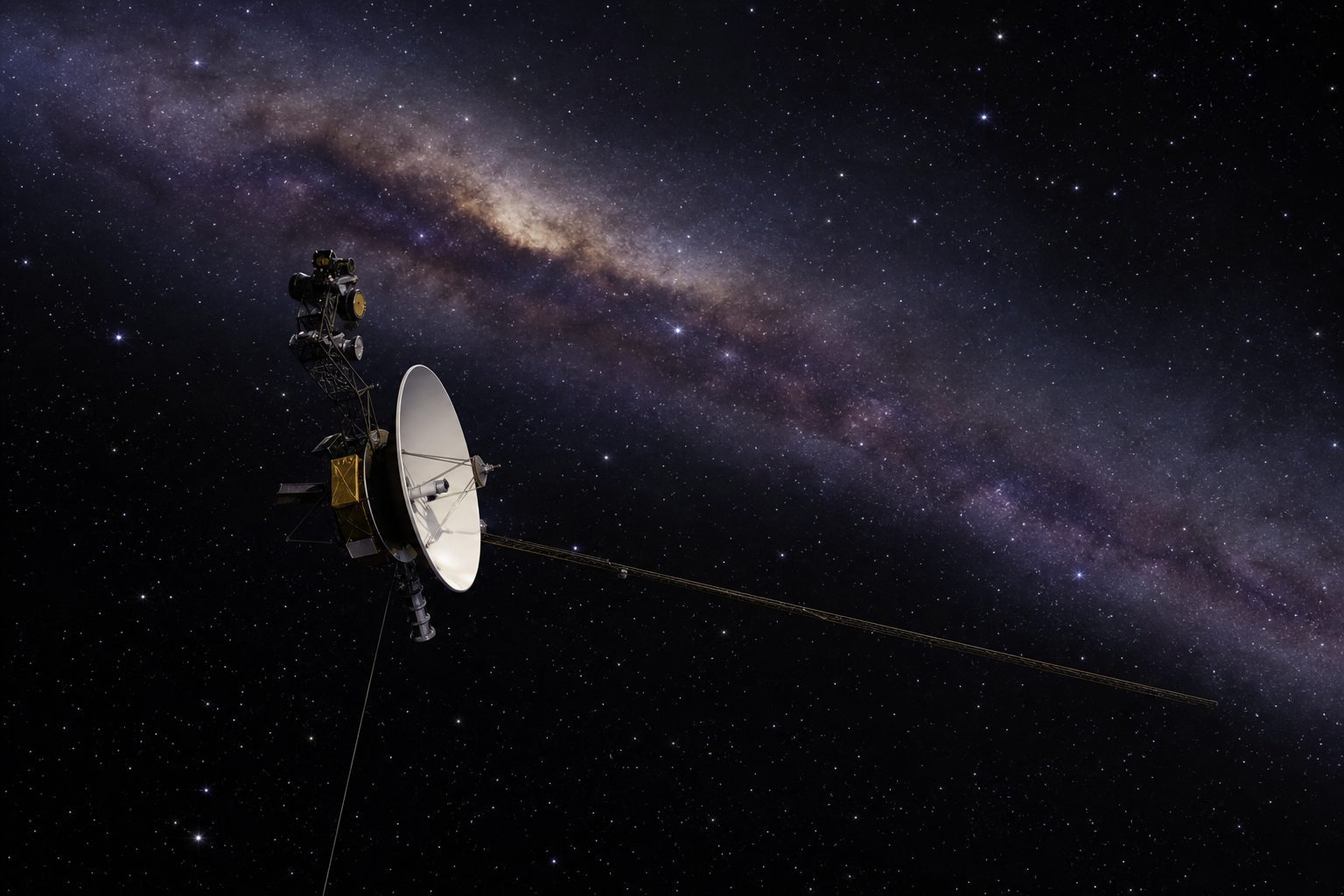
In 1977, at the height of technological ambition and cosmic curiosity, NASA launched two spacecraft that would forever redefine humanity’s relationship with the universe: Voyager 1 and Voyager 2. Originally designed for a five-year mission to study the outer planets, the Voyager probes have since become the longest-operating and most distant human-made objects in history.
A Mission Beyond Expectations
The Voyager program took advantage of a rare planetary alignment that occurs only once every 176 years. This alignment allowed the spacecraft to use gravitational assists—slingshot maneuvers around planets—to extend their journey far beyond initial expectations. Voyager 2 became the only spacecraft to visit Uranus and Neptune, while Voyager 1 provided unprecedented detail of Jupiter and Saturn.
What began as a planetary mission soon evolved into something far more profound. After completing their primary objectives, both spacecraft continued traveling outward, crossing the boundary known as the heliosphere—the protective bubble created by the Sun—and entering interstellar space. Voyager 1 achieved this milestone in 2012, followed by Voyager 2 in 2018.
The Golden Record: A Message in a Bottle
Perhaps the most poetic aspect of the Voyager mission is the inclusion of the Golden Record—a phonograph record containing sounds and images representing life on Earth. Curated by a team led by astronomer Carl Sagan, the record includes greetings in 55 languages, music from various cultures, and natural sounds like ocean waves and birdsong.
The Golden Record is not just a scientific artifact; it is a statement. It reflects humanity’s desire to connect, to be understood, and to leave a trace of our existence in the vast cosmic ocean. Though the likelihood of it being discovered by extraterrestrial intelligence remains uncertain, its symbolic value is immeasurable.
Engineering for Eternity
The longevity of the Voyager spacecraft is a testament to engineering excellence. Powered by radioisotope thermoelectric generators (RTGs), they continue to send data back to Earth decades after launch. Even as their power diminishes, engineers at NASA carefully manage onboard systems to extend their operational life.
Communication with Voyager is maintained through the Deep Space Network, a global system of antennas capable of receiving incredibly faint signals from billions of miles away. Each message takes over 20 hours to reach Earth—a reminder of the immense distances involved.
A Legacy That Transcends Science
Voyager is more than a mission; it is a symbol of exploration and resilience. It represents a time when humanity dared to look outward with optimism and curiosity. As the spacecraft drift silently through interstellar space, they carry with them a piece of Earth—a time capsule of who we were in the late 20th century.
In an era increasingly defined by rapid change and uncertainty, Voyager stands as a quiet, enduring beacon of what we can achieve when we aim beyond our immediate horizons. Long after Earth’s civilizations evolve or fade, these spacecraft will continue their journey, bearing witness to the fact that, once, a small planet reached for the stars.
Conclusion
The Voyager mission reminds us that exploration is not just about discovery—it is about identity. It challenges us to consider our place in the universe and inspires future generations to continue pushing the boundaries of what is possible. As Voyager 1 and 2 venture deeper into the unknown, they carry with them humanity’s oldest and most enduring question: Are we alone?
Comments
No comments yet.