
There's a Whole Galaxy Hidden Inside the Milky Way — And Scientists Just Found It
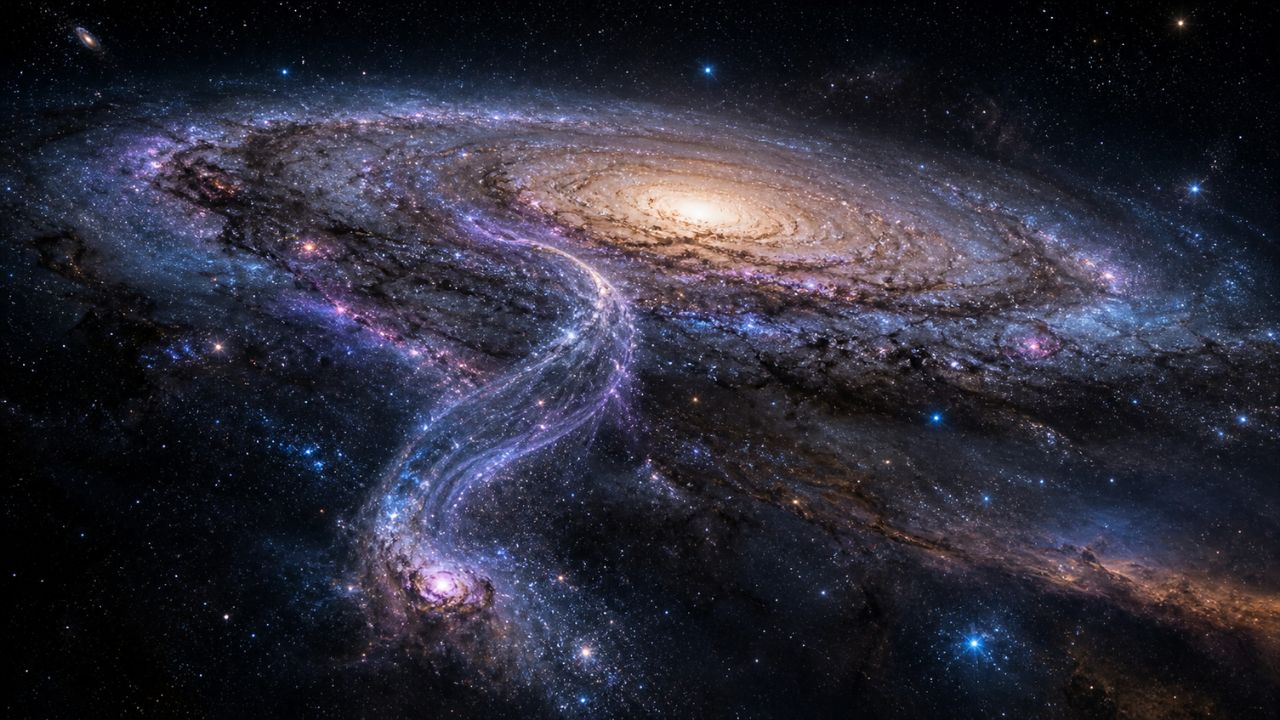
"What if the galaxy you live in is actually built from the bones of galaxies it devoured long ago — and one of those galaxies was hiding in plain sight the whole time?"
That's not science fiction. That's the conclusion of a remarkable new study published in the Monthly Notices of the Royal Astronomical Society in late April 2026. An international team of astronomers has found strong evidence that the Milky Way is hiding the ghost of an ancient dwarf galaxy deep within its own disk — and they've named it Loki, after the Norse trickster god who was famous for hiding in plain sight.
The discovery has set the astronomy world buzzing and is trending across the United States, because it forces us to rethink something we thought we understood: our own cosmic home.
Wait — A Galaxy Inside a Galaxy?
Yes, really. And while it sounds like something out of a sci-fi novel, it actually makes perfect sense once you understand how galaxies — including our own Milky Way — grow over time.
Galaxies aren't born fully formed. They're built through a long, violent process of mergers: smaller galaxies crashing into, orbiting, and eventually being absorbed by larger ones. Over billions of years, the Milky Way has been a cosmic predator, pulling in smaller satellite galaxies and dwarf galaxies and folding their stars into itself. Think of it as the universe's version of a snowball rolling downhill and picking up more snow as it grows.
When smaller galaxies get swallowed this way, they don't disappear completely. Their stars remain — scattered, mixed in with the Milky Way's own stellar population, often indistinguishable to the naked eye. Finding them again is a bit like finding a single raisin that was baked into a giant loaf of bread ten billion years ago.
That's exactly what this research team did.
How Did Astronomers Find Loki?
The discovery hinges on something called stellar chemistry — essentially, reading the "birth certificate" written in the chemical composition of stars.
Here's the key insight: the first stars that formed in the universe were made almost entirely of hydrogen and helium. Only over billions of years, as stars lived, burned, and exploded, did heavier elements — what astronomers call "metals" — get forged and spread into the cosmos. Stars formed early in cosmic history, therefore, contain very few of these heavy elements. Scientists call them metal-poor stars, and they are essentially living fossils from the universe's childhood.
The research team, led by Federico Sestito and collaborators from the United Kingdom, Canada, Chile, and other countries, identified a group of 20 such extremely metal-poor stars within the Milky Way's galactic plane — the flat, disc-shaped region where most of the galaxy's stars reside, including our own Sun.
Key Finding: Most extremely metal-poor stars are found in the galaxy's outer halo — far from the disk. Finding this cluster of 20 such stars right in the galactic plane was immediately unusual and suspicious to astronomers.
When the team analyzed the chemical fingerprints of these stars and compared them to other stars in the galaxy's halo and known dwarf galaxies, a clear picture emerged. These 20 stars shared nearly identical chemical signatures, suggesting they all formed in the same system. They showed evidence of enrichment by high-energy supernovae, hypernovae, rapidly rotating massive stars, and collisions between neutron stars. But here's what made the scientists really sit up: there were no signs of white dwarf explosions.
A white dwarf — the burned-out core of a Sun-like star — takes billions of years to form. The absence of their chemical signature means these stars came from a system that lived fast and died young. It had an intense burst of star formation, enriched its stars with the products of violent cosmic events, and then fizzled out — all before it had time to produce white dwarfs. That profile matches a very small, energetic dwarf galaxy.
Why Is It Called "Loki"?
The name is fitting on multiple levels. In Norse mythology, Loki is the shape-shifter, the trickster — a being who hides in plain sight and is notoriously hard to pin down. This ancient galaxy has been doing exactly that for over 10 billion years, hiding among the Milky Way's billions of stars, disguised as just another cluster in the galactic plane.
The astronomers have provisionally named it Loki while further research continues to confirm its existence. And there's still a puzzle that Loki is presenting: the orbits of these 20 stars are decidedly odd. Eleven of them are on prograde orbits — meaning they travel in the same direction the Milky Way spins. The remaining nine are on retrograde orbits, going in the opposite direction.
How can stars from the same system end up moving in opposite directions? The researchers believe the answer lies in Loki's early and turbulent merger with the young Milky Way. When the proto-Milky Way was still forming — chaotic, disorganized, not yet settled — Loki was absorbed. At that early stage, even the Milky Way's own stars were swirling in disordered paths. The gravitational chaos of that "early accretion" event could have scrambled Loki's stars, sending some forward and some backward relative to the eventual direction of galactic rotation.
What Makes This Discovery So Significant?
1. It's in the Wrong Place
Previous merger relics found inside the Milky Way — like the fossil galaxy "Heracles," discovered in 2020 — were identified in the galaxy's halo or bulge. Finding evidence of an absorbed galaxy within the galactic plane itself is unprecedented in this way. It suggests the merger happened so early, when the Milky Way was so young, that Loki's stars became embedded in the disk rather than in the halo.
2. It Rewrites Our Timeline
This discovery pushes the story of the Milky Way's formation back further than we realized. If Loki was swallowed more than 10 billion years ago — when the universe itself was only about 3–4 billion years old — then the Milky Way was already eating smaller galaxies in its infancy. This gives us a new data point for understanding how our galaxy evolved into what it is today.
3. It Validates Galactic Archaeology as a Science
The method used here — reading the chemical composition of stars to trace their origins — is called galactic archaeology. This discovery is a stunning proof of concept. By reading what's essentially a stellar DNA profile, astronomers can reconstruct billion-year-old cosmic events with remarkable precision. Future surveys like WEAVE and 4MOST will allow scientists to examine far more stars with even greater detail, potentially uncovering many more Lokis buried inside the Milky Way.
4. It Raises New Questions About Dark Matter
Dwarf galaxies are of intense scientific interest partly because they tend to be dominated by dark matter — the invisible, mysterious substance that makes up most of the universe's mass. Understanding how a dwarf galaxy like Loki formed, evolved, and was absorbed could help scientists better understand how dark matter shapes galaxy formation on the smallest scales.
What Happens Next?
The researchers are quick to note that the sample size — just 20 stars — is small. The study's authors themselves acknowledge that confirmation from future, larger spectroscopic surveys is needed. While the chemical evidence is compelling, the science community appropriately wants more data before Loki is declared definitively real.
Fortunately, help is on the way. Upcoming astronomical surveys, including the WEAVE instrument on the William Herschel Telescope and the 4MOST spectrograph in Chile, are designed to analyze hundreds of thousands of stars in detail. These projects could either confirm Loki's existence with a much larger stellar sample or reveal the picture is more complicated than it currently appears.
In the meantime, astronomers now have a new direction to search: the galactic plane itself. If Loki exists, there may be other ghost galaxies hidden in the same region — ancient cosmic casualties of the Milky Way's long history of absorption and growth.
The Bigger Picture: You Live in a Cosmic Graveyard
There's something almost poetic about this discovery. Every star you see in the night sky has a story. Many of them are native to the Milky Way. But some — like the stars that may once have belonged to Loki — are immigrants, the last survivors of galaxies that no longer exist, absorbed long before Earth even formed.
The Milky Way as we know it today is not a single, pure galaxy. It is a mosaic — built from the remnants of smaller galaxies that were consumed across billions of years of cosmic history. Loki is just one piece of that mosaic that we've finally identified.
As telescope technology improves and surveys become more comprehensive, we will almost certainly find more. The Milky Way's past is written in the stars — quite literally — and we are only just beginning to learn how to read it.
The Bottom Line
A new 2026 study in Monthly Notices of the Royal Astronomical Society presents strong evidence that a lost ancient dwarf galaxy — nicknamed Loki — is hidden inside the Milky Way's galactic plane, consumed by our galaxy more than 10 billion years ago. The discovery was made by analyzing the unique chemical signatures and unusual orbits of 20 extremely old, metal-poor stars. While further confirmation is needed, this finding reshapes our understanding of how the Milky Way formed and proves that galactic archaeology can uncover secrets written in the stars themselves.
Frequently Asked Questions
What is the "Loki" galaxy?
Loki is the provisional name given to an ancient dwarf galaxy that astronomers believe was absorbed by the Milky Way more than 10 billion years ago. Its existence is suggested by a group of 20 metal-poor stars found in the Milky Way's galactic plane that share unusual chemical signatures and orbits consistent with coming from a single, short-lived dwarf galaxy.
How did scientists find a buried galaxy inside the Milky Way?
By analyzing the chemical composition of extremely old, metal-poor stars in the galactic plane. Stars formed in the same system share similar chemical "fingerprints." This group of 20 stars showed signatures of a short-lived, energetic environment — consistent with a small dwarf galaxy — but notably lacked signs of white dwarf explosions, which take billions of years to form.
Is the Loki galaxy discovery confirmed?
Not definitively. The study, published in Monthly Notices of the Royal Astronomical Society in 2026, presents compelling evidence, but the sample of 20 stars is small. The researchers themselves call for confirmation from future surveys like WEAVE and 4MOST before the discovery can be considered fully established.
Why is finding a galaxy inside the Milky Way's disk unusual?
Most remnants of absorbed galaxies are found in the Milky Way's outer halo, not in the disk. Finding evidence of a merged galaxy within the galactic plane suggests the merger happened extremely early — when the Milky Way itself was still forming — allowing Loki's stars to become embedded in the disk rather than ending up in the halo.
Why is this called "galactic archaeology"?
Galactic archaeology is the scientific discipline of studying old stars' chemical compositions and orbital properties to reconstruct the early history of galaxy formation. Just as archaeologists dig through layers of soil to find ancient artifacts, galactic archaeologists "dig" through stellar populations to find evidence of galaxies that no longer exist.

Written by
Koti Deva
Digital Marketing Specialist
Koti is a Digital Marketing Specialist with over 10 years of experience and the co-founder of MCQ Orbit — a free exam prep platform built for Indian competitive exam aspirants.
With strong personal knowledge in Quantitative Aptitude, Logical Reasoning, and Mathematics, Koti has a deep understanding of what it takes to crack exams like SSC CGL, IBPS PO, SBI Clerk, UPSC Prelims, NEET, and JEE. Having followed these exams closely for years, he understands the exact topics, patterns, and shortcuts that matter most.
MCQ Orbit was born from a simple desire — to build a platform where every aspirant in India can practice quality MCQs, read reliable current affairs, and prepare confidently, without paying a rupee. Koti combines his digital expertise with his passion for competitive exams to create content that is accurate, practical, and genuinely useful for students.
His mission is straightforward: if the right guidance had been freely available earlier, more students would have cracked their dream exams. MCQ Orbit is his way of making that happen.
Comments
No comments yet.