NASA Picture of the Day: "Seeing Titan" — What It Means
If you have been scrolling through social media in the US today and noticed "NASA Picture of the Day" trending, you are not alone. Millions of people around the world — scientists, students, space enthusiasts, and curious minds — regularly follow NASA's Astronomy Picture of the Day (APOD), one of the most popular science pages on the internet. And the image that captured everyone's attention on 2 May 2026 is truly something special.
The featured image is titled "Seeing Titan" — and it shows Saturn's largest moon, Titan, as never seen before. Using 13 years of infrared image data from the Cassini spacecraft, scientists have produced the clearest global map of Titan's mysterious surface to date. If you are preparing for UPSC, SSC CGL, ISRO, or any science-based competitive exam in India, this is exactly the kind of topic that can appear in GS Paper III or a general science section. Let's break it all down in a way that's easy to understand and remember.
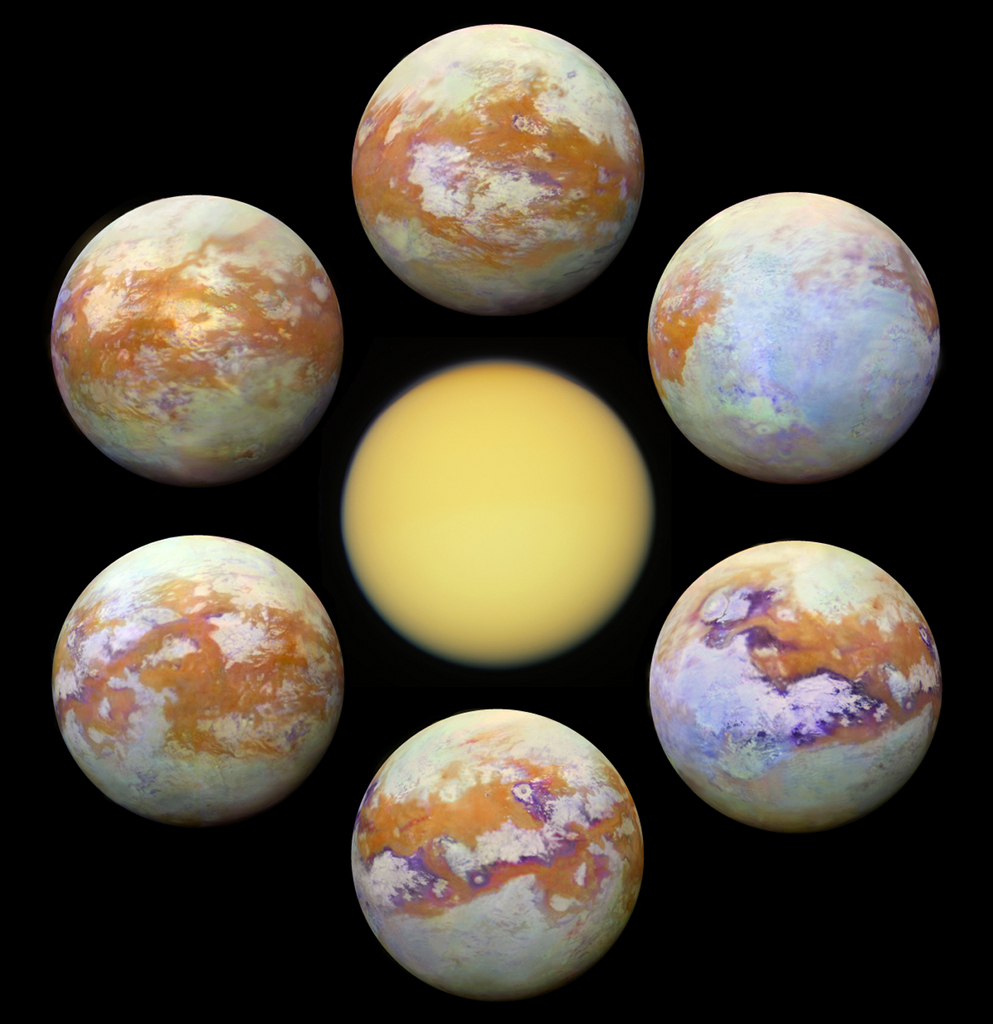
Image Credit: VIMS Team, Univ. Arizona, U. Nantes, ESA, NASA
What Exactly Is NASA's "Picture of the Day"?
NASA's Astronomy Picture of the Day (APOD) is a free, publicly available webpage run by NASA and Michigan Technological University. Every single day since 16 June 1995, a new image or photograph of the universe has been featured on this page, along with a brief explanation written by a professional astronomer.
That's over 11,000 consecutive days of astronomical wonder — making it one of the longest-running science communication projects on the internet. APOD covers everything from stars, galaxies, nebulae, planets, comets, and solar eclipses to Earth photographed from space. It is authored and edited by Robert Nemiroff (MTU) and Jerry Bonnell (UMCP), and is an official service of NASA's Astrophysics Science Division.
For UPSC aspirants, APOD is a fantastic daily habit — it keeps you updated on space science, helps you understand complex topics visually, and regularly feeds stories into Current Affairs and Science & Technology question banks.
The May 2, 2026 APOD: "Seeing Titan"
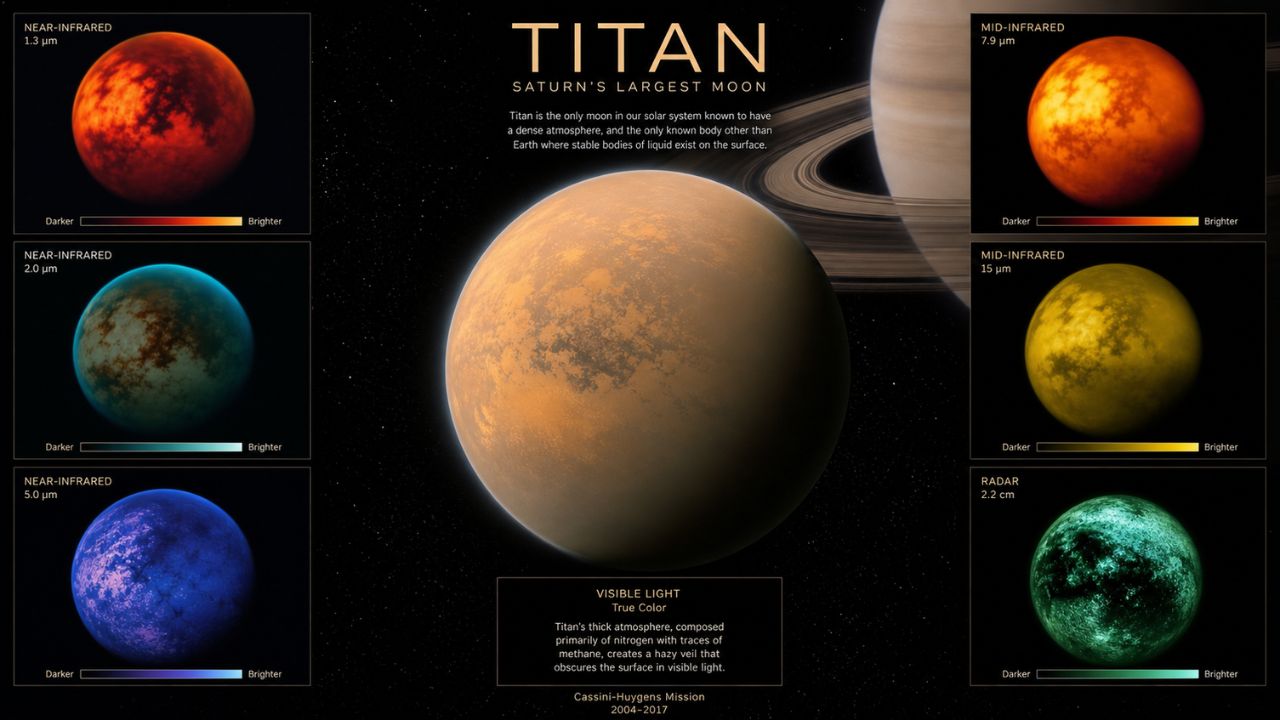
The image trending today shows Titan — the largest moon of Saturn and the second-largest moon in our entire solar system — captured in an extraordinary multi-panel composite. Here is what makes this image so remarkable.
Titan is shrouded in a thick, hazy atmosphere. Small particles suspended in its upper layers scatter visible light so intensely that if you looked at Titan with your naked eye or even a regular telescope, you would see essentially nothing but an orange haze. Its surface is completely hidden from view at visible wavelengths.
That is where the Cassini spacecraft came in.
The Cassini Mission: India's Connection and Why You Should Know It
The Cassini-Huygens mission was a joint project of NASA, the European Space Agency (ESA), and the Italian Space Agency (ASI). Launched in October 1997, Cassini arrived at Saturn in 2004 and spent 13 extraordinary years orbiting the ringed giant before its deliberate plunge into Saturn's atmosphere on 15 September 2017 — an event called the Grand Finale. This was done intentionally to avoid any chance of contaminating Titan or Enceladus, which might harbour life.
During its 13-year mission, Cassini:
Completed 294 orbits around Saturn
Made 162 targeted flybys of Saturn's moons
Discovered active water-ice geysers on Enceladus
Deployed the Huygens probe (ESA) onto Titan's surface on 14 January 2005 — the first and only landing on a world in the outer solar system
Captured the image data used in today's trending APOD
Why is this relevant for India? ISRO has expressed interest in future outer planet exploration missions, and Cassini-type planetary science directly informs India's long-term deep space ambitions. Questions on Cassini, Huygens, and Saturn's moons have appeared in various competitive exams and UPSC Prelims science sections.
What Is the VIMS Instrument?
The images in today's APOD were captured by the Visual and Infrared Mapping Spectrometer (VIMS) onboard Cassini, developed by the University of Arizona and the University of Nantes (France) in partnership with ESA and NASA. VIMS works by detecting light at infrared wavelengths, where atmospheric scattering is much weaker than at visible wavelengths. This allows it to effectively "see through" Titan's haze and map surface features.
The six panels surrounding the central visible-light image of Titan in today's APOD each represent a different infrared processing of Titan's surface — presented in false colour. False colour means that colours are assigned to different wavelengths of infrared light to make surface features visible to the human eye, which cannot naturally see infrared. Different colours reveal different types of surface material — organic-rich plains, ice-rich highlands, and the dark liquid hydrocarbon seas of Titan.
Titan: The Most Earth-Like World in the Solar System
Here is why Titan is one of the most fascinating places in our solar system — and a common topic in space science questions.
1. It Has a Dense Atmosphere. Titan is the only moon in the solar system with a thick atmosphere — composed mainly of nitrogen (95%) and methane (5%). Earth's atmosphere is also primarily nitrogen. This makes Titan uniquely Earth-like in this respect.
2. It Has Rain, Rivers, and Seas — But Not of Water. Titan has a complete methane/ethane cycle analogous to Earth's water cycle. Methane evaporates, forms clouds, rains down, flows through rivers, and collects in large hydrocarbon seas and lakes near its polar regions. The largest is Kraken Mare, which is bigger than the Caspian Sea.
3. Its Surface Temperature Is Extremely Cold. At approximately -179°C (-290°F), Titan is far too cold for liquid water on its surface. However, scientists believe there may be a subsurface ocean of liquid water mixed with ammonia beneath its icy crust — making it a potential candidate in the search for life.
4. NASA's Dragonfly Mission Is Going to Titan. NASA's Dragonfly — a rotorcraft-lander — is scheduled to arrive at Titan around 2034. It will fly across Titan's surface, sampling material at multiple sites to investigate prebiotic chemistry and assess habitability. This is one of the most ambitious planetary exploration missions ever designed and is highly relevant for current affairs science questions.
Key Facts About Titan for Competitive Exams
Here is a quick revision table for your exam preparation:
Parameter | Detail |
|---|---|
Parent Planet | Saturn |
Discovery | Christiaan Huygens, 1655 |
Diameter | ~5,150 km (larger than Mercury) |
Atmosphere | Nitrogen-methane; only moon with thick atmosphere |
Surface Liquids | Methane and ethane lakes/seas |
Largest Sea | Kraken Mare |
Key Mission | Cassini-Huygens (NASA/ESA/ASI) |
Huygens Probe Landing | 14 January 2005 |
Upcoming Mission | NASA Dragonfly (arrival ~2034) |
Relevance | Astrobiology, planetary science, outer solar system |
Why "NASA Picture of the Day" Trending Is Good News for You
Every time a NASA image goes viral or trends globally, it creates a window of opportunity for exam aspirants. Here is how to use it smartly:
Connect it to the syllabus. Today's Titan image connects to GS-III topics like space technology, planetary science, ISRO's ambitions, and international space missions. Any examiner following current events could frame a question around Cassini, Titan, or VIMS.
Use it as a memory hook. Visual information sticks far better than plain text. If you ever see a question about which moon has a methane cycle, or which spacecraft orbited Saturn, the image of those glowing infrared panels will immediately come to mind.
Stay updated on APOD. Bookmarking apod.nasa.gov and spending two minutes on it daily can quietly build your space science vocabulary over months — and give you talking points in interviews and mains answers.
The Bigger Picture: Why Space Science Matters for India
India is no longer a passive observer in space exploration. With ISRO's Chandrayaan-3 achieving a successful lunar south pole landing in August 2023, Aditya-L1 studying the Sun from L1 point, and plans for Gaganyaan (India's first crewed spaceflight) and future missions to Venus and Mars, space science sits at the heart of India's scientific and strategic identity.
Understanding global missions like Cassini, James Webb Space Telescope, or NASA's Dragonfly is not just about GK for its own sake — it contextualises where India fits in the global space race, what partnerships ISRO is building, and what questions tomorrow's UPSC paper might ask.
Final Thought
The next time you see "NASA Picture of the Day" trending on social media, do not just scroll past it. Click on it, read the explanation, and ask yourself: what competitive exam topic does this connect to? Today, a stunning infrared mosaic of Titan gave us a glimpse of a world with rain, seas, and rivers — just not as we know them. And for millions of exam aspirants across India, it is one more reason to look up, stay curious, and keep learning.

Written by
Koti Deva
Digital Marketing Specialist
Koti is a Digital Marketing Specialist with over 10 years of experience and the co-founder of MCQ Orbit — a free exam prep platform built for Indian competitive exam aspirants.
With strong personal knowledge in Quantitative Aptitude, Logical Reasoning, and Mathematics, Koti has a deep understanding of what it takes to crack exams like SSC CGL, IBPS PO, SBI Clerk, UPSC Prelims, NEET, and JEE. Having followed these exams closely for years, he understands the exact topics, patterns, and shortcuts that matter most.
MCQ Orbit was born from a simple desire — to build a platform where every aspirant in India can practice quality MCQs, read reliable current affairs, and prepare confidently, without paying a rupee. Koti combines his digital expertise with his passion for competitive exams to create content that is accurate, practical, and genuinely useful for students.
His mission is straightforward: if the right guidance had been freely available earlier, more students would have cracked their dream exams. MCQ Orbit is his way of making that happen.
Comments
No comments yet.