
NASA Artemis II Photos: 12,000 Stunning Images from Humanity's Return to the Moon
Have you ever looked up at the Moon and wondered what Earth looks like from there?
On April 6, 2026, four human beings got the answer to that question — and they brought back photographs to prove it.
NASA's Artemis II mission just made history, and if you haven't seen the photos yet, you're missing one of the most extraordinary visual collections ever assembled in the story of human spaceflight. On May 4, 2026, NASA released a massive archive of over 12,000 images captured during the mission — and the internet is still catching its breath.
Whether you're a space enthusiast, a student preparing for competitive exams like UPSC or SSC, or simply someone who finds the cosmos awe-inspiring, this article breaks down everything you need to know about these historic Artemis II photos — what they show, why they matter, and what questions they're likely to generate in general knowledge tests.
What Was the Artemis II Mission?
Before we dive into the photos, a quick recap for those catching up.
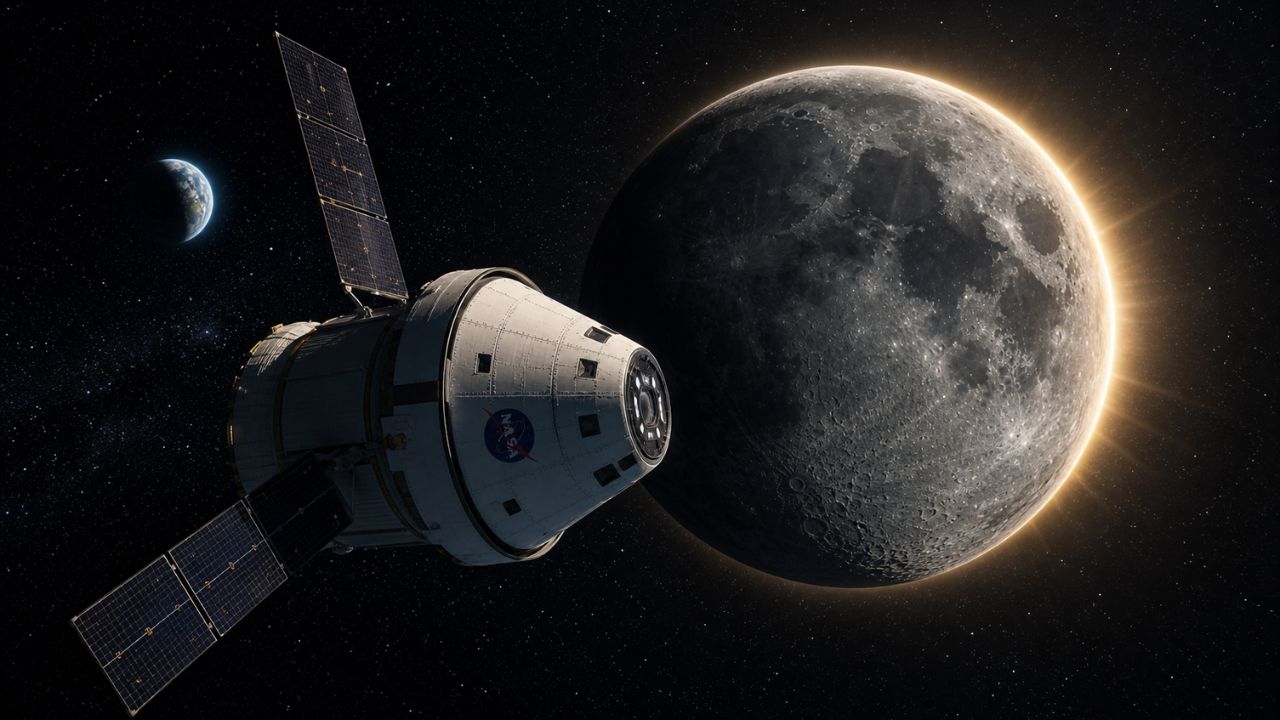
The Artemis II mission launched on April 1, 2026, from Launch Pad 39B at NASA's Kennedy Space Center in Florida. NASA's Space Launch System (SLS) rocket — one of the most powerful ever built — carried four astronauts aboard the Orion spacecraft on a planned test flight around the Moon and back.
The crew was:
Reid Wiseman (Commander, NASA)
Victor Glover (Pilot, NASA)
Christina Koch (Mission Specialist, NASA)
Jeremy Hansen (Mission Specialist, Canadian Space Agency)
This was the first crewed lunar flyby in over 50 years — the last time humans had been anywhere near the Moon was the Apollo era. The crew completed their lunar flyby on April 6, 2026, performed a seven-hour pass around the Moon's far side, and splashed down off the coast of San Diego on April 10, 2026, completing a nearly 10-day journey.
The mission also broke records — the crew traveled 694,481 miles in total and set a new record for the farthest distance humans have ever traveled from Earth.
The 12,000 Photos: Why Is Everyone Talking About Them?
During the mission, NASA had been releasing select photographs in real time — iconic shots that immediately went viral. But on May 4, 2026, the space agency opened the floodgates and released a massive trove of 12,000 previously unseen images from the voyage.
These photos were shot using a combination of:
Nikon D5 SLR (a trusted camera that's been flying on missions for years)
Nikon Z9 mirrorless (added at the last minute before launch)
iPhone 17 (yes, consumer smartphones made it to lunar orbit)
All four crew members contributed to the photography, though NASA has intentionally left each image without individual credit — a deliberate decision made by the crew to present the work as a collective effort.
The result is a collection that is equal parts scientific documentation and breathtaking art.
The Photos That Took the World's Breath Away
1. The New "Earthrise" — An Echo of Apollo 8
Perhaps the single most talked-about image from Artemis II is a modern recreation of one of the most famous photographs in human history.
In 1968, Apollo 8 astronauts captured "Earthrise" — a photo of Earth rising above the lunar horizon that changed how humanity saw itself. In 2026, the Artemis II crew captured a near-identical composition: a crescent Earth emerging over the Moon's curved limb, soft and luminous against the absolute black of space.
The image was taken at 7:22 p.m. EDT on April 6, 2026, using a 400mm lens through the Orion spacecraft window. It shows Earth as a delicate arc of blue and white cloud, with the rugged lunar terrain silhouetted in the foreground. Both Earth and Moon are oriented with their north poles to the left — a unique deep-space perspective no human had captured before.
It is hauntingly beautiful, and it puts our entire planet in perspective.
2. The Solar Eclipse From Deep Space
On April 6, as the Orion spacecraft moved behind the Moon during the flyby, the crew witnessed and photographed something that can never be seen from Earth — a total solar eclipse lasting nearly 54 minutes of totality.
From their vantage point in deep space, the Moon appeared large enough to completely block out the Sun. The resulting photograph shows the Sun's corona — its glowing outer atmosphere normally invisible to the naked eye — forming a dramatic halo around the dark lunar disk.
Look carefully at that photo and you'll notice more than the eclipse. The bright silver glint on the left edge is the planet Venus. The bright spot at the right edge is Mars. And the faint glow on the Moon's surface? That's Earthlight — sunlight reflecting off our planet and softly illuminating the lunar surface.
One image, four celestial bodies. It may be the most scientifically rich photograph ever taken.
3. Earthset — Our Planet "Setting" on the Moon
Just as the Sun sets on Earth, the crew captured "Earthset" — Earth dropping below the lunar horizon as seen from the Orion spacecraft.
In this image, taken just before the crew lost radio contact with Earth for 40 minutes, a partially lit crescent Earth sinks behind the Moon's curved limb. Australia and Oceania are visible in daylight, while the rest of the planet rests in night. In the foreground, the Ohm crater is clearly visible, its terraced edges and central peaks frozen in sharp lunar clarity.
This photo was captured at 6:41 p.m. EDT — just three minutes before Orion disappeared behind the Moon and communications went dark.
4. The Moon's Far Side — Terrain No Human Has Seen
Most of us have only ever seen one face of the Moon. The far side — permanently turned away from Earth — is a mystery to our naked eyes. Artemis II gave the crew the first-ever close human view of this hidden hemisphere.
The crew photographed craters, basins, and rugged terrain in extraordinary detail. One close-up shows Vavilov Crater on the far side's rim. Another captures the heavily cratered terrain of the Moon's eastern edge. These aren't just pretty pictures — they're scientific data that geologists and planetary scientists will be studying for years.
5. Christina Koch — Farther Than Any Woman Has Ever Been
One image shows mission specialist Christina Koch looking out of the Orion spacecraft window at Earth. At that moment, she was farther from our planet than any woman in history. It's a quiet, human moment in the middle of a record-breaking mission — and it carries the weight of everything that brought humanity to that point.
6. Star Trails and Long Exposures
Among the newly released 12,000 images are long-exposure photographs showing star trails — the movement of stars across the sky captured as sweeping arcs of light. These images, taken from a perspective no Earth-based photographer can replicate, show the universe in motion from the vantage point of deep space.
Inside the Orion Spacecraft: The Human Side of Artemis II
Beyond the cosmic shots, the photo archive gives us something equally fascinating — a window into life inside Orion.
There are images of the crew's sleeping bags illuminated inside the cabin on Flight Day 5. Candid photos of the astronauts working, communicating, and gathering at the windows together. A shot of Victor Glover and Jeremy Hansen preparing for the lunar flyby observation period, surrounded by floating equipment and the glow of instrument panels.
These images remind us that behind every historic mission are human beings — doing the extraordinary while also eating, sleeping, and getting their work done.
Why These Photos Matter Beyond Their Beauty
The Artemis II mission is not just a milestone in space exploration — it is the foundation for what comes next. Artemis III, currently planned, will see astronauts actually land on the Moon's surface, including near the lunar south pole, a region that may hold water ice.
The photographs from Artemis II serve multiple purposes:
Scientifically, they provide new data on the lunar far side, the Sun's corona, and the behavior of light and shadow in deep space.
Technologically, the mission validated the Orion spacecraft and SLS rocket systems for future crewed missions — including eventually putting humans on Mars.
Culturally, these images reinvigorate public interest in space exploration at a time when it matters enormously for science funding and international cooperation.
How to View the Artemis II Photos Yourself
If you want to explore the full collection, NASA has made all images publicly available through its Gateway to Astronaut Photography of Earth website. The lunar flyby photos are also organized in a dedicated Artemis II Lunar Flyby Gallery on NASA's official site (nasa.gov). Most images include camera metadata, so you can see exactly which Nikon or iPhone lens captured each shot.
Final Thoughts
There is something deeply moving about the Artemis II photographs — not just because of their technical brilliance, but because of what they represent. After decades of pause, humanity is going back to the Moon. Not just to visit, but to stay, to learn, and eventually, to push further out into the solar system.
The image of that crescent Earth hanging above the lunar surface is more than a photograph. It's a reminder that we live on a fragile, beautiful, spinning rock — and that some of the best things we do as a species involve leaving it temporarily to see it more clearly.
These 12,000 images are now part of the permanent record of human achievement. Make sure you've seen them.

Written by
Koti Deva
Digital Marketing Specialist
Koti is a Digital Marketing Specialist with over 10 years of experience and the co-founder of MCQ Orbit — a free exam prep platform built for Indian competitive exam aspirants.
With strong personal knowledge in Quantitative Aptitude, Logical Reasoning, and Mathematics, Koti has a deep understanding of what it takes to crack exams like SSC CGL, IBPS PO, SBI Clerk, UPSC Prelims, NEET, and JEE. Having followed these exams closely for years, he understands the exact topics, patterns, and shortcuts that matter most.
MCQ Orbit was born from a simple desire — to build a platform where every aspirant in India can practice quality MCQs, read reliable current affairs, and prepare confidently, without paying a rupee. Koti combines his digital expertise with his passion for competitive exams to create content that is accurate, practical, and genuinely useful for students.
His mission is straightforward: if the right guidance had been freely available earlier, more students would have cracked their dream exams. MCQ Orbit is his way of making that happen.
Comments
No comments yet.