Current Affairs 5 May 2026 | 5th May 2026 Current Affairs | Daily GK Updates
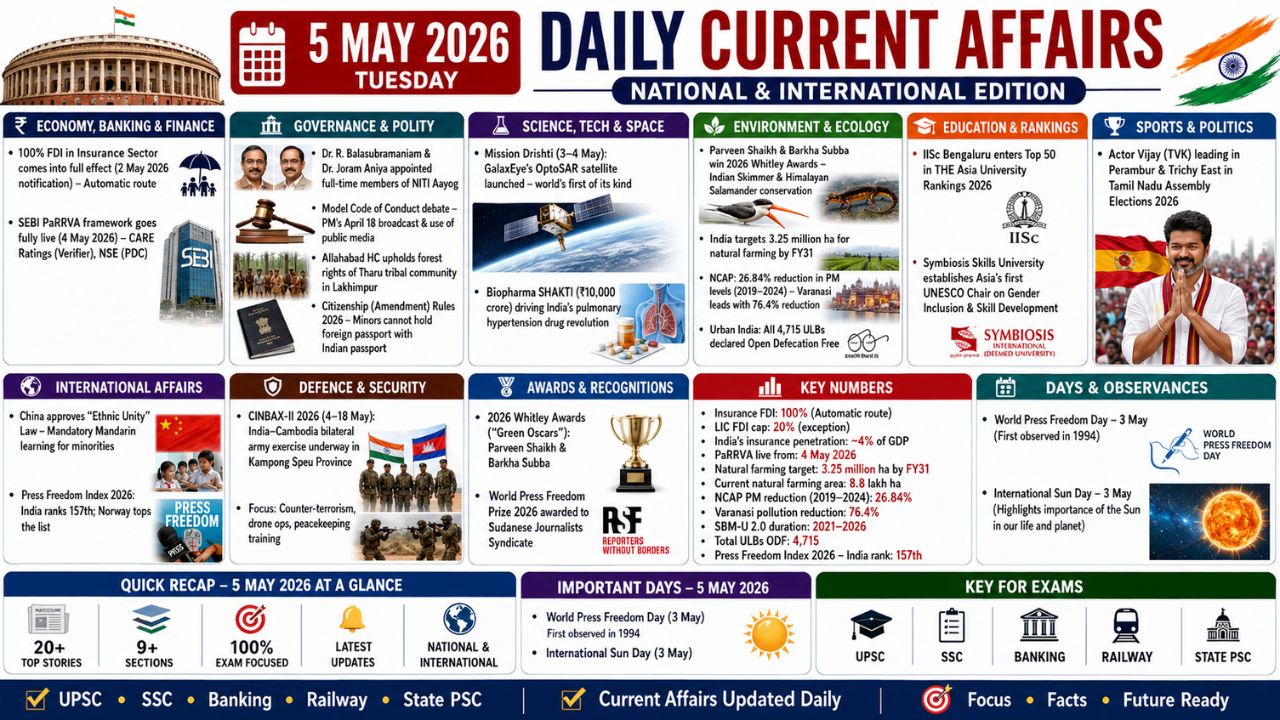
5 May 2026 Current Affairs is here — and today's edition is loaded with high-weightage topics across every section of your GK syllabus. Whether you're preparing for UPSC, SSC CGL, IBPS PO, Railways, or any State PSC exam, you cannot afford to miss what happened on 5th May 2026. The biggest story of the day is India opening 100% FDI in the insurance sector via the automatic route — a historic liberalisation of one of India's most regulated industries. Beyond that, two new full-time members were appointed to NITI Aayog, the SEBI PaRRVA framework went fully live, India's natural farming target was set at 3.25 million hectares by FY31, IISc Bengaluru entered the top 50 of the THE Asia University Rankings 2026, and India's conservationists won the prestigious 2026 Whitley Awards. From economy and governance to science, environment, and sports — the current affairs of 5th May 2026 cover it all. Read carefully, make notes, and stay one step ahead.
Economy, Banking & Finance
100% FDI in Insurance Sector Comes into Full Effect — Policy Analysis, Implications & Regulatory Framework
The formal notification of 100% Foreign Direct Investment (FDI) in the insurance sector under the automatic route — announced on 2 May 2026 through the FEMA (Non-Debt Instruments) Rules, 2026 — came under detailed policy scrutiny on 5 May 2026, as markets, regulators, and analysts assessed its full implications for India's financial sector.
The evolution of FDI limits in Indian insurance tells a fascinating story of gradual liberalisation: the sector was opened to private players in 1999 with a 26% FDI cap, raised to 49% in 2015, then to 74% in 2021, and now reaching 100% in 2026. This progression flows from the Sabka Bima Sabki Raksha (Amendment of Insurance Laws) Act, 2025, which amended three core statutes — the Insurance Act, 1938, the LIC Act, 1956, and the IRDAI Act, 1999. One important carve-out to remember: Life Insurance Corporation of India (LIC) remains capped at 20% FDI due to its sovereign importance and the massive public trust and government backing it carries.
What does the new 100% FDI framework actually cover? It applies to: life insurance companies, general insurance companies, health insurance companies, and all insurance intermediaries — including insurance brokers, re-insurance brokers, insurance consultants, corporate agents, third-party administrators (TPAs), surveyors and loss assessors, and managing general agents. Under the automatic route, no prior approval from the government is required — a foreign company can directly invest up to 100% in an Indian insurance entity subject to IRDAI regulatory compliance.
Why does this matter for India? India's insurance penetration stands at approximately 4% of GDP against a global average of roughly 7% — a significant gap, especially in health and life insurance in rural and semi-urban areas. The government hopes that global insurance capital, advanced actuarial expertise, and international technology platforms will help bridge this gap. However, policy analysts have flagged important safeguards that need to be in place: strict data localisation and cybersecurity norms for foreign-owned insurers (given the sensitivity of health and financial data), a mandatory rural and social sector obligation to prevent foreign players from cherry-picking only urban profitable segments, and a structured review every 2–3 years on market concentration and profit repatriation trends. The IRDAI has also been empowered under the new Act with search and seizure powers and authority to disgorge wrongful gains — strengthening the regulator's teeth alongside the sector's liberalisation.
Key facts to remember for exams:
Route: Automatic (no prior government approval needed)
LIC FDI cap: 20% (exception to the 100% rule)
Regulator: IRDAI (Insurance Regulatory and Development Authority of India)
At least one Key Managerial Person must be a Resident Indian Citizen
India's insurance penetration: ~4% of GDP vs global average of ~7%
SEBI PaRRVA Framework — Full Operations Begin 4 May 2026; CARE Ratings & NSE Roles Explained
SEBI's PaRRVA (Past Risk and Return Verification Agency) framework commenced full-scale operations from 4–5 May 2026, following a successful pilot phase that began in December 2025. CARE Ratings Limited is designated as the verification agency, and the National Stock Exchange (NSE) functions as the PaRRVA Data Centre (PDC).
What problem does PaRRVA solve? India has witnessed an explosion in retail investor participation — demat accounts crossed 18 crore in 2026 — and with this surge came a proliferation of unverified, cherry-picked, or outright fabricated performance claims by investment advisers and research analysts, particularly on social media. A YouTube channel could claim "200% returns in 6 months" with no accountability whatsoever. PaRRVA directly addresses this: under the framework, all SEBI-registered investment advisers, research analysts, and algorithmic trading service providers must have their historical performance data — risk-adjusted returns, drawdowns, and benchmark comparisons — independently verified by PaRRVA before using these figures in any client communication, advertisement, or marketing material. This positions India's regulatory framework among the most advanced globally in mandating independent verification of advisory performance claims.
Governance, Polity & Appointments
Two New Full-Time Members Appointed to NITI Aayog — Total Strength Rises to Seven
In a significant development in May 2026, Prime Minister Narendra Modi approved the appointment of Dr. R. Balasubramaniam and Dr. Joram Aniya as full-time members of NITI Aayog (National Institution for Transforming India). With these two appointments, the total number of full-time members of NITI Aayog increased from five to seven.
Quick background on NITI Aayog: It replaced the Planning Commission in January 2015, shifting India's development planning approach from a top-down centralised model to a bottom-up, cooperative federalism approach. The NITI Aayog structure includes: the Prime Minister as Chairperson, a Vice Chairperson, Full-Time Members, Ex-Officio Members (Cabinet Ministers), Special Invitees, and a CEO (who heads the secretariat). Unlike the Planning Commission, NITI Aayog does not allocate funds directly to states — that role belongs to the Finance Commission and Union Budget.
Model Code of Conduct Controversy — PM's April 18 Broadcast and the Doordarshan Question
A Prime Minister's broadcast on April 18, 2026 triggered a major debate over alleged violation of the Model Code of Conduct (MCC), specifically around the use of publicly funded media — Doordarshan, All India Radio (AIR), and Sansad TV — during an active election period.
What is the Model Code of Conduct? The MCC is a set of guidelines issued by the Election Commission of India (ECI) under Article 324 of the Constitution, which kicks in from the announcement of election dates until the completion of the electoral process. It governs the conduct of political parties, candidates, and the ruling government — specifically barring the ruling party from using government machinery, resources, or publicly funded media for partisan purposes. The Representation of the People Act, 1951 provides the legal framework within which the ECI exercises its supervisory powers. The controversy reignited a long-standing debate: publicly funded broadcasters like Doordarshan are state entities — their use for government communication during an election period raises fundamental questions about the neutrality of state machinery and the spirit of free and fair elections.
Allahabad HC Upholds Forest Rights of Tharu Tribal Community in Lakhimpur
On April 20, 2026, the Allahabad High Court (Lucknow Bench) struck down a District Level Committee (DLC) order that had wrongly rejected the forest rights claims of the Tharu tribal community in Lakhimpur, Uttar Pradesh. The DLC had cited a 2000 Supreme Court interim order barring dereservation of forests as the basis for its 2021 rejection — but the High Court held this reasoning to be flawed and directed reconsideration of the claims.
Why does this matter? The Forest Rights Act (FRA), 2006 — formally known as the Scheduled Tribes and Other Traditional Forest Dwellers (Recognition of Forest Rights) Act — is one of the most consequential pieces of legislation for India's Adivasi communities. It recognises the rights of forest-dwelling communities to land they have traditionally cultivated or inhabited, as well as community rights over forest produce and governance. The Tharu community is an indigenous group predominantly found in the Terai belt of Uttar Pradesh and Uttarakhand. Their forest-based livelihood and land rights have been a subject of prolonged legal and administrative battles. The HC ruling reinforces the constitutional protection under Articles 244, 244A, and Schedule V for tribal rights, and upholds the spirit of the FRA against administrative overreach.
Citizenship (Amendment) Rules 2026 — Minors Cannot Hold Foreign Passport Alongside Indian Passport
The Citizenship (Amendment) Rules, 2026 introduced a specific proviso to Rule 3, explicitly mandating that a minor child cannot hold a foreign passport while possessing an Indian passport. This was aimed at closing a legal loophole where minors were occasionally found holding travel documents from two different nations simultaneously.
The legal rationale: India maintains a strict policy of single citizenship — unlike the USA or UK which permit dual nationality. While Overseas Citizens of India (OCI) status provides certain privileges (multi-purpose lifelong visas, exemption from reporting to police), OCI holders remain legally foreign nationals — it is frequently misunderstood as dual citizenship, which it is not. The new rules also transition OCI card management to a fully digital e-OCI framework, streamlining identity services while reinforcing these core legal boundaries. The 2026 amendment was notified through the Ministry of Home Affairs and applies uniformly to all Indian citizens regardless of age.
Science, Technology & Space
Mission Drishti Deep Dive — GalaxEye's OptoSAR Technology and India's NewSpace Revolution
While Mission Drishti was launched on 3–4 May 2026, detailed technical and policy analysis of the satellite and its implications continued to dominate science and technology discussions on 5 May 2026. GalaxEye, the Bengaluru-based private space-tech startup founded in 2020 by IIT Madras alumni, achieved a global first with this mission: the world's first OptoSAR satellite and India's largest privately developed Earth observation satellite (weighing approximately 190 kg).
What makes OptoSAR different? Traditional Earth observation satellites carry either Synthetic Aperture Radar (SAR) — which uses microwave signals to penetrate cloud cover and image the Earth day or night — or Electro-Optical/Multispectral Imaging (MSI) — which captures high-resolution optical imagery in daylight and clear conditions. The problem with single-sensor satellites is that data from SAR and optical sensors from different satellites needs to be manually co-registered, introducing time delays and geolocation errors. GalaxEye's breakthrough is a proprietary synchronisation technology stack that enables both sensors to observe the same location at the same time on a single platform — delivering unprecedented accuracy for applications ranging from border surveillance and disaster management to agriculture monitoring, urban planning, and climate research. The satellite operates in Sun-Synchronous Low Earth Orbit (LEO) at ~500 km altitude with a resolution of 1.2 to 1.8 metres. GalaxEye plans a constellation of 8–12 satellites by 2029, enabling revisit of any Earth location every 4 days. The mission was facilitated by IN-SPACe (Indian National Space Promotion and Authorisation Centre) and validates India's Space Policy 2023 push for private sector participation.
Biopharma SHAKTI & India's Pulmonary Hypertension Breakthrough — From Import Dependence to Atmanirbhar Healthcare
India's rapid transformation in the treatment of Pulmonary Hypertension (PH) — a serious condition characterised by abnormally high blood pressure in the arteries carrying blood from the heart to the lungs — came into sharp focus on 5 May 2026. India has emerged as a major domestic manufacturer of affordable PH drugs, significantly reducing dependence on costly imports.
What is Pulmonary Hypertension? It is a progressive condition where increased pressure in the pulmonary arteries forces the right ventricle of the heart to work harder — eventually leading to right heart failure if untreated. Symptoms include shortness of breath during routine activity, persistent fatigue, chest pain, dizziness, and swelling in the legs and abdomen. Historically, the key drug classes — Endothelin Receptor Antagonists (ERAs) and Phosphodiesterase-5 (PDE5) inhibitors — had to be imported at high cost, making treatment inaccessible for most patients. ERAs work by blocking endothelin, a substance that causes narrowing of blood vessels, thereby improving blood flow.
The government's role: Customs duty reductions, support for domestic manufacturing under Make in India, and the landmark Biopharma SHAKTI initiative — a flagship programme with a financial outlay of ₹10,000 crore aimed at transforming India into a global hub for biologics and advanced therapies. The programme covers innovation, infrastructure, and clinical research. This sits alongside the broader Atmanirbhar Bharat in healthcare framework and the Ayushman Bharat Digital Mission (ABDM) 2.0 for digital health ecosystem expansion.
Environment & Conservation
Two Indian Conservationists Win 2026 Whitley Awards — Indian Skimmer and Himalayan Salamander in Focus
Indian conservationists Parveen Shaikh and Barkha Subba won the 2026 Whitley Awards — popularly known as the "Green Oscars" — for their outstanding grassroots conservation work protecting the Indian Skimmer and the Himalayan Salamander respectively.
About the Whitley Awards: Conferred by the Whitley Fund for Nature (WFN), a UK-based charity, the awards honour grassroots conservation leaders from the Global South who have demonstrated outstanding leadership in protecting biodiversity with limited resources. Previous Indian winners include Dr. Purnima Devi Barman (2024, for her work with the Greater Adjutant Stork), Y. Nuklu Phom (2021), and Vivek Menon (2001 — the first Indian to win the Award).
About the Indian Skimmer: A remarkable riverine bird that catches fish by flying low over water surfaces and skimming with its uniquely shaped bill — the lower mandible is longer than the upper one, slicing through water to catch fish mid-flight. Found in India, Bangladesh, and Pakistan with some populations in Nepal and Myanmar, India hosts nearly 90% of the global population. It inhabits large sandy lowland rivers and is critically threatened by sand mining, river damming, and human disturbance at nesting sites. IUCN Status: Endangered. Wildlife Protection Act (WPA) Schedule: I. CMS: Appendix II.
About the Himalayan Salamander: A rare amphibian and one of only two salamander species found in India — the other being the Manipuri Newt (Zaimeng Lake Newt). Found in high-altitude Himalayan streams, it is under threat from habitat degradation, climate change-induced glacial shifts, and pollution.
India Plans 3.25 Million Hectare Push for Natural Farming by FY31 — Policy, Targets & Challenges
India announced an ambitious expansion of chemical-free natural farming to 3.25 million hectares by FY2030-31 — up from the current coverage of approximately 8.8 lakh hectares. If achieved, this would represent about 1.8% of India's total farmland being converted to natural farming practices.
The implementation architecture is detailed: The plan includes 65,000 clusters (each covering 50 hectares), supported by 26,000 Community Resource Persons (CRPs) for last-mile farmer handholding, 5,000 Bio-Input Resource Centres (BRCs) for providing natural inputs like jeevamrit and beejamrit, and 2,858 demonstration farms to showcase natural farming results to neighbouring farmers. Institutional backing comes from ICAR, Krishi Vigyan Kendras (KVKs), and agricultural universities for research and extension support.
Constitutional and policy dimension: Agriculture falls under the State List (Entry 14) of the Seventh Schedule — but the Centre guides adoption through centrally sponsored schemes, reflecting cooperative federalism in action. Natural farming also aligns with Article 48A (environment protection) and Article 21 (right to life — interpreted to include the right to a clean environment). The policy also contributes to India's Nationally Determined Contributions (NDCs) under the Paris Agreement by reducing greenhouse gas emissions from synthetic fertiliser use.
Challenges are real and shouldn't be ignored: Yield uncertainty during the transition phase (1–3 years) can threaten farmer income; lack of a robust certification and market linkage system limits premium pricing; and scientific debate continues around large-scale empirical evidence supporting natural farming productivity versus conventional methods.
National Clean Air Programme (NCAP) — India Achieves 26.84% PM Reduction; Varanasi Leads
India achieved a 26.84% reduction in nationwide Particulate Matter (PM) levels from 2019 to 2024, with NCAP (National Clean Air Programme) cities showing a 24.45% improvement due to targeted interventions, as per data reviewed on 5 May 2026. Among individual cities, Varanasi led nationally with a 76.4% pollution reduction, followed by Moradabad (58%) and Kanpur (51.2%) — all in Uttar Pradesh.
What are Non-Attainment Cities? These are urban areas that have consistently failed to meet the National Ambient Air Quality Standards (NAAQS) for PM2.5 and PM10 — two key pollutants. Under NCAP (launched in 2019 with a target of 20–30% reduction by 2024), these cities were required to prepare City Action Plans focused on dust control, vehicular emission reduction, waste management, and industrial pollution. State Action Plans (SAPs) were also mandated, covering both NCAP and non-NCAP areas with a clear funding mechanism. The National Green Tribunal (NGT) mandated Airshed-level coordination among states — recognising that air pollution does not respect administrative boundaries and requires multi-state institutional coordination for effective management.
Urban India Achieves Full Open Defecation Free Status — All 4,715 ULBs Declared ODF
A landmark public health milestone was confirmed: Urban India has become completely Open Defecation Free (ODF), with all 4,715 Urban Local Bodies (ULBs) across the country achieving ODF status under the Swachh Bharat Mission-Urban 2.0 (SBM-U 2.0), which ran from 2021 to 2026 with an allocation announced in Budget 2021-22.
SBM-U 2.0 went beyond just eliminating open defecation — it aimed at making cities Garbage Free through source segregation of solid waste, remediation of legacy dumpsites, and scientific waste processing. It also focused on faecal sludge management for areas without underground sewer systems, and on making all existing toilets functional and well-maintained (the "sustainability" challenge that Phase 1 struggled with). The original Swachh Bharat Mission (Urban) — Phase 1 — was launched on 2 October 2014 (Gandhi Jayanti) and declared urban India ODF in 2019, but Phase 2 consolidated and deepened those gains with infrastructure and behavioural focus. The mission's success is measured against the Swachh Survekshan — an annual cleanliness survey of cities — which has driven competitive improvement among ULBs.
Education & Rankings
IISc Bengaluru Enters Top 50 of Times Higher Education Asia University Rankings 2026
The Indian Institute of Science (IISc), Bengaluru was included in the top 50 of the Times Higher Education (THE) Asia University Rankings 2026 — a significant recognition of India's premier research university on the continental stage.
About IISc: Established in 1909 in Bengaluru, IISc is India's foremost research institution, consistently ranked as the top research university in India in global rankings. It was established through the joint efforts of Jamsetji Nusserwanji Tata and Maharaja Krishnaraja Wadiyar IV of Mysore, with the Tata family endowing the land and the Mysore Durbar providing the site. IISc offers undergraduate, postgraduate, and doctoral programmes across science, engineering, design, and management disciplines. It was granted Institute of Eminence status by the UGC in 2018. The THE Asia University Rankings assess institutions across teaching, research environment, research quality, industry engagement, and international outlook — making a top-50 rank a validation across all these dimensions.
About Symbiosis Skills University — Asia's First UNESCO Chair on Gender Inclusion: Separately, Symbiosis Skills and Professional University (SSPU), Pune established Asia's first UNESCO Chair on Gender Inclusion and Skill Development under UNESCO's UNITWIN (University Twinning and Networking) Programme — a landmark for Indian higher education's growing global recognition.
Sports
Tamil Nadu Assembly Elections 2026 — Actor Vijay (TVK) Leading in Perambur and Trichy East
In a major political development, Vijay — popular Tamil film actor and founder of the Tamilaga Vettri Kazhagam (TVK) — was leading in both Perambur and Trichy East constituencies during vote counting in the Tamil Nadu Assembly Elections 2026. Vijay, who formally entered politics by launching TVK in 2024, had contested from two seats — a significant political debut for a major film star-turned-politician.
Tamil Nadu, with 234 Assembly constituencies, has a history of film personalities successfully transitioning into politics — most notably M. G. Ramachandran (MGR) who founded the AIADMK and served as Chief Minister, and J. Jayalalithaa who led the party for decades. Vijay's entry represents the latest chapter in this tradition. Tamil Nadu sends 39 members to the Lok Sabha and 18 to the Rajya Sabha.
International Affairs
China Approves "Ethnic Unity" Law — Mandarin Learning Mandatory for Minorities
China approved an "Ethnic Unity" law in early May 2026, making the learning of Mandarin (Putonghua) compulsory for ethnic minorities across the country. The law has drawn sharp international criticism from human rights organisations and governments, who argue it represents a systematic attempt to assimilate minority cultures and erase linguistic diversity — particularly affecting Tibetan, Uyghur, Mongolian, and other minority communities.
Context: China officially recognises 56 ethnic groups, of which the Han Chinese form approximately 91% of the population. The remaining 55 minorities — including Tibetans, Uyghurs in Xinjiang, Mongols, and Zhuang people — have historically had constitutional protections for their languages and cultures under China's Regional Ethnic Autonomy Law. Critics argue these protections have been progressively eroded. The new "Ethnic Unity" law follows years of reported restriction on Tibetan-language education and the suppression of Uyghur cultural expression in Xinjiang. From India's perspective, this is relevant in the context of the Tibet issue, the Dalai Lama's presence in India, and India-China relations — where human rights and minority rights remain a sensitive diplomatic backdrop.
CINBAX-II 2026 — India-Cambodia Bilateral Military Exercise Continues
The CINBAX-II 2026 (Cambodia-India Bilateral Army Exercise), which commenced on 4 May 2026 at the Techo Sen Phom Thom Mreas Prov Royal Cambodian Air Force Training Centre, Kampong Speu Province, Cambodia, continued into its second day on 5 May. Approximately 120 Indian Army personnel from the Maratha Light Infantry Regiment and 160 Cambodian troops are participating in the two-week exercise. Training activities include counter-terrorism drills, drone operations, sniper and mortar training, and joint peacekeeping scenario exercises under the UN Chapter VII mandate.
The exercise reflects India's Act East Policy and its deepening defence partnerships with ASEAN nations. Cambodia's strategic location in mainland Southeast Asia makes defence engagement significant as India navigates China's growing influence in the region. India's other bilateral exercises in the ASEAN region include MITRA SHAKTI (Sri Lanka), BOLD KURUKSHETRA (Singapore), and GARUDA SHAKTI (Indonesia).
Press Freedom Index 2026 — India Ranks 157th; Norway Tops the List
The RSF (Reporters Without Borders) World Press Freedom Index (WPFI) 2026 — released on April 30, 2026 — was widely discussed and analysed in the context of World Press Freedom Day (May 3) and the 2026 MCC controversy. Norway ranked 1st, Netherlands 2nd, and Estonia 3rd. India ranked 157th with a score of 31.96 out of 180 countries assessed.
The 2026 World Press Freedom Prize was awarded to the Sudanese Journalists Syndicate — an independent body — at UNESCO Headquarters in Paris, France on 4 May 2026. The prize recognises media organisations and journalists who defend press freedom at great personal and professional risk. World Press Freedom Day itself is observed on May 3 every year — formally proclaimed by the UN General Assembly in 1993 following a recommendation by UNESCO's 26th General Conference in 1991. The first World Press Freedom Day was observed on May 3, 1994. Relevant constitutional provisions in India include Article 19(1)(a) (freedom of speech and expression, which implicitly protects press freedom) and its reasonable restrictions under Article 19(2).
Written by
Koti Deva
Digital Marketing Specialist
Koti is a Digital Marketing Specialist with over 10 years of experience and the co-founder of MCQ Orbit — a free exam prep platform built for Indian competitive exam aspirants.
With strong personal knowledge in Quantitative Aptitude, Logical Reasoning, and Mathematics, Koti has a deep understanding of what it takes to crack exams like SSC CGL, IBPS PO, SBI Clerk, UPSC Prelims, NEET, and JEE. Having followed these exams closely for years, he understands the exact topics, patterns, and shortcuts that matter most.
MCQ Orbit was born from a simple desire — to build a platform where every aspirant in India can practice quality MCQs, read reliable current affairs, and prepare confidently, without paying a rupee. Koti combines his digital expertise with his passion for competitive exams to create content that is accurate, practical, and genuinely useful for students.
His mission is straightforward: if the right guidance had been freely available earlier, more students would have cracked their dream exams. MCQ Orbit is his way of making that happen.
Comments
No comments yet.