Current Affairs 8 May 2026 | 8th May 2026 Current Affairs | Daily GK Updates
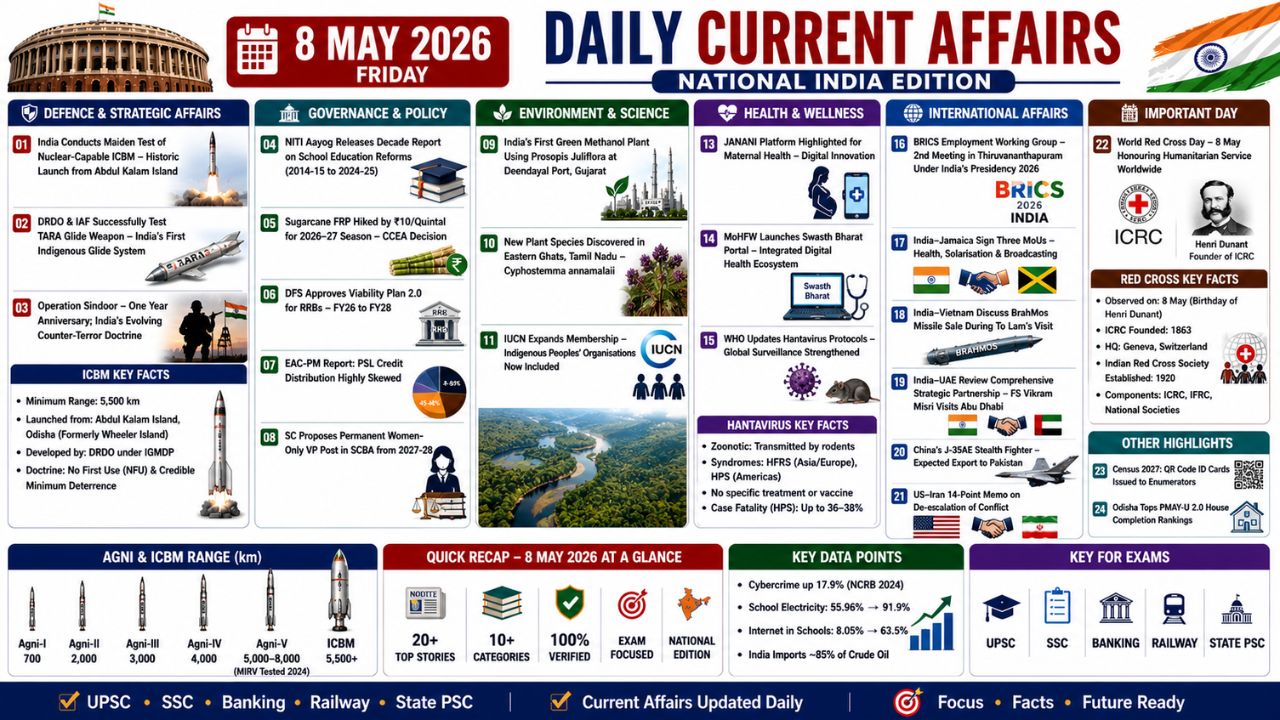
8 May 2026 Current Affairs is a must-read — especially for anyone sitting for UPSC Prelims on May 24. Today's biggest stories include India's maiden ICBM test off the Odisha coast — a landmark in India's strategic deterrence capability. The DRDO and IAF successfully tested the TARA glide weapon — India's first indigenous precision glide system. The NITI Aayog released a landmark report on a decade of school education reforms. Sugarcane FRP was hiked by ₹10/quintal for 2026–27. India's first green methanol plant is being set up at Deendayal Port Authority, Gujarat. The BRICS Employment Working Group met under India's Presidency 2026. A new plant species of the grape family was discovered in Tamil Nadu's Eastern Ghats. And World Red Cross Day was observed globally on May 8. Let's break it all down.
Defence & Strategic Affairs
India Conducts Maiden Test of Nuclear-Capable ICBM — Abdul Kalam Island, Odisha
This is the most significant defence story of the day — and possibly one of the biggest strategic developments of 2026.
India conducted a maiden test of a nuclear-capable intercontinental ballistic missile (ICBM) off the Odisha coast on 8 May 2026. The launch took place from Abdul Kalam Island.
What is an ICBM?
An Intercontinental Ballistic Missile is a long-range ballistic missile with a minimum range of 5,500 kilometres — designed primarily for nuclear weapons delivery. ICBMs follow a ballistic trajectory — they are launched into space and re-enter the atmosphere at hypersonic speeds to strike their targets. Only a small number of countries in the world possess operational ICBM capability: the USA, Russia, China, France, and the UK among declared nuclear states. India's successful maiden test places it in a strategically exclusive club.
India's missile programme — context: India's missile development has been driven by the Defence Research and Development Organisation (DRDO) through the Integrated Guided Missile Development Programme (IGMDP), launched in 1983 under the leadership of Dr. APJ Abdul Kalam. The IGMDP produced five flagship missiles — Agni, Prithvi, Akash, Trishul, and Nag. The Agni series has been India's primary strategic missile programme:
Missile | Range | Status |
|---|---|---|
Agni-I | ~700 km | Operational |
Agni-II | ~2,000 km | Operational |
Agni-III | ~3,000 km | Operational |
Agni-IV | ~4,000 km | Operational |
Agni-V | ~5,000–8,000 km | Operational (MIRV tested 2024) |
ICBM (New) | 5,500+ km | Maiden test May 8, 2026 |
Abdul Kalam Island — formerly known as Wheeler Island — is located off the coast of Odisha in the Bay of Bengal. It has been India's primary missile testing range and is named after Dr. APJ Abdul Kalam — the architect of India's missile programme and India's 11th President.
Strategic significance: An ICBM-capable India sends a powerful deterrence signal — particularly in the context of the evolving threat landscape in the Indo-Pacific. India's nuclear doctrine of "No First Use (NFU)" and a credible minimum deterrence posture means the ICBM is a second-strike capability tool — ensuring India can absorb a nuclear first strike and still retaliate effectively.
ICBM = minimum range 5,500 km. Tested from Abdul Kalam Island (formerly Wheeler Island), Odisha. IGMDP = 1983, under Dr. APJ Abdul Kalam. Agni-V = previously longest-range Agni (5,000–8,000 km, MIRV tested 2024). India's nuclear doctrine = No First Use + credible minimum deterrence. NFU announced 1998 post-Pokhran-II tests. This is a landmark UPSC GS Paper III and defence MCQ topic.
DRDO and IAF Successfully Test TARA — India's First Indigenous Glide Weapon
The DRDO and the Indian Air Force (IAF) successfully conducted the maiden flight-trial of the Tactical Advanced Range Augmentation (TARA) weapon off the coast of Odisha. TARA is a modular range extension kit and India's first indigenous glide weapon system. It is designed to be fitted onto existing unguided warheads, converting them into advanced precision-guided weapons.
What exactly is TARA? TARA essentially converts a "dumb bomb" — an unguided free-fall weapon — into a "smart weapon" — a precision-guided glide munition. The kit adds GPS-aided navigation, guidance fins, and a glide mechanism to existing bombs, dramatically extending their range and accuracy without requiring an aircraft to fly close to the target. This means Indian fighter jets can release these weapons from a safe standoff distance — outside the effective range of enemy air defences — and still achieve precision strikes.
Why is this strategically important? India currently uses imported standoff weapons like the SCALP (Storm Shadow) cruise missile on Rafale jets. TARA provides an indigenous, cost-effective alternative for precision standoff strikes — applicable to a wide range of existing unguided bombs in India's inventory. It directly supports the Atmanirbhar Bharat in defence vision and reduces dependence on foreign precision munitions supply chains.
TARA = Tactical Advanced Range Augmentation. India's first indigenous glide weapon. Converts unguided warheads into precision-guided weapons. DRDO + IAF joint development. Tested off Odisha coast. Standoff weapon = released outside enemy air defence range. Reduces dependence on imported precision munitions like SCALP.
Operation Sindoor — One Year Anniversary and India's Evolving Counter-Terror Doctrine
Operation Sindoor — the multi-domain military response conducted on May 7–8, 2025 to the Pahalgam terror attack (which claimed 26 lives) carried out by The Resistance Front (TRF), linked to Pakistan-based terror networks — completed one year. It involved precision airstrikes on 9 terror launchpads in Pakistan and PoJK using Rafale jets with SCALP missiles and HAMMER bombs, demonstrating India's capability for deep, calibrated strikes.
India's counter-terror doctrine evolution — what changed:
The shift reflects lessons from drone warfare, grey-zone conflicts, and cross-border terrorism, shaping India's evolving national security doctrine. India placed the 1960 Indus Waters Treaty in abeyance, leveraging upstream control as a strategic pressure tool. India imposed economic isolation measures, including suspension of trade and closure of the Attari-Wagah border, targeting Pakistan's economic vulnerabilities. India conducted global diplomatic outreach, presenting evidence of terror links and isolating Pakistan internationally.
Key doctrinal concepts:
Doval Doctrine: Integration of hard power, intelligence, and diplomacy to achieve comprehensive national security objectives — named after National Security Adviser Ajit Doval
PRAHAAR: India's National Counter-Terrorism Strategy under the Ministry of Home Affairs — a whole-of-government approach integrating intelligence, law enforcement, and community engagement
Mission Sudarshan Chakra: India's integrated air defence initiative — coordinates S-400 Triumf, Project Kusha (indigenous long-range SAM), and the Akashteer system
C4I2SR: Command, Control, Communications, Computers, Intelligence, Information, Surveillance and Reconnaissance — the integrated network that coordinated Operation Sindoor
Operation Sindoor = May 7–8, 2025. 9 terror camps struck. Rafale + SCALP + HAMMER. TRF = The Resistance Front (Pakistan-linked). Pahalgam attack = 26 victims. Indus Waters Treaty = placed in abeyance. Attari-Wagah = closed. Doval Doctrine = hard power + intelligence + diplomacy. PRAHAAR = National Counter-Terror Strategy (MHA).
Governance & Policy
NITI Aayog Releases Decade Report on School Education — 2014-15 to 2024-25
NITI Aayog released a comprehensive policy report titled 'School Education System in India: Temporal Analysis and Policy Roadmap for Quality Enhancement (2026)' — analysing a decade of India's school education system from 2014-15 to 2024-25, providing a strategic roadmap to enhance quality and equity as India moves toward its Viksit Bharat @2047 vision.
Key data highlights from the report:
Indicator | 2014-15 | 2024-25 |
|---|---|---|
GER — Primary Level | — | 90.9% |
GER — Upper Primary | — | 90.3% |
Functional Electricity in Schools | 55.96% | 91.9% |
Internet Facility in Schools | 8.05% | 63.5% |
Jharkhand Primary Dropout Rate | 6.41% | 0% |
There are 7.3 lakh primary schools but only 1.64 lakh higher secondary schools, causing transitions to be difficult. Recent PARAKH scores show that students are increasingly able to perform foundational tasks and basic arithmetic.
What is GER?
The Gross Enrolment Ratio measures the total enrolment in a specific level of education, regardless of age, expressed as a percentage of the eligible official school-age population. A GER of 90.9% at primary level means about 9 in 10 eligible children are enrolled.
What is PARAKH?
Performance Assessment, Review and Analysis of Knowledge for Holistic Development — a national assessment framework under the National Education Policy (NEP) 2020 — India's standardised evaluation system for measuring learning outcomes across state board systems.
NITI Aayog School Education Report 2026. School electricity: 55.96% → 91.9%. Internet: 8.05% → 63.5%. Jharkhand dropout: 6.41% → 0%. 7.3 lakh primary schools vs only 1.64 lakh higher secondary. PARAKH = assessment framework under NEP 2020. GER primary = 90.9%. UDISE+ = database tracking these numbers.
Sugarcane FRP Hiked by ₹10/Quintal for 2026–27 Sugar Season
The Cabinet Committee on Economic Affairs (CCEA) raised the sugarcane Fair and Remunerative Price (FRP) by ₹10 per quintal for the 2026–27 sugar season (October–September). FRP is the legally mandated minimum price that sugar mills must pay sugarcane farmers across India. It is governed by the Sugarcane Control Order, 1966 under the Essential Commodities Act (ECA), 1955. CCEA determines FRP based on recommendations of the Commission for Agricultural Costs and Prices (CACP).
Key facts about FRP:
FRP pricing links farmer payment to the sugar recovery percentage achieved by the mill — the higher the recovery of sugar from cane, the higher the price paid to farmers
Factors considered: sugarcane production costs, alternative-crop returns, agricultural price trends, consumer sugar availability, sugar sales realisation, by-products (molasses, bagasse), and grower margins
FRP applies nationally; however, some sugarcane-producing states like Uttar Pradesh declare their own State Advised Price (SAP) — which is usually higher than FRP
India is the world's second-largest sugar producer after Brazil and the largest consumer of sugar globally
FRP hiked by ₹10/quintal for 2026–27. CCEA decides FRP. Based on CACP recommendations. Governed by Sugarcane Control Order 1966 under Essential Commodities Act 1955. SAP = State Advised Price (higher, state-specific). India = world's 2nd largest sugar producer (after Brazil), largest consumer.
DFS Approves Viability Plan 2.0 for Regional Rural Banks — FY26 to FY28
The Department of Financial Services (DFS) under the Ministry of Finance approved Viability Plan 2.0 to institutionalise performance monitoring and strengthen governance reforms for Regional Rural Banks (RRBs). Viability Plan 2.0 has been extended for three years from FY 2025-26 to FY28, after completion of the FY22–FY25 phase. The plan evaluates RRBs based on indicators such as Capital to Risk Weighted Assets Ratio (CRAR), credit-deposit ratio, digital adoption, Non-Performing Asset (NPA) levels, recovery performance, profitability ratios, and implementation of Government of India schemes. This initiative strengthens financial stability and improves operational efficiency across all 28 RRBs.
What are RRBs?
Regional Rural Banks were established under the Regional Rural Banks Act, 1976 — after the recommendations of the M. Narasimham Committee (1975). They are scheduled commercial banks that operate at the regional level in rural areas. RRBs are jointly owned by:
Central Government — 50%
Sponsor Bank (commercial bank) — 35%
State Government — 15%
RRBs were created to provide credit and banking facilities to small and marginal farmers, agricultural labourers, artisans, and small entrepreneurs in rural India — a segment historically underserved by commercial banks.
RRBs established under RRB Act 1976 (Narasimham Committee 1975). Ownership: Centre 50%, Sponsor Bank 35%, State 15%. Total RRBs = 28. Viability Plan 2.0 = FY26 to FY28. CRAR, NPA, credit-deposit ratio = key performance metrics. DFS under Ministry of Finance.
EAC-PM Report — Priority Sector Lending Distribution Skewed
The Economic Advisory Council to the Prime Minister (EAC-PM) released a paper titled 'Economic Impact Analysis of Priority Sector Lending'. Key finding: approximately 7–8% of districts receive 45–46% of PSL credit, leaving many regions — particularly in the Northeast — significantly underserved.
What is Priority Sector Lending (PSL)?
PSL is a directive from the Reserve Bank of India (RBI) that mandates commercial banks to lend a specified portion of their credit to sectors deemed important for the overall development of the economy. These sectors include:
Agriculture
Micro, Small and Medium Enterprises (MSMEs)
Education
Housing
Social infrastructure
Renewable Energy
Export credit
Weaker sections
PSL targets:
Domestic commercial banks and foreign banks (with 20+ branches): 40% of Adjusted Net Bank Credit (ANBC)
Agriculture: 18% of ANBC (with 8% specifically for small/marginal farmers)
The EAC-PM finding that just 7–8% of districts absorb nearly half of all PSL credit is a structural indictment — it means the financial inclusion mandate is geographically skewed, leaving lagging regions further behind.
EAC-PM = Economic Advisory Council to PM. PSL mandate = 40% of ANBC for domestic banks. Agriculture = 18% of ANBC. 7–8% districts get 45–46% of PSL credit = key inequality finding. PSL regulated by RBI. ANBC = Adjusted Net Bank Credit.
Supreme Court Proposes Permanent Women-Only Vice-President Post in SCBA
The Supreme Court of India proposed on 8 May 2026 a permanent women-only Vice-President post in the Supreme Court Bar Association (SCBA) from the 2027-28 cycle.
About SCBA: The Supreme Court Bar Association is the body of advocates registered to practice in the Supreme Court of India. It is one of the most prestigious bar associations in the country. The proposal for a permanent women-only VP post is aimed at ensuring institutional representation for women lawyers at the apex court level — a significant gender equity measure in the legal profession.
SCBA = Supreme Court Bar Association. SC proposed permanent women-only VP post from 2027-28 cycle. Gender representation in legal institutions = important for GS Paper II (Governance + Social Justice).
BRICS Employment Working Group — 2nd Meeting Under India's Presidency 2026
The 2nd Employment Working Group (EWG) meeting under India's BRICS Presidency 2026 was held in Thiruvananthapuram, Kerala. Countries shared best practices such as India's e-Shram and NCS (National Career Service), UAE's Wage Protection System, and Brazil's Equal Pay Law.
About BRICS: BRICS is the grouping of major emerging economies — originally Brazil, Russia, India, China, and South Africa, expanded in January 2024 to include Egypt, Ethiopia, Iran, Saudi Arabia, and UAE (BRICS+). India holds the BRICS Presidency in 2026. The EWG focuses on labour market policies, employment generation, social security portability for migrant workers, and skill development cooperation among BRICS nations.
India's e-Shram portal: Launched in August 2021 by the Ministry of Labour and Employment, e-Shram is a national database of unorganised workers — covering construction workers, domestic workers, street vendors, agricultural labourers, and others. It provides a 12-digit Unique Shram Card and links workers to social security benefits.
BRICS EWG 2nd meeting = Thiruvananthapuram. India's BRICS Presidency 2026. India shared e-Shram + NCS portal. BRICS expanded Jan 2024 (now 10 members). e-Shram = unorganised workers database, launched Aug 2021. Ministry of Labour and Employment.
Census 2027 — QR Code Identity Cards Issued to Enumerators
India has issued identity cards with QR codes to Census enumerators for the Census 2027 exercise. The QR code allows residents to verify the authenticity of enumerators by scanning it with a smartphone.
This is a significant step in building public trust for Census 2027 — India's first post-pandemic national census, which was postponed from 2021 due to COVID-19. The QR-code enabled ID system helps residents distinguish genuine government enumerators from fraudsters — a critical safeguard given the sensitive demographic and socio-economic data collected during the census exercise.
Census 2027 key facts:
First digital census in India's history
Reference date: 1 March 2027 for most states
Conducted under the Census Act, 1948
Under Ministry of Home Affairs
Will include a House Listing and Housing Census phase followed by the Population Enumeration phase
For the first time, self-enumeration through a mobile app will be available to citizens
Census 2027 = first digital census. Reference date = 1 March 2027. Census Act 1948. Under MHA. QR code IDs for enumerators = new trust-building feature. Self-enumeration via mobile app = historic first.
Odisha Tops PMAY-Urban 2.0 House Completion Rankings
Odisha has emerged as the top-performing state in India for house completion under the Pradhan Mantri Awas Yojana-Urban (PMAY-U 2.0) as of 8 May 2026.
About PMAY-U 2.0: Pradhan Mantri Awas Yojana-Urban 2.0 was launched in 2024 with a target of constructing 1 crore urban houses for economically weaker sections (EWS) and lower-income groups (LIG) over five years. It builds on PMAY-U Phase 1 (launched June 2015) which aimed to provide "Housing for All" by 2022. PMAY-U uses four implementation verticals:
In-Situ Slum Redevelopment (ISSR)
Affordable Housing in Partnership (AHP)
Beneficiary-Led Construction (BLC)
Affordable Rental Housing Complexes (ARHC)
Odisha = top state in PMAY-U 2.0 house completion. PMAY-U 2.0 = 1 crore houses target. Launched 2024. PMAY-U Phase 1 = June 2015. Four verticals: ISSR, AHP, BLC, ARHC. Ministry of Housing and Urban Affairs.
Environment & Science
India's First Green Methanol Plant — Prosopis Juliflora to Marine Fuel at Deendayal Port
India's first green methanol production plant is being set up at Deendayal Port Authority (DPA) in Kutch, Gujarat, where the invasive Prosopis juliflora shrub — locally known as "Gando Baval" — will be converted into green marine fuel for ocean-going ships using advanced biomass gasification technology.
This story has multiple exam angles — let's unpack all of them:
About Prosopis juliflora:
An invasive alien plant species originally from Central and South America
Introduced to India during the colonial period for afforestation in arid regions — particularly in Rajasthan and Gujarat
Has since spread aggressively, outcompeting native vegetation, reducing biodiversity, and encroaching on agricultural land and water bodies
Classified as an invasive species — listed under India's biodiversity regulations
Produces pods toxic to grazing livestock if consumed in excess
Called "Gando Baval" (meaning "mad babool") in Gujarat for its uncontrollable spread
About Green Methanol:
Methanol (CH₃OH) is the simplest alcohol
Green methanol is produced from biomass, waste, or renewable electricity — as opposed to conventional methanol made from fossil fuels (natural gas or coal)
It is emerging as a key alternative marine fuel for decarbonising the shipping sector — which accounts for approximately 2.5% of global greenhouse gas emissions
The International Maritime Organisation (IMO) has mandated that global shipping achieve net zero GHG emissions by 2050
Biomass gasification: The process converts organic material (biomass) into syngas (synthesis gas — a mixture of hydrogen and carbon monoxide) through high-temperature partial combustion with limited oxygen. The syngas is then processed into methanol.
Why Deendayal Port?
DPA (formerly Kandla Port) is India's largest port by cargo volume — making it a logical hub for marine fuel production and bunkering (refuelling ships). Kutch also has abundant Prosopis juliflora biomass, creating a direct local feedstock supply chain.
India's first green methanol plant = Deendayal Port Authority, Kutch, Gujarat. Feedstock = Prosopis juliflora (Gando Baval) — invasive alien plant. Biomass gasification technology. Green methanol = alternative marine fuel. IMO net zero shipping target = 2050. DPA = formerly Kandla Port = India's largest port by cargo. Prosopis juliflora = from Central/South America. Multiple angles for UPSC Environment, Economy, and GS Paper III.
New Plant Species Discovered in Tamil Nadu's Eastern Ghats — Cyphostemma annamalaii
A new plant species — Cyphostemma annamalaii — of the grape family (Vitaceae) was discovered in Tamil Nadu's Eastern Ghats.
About Cyphostemma annamalaii:
Belongs to the family Vitaceae — the same family as grapes (genus Vitis)
Named annamalaii — likely in reference to the Anamalai Hills of Tamil Nadu
Represents a significant botanical discovery, adding to India's documented plant biodiversity
About the Eastern Ghats: The Eastern Ghats is a discontinuous chain of hills running parallel to the eastern coast of India — through Odisha, Andhra Pradesh, Telangana, and Tamil Nadu. Unlike the Western Ghats (a UNESCO Biodiversity Hotspot and continuous mountain range), the Eastern Ghats are less studied but harbour significant endemic biodiversity. New species discoveries here are particularly valuable for building India's biodiversity inventory.
Cyphostemma annamalaii = new plant species. Family = Vitaceae (grape family). Discovered in Eastern Ghats, Tamil Nadu. Eastern Ghats = discontinuous hills along India's east coast (Odisha, AP, Telangana, TN). Vitaceae = grape family. New species discovery = important for UPSC Environment and Biodiversity section.
IUCN Expands Membership — Indigenous Peoples' Organisations Now Included
The recent addition to IUCN membership emphasises the inclusion of Indigenous Peoples' and community-based organisations, strengthening representative participation in governance. With over 75 years of experience, IUCN is the primary global authority on nature conservation.
About IUCN: The International Union for Conservation of Nature (IUCN) is headquartered in Gland, Switzerland. Founded in 1948, it is the world's leading conservation organisation. Key IUCN tools include:
The IUCN Red List of Threatened Species — the world's most comprehensive inventory of species conservation status (categories: Extinct, Extinct in the Wild, Critically Endangered, Endangered, Vulnerable, Near Threatened, Least Concern, Data Deficient)
The IUCN Green Status — measuring species recovery
The World Conservation Congress — held every four years
The inclusion of Indigenous Peoples' organisations in IUCN governance reflects the global recognition that indigenous communities are the frontline guardians of biodiversity — managing approximately 80% of the world's remaining biodiversity while constituting only 5% of the global population.
IUCN = International Union for Conservation of Nature. HQ = Gland, Switzerland. Founded 1948. Red List categories: Extinct → Critically Endangered → Endangered → Vulnerable → Near Threatened → Least Concern. Indigenous peoples manage ~80% of world's biodiversity. New: Indigenous Peoples' orgs added to IUCN membership.
JANANI Platform — Maternal Health Digital Innovation
The JANANI maternal health platform was highlighted in policy discussions around India's digital health ecosystem.
JANANI stands for Jan Arogya Network for Antenatal and Neonatal Intelligence — a digital platform under the National Health Mission (NHM) designed to track high-risk pregnancies, monitor maternal health indicators, and ensure timely intervention for at-risk mothers and newborns. It works alongside the Mother and Child Tracking System (MCTS) which already tracks beneficiaries under reproductive and child health programmes.
India's Maternal Mortality Rate (MMR) has fallen from 254 per lakh live births (2004-06) to approximately 97 per lakh (2018-20) — a significant decline, though still above the national target of under 70 per lakh (Sustainable Development Goal target = under 70 by 2030).
JANANI = digital maternal health platform. Jan Arogya Network for Antenatal and Neonatal Intelligence. Under NHM. India's MMR = ~97 per lakh live births (2018-20). SDG target = below 70 by 2030. Works alongside MCTS.
Yavarí-Tapiche Corridor — Amazon Biodiversity Hotspot in Focus
The Yavarí-Tapiche Corridor in the Amazon was highlighted in biodiversity conservation discussions.
About the Yavarí-Tapiche Corridor: Located in the Peruvian Amazon — in the region between the Yavarí and Tapiche rivers — this corridor is one of the most biodiverse regions on Earth. It is home to several uncontacted indigenous tribes (peoples who have had no regular contact with mainstream society) and harbours extraordinary densities of mammals, birds, reptiles, and plant species. Conservation of such corridors is critical for maintaining the Amazon's role as a carbon sink — the Amazon absorbs approximately 2 billion tonnes of CO₂ annually, making it central to global climate regulation.
Yavarí-Tapiche = Peruvian Amazon corridor. Between Yavarí and Tapiche rivers. Hosts uncontacted indigenous tribes. Amazon absorbs ~2 billion tonnes CO₂/year. Amazon = world's largest tropical rainforest (60% in Brazil). Relevant for UPSC Environment and International Relations sections.
Health
MoHFW Launches Swasth Bharat Portal — Integrated Digital Health Ecosystem
The Ministry of Health and Family Welfare (MoHFW) launched the Swasth Bharat Portal at the 10th National Summit on Innovation and Good Practices in Public Healthcare Service Delivery.
The Swasth Bharat Portal is positioned as an integrated hub for India's digital health ecosystem — bringing together information on government health schemes, hospital networks, telemedicine, and health data under one unified digital interface. It complements the Ayushman Bharat Digital Mission (ABDM) — India's flagship digital health identity framework that provides every citizen with a unique Ayushman Bharat Health Account (ABHA) number.
Swasth Bharat Portal key aims:
Unified access point for all public health services and information
Integration with AB-PMJAY (Ayushman Bharat Pradhan Mantri Jan Arogya Yojana) beneficiary data
Telemedicine facilitation — connecting patients to government health services remotely
Tracking of health scheme implementation and beneficiary coverage in real time
Swasth Bharat Portal = MoHFW launch. Integrated digital health ecosystem. Complements ABDM (Ayushman Bharat Digital Mission). ABHA = Ayushman Bharat Health Account (unique health ID). AB-PMJAY = health insurance scheme for 55 crore beneficiaries.
WHO Updates Hantavirus Protocols — Global Surveillance Strengthened
The World Health Organization updated its technical protocols and response toolbox for dealing with hantavirus outbreaks globally, stressing surveillance and response capacities as cases are reported in some regions.
About Hantavirus:
Hantavirus is a zoonotic virus — transmitted from animals (primarily rodents) to humans
Humans get infected through contact with infected rodent urine, droppings, or saliva — or through rodent bites
Two main clinical syndromes: HFRS (Haemorrhagic Fever with Renal Syndrome) — common in Asia and Europe, and HPS (Hantavirus Pulmonary Syndrome) — common in the Americas
No specific treatment or vaccine currently approved; management is supportive
Case fatality rate for HPS can be as high as 36–38%
Hantavirus = zoonotic (rodent-borne). Two syndromes: HFRS (Asia/Europe) and HPS (Americas). No vaccine. WHO updated protocols 2026. Case fatality for HPS = up to 36–38%. Relevant for Health and Disease sections of UPSC and State exams.
International Affairs
China's J-35AE Stealth Fighter — Export-Oriented Platform Targets Pakistan
China publicised the J-35AE stealth fighter jet as an export-oriented platform described as a rival to the US F-35, with reports suggesting Pakistan could be among the export customers.
About J-35AE: The J-35A is China's second operational stealth fighter (after J-20). The "E" variant (J-35AE) is specifically designed for export — with some systems downgraded to comply with China's export control regulations. It is a twin-engine, carrier-capable stealth aircraft designed for both land-based and carrier operations.
Strategic implications for India:
If Pakistan acquires J-35AE, it would represent a significant qualitative upgrade to Pakistan Air Force's capabilities — currently reliant on JF-17 Thunder (jointly developed with China) and ageing F-16s
India would need to accelerate indigenous 5th-generation fighter development — the Advanced Medium Combat Aircraft (AMCA) programme — and potentially expand its Rafale fleet
This also reflects China's growing role as a top-tier arms exporter — challenging the traditional dominance of the US, Russia, France, and the UK
J-35AE = China's export stealth fighter. Rival to US F-35. Pakistan = potential customer. India's 5th-gen response = AMCA (Advanced Medium Combat Aircraft). J-20 = China's first operational stealth fighter. JF-17 = China-Pakistan joint fighter. Critical for India's neighbourhood and defence sections.
US-Iran 14-Point Memo — De-escalation Framework Takes Shape
A reported one-page, 14-point memo between the United States and Iran aimed at de-escalating conflict in the Middle East remained a major diplomatic talking point on May 8, 2026, reflecting continuing efforts to manage regional tensions.
This diplomatic document — reportedly outlining mutual commitments on ceasefire maintenance, sanctions relief discussions, and nuclear programme oversight — is a tentative framework rather than a binding treaty. Its significance lies in the fact that direct US-Iran diplomatic communication at this level has been rare. India has a direct interest in this de-escalation — India's energy security, the safety of its 3.5 million-strong diaspora in the Gulf, and its trade through the Strait of Hormuz all depend on regional stability.
US-Iran 14-point de-escalation memo. Not a binding treaty. India's interest = energy security, diaspora safety, Strait of Hormuz trade. India imports ~85% of crude oil. Gulf diaspora = 3.5 million Indians.
Important Day — World Red Cross Day, May 8
8 May is observed as World Red Cross and Red Crescent Day to honour humanitarian efforts and the work of Red Cross volunteers worldwide.
Key facts:
Observed on May 8 every year — the birthday of Henri Dunant, founder of the International Committee of the Red Cross (ICRC) and winner of the first Nobel Peace Prize in 1901
The ICRC is headquartered in Geneva, Switzerland — founded in 1863
The Red Cross movement has three components: the ICRC, the International Federation of Red Cross and Red Crescent Societies (IFRC), and National Societies
The Indian Red Cross Society was established in 1920 under the Indian Red Cross Society Act, 1920
The Red Crescent is used instead of the Red Cross in Muslim-majority countries
World Red Cross Day = May 8. Henri Dunant's birthday. First Nobel Peace Prize winner (1901). ICRC founded 1863. HQ = Geneva. Indian Red Cross = established 1920. Three components: ICRC + IFRC + National Societies.
FAQs — 8 May 2026 Current Affairs
Q. What is the significance of India's ICBM test on May 8, 2026?
India successfully conducted its maiden test of a nuclear-capable intercontinental ballistic missile (minimum range 5,500 km) from Abdul Kalam Island off the Odisha coast — a landmark in India's strategic deterrence. India's nuclear doctrine is based on No First Use (NFU) and credible minimum deterrence.
Q. What is the TARA weapon system?
TARA (Tactical Advanced Range Augmentation) is India's first indigenous glide weapon system — a modular range extension kit that converts existing unguided warheads into precision-guided standoff weapons. Developed by DRDO and successfully flight-tested with the IAF off Odisha.
Q. What did the NITI Aayog school education report reveal?
The report covering 2014-15 to 2024-25 showed school electricity improved from 55.96% to 91.9%, internet access from 8.05% to 63.5%, and Jharkhand's primary dropout rate fell from 6.41% to 0%. However, there are only 1.64 lakh higher secondary schools against 7.3 lakh primary schools.
Q. What is India's first green methanol plant and where is it?
It is being set up at Deendayal Port Authority (DPA), Kutch, Gujarat — using invasive Prosopis juliflora (Gando Baval) as feedstock, converted via biomass gasification into green methanol for use as marine fuel.
Q. What is the FRP for sugarcane and how is it determined?
FRP (Fair and Remunerative Price) is the legally mandated minimum price sugar mills must pay farmers. It is recommended by CACP and decided by CCEA. For 2026-27, it was hiked by ₹10/quintal.
Q. What is Cyphostemma annamalaii?
A newly discovered plant species of the grape family (Vitaceae), found in Tamil Nadu's Eastern Ghats — adding to India's documented plant biodiversity.
Q. Why is World Red Cross Day observed on May 8?
May 8 is the birthday of Henri Dunant — the Swiss humanitarian and founder of the International Committee of the Red Cross (ICRC), who won the first Nobel Peace Prize in 1901. ICRC was founded in 1863 and is headquartered in Geneva.
Q. What is the significance of the J-35AE for India?
China's export-oriented J-35AE stealth fighter — a rival to the US F-35 — may be sold to Pakistan. This would significantly upgrade Pakistan Air Force capabilities, requiring India to accelerate its Advanced Medium Combat Aircraft (AMCA) programme and strategic air power planning.
Q. What is Hantavirus?
A zoonotic virus transmitted through infected rodents. It causes two main syndromes — HFRS (Asia/Europe) and HPS (Americas). There is no approved vaccine or specific treatment. WHO updated its hantavirus response protocols in May 2026.
Written by
Koti Deva
Digital Marketing Specialist
Koti is a Digital Marketing Specialist with over 10 years of experience and the co-founder of MCQ Orbit — a free exam prep platform built for Indian competitive exam aspirants.
With strong personal knowledge in Quantitative Aptitude, Logical Reasoning, and Mathematics, Koti has a deep understanding of what it takes to crack exams like SSC CGL, IBPS PO, SBI Clerk, UPSC Prelims, NEET, and JEE. Having followed these exams closely for years, he understands the exact topics, patterns, and shortcuts that matter most.
MCQ Orbit was born from a simple desire — to build a platform where every aspirant in India can practice quality MCQs, read reliable current affairs, and prepare confidently, without paying a rupee. Koti combines his digital expertise with his passion for competitive exams to create content that is accurate, practical, and genuinely useful for students.
His mission is straightforward: if the right guidance had been freely available earlier, more students would have cracked their dream exams. MCQ Orbit is his way of making that happen.
Comments
No comments yet.