
Current Affairs 4 May 2026 | 4th May 2026 Current Affairs | Daily GK Updates
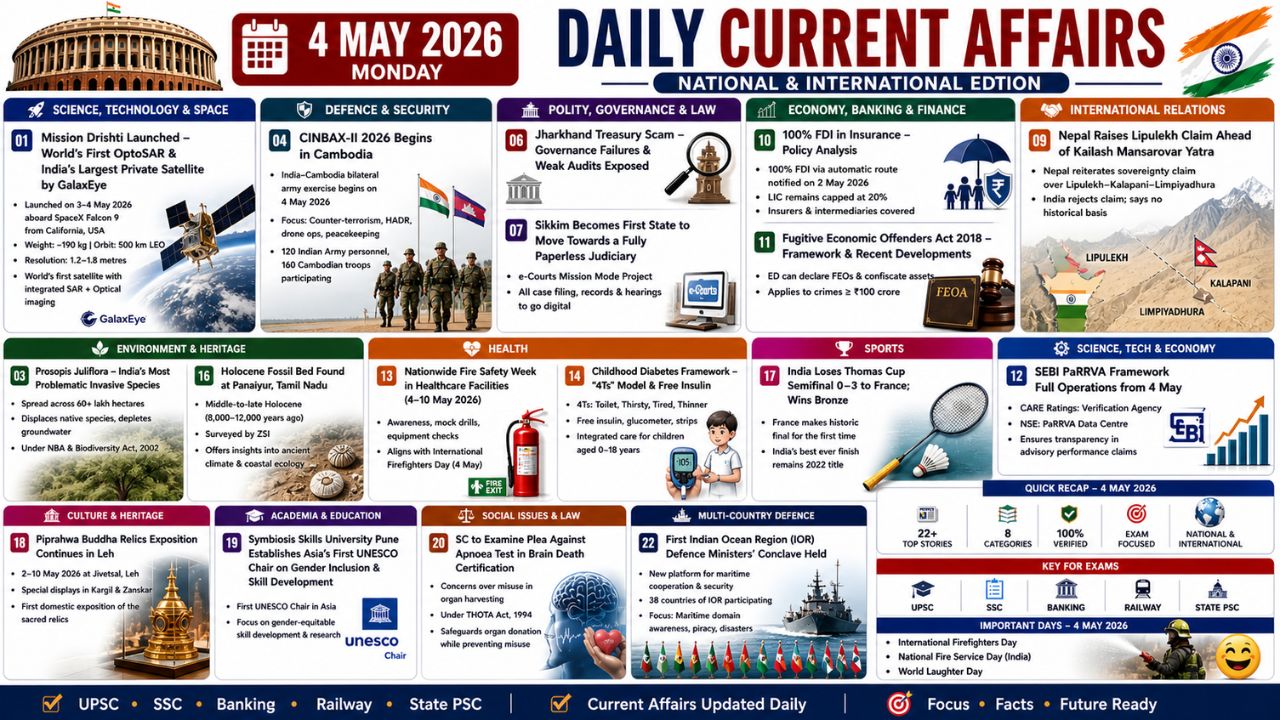
4 May 2026 Current Affairs is here — and it's packed with some of the most important national events that every competitive exam aspirant needs to know. Whether you are preparing for UPSC, SSC CGL, IBPS PO, Railway, or any State PSC exam, today's current affairs are loaded with high-weightage topics. The biggest story of the day is undoubtedly the launch of Mission Drishti — the world's first OptoSAR satellite by Bengaluru-based startup GalaxEye, hailed by PM Modi as a "major achievement in India's space journey." Alongside this, the CINBAX-II 2026 military exercise between India and Cambodia kicked off, the Enforcement Directorate celebrated its 70th founding anniversary with a record ₹81,422 crore in asset attachments, India's Thomas Cup 2026 campaign ended with a bronze medal, and Sikkim became the first state in India to move towards a fully paperless judiciary. From science and defence to governance, health, and sports — the current affairs of 4th May 2026 cover every section of your GK syllabus in one place. Read on, take notes, and stay ahead of your competition.
Science, Technology & Space
Mission Drishti Launched — India's Largest Private Satellite & World's First OptoSAR by GalaxEye
In a landmark achievement for India's private space sector, Bengaluru-based startup GalaxEye successfully launched Mission Drishti — the world's first OptoSAR satellite and India's largest privately developed Earth observation satellite — aboard a SpaceX Falcon 9 rocket from Vandenberg Space Force Base (SLC-4E), California, USA at approximately 12:29–12:30 PM IST on 3–4 May 2026. PM Narendra Modi hailed it as "a major achievement in our space journey," while Defence Minister Rajnath Singh said it "will strengthen capabilities in advanced Earth observation and strategic applications."
What is OptoSAR? OptoSAR stands for the integration of two complementary imaging technologies onto a single platform: Synthetic Aperture Radar (SAR) — which uses microwave signals to image the Earth regardless of cloud cover or darkness — and Electro-Optical/Multispectral Imaging (MSI) — which captures high-resolution optical imagery in daylight. Traditional Earth observation satellites carry only one sensor type. GalaxEye's breakthrough was developing a synchronisation technology stack that enables both sensors to observe the same location at the same time, eliminating the need to manually align datasets from different satellites. This makes Mission Drishti far more accurate and useful than conventional single-sensor satellites.
Key Specs: Weight: ~190 kg (heaviest satellite built by an Indian private company). Orbit: Sun-Synchronous Low Earth Orbit (LEO) at ~500 km altitude. Resolution: 1.2 to 1.8 metres. Facilitated by: IN-SPACe (Indian National Space Promotion and Authorisation Centre). GalaxEye was founded in 2020 by IIT Madras alumni. A precursor payload (GLX-SQ) flew on ISRO's PSLV-C60/POEM-4 mission in December 2024. GalaxEye plans to launch a constellation of 8–12 satellites by 2029, enabling revisit of any Earth location every 4 days or less. Applications include border surveillance, disaster management, agriculture monitoring, urban planning, and climate research. The mission is a strong validation of India's space policy reforms under IN-SPACe and the Space Policy 2023.
EU Carbon Border Adjustment Mechanism (CBAM) Fully Enforced — India Explores IBAM Response
With the European Union's Carbon Border Adjustment Mechanism (CBAM) entering full force on 1 January 2026, India is actively exploring strategic responses including a potential India Border Adjustment Mechanism (IBAM) — a domestic carbon pricing system that would allow India to retain carbon revenues rather than effectively paying a "carbon tax" to the EU on its exports.
What is CBAM? CBAM is the EU's mechanism to impose a carbon price on imports of carbon-intensive goods — including steel, cement, aluminium, fertilisers, electricity, and hydrogen — from countries that do not have equivalent carbon pricing systems. It is designed to prevent "carbon leakage" — the risk that EU climate regulations push high-carbon production outside the EU to countries with laxer standards. From January 2026, importers of covered goods must purchase CBAM certificates corresponding to the carbon price that would have been paid under EU's Emissions Trading System (ETS). For India, this is significant as the EU is its largest trading partner, and Indian exports of steel, aluminium, and chemicals face significant cost increases. The IBAM proposal would involve India setting its own domestic carbon tax or ETS, with export proceeds staying in India rather than flowing to the EU. Opportunities: Revenue retention for India's green transition, forced technological upgrading. Challenges: Compliance costs for MSMEs, competitiveness vis-à-vis non-CBAM competitors, data sovereignty concerns (sharing emission data with EU auditors), risk of becoming a "rule-taker" in global carbon standards.
Prosopis Juliflora — India's Most Problematic Invasive Plant Species in Focus
Prosopis juliflora, commonly known as Mesquite or Vilayati Babool, came under renewed ecological and policy attention in early May 2026. It is widely considered India's most problematic invasive plant species, having spread across over 60 lakh hectares of land — particularly in arid and semi-arid regions of Rajasthan, Gujarat, Andhra Pradesh, and Tamil Nadu.
Originally introduced to India in the 1870s during the British era for fuelwood, fodder, and to combat desertification, Prosopis juliflora rapidly spread beyond intended areas. Its ecological impacts are severe: it forms impenetrable monocultures that displace native vegetation, reduces biodiversity, competes aggressively for groundwater (its deep taproots can reach water tables), and makes soil inhospitable for other plants. Its thorns injure wildlife and livestock. However, it also has uses — as a source of fuelwood, charcoal, livestock fodder (pods), and in biomass energy — which creates a complex policy challenge for eradication efforts. Under India's Biological Diversity Act, 2002 and the National Biodiversity Authority (NBA), invasive species management is an ongoing challenge, with national and state-level action plans for control and removal of Prosopis juliflora in ecologically sensitive areas.
Defence & Security
CINBAX-II 2026 — India-Cambodia Bilateral Military Exercise Begins in Kampong Speu Province
The second edition of CINBAX (Cambodia-India Bilateral Army Exercise) — CINBAX-II 2026 commenced on 4 May 2026 at the Techo Sen Phnom Thom Mreas Prov Royal Cambodian Air Force Training Centre, Kampong Speu Province, Cambodia. Approximately 120 Indian Army personnel, primarily from the Maratha Light Infantry Regiment, and 160 Cambodian troops from the Royal Cambodian Army are participating in the two-week exercise.
CINBAX focuses on counter-terrorism, sub-conventional warfare, humanitarian assistance, and disaster relief (HADR). Training activities include: tactical combat drills, drone operations (reflecting modern warfare's UAV-centric nature), sniper and mortar training, and joint peacekeeping scenario drills that mirror real-world missions. The exercise enhances interoperability, coordination, and mutual strategic understanding between the two armies. India's military engagement with Cambodia reflects its broader "Act East" foreign policy and ASEAN outreach. Cambodia is a member of ASEAN and is strategically located in Southeast Asia — an important zone for India as it navigates China's growing influence in the region. India's bilateral military exercises with ASEAN nations include MITRA SHAKTI (Sri Lanka), BOLD KURUKSHETRA (Singapore), and GARUDA SHAKTI (Indonesia).
Enforcement Directorate (ED) Celebrates 70th Founding Anniversary — ₹81,422 Crore Attachments in FY 2025-26
The Enforcement Directorate (ED) celebrated its 70th Founding Anniversary on 1 May 2026. In its annual performance review, the ED reported attaching assets worth a record ₹81,422 crore in FY 2025-26 — marking a 171% surge over FY 2024-25. It maintained a conviction rate of 93–94% under the Prevention of Money Laundering Act (PMLA), and the average case lifecycle from investigation to charge filing has shrunk dramatically from 3–4 years to 1–1.5 years, reflecting improved efficiency through AI-assisted analytics and inter-agency coordination.
The Enforcement Directorate was established on 1 May 1956 under the Ministry of Finance, initially focused on exchange control violations. It has since evolved into India's premier financial crime investigation agency, now operating under the Prevention of Money Laundering Act (PMLA), 2002, the Foreign Exchange Management Act (FEMA), 1999, the Fugitive Economic Offenders Act (FEOA), 2018, and the Conservation of Foreign Exchange and Prevention of Smuggling Activities Act (COFEPOSA). The ED's mandate covers money laundering, foreign exchange violations, economic offences, and tracking Fugitive Economic Offenders (FEOs). A Fugitive Economic Offender is an individual who has left India to evade prosecution for a scheduled offence (total crime value ≥ ₹100 crore) or refuses to return. The ED has been instrumental in high-profile cases involving Vijay Mallya, Nirav Modi, Mehul Choksi, and more recently, digital fraud syndicates and cryptocurrency-linked crime networks.
Polity, Governance & Law
Jharkhand Treasury Scam — Governance Failures, Weak Audits & Ethical Lapses Exposed
The Jharkhand Treasury Scam came under intense national scrutiny in early May 2026, exposing deep-rooted governance failures, weak internal audits, and systemic ethical lapses within the state's public financial management system. Investigations revealed large-scale embezzlement of government funds through fraudulent withdrawals from the state treasury, often exploiting gaps in financial oversight mechanisms.
Treasury scams in India typically exploit weaknesses in the Public Financial Management System (PFMS) — the digital platform through which government disbursements are tracked. Key governance failures highlighted by the Jharkhand case include: absence of real-time audit trails; over-reliance on manual processes susceptible to manipulation; inadequate segregation of duties between authorisation, custody, and recording functions; and weak internal control frameworks at the department level. The case reinvigorates debates around strengthening India's Comptroller and Auditor General (CAG) of India's oversight capacity, implementation of the Government Accounting Standards, and the need for robust whistleblower protection under the Whistleblowers Protection Act, 2014. It also underscores the importance of the Public Accounts Committee (PAC) of state legislatures in providing parliamentary oversight over executive expenditure.
Sikkim Becomes First State to Move Towards a Fully Paperless Judiciary
Sikkim became the first state in India to move towards a fully paperless judiciary, as its High Court and district courts began transitioning all case management, filing, and record-keeping processes to fully digital platforms. The initiative is part of the broader e-Courts Mission Mode Project under the Department of Justice, Ministry of Law and Justice.
The e-Courts Project (Phase III), approved by the Cabinet in 2023 with an outlay of ₹7,210 crore, aims to achieve a fully digital, paperless judicial ecosystem across India — with features including e-filing, digital case management, virtual hearings, AI-assisted scheduling, and digital evidence management. Sikkim, being a small state with a relatively compact court system (compared to states like UP or Maharashtra with crores of pending cases), was well-positioned to pilot this transition. India currently has a backlog of over 5 crore cases across all courts — a major impediment to timely justice. Digitisation is seen as one of the key tools to improve case disposal rates, enhance transparency, and reduce the physical burden on litigants and lawyers. This development aligns with the National Mission for Justice Delivery and Legal Reforms, and with the Supreme Court's own push for digital courts post-COVID.
Hemant Soren Writes to President & PM Seeking 'Sarna' Religious Code in Census 2027
Jharkhand Chief Minister Hemant Soren wrote to President Droupadi Murmu and Prime Minister Narendra Modi, renewing the demand for a separate 'Sarna' religious code for tribal communities in the upcoming Census 2027. The demand has been a long-standing political and cultural aspiration of tribal communities across Jharkhand, Odisha, Chhattisgarh, West Bengal, and other states.
Sarna refers to the nature-based, animist religious tradition followed by millions of indigenous tribal people in India — particularly Adivasi communities like the Santals, Mundas, Oraons, and Ho. Sarna worshippers revere nature — particularly the sacred grove (Jaher) — and do not identify with Hinduism, Islam, Christianity, or any of the officially recognised religions in India's census. Currently, the census does not have a separate code for Sarna — tribal people who follow this faith are either counted under "Others" or assigned to the religion of whatever community surveyor fills in. Sorna advocates argue this undercount leads to denial of accurate demographic data and policy benefits. The demand for a Sarna code was passed by resolution in the Jharkhand Legislative Assembly in 2020. The constitutional and policy debate around Sarna intersects with issues of Scheduled Tribes status, Forest Rights, and the protection of indigenous cultural identity — key topics in GS-I (Diversity/Society) and GS-II (Governance) for UPSC.
Nepal Raises Lipulekh Sovereignty Claim Ahead of Kailash Mansarovar Yatra — India Rejects
Nepal reiterated its sovereignty claim over the Lipulekh–Kalapani–Limpiyadhura tri-junction region ahead of the Kailash Mansarovar Yatra 2026 via the Lipulekh Pass. India formally rejected Nepal's claim, stating there is no "historical basis" for Nepal's assertion, reviving one of the most sensitive bilateral territorial disputes between the two countries.
Lipulekh Pass (approximately 5,334 m) is located in the Pithoragarh district of Uttarakhand, India, and serves as one of the two main routes for the Kailash Mansarovar Yatra. It was the first Indian border post opened for trade with China in 1992, followed by Shipki La in Himachal Pradesh (1994) and Nathu La in Sikkim (2006). Nepal's claim is based on the Sugauli Treaty of 1816, under which the Kali River was accepted as the boundary — but the two sides disagree on which tributary constitutes the actual source of the Kali River. India updated its official political map in 2019 showing Lipulekh, Kalapani, and Limpiyadhura as part of its territory — a move Nepal strongly protested. Nepal subsequently updated its own political map to include these areas. The dispute remains unresolved through diplomatic dialogue and is a recurring point of bilateral friction.
Economy, Banking & Finance
100% FDI in Insurance — Policy Analysis and Implications for India's Financial Sector
The formal notification of 100% FDI in the insurance sector via the automatic route (announced 2 May 2026) generated significant policy debate on 4 May 2026. The evolution of FDI limits in Indian insurance: 26% (1999) → 49% (2015) → 74% (2021) → 100% (2026). The latest change flows from the Sabka Bima Sabki Raksha (Amendment of Insurance Laws) Act, 2025, amending the Insurance Act 1938, LIC Act 1956, and IRDAI Act 1999. LIC remains capped at 20% FDI.
Coverage of the new 100% FDI framework: Insurance companies (life, general, health); insurance intermediaries including insurance brokers, re-insurance brokers, insurance consultants, corporate agents, third-party administrators, surveyors and loss assessors, and managing general agents. Policy analysts recommended safeguards: offering domestic insurers targeted technology funds and a fair transition period; enforcing strict data localisation and cybersecurity norms for foreign-owned insurers; instituting a structured review every 2–3 years covering market concentration, rural coverage, and profit repatriation trends. India's insurance penetration stands at ~4% of GDP against a global average of ~7%, and the government hopes that global insurance capital and expertise will help bridge this gap — particularly in underpenetrated rural markets and health insurance. The Insurance Regulatory and Development Authority of India (IRDAI) has also been empowered under the new Act with search and seizure powers and authority to disgorge wrongful gains.
Fugitive Economic Offenders Act 2018 — Framework and Recent Developments
The Fugitive Economic Offenders Act (FEOA), 2018 and the Enforcement Directorate's powers under it came into renewed focus in May 2026, following the ED's record asset attachments. A Fugitive Economic Offender (FEO) is defined as an individual who: (1) has an active arrest warrant for a scheduled offence; (2) the total value of the crime is ₹100 crore or more; and (3) the person has left India to evade prosecution or refuses to return for trial.
The process: A Director or Deputy Director of the ED (appointed under PMLA) files an application before a Special Court (Prevention of Money Laundering) to declare someone an FEO. Once declared, their properties — both in India and abroad — can be confiscated to the Central Government without the individual being required to be present in court. This is a significant departure from normal criminal law and was specifically designed to address cases like Vijay Mallya, Nirav Modi, and Mehul Choksi — high-profile accused who fled India before prosecution. The Act has been used to confiscate prime properties in India belonging to fugitives. India also pursues extradition through bilateral extradition treaties — currently operational with about 50 countries — and INTERPOL Red Notices for international coordination.
SEBI PaRRVA Framework — CARE Ratings & NSE Roles Explained; Full Operations from 4 May
SEBI's PaRRVA (Past Risk and Return Verification Agency) framework commenced full-scale operations on 4 May 2026, following the successful pilot phase that began in December 2025. CARE Ratings Limited is the designated verification agency, and the National Stock Exchange (NSE) functions as the PaRRVA Data Centre (PDC).
Under this framework, SEBI-registered investment advisers, research analysts, and algorithmic trading service providers must have their claimed historical performance data — risk-adjusted returns, drawdowns, and benchmark comparisons — independently verified by PaRRVA before they can use these figures in client communications, advertisements, or marketing materials. This directly addresses a major investor protection gap: the proliferation of unverified, cherry-picked, or fabricated performance claims by unscrupulous advisers, particularly on social media platforms. India has seen a surge in retail investor participation — demat accounts crossed 18 crore in 2026 — making investor protection more critical than ever. SEBI's PaRRVA framework positions India's regulatory framework as among the most advanced globally in mandating independent verification of advisory performance claims.
Health
Nationwide Fire Safety Week Observed in Healthcare Facilities — 4 to 10 May 2026
The Union Ministry of Health and Family Welfare launched a nationwide Fire Safety Week from 4 to 10 May 2026 across all healthcare facilities in India — including government hospitals, private hospitals, nursing homes, and clinics. The week is dedicated to fire safety awareness, mock drills, equipment checks, and staff training on emergency evacuation procedures.
Hospital fires are among the deadliest categories of fire incidents — patients are often immobile, sedated, or on life support, making evacuation exceptionally challenging. India has witnessed several devastating hospital fires in recent years — including the 2011 AMRI Hospital fire in Kolkata (which killed 94 people) and multiple other incidents across states. Hospitals are required to comply with fire safety norms under the National Building Code of India (NBC), Fire Prevention and Fire Safety Act provisions, and National Accreditation Board for Hospitals (NABH) standards. International Firefighters Day is also observed on 4 May globally, honouring the courage and sacrifice of firefighters worldwide. The Health Ministry's fire safety week aligns these two observances with a practical, institution-level safety push.
Childhood Diabetes National Framework — "4Ts" Model, Free Insulin, Integrated Care Pathway
India's newly launched Guidance Document on Diabetes Mellitus in Children was elaborated in detail on 4 May 2026. The framework introduces a structured, Integrated Continuum of Care linking community screening centres, district hospitals, and tertiary medical colleges into a seamless referral chain for children aged 0–18 years.
The "4Ts" Early Awareness Model is one of the most memorable aspects of the framework: Toilet (frequent urination), Thirsty (excessive thirst / polydipsia), Tired (fatigue and weakness), and Thinner (unexplained weight loss) — the four key early warning symptoms of Type 1 Diabetes in children. These are to be communicated to community health workers, ASHA workers, school teachers, and parents nationwide for early identification. The framework provides for a comprehensive free-of-cost care package at public health facilities — including insulin therapy, glucometers, test strips, regular follow-ups, and HbA1c monitoring. It also emphasises training of families and teachers in insulin administration and emergency response to hypoglycaemic episodes. The framework is to be integrated with the National Programme for Non-Communicable Disease Control and Prevention (NP-NCD/NPCDCS) under the National Health Mission.
Environment & Heritage
17th Petersberg Climate Dialogue Held in Berlin — India Participates Ahead of COP31
Ministers from 30+ countries gathered in Berlin, Germany for the 17th Petersberg Climate Dialogue — a high-level informal forum convened ahead of COP31 under the UNFCCC. The dialogue was co-hosted by Germany together with the COP31 Presidency partners — Türkiye and Australia.
The Petersberg Climate Dialogue was launched in 2010 after COP15 (Copenhagen) to provide an informal, frank discussion forum outside the formal UNFCCC negotiating structure. It aims to build political consensus, address contentious negotiating blocks, and prepare the groundwork for successful COPs. The 2026 dialogue's focus areas include: climate finance for developing nations (a major flashpoint — the failure to deliver the $100 billion annual climate finance pledge has undermined trust), geopolitical risks from fossil fuel dependence in the context of the West Asia conflict and global energy disruptions, and electrification in mobility and industry as a key decarbonisation pathway. India — as a major developing economy with rapidly growing energy needs — plays a critical bridging role between developed nations (pushing aggressive mitigation) and the Global South (prioritising development rights and adaptation finance). The COP31, to be jointly hosted by Türkiye and Australia in 2026, will be a pivotal moment for global climate governance.
Middle-to-Late Holocene Fossil Bed Discovered at Panaiyur, Tamil Nadu — ZSI Survey
A significant fossil bed dating to the middle-to-late Holocene epoch (approximately 8,000–12,000 years ago) was discovered at Panaiyur village in Thoothukudi (Tuticorin) district, Tamil Nadu. The site was first identified following heavy rains in 2023, which exposed fossil deposits, and was subsequently surveyed and documented by the Zoological Survey of India (ZSI).
Key findings: The discovery enriches India's Quaternary fossil record — the geological period covering the last 2.6 million years, characterised by repeated glaciations. The site offers valuable insights into climatic and ecological changes in the coastal Tamil Nadu region during the Holocene. Geological features like cross-stratification and bioturbation help scientists reconstruct ancient coastal environments, shorelines, and biodiversity. However, the exposed fossil deposits face threats from natural erosion, prompting urgent conservation measures. Separately, prehistoric rock paintings were discovered at Vellarikkombai village in Nilgiris district, Tamil Nadu during a field survey by Yaakkai Trust, further adding to Tamil Nadu's rapidly growing archaeological heritage portfolio. These discoveries underscore the cultural and scientific importance of heritage protection under the Archaeological Survey of India (ASI) and the Ancient Monuments and Archaeological Sites and Remains (AMASR) Act, 1958.
Sports
India Loses Thomas Cup 2026 Semifinal 0–3 to France — Wins Bronze; France Makes Historic Final
India's campaign at the Thomas Cup 2026 ended at the semifinal stage after a disappointing 0–3 defeat to France on 4 May 2026. France dominated all three singles matches: Christo Popov defeated Ayush Shetty, Alex Lanier overcame Kidambi Srikanth, and Toma Junior Popov beat HS Prannoy. France made Thomas Cup history by reaching the final for the first time ever.
India's performance was significantly weakened by the absence of Lakshya Sen due to injury — widely considered India's strongest singles player and ranked in the world's top 10. Despite the loss, India's semifinal finish guarantees a bronze medal — consistent with their historical Thomas Cup performances. India had created history by winning the Thomas Cup for the first time in 2022, defeating Indonesia. The Thomas Cup (men's team championship) and Uber Cup (women's) are the premier international team badminton competitions organised by the Badminton World Federation (BWF). India's men's badminton depth — beyond Lakshya Sen — remains an area of focus: the emergence of Ayush Shetty and others from the junior pipeline is encouraging, but matching elite European and Asian nations consistently requires further investment in the talent ecosystem.
Culture, Heritage & Social
Piprahwa Buddha Relics Exposition Continues in Leh — Special Displays in Kargil & Zanskar
The historic international public exposition of the sacred Piprahwa Relics of Tathagata (Lord Buddha) continued in Leh, Ladakh, running from 2 to 10 May 2026 at Jivetsal. The exposition also included special displays in Kargil and Zanskar — ensuring broader access for Buddhist communities across the geographically vast Ladakh region. The relics were transported from the National Museum, New Delhi via an Indian Air Force aircraft and were received with full state honours and extensive public participation.
The Piprahwa Relics are a collection of bone fragments, crystal caskets, gold ornaments, and gemstones discovered in 1898 at the Piprahwa Stupa in Uttar Pradesh by British engineer William Claxton Peppé, with a Brahmi inscription linking them to the Sakya clan (~3rd century BC). This is reportedly the first domestic exposition of the relics outside their preservation site, having previously only been displayed internationally. The occasion coincides with Buddha Purnima (1 May 2026) and carries deep spiritual significance for Buddhist communities in Ladakh, across India, and globally. The term Tathagata is a title for Gautama Buddha meaning "one who has attained enlightenment." In Mahayana and Vajrayana traditions (predominant in Ladakh), the Five Tathagatas (Pancha Buddha) symbolise aspects of wisdom and compassion.
Symbiosis Skills University Pune Establishes Asia's First UNESCO Chair on Gender Inclusion & Skill Development
Symbiosis Skills and Professional University (SSPU), Pune established Asia's first UNESCO Chair on Gender Inclusion and Skill Development — a landmark achievement for Indian higher education and a recognition of India's growing role in global education diplomacy. UNESCO Chairs are established under UNESCO's UNITWIN (University Twinning and Networking) Programme and involve universities that have demonstrated outstanding work in a specific academic and research area.
The UNESCO Chair on Gender Inclusion and Skill Development at SSPU will focus on: research and policy advocacy on gender-equitable vocational and technical education; developing model curricula for gender-sensitive skill training; cross-national collaborative research with UNESCO member universities; and building knowledge networks on women's economic empowerment through skills. India has been increasingly active in the UNESCO ecosystem — India contributes to UNESCO's budget, has World Heritage Sites, and participates actively in UNESCO's education, science, and cultural programmes. The establishment of such a Chair in India (and specifically, the first in Asia) reflects the growing recognition of Indian academic institutions as global research leaders in the education-development nexus.
International Firefighters Day — Observed on 4 May 2026
International Firefighters Day (IFFD) is observed globally on 4 May every year to honour the courage, sacrifice, and dedication of firefighters who protect lives, property, and the environment. The day is symbolised by a red and blue ribbon — red representing fire and blue representing water.
The origin of International Firefighters Day traces to 1998, following a proposal by an Australian firefighter in memory of five volunteer firefighters who died fighting a wildfire in Linton, Victoria, Australia on 2 December 1998. The proposal gained global traction and 4 May was chosen as it coincides with the feast day of Saint Florian — the patron saint of firefighters in many Christian traditions. In India, fire safety governance involves the State Fire Services (fire services are a State subject under the Constitution), with national oversight through the National Fire Service College (NFSC), Nagpur — the apex training institution for fire services in India. The Fourteenth Finance Commission had recommended specific grants for fire services modernisation. The Health Ministry's Fire Safety Week (4–10 May) running concurrently makes this observance particularly relevant in 2026.
SC to Examine Plea Against Apnoea Test in Brain Death Certification — Organ Transplant Law
The Supreme Court of India agreed to examine a petition challenging practices related to brain death certification — specifically, concerns that the apnoea test (the key clinical confirmatory test for brain death) is being misused or improperly conducted to facilitate organ harvesting. The SC's scrutiny focuses on whether malpractices in brain death determination are endangering patients who may not meet the strict legal definition of brain death.
Brain death is the irreversible cessation of all brain-stem functions, including the ability to breathe independently. Under Indian law — the Transplantation of Human Organs and Tissues Act (THOTA), 1994 and its 2011 amendment — and guidelines of the National Organ and Tissue Transplant Organisation (NOTTO), brain death is certified by a 4-member medical panel comprising a neurologist or neurosurgeon, the treating doctor, and two other certified doctors. The Apnoea Test specifically checks whether the patient can breathe independently without ventilator support: the patient is temporarily disconnected from the ventilator to see if spontaneous breathing begins. Other confirmatory tests include EEG (checking brain electrical activity), cerebral angiography (checking blood flow to brain), and assessment of brainstem reflexes. The SC case highlights governance gaps in India's organ donation and transplantation system — a system that saves lives but requires extremely robust safeguards to prevent potential misuse.
First Indian Ocean Region (IOR) Defence Ministers' Conclave Held — India's New Maritime Diplomacy Platform
The first-ever Indian Ocean Region (IOR) Defence Ministers' Conclave was held, establishing a new multilateral defence and security dialogue platform for nations in the Indian Ocean Region. This inaugural edition marks a significant step in India's maritime diplomacy, reinforcing its commitment to peace, stability, and cooperative security in the Indo-Pacific.
The Indian Ocean Region encompasses 38 countries across South Asia, Southeast Asia, East Africa, and the Middle East, connected by the world's most strategically important sea lanes — through which approximately 80% of global seaborne oil trade and a significant share of global maritime commerce passes. India, given its central geographical location in the IOR with a 7,500 km coastline, naturally positions itself as the "net security provider" in the region. The conclave's objectives include: strengthening defence cooperation and interoperability; enhancing maritime domain awareness (MDA); building mutual trust for regional stability; and addressing common threats including piracy, terrorism, and climate-related maritime disasters. This forum complements India's existing multilateral maritime engagements including the Indian Ocean Naval Symposium (IONS) and the Indian Ocean Rim Association (IORA).
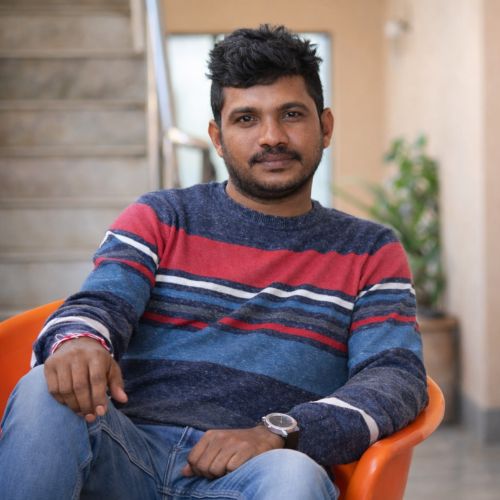
Written by
Koti Deva
Digital Marketing Specialist
Koti is a Digital Marketing Specialist with over 10 years of experience and the co-founder of MCQ Orbit — a free exam prep platform built for Indian competitive exam aspirants.
With strong personal knowledge in Quantitative Aptitude, Logical Reasoning, and Mathematics, Koti has a deep understanding of what it takes to crack exams like SSC CGL, IBPS PO, SBI Clerk, UPSC Prelims, NEET, and JEE. Having followed these exams closely for years, he understands the exact topics, patterns, and shortcuts that matter most.
MCQ Orbit was born from a simple desire — to build a platform where every aspirant in India can practice quality MCQs, read reliable current affairs, and prepare confidently, without paying a rupee. Koti combines his digital expertise with his passion for competitive exams to create content that is accurate, practical, and genuinely useful for students.
His mission is straightforward: if the right guidance had been freely available earlier, more students would have cracked their dream exams. MCQ Orbit is his way of making that happen.
Comments
No comments yet.