
Current Affairs 29 April 2026 | 29th April 2026 Current Affairs | Daily GK Updates
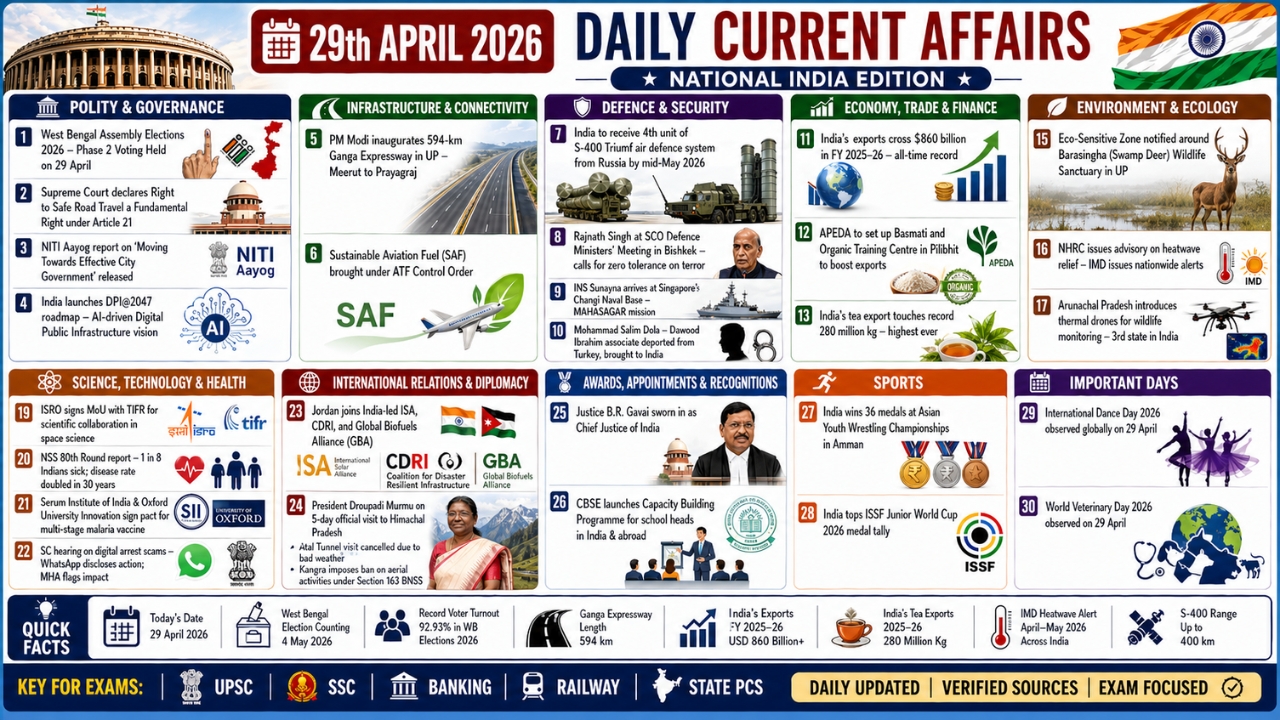
Stay updated with the most important 29th April 2026 current affairs covering national, international, economy, governance, defence, science, environment, and infrastructure developments. These daily current affairs are essential for aspirants preparing for UPSC, SSC, Banking, Railways, State PSC, Defence, and other competitive exams. Our carefully curated current affairs today section highlights major government decisions, policy reforms, landmark Supreme Court judgments, defence updates, international diplomacy, economic milestones, and scientific advancements from April 2026 current affairs. Regular practice of daily current affairs helps improve general awareness, boosts exam performance, and keeps learners informed about the latest happenings around India and the world. Explore the complete 29 April 2026 current affairs below for accurate, exam-focused, and easy-to-understand updates.
Polity & Governance
West Bengal Assembly Elections 2026 — Phase 2 Voting Held on 29 April
The second and final phase of West Bengal Legislative Assembly Elections 2026 was held on 29 April 2026, covering 142 constituencies. The Election Commission of India deployed over 3.5 lakh (350,000) security personnel statewide — notably including the National Investigation Agency (NIA) for the first time in a state election — amid reports of localised violence in Howrah and Hooghly districts.
Phase 1 had been held on 23 April 2026 covering 152 constituencies. Both phases together elected all 294 members of the West Bengal Legislative Assembly. The elections recorded a historic voter turnout of 92.93% — the highest ever in the state, surpassing the 2011 election. Counting of votes is scheduled for 4 May 2026, and the tenure of the current assembly ends on 7 May 2026.
The election was primarily contested between the ruling Trinamool Congress (TMC) led by Chief Minister Mamata Banerjee (seeking a record fourth term) and the Bharatiya Janata Party (BJP). The campaign was shaped by debates over electoral rolls and citizenship, border security and undocumented migration, women's safety, employment, and anti-incumbency after 15 years of TMC rule. The TMC ultimately won the election, securing 215 out of 294 seats, with Mamata Banerjee sworn in as Chief Minister again.
Supreme Court Declares Right to Safe Road Travel a Fundamental Right Under Article 21
The Supreme Court of India officially declared that the 'Right to Safe Road Travel' is an integral part of the Right to Life under Article 21 of the Constitution. The landmark judgment was delivered in the matter of "In Re: Phalodi Accident", where the Court examined issues related to road safety and accountability on highways and expressways.
The Court issued several key directives: It banned unauthorised dhabas and eateries on the Right of Way (ROW) of National Highways and mandated that no new licences or No Objection Certificates (NOC) can be issued without approval from the National Highways Authority of India (NHAI). The judgment expands the scope of Article 21 by recognising commuter safety as a fundamental right and emphasises the State's constitutional duty to ensure safe infrastructure and prevent avoidable loss of life. This ruling has significant implications for road design, crash barriers, highway lighting, and accountability of road construction agencies. India records over 1.5 lakh road accident deaths annually, making this one of the most pressing public health and infrastructure issues in the country.
NITI Aayog Report on 'Moving Towards Effective City Government' Released
Union Minister Manohar Lal Khattar (Ministry of Housing and Urban Affairs — MoHUA) released the NITI Aayog report titled 'Moving Towards Effective City Government — A Framework for Million-plus Cities' at the India Habitat Centre, New Delhi. The report addresses the structural and institutional challenges facing India's fastest-growing urban centres.
The report identifies persistent governance issues in India's million-plus cities, including weak and fragmented leadership structures, constrained fiscal capacity (most urban local bodies depend heavily on central and state grants rather than own-source revenues), and institutional capacity gaps that limit efficient service delivery and urban performance. It stresses the need to strengthen Mayors' powers, rationalise the three-tier government structure (Union–State–Municipal), and position million-plus cities as key engines of national economic growth. India is expected to have 87 cities with populations exceeding one million by 2050. The report aligns with goals under the Smart Cities Mission, PM Awaas Yojana (Urban), and the broader vision of urban India as a driver of the $5 trillion economy target.
India Launches DPI@2047 Roadmap — AI-Driven Digital Public Infrastructure Vision
India released the DPI@2047 roadmap, outlining a transformative vision for the country's Digital Public Infrastructure (DPI) over the next two decades, with AI as a core enabler. The roadmap positions India's DPI not merely as a tool for digital access, but as a platform for capability building, productivity enhancement, and wealth creation at population scale.
Key pillars of the DPI@2047 roadmap include: Iterative Transformation Cycles — adopting 2-year cycles starting with MSME and Agriculture sectors in 2026–27 to build replicable models before scaling; District-Level Demand Aggregation — using district programs to aggregate demand for digital solutions and create a predictable pipeline for local tech entrepreneurs; AI-DPI Convergence — integrating AI as a first-response assistant to provide personalised, vernacular guidance to farmers, teachers, and small business owners; and establishing a globally focused neutral ecosystem body by 2027 to lead international DPI collaboration and showcase India's models to other developing nations. India's DPI stack — comprising Aadhaar, UPI, DigiLocker, ONDC, Ayushman Bharat Digital Mission, and others — is already globally recognised as a model for inclusive digital transformation.
Infrastructure & Connectivity
PM Modi Inaugurates 594-km Ganga Expressway in Uttar Pradesh — Meerut to Prayagraj
Prime Minister Narendra Modi inaugurated the 594-kilometre-long Ganga Expressway in Uttar Pradesh on 29 April 2026 at a ceremony in Hardoi. This is UP's longest expressway and one of the biggest road infrastructure projects in India, built at a cost of ₹36,230 crore.
The expressway connects Meerut to Prayagraj and passes through 12 districts including Meerut, Hapur, Bulandshahr, Shahjahanpur, Hardoi, and Prayagraj. It will reduce travel time between Meerut and Prayagraj from the current 10–12 hours to 6–8 hours and is expected to save fuel costs by up to 30%. It is designed as a 6-lane road expandable to 8 lanes, with a design speed of 120 kmph.
Notably, Adani Road Transport Limited (ARTL) — the roads arm of Adani Enterprises Limited — developed 464 km (approximately 80%) of the total 594 km alignment, deploying over 12,000 workers at peak construction. PM Modi described the Ganga Expressway as the "new lifeline" of Uttar Pradesh, drawing a parallel to the Ganga river's historical significance for the state. UP now has a growing network of expressways including the Yamuna, Agra-Lucknow, Purvanchal, Bundelkhand, and Gorakhpur Link Expressways, cementing its position as the expressway capital of India.
Sustainable Aviation Fuel (SAF) Brought Under ATF Control Order
The central government brought Sustainable Aviation Fuel (SAF)-blended fuel under the Aviation Turbine Fuel (ATF) Control Order, enabling regulation of pricing and distribution of eco-friendly aviation fuel across India. This is a key step in India's commitment to reducing carbon emissions from the aviation sector.
SAF is produced from sustainable sources such as agricultural residues, municipal solid waste, and algae — as opposed to conventional fossil-based jet fuel. Blending SAF with conventional ATF can reduce lifecycle carbon emissions by up to 80% compared to unblended jet fuel. India's aviation sector is one of the fastest-growing in the world, with passenger traffic expected to triple by 2040. The inclusion of SAF under the ATF Control Order gives the government pricing authority and ensures that SAF blending mandates (which are being introduced in phases) can be systematically enforced across airlines and fuel suppliers. This aligns with India's National Biofuel Policy, 2018 and its broader Net Zero commitments.
Defence & Security
India to Receive 4th Unit of S-400 Triumf Air Defence System from Russia by Mid-May 2026
India is set to receive its fourth unit (regiment) of the S-400 Triumf air defence system from Russia by mid-May 2026, which will be deployed along the western border with Pakistan. The delivery comes in the backdrop of heightened tensions following Operation Sindoor, during which the S-400 systems already deployed proved their effectiveness in India's multi-layered air defence network.
India signed a $5.43 billion deal with Russia in 2018 for five S-400 Triumf regiments despite pressure from the United States, which had warned of potential CAATSA (Countering America's Adversaries Through Sanctions Act) sanctions. The S-400 is regarded as one of the world's most advanced surface-to-air missile systems, capable of simultaneously tracking up to 160 targets and engaging up to 80 targets at a range of up to 400 km. It can engage aircraft, ballistic missiles, and cruise missiles. The system significantly enhances India's ability to deter aerial threats from both Pakistan and China simultaneously, making it a cornerstone of India's integrated air defence posture.
Rajnath Singh at SCO Defence Ministers' Meeting in Bishkek — Calls for Zero Tolerance on Terror
Defence Minister Rajnath Singh attended the Shanghai Cooperation Organisation (SCO) Defence Ministers' Meeting in Bishkek, Kyrgyzstan. He issued a strong warning against terrorism, reiterating India's position of zero tolerance for cross-border terrorism and called on all member nations to take collective action against terror networks operating from their soil.
On the sidelines, Rajnath Singh held bilateral talks with defence counterparts from Russia, China, and Belarus, focusing on regional security, defence cooperation, and bilateral defence trade. India became a full member of the SCO in 2017 at the Astana Summit. The SCO is a Eurasian political, economic, and military alliance headquartered in Beijing. Its members include China, Russia, India, Pakistan, Kazakhstan, Kyrgyzstan, Tajikistan, Uzbekistan, and Iran. India uses SCO platforms to push its counter-terrorism agenda, while also managing complex relationships with China and Pakistan within the multilateral framework.
INS Sunayna Arrives at Singapore's Changi Naval Base — MAHASAGAR Mission
Indian Naval Ship INS Sunayna arrived at Singapore's Changi Naval Base as part of Mission Sagar (MAHASAGAR initiative), strengthening India's maritime diplomacy and naval presence in the Indo-Pacific region. The deployment reinforces bilateral defence cooperation between India and Singapore.
MAHASAGAR stands for Maritime Alliance for Humanitarian Assistance and Security — Action for Geo-strategic And Resilient cooperation. It is India's flagship naval outreach initiative under the broader SAGAR (Security and Growth for All in the Region) doctrine articulated by PM Modi. INS Sunayna is an Offshore Patrol Vessel (OPV) of the Indian Navy, primarily used for coastal surveillance, Exclusive Economic Zone (EEZ) patrol, anti-piracy operations, and humanitarian assistance. India and Singapore share deep defence ties, including the India-Singapore Bilateral Agreement for the Provision of Logistics, Joint Military Exercises (Bold Kurukshetra, Simbex, Prabal Dostyq), and Singapore's unique access to Indian training grounds.
Mohammad Salim Dola — Dawood Ibrahim Associate Deported from Turkey, Brought to India
Mohammad Salim Dola, a close aide of fugitive underworld don Dawood Ibrahim, was deported from Turkey and brought back to India on 28 April 2026. This marks a significant development in India's ongoing efforts to dismantle organised crime networks with international links and to bring fugitives to justice.
Dawood Ibrahim, India's most wanted criminal, is believed to be based in Pakistan and is designated as a global terrorist by the United States. He heads the D-Company, one of the world's most powerful criminal organisations, linked to drug trafficking, extortion, contract killings, and the 1993 Mumbai serial blasts. The deportation of Salim Dola from Turkey underscores the effectiveness of India's international law enforcement cooperation and bilateral extradition and deportation frameworks. India has been actively pursuing Dawood's associates globally — the return of Dola adds pressure on D-Company's operational networks within India.
Economy, Trade & Finance
India's Exports Cross $860 Billion in FY 2025–26 — All-Time Record
Commerce Minister Piyush Goyal announced that India's total exports (merchandise + services) crossed $860 billion in the financial year 2025–26, reflecting a strong external trade performance despite significant global headwinds including geopolitical tensions, supply chain disruptions, and sluggish demand in key trading partners.
This achievement underscores India's growing resilience in international markets. India's services exports — particularly IT, software, business process outsourcing, and financial services — have been a major driver of total export growth. On the merchandise side, key contributors included engineering goods, pharmaceuticals, chemicals, and textiles. India has been actively pursuing new markets in Africa, Latin America, and Southeast Asia as part of its export diversification strategy. Commerce Minister Goyal termed this a milestone in India's journey towards becoming a $1 trillion export economy — one of the government's stated medium-term goals.
APEDA to Set Up Basmati and Organic Training Centre in Pilibhit to Boost Exports
The Agricultural and Processed Food Products Export Development Authority (APEDA) announced plans to set up a Basmati and Organic Training Centre in Pilibhit, Uttar Pradesh, aimed at improving farmers' knowledge of organic farming practices, Basmati cultivation standards, and export compliance requirements.
APEDA functions under the Ministry of Commerce and Industry and is mandated to develop and promote exports of scheduled agricultural and processed food products. Pilibhit is a key Basmati-growing district in UP's Terai region. India is the world's largest exporter of Basmati rice, with major buyers including Saudi Arabia, Iran, UAE, Iraq, and the US. The centre will train farmers on Good Agricultural Practices (GAP), pesticide residue management (a major non-tariff barrier in export markets), organic certification procedures (for markets like the EU and US), and traceability systems. This initiative aligns with India's push to scale up organic exports, which currently stand at over $1.5 billion annually.
India's Tea Export Touches Record 280 Million Kg — Highest Ever
India exported around 280 million kilograms of tea in 2025–26 — the highest ever recorded in the country's tea export history. Despite global challenges, the tea industry performed strongly, backed by consistent demand from key buyers. Major export destinations included Iran, Iraq, UAE, Russia, and other CIS countries.
India is the world's second largest tea producer (after China) and the fourth largest tea exporter globally. The tea industry employs over 3.5 million people — making it one of the largest private-sector employers in India, particularly in Assam and West Bengal. Assam and West Bengal together account for over 75% of India's total tea production. The record export figure comes despite competition from Kenya, Sri Lanka, and China, and reflects India's success in diversifying export markets and investing in specialty teas (Darjeeling, Assam Orthodox) which command premium prices. The Tea Board of India, under the Ministry of Commerce, oversees the sector.
Environment & Ecology
Eco-Sensitive Zone Notified Around Barasingha (Swamp Deer) Wildlife Sanctuary in UP
The Ministry of Home Affairs (MHA) drafted a notification to declare an Eco-Sensitive Zone (ESZ) around the Barasingha Wildlife Sanctuary in Uttar Pradesh, aiming to protect the habitat of the endangered Swamp Deer (Barasingha — Rucervus duvaucelii).
Eco-Sensitive Zones (ESZs) are areas notified around Protected Areas (National Parks, Wildlife Sanctuaries, Biosphere Reserves) under the Environment (Protection) Act, 1986, following Supreme Court directions. They act as a "shock absorber" between the core protected area and the surrounding human activity zones, regulating or prohibiting certain activities while allowing others with conditions. The Barasingha (Swamp Deer) is the state animal of Madhya Pradesh and is listed as Vulnerable on the IUCN Red List. Its largest population is found in Kanha Tiger Reserve, Madhya Pradesh. The UP notification is aimed at protecting isolated pockets of swamp deer population in the Terai belt. Threats to Barasingha include wetland drainage, agricultural encroachment, and hunting.
NHRC Issues Advisory on Heatwave Relief — IMD Issues Nationwide Alerts
The National Human Rights Commission (NHRC) urged all state governments and the Delhi government to strengthen heatwave relief measures as temperatures soared across India in late April 2026. The India Meteorological Department (IMD) simultaneously issued nationwide heatwave alerts, with forecasts of severe heat conditions across multiple regions during April–May 2026.
The NHRC's intervention underscores the constitutional and human rights dimension of climate-induced extreme heat, framing heatwaves as a public health emergency particularly affecting outdoor workers, the elderly, children, and marginalised communities. A heatwave is declared when the maximum temperature of a station reaches at least 40°C for plains and 30°C for hilly regions, AND the departure from normal is +4.5°C to +6.4°C (severe heatwave: departure exceeds +6.4°C). Heatwaves are estimated to cost India up to 2% of its GDP annually through lost labour productivity and healthcare burdens. The government's National Action Plan on Heat-Related Illnesses and state-level Heat Action Plans (HAPs) are the primary response frameworks.
Arunachal Pradesh Introduces Thermal Drones for Wildlife Monitoring — 3rd State in India
Arunachal Pradesh introduced high-tech thermal drones to enhance wildlife monitoring and rescue operations, making it the third state in India to adopt this advanced technology. The drones are being deployed in the state's dense forested areas for surveillance, anti-poaching activities, and monitoring animal movement patterns.
Thermal drones detect heat signatures (infrared radiation) emitted by living organisms, making them highly effective in dense forest cover and night-time operations where conventional visual surveillance is impossible. They can track tigers, elephants, rhinos, and other wildlife; detect poachers; and assist in real-time rescue operations during human-wildlife conflicts. Arunachal Pradesh is a biodiversity-rich state hosting part of the Eastern Himalayan Biodiversity Hotspot and is home to rare species including the Clouded Leopard, Snow Leopard, Gayal (Mithun), and numerous endemic bird species. The adoption of thermal drones reflects India's growing investment in technology-driven wildlife protection — part of the broader framework of Project Tiger, Project Elephant, and state wildlife action plans.
Science, Technology & Health
ISRO Signs MoU with TIFR for Scientific Collaboration in Space Science
The Indian Space Research Organisation (ISRO) signed a Memorandum of Understanding (MoU) with the Tata Institute of Fundamental Research (TIFR) on 20 April 2026 for scientific collaboration in space science, technology, and exploration. The partnership will enhance India's research capabilities and foster a deeper industry-academia nexus in space sciences.
TIFR is one of India's premier fundamental research institutions, known for its world-class work in physics, chemistry, biology, mathematics, and computer science. The ISRO-TIFR partnership is expected to accelerate research in areas such as astrophysics, atmospheric science, planetary science, and space-based instrumentation. It also aligns with the vision of the newly constituted IN-SPACe (Indian National Space Promotion and Authorisation Centre), which encourages collaboration between government space agencies and academic institutions. This MoU forms part of ISRO's broader strategy to build India's long-term scientific space capabilities, critical for future missions like Gaganyaan, Chandrayaan-4, Mangalyaan-2, and the Indian Space Station.
NSS 80th Round Report — 1 in 8 Indians Sick; Disease Rate Doubled in 30 Years
The National Statistical Office (NSO) released the 80th Round NSS (2025) report on Household Social Consumption: Health, revealing alarming data on India's rising disease burden. The report found that approximately 1 in 8 Indians were reporting illness during the reference period, and the rate of disease has effectively doubled over the past 30 years.
The report highlights India's ongoing epidemiological transition — a shift from infectious diseases to non-communicable diseases (NCDs) such as diabetes, hypertension, cardiovascular disease, and cancer. Key findings include demographic disparities (the elderly, women, and rural populations bearing a disproportionate disease burden), rising out-of-pocket health expenditure despite government schemes like Ayushman Bharat – PM Jan Arogya Yojana (AB-PMJAY), and inadequate rural healthcare infrastructure. The NSS uses a 15-day recall period for morbidity estimation. The findings underline the urgent need to strengthen India's primary healthcare infrastructure, expand PMJAY coverage, and invest in preventive healthcare, in line with the National Health Policy, 2017 target of raising public health expenditure to 2.5% of GDP.
Serum Institute of India & Oxford University Innovation Sign Pact for Multi-Stage Malaria Vaccine
Oxford University Innovation and the Serum Institute of India (SII) signed a pact to develop a new multi-stage malaria vaccine. The agreement covers development, large-scale manufacturing, and future commercialisation of the vaccine candidate, which targets multiple stages of the malaria parasite lifecycle.
The Serum Institute of India, headquartered in Pune, is the world's largest vaccine manufacturer by volume. It has previously worked with Oxford on the Covishield (AstraZeneca) COVID-19 vaccine. The new multi-stage malaria vaccine aims to improve on earlier candidates like the R21/Matrix-M vaccine, which Oxford developed with SII and which received WHO recommendation in 2023. Malaria remains one of the world's deadliest infectious diseases, killing over 600,000 people annually — predominantly in Sub-Saharan Africa and parts of South Asia. A multi-stage vaccine approach enhances effectiveness by targeting the parasite at different points in its lifecycle, making it harder for the parasite to evade immunity. This partnership reinforces India's position as the "pharmacy of the world."
SC Hearing on Digital Arrest Scams — WhatsApp Discloses Action; MHA Flags Impact
In proceedings before the Supreme Court of India, messaging platform WhatsApp disclosed actions it has taken against "digital arrest scams", while the Ministry of Home Affairs (MHA) highlighted the large-scale financial and psychological impact of such frauds on Indian citizens. 9,400 WhatsApp accounts were reportedly banned for being linked to digital arrest activities.
Digital arrest scams involve fraudsters impersonating law enforcement officers, CBI agents, narcotics officials, or judicial authorities, and coercing victims via video calls into transferring money under threat of fake legal action (arrest warrants, drug trafficking allegations, etc.). These crimes fall under cyber fraud and impersonation offences governed by the Information Technology Act, 2000 and the Bharatiya Nyaya Sanhita (BNS), 2023. India's nodal agency for such crimes is the Indian Cyber Crime Coordination Centre (I4C) under MHA. PM Modi had specifically warned citizens about digital arrest scams in his Mann Ki Baat address. India reported over ₹11,000 crore in cybercrime losses in 2023 alone, a number that has grown sharply in 2024 and 2025.
International Relations & Diplomacy
Jordan Joins India-Led ISA, CDRI, and Global Biofuels Alliance (GBA)
The Hashemite Kingdom of Jordan formally joined three India-led international initiatives: the International Solar Alliance (ISA), the Coalition for Disaster Resilient Infrastructure (CDRI), and the Global Biofuels Alliance (GBA). The membership documents were formally handed over by Yousef Abdelghani, Jordan's Ambassador to India, to Dr. Neena Malhotra, Secretary (South), Ministry of External Affairs, in New Delhi.
The ISA was co-founded by India and France in 2015 at the Paris COP21 Summit, with its headquarters in Gurugram. It is an intergovernmental treaty-based organisation focused on deploying solar energy across 120+ member countries, particularly in the tropics. The CDRI was launched by India at the 2019 UNGA and focuses on making infrastructure resilient to climate change and natural disasters. The GBA was launched by India at the G20 Summit in September 2023, aimed at promoting sustainable biofuels globally and helping countries transition to cleaner fuels. Jordan's membership strengthens India's diplomatic soft power and the geographic reach of these initiatives into the Middle East.
President Droupadi Murmu on 5-Day Official Visit to Himachal Pradesh
President Droupadi Murmu was on a five-day official visit to Himachal Pradesh starting 27 April 2026, attending official functions, interacting with senior officials, and promoting developmental activities in the state. Her scheduled visit to the Atal Tunnel at Rohtang was cancelled due to adverse weather conditions.
The Atal Tunnel (also called the Rohtang Tunnel) is a 9.02 km-long highway tunnel built under the Rohtang Pass in the Pir Panjal range of the Himalayas in Himachal Pradesh. It was inaugurated by PM Modi in October 2020 and is named after former PM Atal Bihari Vajpayee. It provides all-weather connectivity to the Lahaul and Spiti Valley, which was previously cut off for about 6 months each year due to snowfall. The tunnel is built at an altitude of approximately 3,000 metres. The Kangra administration in HP also imposed a temporary ban on aerial activities including paragliding, drones, and hot air balloons under Section 163 of the Bharatiya Nagarik Suraksha Sanhita (BNSS) due to security arrangements for VIP movements and IPL matches in the region.
Conclusion
These 29th April 2026 current affairs covered significant developments across polity, governance, defence, economy, infrastructure, science, environment, and international relations. From the historic West Bengal Assembly Elections and Supreme Court’s landmark road safety judgment to India’s export milestones, major infrastructure projects, and global diplomatic initiatives, the day highlighted key events shaping India’s progress. Staying updated with such daily current affairs is crucial for competitive exam aspirants, as it strengthens general awareness, improves answer writing, and supports success in exams like UPSC, SSC, Banking, Railways, and State PSCs. Regular revision of April 2026 current affairs ensures better preparation and deeper understanding of current national and global affairs.
Written by
Koti Deva
Digital Marketing Specialist
Koti is a Digital Marketing Specialist with over 10 years of experience and the co-founder of MCQ Orbit — a free exam prep platform built for Indian competitive exam aspirants.
With strong personal knowledge in Quantitative Aptitude, Logical Reasoning, and Mathematics, Koti has a deep understanding of what it takes to crack exams like SSC CGL, IBPS PO, SBI Clerk, UPSC Prelims, NEET, and JEE. Having followed these exams closely for years, he understands the exact topics, patterns, and shortcuts that matter most.
MCQ Orbit was born from a simple desire — to build a platform where every aspirant in India can practice quality MCQs, read reliable current affairs, and prepare confidently, without paying a rupee. Koti combines his digital expertise with his passion for competitive exams to create content that is accurate, practical, and genuinely useful for students.
His mission is straightforward: if the right guidance had been freely available earlier, more students would have cracked their dream exams. MCQ Orbit is his way of making that happen.
Comments
No comments yet.