Current Affairs 1 May 2026 | 1st May 2026 Current Affairs | Daily GK Updates
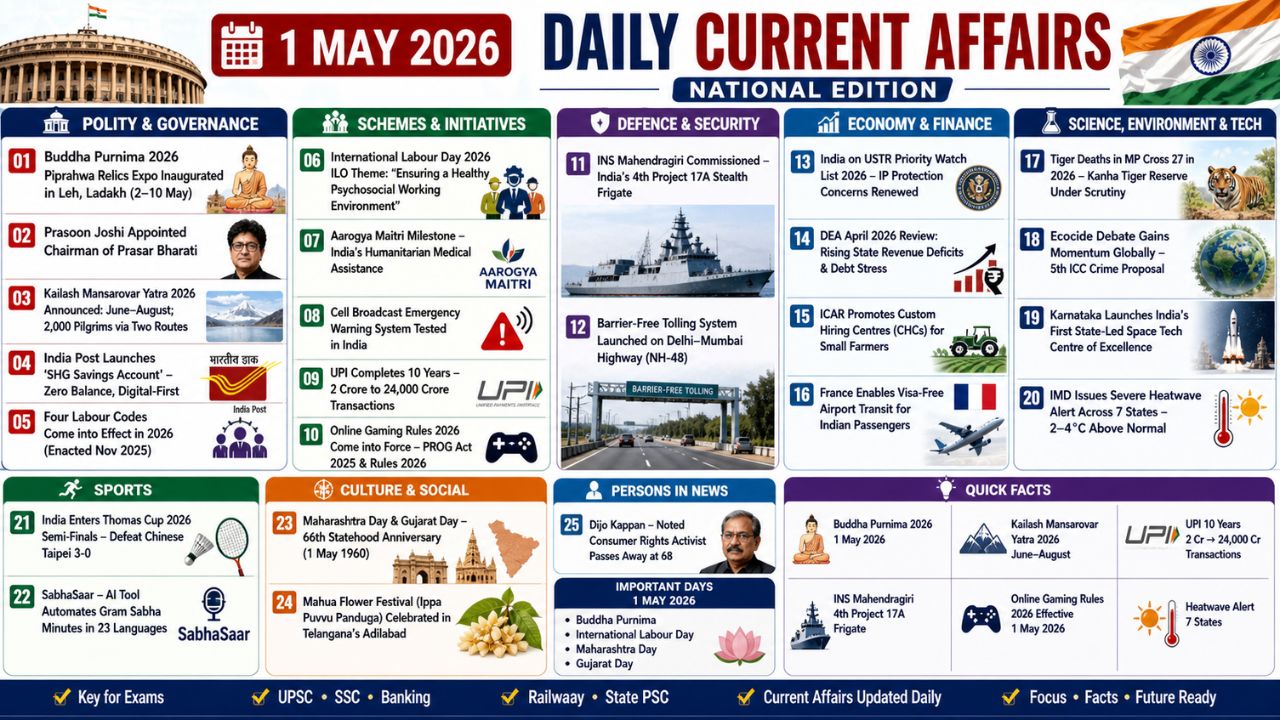
Stay updated with the 1 May 2026 Current Affairs, covering all major national, international, government, economy, defence, environment, sports, and important day updates essential for UPSC, SSC, Banking, Railway, State PSC, and other competitive exams. This comprehensive Daily Current Affairs of 1st May 2026 includes the latest May 2026 current affairs, important appointments, schemes, reports, observances, and exam-relevant GK topics sourced from verified official and trusted platforms. Whether you are searching for today current affairs, daily GK updates, or current affairs May 2026, this complete digest helps aspirants strengthen preparation with accurate, exam-focused knowledge.
Important Days & Observances — Triple Significance of 1 May 2026
Buddha Purnima 2026 — Birth, Enlightenment & Mahaparinirvana of Lord Buddha
Buddha Purnima (Vesak) was observed on 1 May 2026 — the full moon day of the Vaishakha month of the Hindu calendar. It is the most sacred day in the Buddhist calendar as it commemorates three major events in the life of Gautama Buddha: his birth (in Lumbini, present-day Nepal), his attainment of Enlightenment (Bodhi) at Bodh Gaya, Bihar, and his Mahaparinirvana (death) at Kushinagar, Uttar Pradesh. It is recognised by the United Nations as Vesak, observed globally by Buddhist communities across 180+ countries.
On this occasion, PM Narendra Modi noted with joy that on Buddha Purnima, the first-ever international public exposition of the sacred relics of the Tathagata (Lord Buddha) was formally inaugurated at Jivetsal, Leh, Ladakh. The Piprahwa Relics — discovered in 1898 at the Piprahwa Stupa in Uttar Pradesh and recently repatriated from abroad — are being displayed from 2–10 May 2026. Union Home Minister Amit Shah visited Ladakh for the occasion, accompanied by Union Ministers, ambassadors, Chief Ministers of Buddhist-majority states, and representatives of Buddhist organisations from across the world, making it a significant moment of global Buddhist solidarity centered in India.
International Labour Day 2026 — ILO Theme: "Ensuring a Healthy Psychosocial Working Environment"
International Labour Day (May Day) is observed every year on 1 May worldwide to honour the contributions of workers and promote fundamental labour rights — fair wages, workplace safety, and the dignity of labour. In India, it is celebrated as Antarrashtriya Shramik Diwas. The day originated from the Haymarket Affair of Chicago (4 May 1886), a pivotal moment in the global labour movement, when workers agitating for an eight-hour workday were met with violence. It became a formal global observance through the Second International in 1889.
The International Labour Organization (ILO) theme for 2026 is "Ensuring a Healthy Psychosocial Working Environment" — spotlighting mental health, work-life balance, and psychological safety at the workplace, especially in the context of the post-pandemic gig economy and rise of remote work. In India, Labour Day 2026 arrived amid significant developments: the Noida garment workers' protest in April 2026, where thousands demanded a minimum monthly wage of ₹20,000 citing pay disparity with Haryana workers; a fatal boiler explosion at the Singhitarai industrial site caused by poor maintenance; and debates around India's four consolidated Labour Codes (enacted November 2025) — which replaced 29 existing laws but are criticised for raising thresholds that exclude smaller firms from safety regulations and for restricting workers' right to strike.
Maharashtra Day & Gujarat Day — 66th Statehood Anniversary (1 May 1960)
Maharashtra Day and Gujarat Day are both observed on 1 May every year, marking the formation of both states in 1960 — making 2026 their 66th statehood anniversary. The two states were carved out of the erstwhile Bombay State under the Bombay Reorganisation Act, 1960, which split the state along linguistic lines — Maharashtra for Marathi speakers and Gujarat for Gujarati speakers.
The demand for a separate Marathi-speaking state had been championed for years through the Samyukta Maharashtra Movement, a widespread socio-political campaign. The movement's leaders, including Keshavrao Jedhe and S.M. Joshi, are remembered as heroes of linguistic democracy. The linguistic reorganisation of states itself followed the recommendations of the States Reorganisation Commission (1955), chaired by Fazal Ali, which reorganised India's states primarily on linguistic grounds — a landmark moment in India's federal history. In 2026, the triple coincidence of Maharashtra Day, Gujarat Day, Labour Day, and Buddha Purnima falling on the same Friday made it an extraordinary public holiday with broader national significance. President Droupadi Murmu and PM Narendra Modi extended greetings to the people of both states.
Governance & Appointments
Prasoon Joshi Appointed Chairman of Prasar Bharati — India's Public Broadcaster
The Ministry of Information and Broadcasting (MIB) appointed renowned communications expert, lyricist, and advertising professional Prasoon Joshi as the new Chairman of Prasar Bharati — India's statutory public broadcasting authority. Joshi is a recipient of the Padma Shri and brings vast and cross-domain experience in advertising, cinema, and cultural institutions to the role.
Prasar Bharati is India's public service broadcaster, established as an autonomous statutory body under the Prasar Bharati Act, 1990. It operates two premier national broadcasting services: Doordarshan (DD) — India's national television network with over 36 channels — and All India Radio (AIR) — one of the world's largest radio broadcasting organisations with a network of 500+ stations. Its Chairman is appointed by the President of India. Prasoon Joshi is known for writing lyrics for blockbuster Hindi films such as Rang De Basanti, Taare Zameen Par, and Bhaag Milkha Bhaag, and also served as the Chairman of the Central Board of Film Certification (CBFC). His appointment is expected to boost Prasar Bharati's digital expansion and content quality in an era of increasing competition from global streaming platforms.
Kailash Mansarovar Yatra 2026 Announced — June to August; 2,000 Pilgrims via Two Routes
The Ministry of External Affairs (MEA) officially announced that the Kailash Mansarovar Yatra 2026 will be conducted from June to August 2026, organised in coordination with the Government of the People's Republic of China. A total of 20 batches of 50 pilgrims each — 2,000 yatris in total — will undertake the pilgrimage this year. The last date for online registration is 19 May 2026, with a registration fee of ₹5,000 on the official portal kmy.gov.in.
The yatra will proceed via two routes: Lipulekh Pass in Uttarakhand (10 batches — the traditional, more physically demanding route) and Nathu La Pass in Sikkim (10 batches — a relatively easier route). Each batch will include liaison officers, support staff, and a medical officer from the Indo-Tibetan Border Police (ITBP). Selection is through a computerised, random, gender-balanced process. The Kailash Mansarovar region in the Tibet Autonomous Region (TAR) of China holds deep religious significance for multiple faiths: Hindus regard Mount Kailash as the abode of Lord Shiva; Buddhists identify it with Mount Meru; Jains associate it with the liberation of Rishabhdeva; and followers of Bon also revere the site. Importantly, climbing Mount Kailash is prohibited to preserve its sanctity.
Defence & Security
INS Mahendragiri Commissioned — India's 4th Project 17A Stealth Frigate Inducted into Navy
India strengthened its maritime capabilities with the formal induction of INS Mahendragiri — the fourth stealth frigate under Project 17A — into the Indian Navy. Project 17A ships are advanced versions of the Shivalik-class frigates, featuring enhanced stealth features, upgraded weapons and sensor suites, and improved platform management systems.
INS Mahendragiri is the seventh and final ship of the Project 17A class (the project includes 7 ships — 4 at Mazagon Dock Limited, Mumbai, and 3 at Garden Reach Shipbuilders & Engineers, Kolkata). It was formally launched on 1 September 2023 by Sudesh Dhankhar, wife of Vice President Jagdeep Dhankhar. The ship is named after Mahendragiri Peak in Odisha's Gajapati district. INS Mahendragiri was designed internally by the Indian Navy's Warship Design Bureau (WDB) and represents the 100th ship designed and delivered by WDB — a landmark in India's indigenous naval capability. The ship is equipped with the BrahMos supersonic cruise missile, torpedo launchers, a 76mm OTO Melara gun, close-in weapon systems (CIWS), and advanced sonar and radar suites. Its enhanced stealth design reduces radar cross-section, making it significantly harder to detect. Project 17A frigates are a central pillar of India's naval modernisation under the Aatmanirbhar Bharat initiative.
India Tests New Cell Broadcast Emergency Warning System — Mass Alert for Disasters
India successfully tested a new Cell Broadcast Emergency Warning System, a critical leap in the country's disaster early warning and mass alert infrastructure. The system sends emergency alerts directly to all mobile phones within a specific geographic area — regardless of whether the phone is registered to a particular number or SIM — using the cellular broadcast technology.
Unlike traditional SMS alerts, cell broadcasts reach all active mobile phones in a cell tower's coverage area simultaneously and instantaneously, without network congestion. This makes it ideal for natural disaster warnings such as earthquakes, cyclones, tsunamis, flash floods, and industrial accidents. India, prone to frequent natural disasters, has been working to integrate cell broadcast alerts into its National Disaster Management Authority (NDMA) framework, alongside the existing Common Alerting Protocol (CAP) and multi-hazard early warning systems. The system aligns with global best practices — similar systems are widely used in the US (Wireless Emergency Alerts / WEA), Japan (J-Alert), and the EU. This is a significant step for GS-III (Disaster Management) and Science & Technology sections of competitive exams.
Aarogya Maitri Marks New Milestone — India's Humanitarian Medical Assistance
Aarogya Maitri — India's flagship humanitarian medical assistance initiative — marked a new milestone on 1 May 2026, reaffirming India's commitment to providing health aid and medical support to disaster-hit and resource-constrained countries.
The Aarogya Maitri initiative is part of India's broader "Vasudhaiva Kutumbakam" (the World is One Family) philosophy in foreign policy, operationalised through the concept of HADR (Humanitarian Assistance and Disaster Relief). A key component is the Aarogya Maitri Cube — a modular, deployable medical unit designed to be transported by air, land, or sea and set up quickly in disaster zones. It provides life-saving medical supplies, diagnostic capabilities, and treatment facilities. India has used this initiative to provide medical assistance to countries including Türkiye (after the 2023 earthquake), Nepal, and various Indian Ocean nations. The initiative underlines India's evolution from a recipient of international aid to a provider — embodying its "Vishwabandhu" (Friend of the World) foreign policy identity under PM Modi. It also plays a strategic role in strengthening India's diplomatic presence in the Global South.
Digital Economy & Technology
UPI Completes 10 Years — From 2 Crore to 24,000 Crore Transactions; Backbone of India's Digital Economy
India's Unified Payments Interface (UPI) completed 10 years in 2026, marking a decade since its launch by the National Payments Corporation of India (NPCI) in 2016 under the Reserve Bank of India (RBI). Over this decade, UPI has evolved from a niche digital payment pilot to the world's largest real-time payment system, handling approximately 85% of India's total digital payment transactions.
The growth has been extraordinary: transactions surged from just 2 crore in 2016–17 to over 24,000 crore in 2025–26, with total transaction value rising to ₹314 lakh crore. UPI's success is driven by: 24×7 instant transfers, interoperability across all banks and wallets, zero-cost Person-to-Person (P2P) transfers, QR code-based merchant payments, and ease of use on basic smartphones. Beyond India, UPI has been internationalised — it is now accepted in over 10 countries including Singapore, UAE, France, UK, Mauritius, Nepal, and Bhutan. The success of UPI has positioned India as a global model for digital public infrastructure and has inspired similar initiatives in developing nations. It forms a critical pillar of India's Digital India initiative and the broader Digital Public Infrastructure (DPI) stack.
Promotion & Regulation of Online Gaming Rules 2026 Come into Force on 1 May
The Promotion and Regulation of Online Gaming (PROG) Rules, 2026 — notified on 22 April 2026 — came into force on 1 May 2026. They flow from the Promotion and Regulation of Online Gaming (PROG) Act, 2025, enacted by Parliament in August 2025. The central government designated 1 May 2026 as the commencement date for enforcement of the full Act and Rules.
Key features of the new regulatory framework: A clear distinction between prohibited online money games (real-money wagering, chance-based gambling) and permitted e-sports and online social games. Establishment of an Online Gaming Authority of India (OGAI) as the centralised regulatory body. A mandatory registration system for specified categories of games. Stringent user protection measures including age verification, spending limits, grievance redressal, and data retention. Cyber cell officials at state, district, and police station levels are authorised to investigate offences under the Act. Foreign gaming companies serving Indian users must comply with Indian registration, user safety, and financial transaction requirements. India's online gaming market generated ₹232 billion in 2024 (77% from transaction-based games) and is projected to grow at a CAGR of 11% to ₹316 billion by 2027. This regulation aims to protect users — particularly youth — from gambling addiction while allowing India's booming e-sports and social gaming sector to flourish.
India Post Launches 'SHG Savings Account' — Paperless, Digital-First Product for Self-Help Groups
India Post (Department of Posts) launched a specialised SHG (Self-Help Group) Savings Account — a dedicated financial product for Self-Help Groups, particularly women-led SHGs, to integrate them into the formal financial ecosystem. The product aligns with national priorities under the National Rural Livelihoods Mission (NRLM) and NABARD-supported SHG programmes.
Key features: Zero-balance account (no initial deposit and no Monthly Average Balance requirement). Maximum balance limit of ₹2,00,000. Digital on-boarding through India Post's postmen and Gramin Dak Sevaks (GDS) network. Quarterly interest payouts based on applicable savings rates. The account is paperless and digital-first, contributing to the government's vision of a less-cash economy. India has over 1.4 crore SHGs under DAY-NRLM alone, with nearly 10 crore women members. Bringing these groups into the formal banking fold improves their access to credit, insurance, and government scheme benefits, and is directly aligned with India's financial inclusion goals under the Jan Dhan–Aadhaar–Mobile (JAM) Trinity.
Environment & Wildlife
Tiger Deaths in Madhya Pradesh Cross 27 in 2026 — Kanha Tiger Reserve Under Scrutiny
The tiger death toll in Madhya Pradesh crossed 27 in 2026, prompting urgent wildlife investigations and renewed scrutiny of forest management practices in the state. Two recent fatalities brought special attention to the Kanha Tiger Reserve (KTR) in Mandla and Balaghat districts.
Kanha Tiger Reserve is one of India's most renowned protected areas, spanning 2,074.32 sq. km. It is located in the Maikal ranges of the Satpuras and was declared a reserve forest as early as 1879, officially designated a National Park in 1955, and was among the first nine tiger reserves included in Project Tiger (1973). India's tiger population has grown significantly under conservation efforts — from approximately 1,411 in 2006 to over 3,600 as of the 2022 tiger census, making India home to nearly 75% of the world's wild tigers. However, rising intra-territorial conflicts, human-wildlife interface pressures, tourism-related disturbances, and poaching threats continue to pose risks. Madhya Pradesh is known as the "Tiger State of India" with the highest tiger population among all states.
Ecocide Debate Gains Momentum Globally — India's Position in International Environmental Law
The concept of ecocide — defined as the most extreme forms of environmental destruction caused by human action, characterised by unlawful or wanton acts committed with knowledge of substantial damage — gained renewed global attention in 2026, as nations including Lebanon and Iran accused Israel of committing ecocide during military operations in West Asia, highlighting the severe ecological devastation caused by modern warfare.
Ecocide refers to mass-scale destruction of ecosystems — including deforestation, pollution of water bodies, destruction of biodiversity, and land degradation at large scales. There is a growing international movement to have ecocide recognised as the 5th International Crime under the Rome Statute of the International Criminal Court (ICC) — alongside genocide, crimes against humanity, war crimes, and the crime of aggression. Currently, international environmental law lacks robust enforcement mechanisms for large-scale ecological destruction. For India, the ecocide debate is relevant given its obligations under the Paris Agreement, Convention on Biological Diversity (CBD), and domestic laws like the Environment Protection Act, 1986 and the Forest Conservation Act, 1980. India's rich biodiversity across its 17 recognised biodiversity hotspots makes environmental protection a matter of both law and national interest.
Economy & Finance
India on USTR Priority Watch List 2026 — IP Protection Concerns Renewed
India's inclusion in the United States Trade Representative (USTR) Priority Watch List 2026 renewed focus on global concerns over Intellectual Property (IP) protection in India. The USTR releases its annual Special 301 Report — a review of global IP protection and enforcement — which places countries on a Watch List or Priority Watch List based on IP-related concerns.
India has been on the USTR Priority Watch List for many years. Key US concerns typically include: compulsory licensing provisions in Indian patent law (particularly for pharmaceuticals); Section 3(d) of the Indian Patents Act, which prevents evergreening of pharmaceutical patents and has been a point of friction with US pharma companies; copyright enforcement; trade secrets protection; and barriers to market access for US IP-intensive industries. India's perspective is that its patent regime balances innovation incentives with access to affordable medicines — a public health priority for a developing nation. This bilateral tension is important for India-US trade relations, especially in the context of ongoing negotiations and India's participation in the Indo-Pacific Economic Framework (IPEF).
India Launches First Barrier-Free Tolling System on Delhi–Mumbai Highway (NH-48)
India took a major step in modernising highway infrastructure with the launch of its first barrier-free tolling system on the Delhi–Mumbai National Highway (NH-48). The system eliminates the need for physical toll booths and barriers, allowing vehicles to pass through at normal speed while tolls are automatically deducted.
This represents an upgrade from the existing FASTag system (RFID-based electronic toll collection), which still requires vehicles to slow down at booths. The new barrier-free system uses GNSS (Global Navigation Satellite System) / GPS-based technology or advanced ANPR (Automatic Number Plate Recognition) cameras with overhead gantries to seamlessly track vehicles and deduct toll charges. It eliminates queue time, reduces fuel wastage, lowers vehicular emissions at toll points, and enhances user experience. The National Highways Authority of India (NHAI) has been gradually phasing out cash transactions at toll plazas — India moved to FASTag and UPI-only payments from April 2026, and this barrier-free pilot is the next logical step in that journey. NH-48 (Delhi–Mumbai), part of the Delhi-Mumbai Industrial Corridor (DMIC) zone, is one of India's busiest highways.
Education, Science & Sports
Karnataka Launches India's First State-Led Centre of Excellence for Space Technology in Bengaluru
Karnataka took a significant step in advancing India's space innovation ecosystem by launching the country's first state-led Centre of Excellence (CoE) for Space Technology in Bengaluru. The initiative is aimed at fostering local space tech start-ups, building talent in space science and engineering, and positioning Karnataka — already home to ISRO, HAL, and a vibrant aerospace ecosystem — as a global space technology hub.
India's space sector was opened up to private players through the establishment of IN-SPACe (Indian National Space Promotion and Authorisation Centre) in 2020. Since then, over 200 private space start-ups have emerged, with Bengaluru being the epicentre. The Karnataka CoE will provide mentorship, infrastructure, testing facilities, and funding linkages to early-stage space start-ups. It builds on India's growing space economy — estimated to reach $44 billion by 2033 from the current ~$8 billion. This is aligned with the government's ambition to capture 9% of the global space market share by 2030.
India Enters Thomas Cup 2026 Semi-Finals — Defeat Chinese Taipei 3-0
India's men's badminton team delivered a dominant 3-0 defeat of Chinese Taipei in the Thomas Cup 2026 quarterfinals, assuring themselves of at least a bronze medal and a berth in the semi-finals. The Thomas Cup is the premier international men's team badminton championship, organised by the Badminton World Federation (BWF), held biennially.
India's Thomas Cup journey has been remarkable — the team won the Thomas Cup in 2022 for the first time in history, defeating Indonesia in the final. Their consistent performance in 2026 demonstrated the strength and depth of India's men's singles pipeline, led by top players including Lakshya Sen and H.S. Prannoy. The Thomas Cup (for men) and the Uber Cup (for women) are the two premier team events in world badminton. India's growing dominance in men's badminton at the international level reflects significant investment in SAI (Sports Authority of India) academies, the Pullela Gopichand Badminton Academy, and the broad talent ecosystem built over the past decade. This is a strong story for India's sporting diplomacy ahead of the 2028 Los Angeles Olympics.
Agriculture & Rural Development
Mahua Flower Festival ('Ippa Puvvu Panduga') Celebrated in Telangana's Adilabad — Tribal Heritage in Focus
The annual Mahua flower festival, locally known as 'Ippa Puvvu Panduga', was celebrated with traditional fervour in Jamidi village, Adilabad district, Telangana. The event highlighted the deep cultural and economic importance of the Mahua tree (Madhuca longifolia) for tribal communities of central and eastern India.
The Mahua tree is often called the "Kalpavriksha" (wish-fulfilling tree) of tribal communities — every part of the tree is useful. Its flowers are used to make a traditional fermented drink, and are also eaten (rich in sugars and nutrients), used to feed livestock, and distilled into bio-fuels; its seeds yield Mahua oil used in cooking, soap making, and as a bio-lubricant; its bark and leaves have medicinal value. The Mahua tree is a critical source of livelihood for millions of Adivasi (tribal) communities in states like Telangana, Chhattisgarh, Odisha, Jharkhand, and Madhya Pradesh. Forest rights protection for Mahua collection is governed under the Forest Rights Act, 2006. The festival underscores the importance of Minor Forest Produce (MFP) rights for tribal livelihoods — a key topic in GS-I (Tribal Issues) and GS-III (Forests, Environment) for UPSC.
Agricultural Engineering — ICAR Promotes Custom Hiring Centres (CHCs) for Small Farmers
The Indian Council of Agricultural Research (ICAR) promoted the expansion of Custom Hiring Centres (CHCs) as a strategy to make modern agricultural machinery accessible to small and marginal farmers who cannot afford to buy equipment outright. CHCs operate on a rental model, providing machinery such as tractors, harvesters, seeders, and drone sprayers at affordable rates.
India has approximately 86% small and marginal farmers (holding less than 2 hectares of land), who together own only a small fraction of total farmland. For these farmers, the cost of buying and maintaining advanced agricultural machinery is prohibitive. CHC-based rental models bridge this gap, enabling mechanisation without ownership. The government supports CHC establishment through sub-mission on Agricultural Mechanisation (SMAM) under the Ministry of Agriculture and Farmers' Welfare, providing subsidies to establish village-level and cluster-level CHCs. Agricultural engineering — integrating smart irrigation, precision farming, drone-based crop monitoring, and soil health management — is identified as a critical driver for India's transition from subsistence to sustainable and data-driven farming, essential for achieving food security for a 1.4 billion+ population.
Social Issues & Labour
Four Labour Codes (Enacted Nov 2025) — Implications for Workers and Industry
India's four consolidated Labour Codes — enacted in November 2025, replacing 29 existing central labour laws — came into full effect in 2026, reshaping the legal framework governing employment across India. The four codes are: Code on Wages (2019), Industrial Relations Code (2020), Code on Social Security (2020), and Occupational Safety, Health and Working Conditions Code (OSH Code, 2020).
Key changes and concerns: The threshold for requiring government approval for retrenchment and layoffs has been raised from 100 to 300 workers — effectively giving companies with up to 300 employees the freedom to hire and fire without prior state approval. Revised definitions of "factory" and "establishment" exclude smaller units from mandatory safety regulations, potentially leaving a large section of India's workforce unprotected. Workers are required to give advance notice before striking and cannot strike during dispute proceedings — critics argue this significantly weakens workers' collective bargaining power. On the positive side, the codes introduce: a universal minimum wage, social security coverage for gig and platform workers for the first time, and simplified compliance for businesses. The reforms are debated on Labour Day 2026 as a pivotal inflection point for India's 500 million-strong labour force.
Dijo Kappan — Noted Consumer Rights Activist Passes Away at 68 in Kerala
Social activist and noted consumer rights champion Dijo Kappan passed away at the age of 68 in Pala, Kerala, while undergoing treatment for injuries he had sustained earlier. Kappan was widely recognised for his tireless advocacy for consumer protection in Kerala and at the national level.
Consumer rights in India are governed by the Consumer Protection Act, 2019, which replaced the older 1986 Act and introduced significant reforms including: a three-tier quasi-judicial consumer redressal mechanism (District, State, and National Consumer Disputes Redressal Commissions), expansion of consumer rights to include e-commerce, product liability provisions, and the establishment of the Central Consumer Protection Authority (CCPA) as a regulatory body. India's consumer rights movement has been critical in empowering ordinary citizens against malpractice by manufacturers, service providers, and traders. Dijo Kappan's work embodied this spirit of citizen vigilance and legal empowerment.
April 2026 Monthly Economic Review — Rising State Revenue Deficits and Debt Stress Flagged
The Department of Economic Affairs (DEA) released its April 2026 Monthly Economic Review, flagging rising State-level revenue deficits and debt stress amid global uncertainties including the ongoing West Asia crisis and geopolitical volatility. Based on States' Budget Estimates for FY 2026–27, the report warned that fiscally stressed States may struggle to absorb economic shocks without cutting developmental expenditure or seeking Central government support.
A revenue deficit arises when a government's total revenue expenditure exceeds its total revenue receipts — meaning it is borrowing to fund day-to-day consumption expenditure rather than capital formation, which is economically unhealthy. India's fiscal federalism framework is governed by the Finance Commission of India, the FRBM Act (2003), and GST-based revenue sharing. The report is significant as it reflects structural fiscal imbalances at the sub-national level — a recurring challenge for India's decentralised development model. States like Punjab, Rajasthan, and Andhra Pradesh have faced persistent fiscal stress in recent years. The review calls for expenditure rationalisation, improved own-source revenue mobilisation, and better adherence to FRBM (Fiscal Responsibility and Budget Management) targets.
Written by
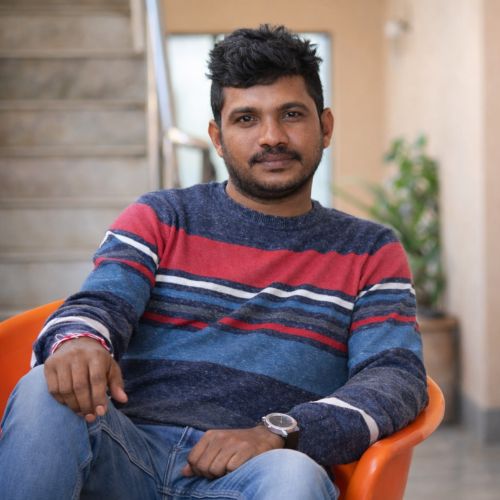
Koti Deva
Digital Marketing Specialist
Koti is a Digital Marketing Specialist with over 10 years of experience and the co-founder of MCQ Orbit — a free exam prep platform built for Indian competitive exam aspirants.
With strong personal knowledge in Quantitative Aptitude, Logical Reasoning, and Mathematics, Koti has a deep understanding of what it takes to crack exams like SSC CGL, IBPS PO, SBI Clerk, UPSC Prelims, NEET, and JEE. Having followed these exams closely for years, he understands the exact topics, patterns, and shortcuts that matter most.
MCQ Orbit was born from a simple desire — to build a platform where every aspirant in India can practice quality MCQs, read reliable current affairs, and prepare confidently, without paying a rupee. Koti combines his digital expertise with his passion for competitive exams to create content that is accurate, practical, and genuinely useful for students.
His mission is straightforward: if the right guidance had been freely available earlier, more students would have cracked their dream exams. MCQ Orbit is his way of making that happen.
Comments
No comments yet.