
Current Affairs 9 May 2026 | 9th May 2026 Current Affairs | Daily GK Updates
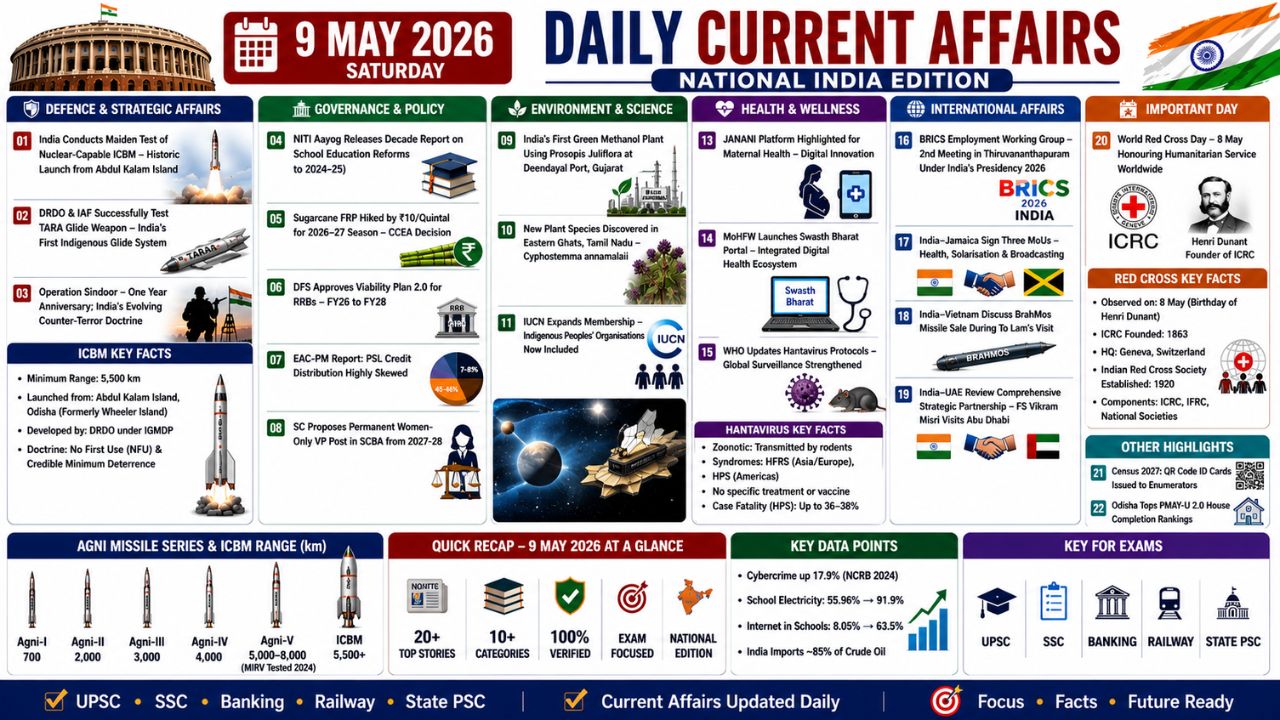
9 May 2026 Current Affairs is headlined by two of the biggest defence appointments India has seen in years — Lt General NS Raja Subramani appointed as India's 3rd Chief of Defence Staff and Vice Admiral Krishna Swaminathan named the next Chief of Naval Staff — both announced simultaneously on the morning of May 9. Alongside this, Pochishe Boishakh — the Bengali calendar birth anniversary of Rabindranath Tagore — was widely celebrated across West Bengal, Tripura, and Bangladesh.
India hosted the ISO/IEC SC14 plenary on space standards in New Delhi with delegates from 13 countries. MoS&PI updated State GDP calculation with 2022-23 as the new base year. JGU became India's first IoE to receive DASCA accreditation. India's CBRN Emergency Response Centre was highlighted in national security discussions. And a new case study emerged around ethanol production vs water security — a critical policy tension. A packed day — let's go through every story.
Defence & Appointments
Lt General NS Raja Subramani Appointed India's 3rd Chief of Defence Staff
This is the most significant appointment story of May 2026 — and one of the most important defence governance developments of the year.
The government announced the appointment of Lieutenant General NS Raja Subramani (Retd.) as India's next Chief of Defence Staff (CDS). He will succeed General Anil Chauhan, whose tenure concludes on May 30, 2026. Lt Gen Raja Subramani currently holds the role of Military Adviser to the National Security Council Secretariat, a position he assumed on September 1, 2025. His previous high-level assignments include serving as Vice Chief of the Army Staff (July 2024 – July 2025) and leading the Central Command as GOC-in-C (March 2023 – June 2024).
Lt Gen NS Raja Subramani will also serve as Secretary to the Government of India in the Department of Military Affairs (DMA) from the date he assumes office.
About the CDS post — every student must know this:
The post of CDS was officially created on 24 December 2019 by the Cabinet Committee on Security (CCS). The Department of Military Affairs (DMA) was established on 30 December 2019.
# | CDS | Background | Tenure |
|---|---|---|---|
1st | General Bipin Rawat | Army | January 2020 – December 2021 (died in helicopter crash) |
2nd | General Anil Chauhan | Army | September 2022 – May 30, 2026 |
3rd | Lt Gen NS Raja Subramani | Army | From May 30, 2026 |
Three CDS appointments since the post was created in December 2019, and three times the four-star baton has gone to a soldier in olive green — continuing the trend of the Army holding India's top military coordination post.
What does the CDS do?
The CDS promotes jointness, integration and coordination among the Army, Navy and Air Force. The CDS also heads the Department of Military Affairs — which handles military-civilian interface on defence procurement, jointness, and theatre command creation. India is in the process of creating Integrated Theatre Commands — a major structural reform that will reorganise the current 17 single-service commands into geographically unified theatre commands under the CDS's oversight.
Profile of Lt Gen NS Raja Subramani: A graduate of the National Defence Academy in Khadakwasla and the Indian Military Academy in Dehradun, he was commissioned into the 8th Battalion of the Garhwal Rifles in December 1985. He is also an alumnus of the Joint Services Command Staff College, Bracknell (UK) and the National Defence College.
Strategic context — why this appointment matters: For a country juggling a tense northern border with China, an unresolved western front with Pakistan, and an ambitious but stalled military restructuring project, the choice of the next CDS was never going to be routine. Raja Subramani comes directly from NSA Ajit Doval's office — the National Security Council Secretariat — giving him deep familiarity with India's strategic and intelligence landscape at the highest level.
CDS post created = December 24, 2019 by CCS. DMA created = December 30, 2019. 1st CDS = Gen Bipin Rawat (Army). 2nd = Gen Anil Chauhan (Army). 3rd = Lt Gen NS Raja Subramani (Army). CDS also heads DMA. Commissioned into Garhwal Rifles 1985. Previously = VCOAS + GOC-in-C Central Command + Military Adviser NSCS.
Vice Admiral Krishna Swaminathan Appointed Next Chief of Naval Staff
On 9 May 2026, the Government of India announced the appointment of Vice Admiral Krishna Swaminathan, PVSM, AVSM, VSM, as the next Chief of the Naval Staff (CNS). He will assume charge on or around 31 May 2026, succeeding Admiral Dinesh Kumar Tripathi, PVSM, AVSM, NM, who retires on that date.
Vice Admiral Swaminathan is a specialist in Communication and Electronic Warfare and is regarded as one of the Navy's most experienced operational commanders. He has commanded key assets including the aircraft carrier INS Vikramaditya and the Western Fleet.
Full command profile: His command appointments have included missile vessels INS Vidyut and INS Vinash, missile corvette INS Kulish, guided missile destroyer INS Mysore, and the aircraft carrier INS Vikramaditya. He also served as Flag Officer Commanding Western Fleet, Chief of Staff of the Western Naval Command, Controller of Personnel Services, Chief of Personnel and Vice Chief of the Naval Staff.
Vice Admiral Swaminathan studied at the National Defence Academy, Joint Services Command and Staff College in the United Kingdom, College of Naval Warfare and the United States Naval War College.
About INS Vikramaditya: India's primary aircraft carrier — formerly Russia's Admiral Gorshkov — acquired in 2013. It is a Kiev-class carrier modified to STOBAR (Short Take-Off But Arrested Recovery) configuration and serves as the flagship of the Indian Navy's Western Fleet. Commanding an aircraft carrier is one of the most prestigious operational assignments in any navy — making Vice Admiral Swaminathan's profile exceptionally strong.
Current Western Naval Command context: Vice Admiral Swaminathan currently serves as the 34th Flag Officer Commanding-in-Chief of the Western Naval Command, a position he assumed on 31 July 2025. The Western Naval Command — headquartered in Mumbai — is responsible for India's maritime security in the Arabian Sea, the Persian Gulf corridor, and the western Indian Ocean, making it India's most strategically active naval command given the Gulf energy trade and recent West Asian tensions.
New CNS = Vice Admiral Krishna Swaminathan. Takes charge May 31, 2026. Succeeds Admiral Dinesh Kumar Tripathi. Specialisation = Communication and Electronic Warfare. Commanded INS Vikramaditya (aircraft carrier). Currently FOC-in-C Western Naval Command. Commissioned July 1, 1987. NDA + JSCSC UK + US Naval War College alumnus.
India Hosts ISO/IEC SC14 Plenary on Space Systems Standards — New Delhi
India hosted the ISO/IEC SC14 plenary on space systems standards in New Delhi. This specific subcommittee is responsible for international standards covering the entire lifecycle of space systems. Scope includes standards for design, production, launch, operations, and space-based services. The 2026 meeting in Delhi focused heavily on space sustainability, debris mitigation, and mission safety. The plenary was attended by 131 delegates from 13 countries, including experts from major space agencies like ISRO, industry leaders, and academia.
Why this matters for India: India hosting the ISO/IEC SC14 plenary is a powerful signal of India's growing centrality in the global space governance ecosystem. As India's NewSpace sector grows rapidly — with IN-SPACe facilitating private launches, GalaxEye's Mission Drishti (May 3–4), and upcoming ISRO missions — having Indian standards experts shape the international technical frameworks for space systems is strategically important.
About ISO/IEC: The International Organisation for Standardisation (ISO) and the International Electrotechnical Commission (IEC) are the two leading global standard-setting bodies. SC14 (Subcommittee 14) specifically handles space systems and operations standards — covering everything from satellite design tolerances to debris mitigation protocols.
Space Debris — the growing concern: There are currently over 35,000 tracked objects in Earth orbit, with millions more untracked fragments. Space debris travels at speeds of up to 28,000 km/hour — capable of destroying a satellite in a collision. The Kessler Syndrome — a theoretical cascade where debris collisions create more debris, eventually making certain orbits unusable — is the long-term worst-case scenario that space sustainability standards aim to prevent.
ISO/IEC SC14 = international standards for space systems lifecycle. 131 delegates, 13 countries. Delhi plenary 2026. Focus = space debris, mission safety, space sustainability. Kessler Syndrome = debris cascade theory. IN-SPACe = India's private space regulator under Space Policy 2023.
Governance & Economy
MoS&PI Updates State GDP Base Year to 2022-23 — New Framework for GSVA
The National Statistics Office (NSO) under the Ministry of Statistics and Programme Implementation (MoS&PI) notified uniform guidelines for compiling Gross State Value Added (GSVA), with 2022-23 as the new base year to ensure a standardised framework and comparability of performance across all states.
What is GSVA and why does the base year matter?
GSVA (Gross State Value Added) is the state-level equivalent of GVA (Gross Value Added) at the national level — it measures the economic output of a state across all sectors (agriculture, industry, services) minus subsidies and plus taxes. It is the primary indicator used to compare the economic performance of different Indian states.
The base year in national accounts is the reference year against which all economic data is measured and compared. Updating the base year is essential because:
It incorporates new and emerging sectors (gig economy, digital services, new manufacturing activities) that didn't exist or weren't captured in older frameworks
It uses modern data collection methods and improved estimation practices
It aligns with evolving international standards — particularly the System of National Accounts (SNA) 2008 framework recommended by the UN
India's base year history:
Earlier base year: 2011-12
Now updated to: 2022-23
This update ensures that India's state GDP comparisons are rooted in a post-pandemic, post-GST, post-digital economy reality — a more accurate picture than what the 2011-12 base year could offer.
NSO under MoS&PI. New GSVA base year = 2022-23 (earlier = 2011-12). GSVA = state-level economic output measure. Base year update = aligns with SNA 2008 framework. Comparable across all Indian states. Standard Economy and Governance MCQ.
CBRN Emergency Response Centre — India's Preparedness Against Chemical, Biological, Radiological & Nuclear Threats
India's CBRN Emergency Response Centre was highlighted in national security discussions. The facility provides multi-agency training and workshops for responders from the MoD, Ministry of Home Affairs (MHA), National Disaster Management Authority (NDMA), Indian Armed Forces, emergency medical teams, civil defence agencies, and specialised response organisations to strengthen practical crisis response capabilities. Preparedness includes CBRN emergency simulation, hazard detection drills, radiation analysis, medical countermeasure preparedness, real-time disaster response exercises, and coordinated field operations under simulated high-risk emergency conditions. Research focuses on heavy ion research, radiation studies, nuclear safety validation, and advanced emergency response technologies.
What is CBRN?
CBRN stands for Chemical, Biological, Radiological, and Nuclear threats — the four categories of weapons of mass destruction or large-scale hazardous incidents that require specialised response protocols beyond conventional emergency services.
India's CBRN Framework:
NDMA (National Disaster Management Authority) leads civilian CBRN response coordination
The Armed Forces have dedicated CBRN units — including the Army's NBC (Nuclear, Biological, Chemical) Regiment
India is a signatory to the Chemical Weapons Convention (CWC) — monitored by the OPCW (Organisation for the Prohibition of Chemical Weapons), headquartered in The Hague
India is also a signatory to the Biological Weapons Convention (BWC) — though BWC has no dedicated verification mechanism (unlike CWC)
India is a non-signatory to the NPT (Nuclear Non-Proliferation Treaty) but participates in nuclear safety frameworks
CBRN = Chemical, Biological, Radiological, Nuclear. NDMA = civilian lead for CBRN response. OPCW = monitors CWC (Chemical Weapons Convention). HQ = The Hague. India is CWC signatory but NOT NPT signatory. BWC = no verification mechanism (unlike CWC). Army NBC Regiment = military CBRN unit.
JGU Becomes India's First Institute of Eminence to Get DASCA Accreditation
O.P. Jindal Global University (JGU) became India's first Institute of Eminence (IoE) to be accredited by the Data Science Council of America (DASCA) — an international standards body that provides professional accreditation in data science and analytics education.
About JGU: O.P. Jindal Global University is located in Sonipat, Haryana. It was established in 2009 and was granted Institute of Eminence status by the UGC — making it one of India's premier private universities. IoE status was created under the UGC (Institutions of Eminence) Regulations, 2017 — allowing selected institutions regulatory relaxations to achieve global ranking standards.
About DASCA: The Data Science Council of America is a leading international standards body that benchmarks and accredits data science and big data analytics education programmes globally. DASCA accreditation signals that a university's data science curriculum meets rigorous international professional standards.
Why this matters: As India builds its AI and data economy — with initiatives like IndiaAI Mission (₹10,372 crore) and Digital India — having world-class data science education programmes is critical. JGU's DASCA accreditation positions it as an internationally benchmarked centre for data science talent.
JGU = O.P. Jindal Global University. Location = Sonipat, Haryana. Established 2009. IoE status = UGC Regulations 2017. DASCA = Data Science Council of America. JGU = first Indian IoE with DASCA accreditation. IndiaAI Mission = ₹10,372 crore.
Ethanol Push vs Water Crisis — A Critical Policy Tension
Non-tariff measures (NTMs) and the ethanol production vs water security tension emerged as key policy discussion points on May 9, 2026.
The core tension: India's Ethanol Blended Petrol (EBP) Programme — targeting 20% ethanol blending by 2025-26 — relies primarily on sugarcane and surplus rice as feedstocks. Both are extremely water-intensive crops. Sugarcane requires approximately 1,500 litres of water per kg of output. As India pushes ethanol production to reduce fossil fuel imports and cut carbon emissions, it is simultaneously putting enormous pressure on already stressed groundwater resources — particularly in Maharashtra, Karnataka, and Uttar Pradesh.
Key government initiatives:
National Biofuel Policy 2018 — revised in 2022 — governs India's ethanol programme
The ENBA (Ethanol for New Biofuel Applications) scheme extended feedstock options to include damaged foodgrains, agricultural residue, and lignocellulosic biomass — to reduce dependence on water-intensive crops
2G (Second Generation) ethanol from agricultural waste (rice straw, sugarcane bagasse) is the long-term solution — producing ethanol without additional water stress
NTMs — quick explainer: Non-tariff measures (NTMs) are policy measures other than ordinary customs tariffs that can affect international trade in terms of quantity, price, or both. NTMs impose higher export costs than tariffs in 88% of countries. India faces NTMs on its agricultural exports — including SPS (Sanitary and Phytosanitary) measures and technical barriers — which affect the competitiveness of Indian ethanol and biofuel exports globally.
EBP Programme target = 20% ethanol blending by 2025-26. Sugarcane = 1,500 litres water/kg. National Biofuel Policy 2018 (revised 2022). 2G ethanol = from agricultural waste. NTMs = non-tariff measures (beyond customs duties). NTMs = higher export costs than tariffs in 88% countries.
Bengaluru Suicide Rate Among Cities — NCRB 2024 Detailed Data
The NCRB Crime in India 2024 report revealed that Bengaluru (Karnataka), commonly referred to as the 'Silicon Valley of India', registered 2,313 suicides in 2022, 2,370 in 2023, and 2,403 in 2024 — with the city's suicide rate standing close to 20 per lakh population through the three-year period.
Why is this significant?
Bengaluru — India's IT hub and startup capital — recording a consistently rising suicide rate despite being one of India's most economically prosperous cities points to a deeper structural issue: high-pressure work environments, housing unaffordability, social isolation for migrant workers, and mental health gaps in India's urban tech ecosystem. This data point is increasingly relevant for GS Paper II (Social Justice) and GS Paper IV (Ethics) in UPSC, and for state-level exams in Karnataka.
Broader context from NCRB 2024:
Total suicides in India: 1,70,746
Daily wage workers = 31% of total (largest category)
Student suicides = 14,488
Homemakers = 22,113
Drug overdose deaths rose 50% (650 in 2023 → 978 in 2024)
Bengaluru suicide rate = ~20 per lakh population (2024). 2,403 suicides in 2024. NCRB Crime in India 2024. Total India suicides = 1,70,746. Drug overdose deaths up 50%. Student suicides = 14,488. These are high-probability Social Justice and Ethics MCQs.
Arts, Culture & Education
Pochishe Boishakh — Rabindranath Tagore's 165th Birth Anniversary Celebrated Across Bengal
Pochishe Boishakh — which literally translates to the 25th of Boishakh in the Bengali calendar — fell on May 9, 2026, and large-scale Rabindra Jayanti celebrations took place across West Bengal, Tripura, and Bangladesh, as well as among the Bengali diaspora worldwide. In 2026, this marks the 165th birth anniversary of Rabindranath Tagore.
Why two dates for Tagore's birthday?
According to the Gregorian calendar, Tagore was born on May 7, 1861 at the Jorasanko mansion in Calcutta (now Kolkata). In the Bengali almanack, he was born on the 25th day of Boishakh — the first month of the Bengali calendar. Unlike the English calendar, the Bengali calendar follows solar cycles, so dates do not align perfectly every year. In 2026, Pohela Boishakh was celebrated on April 15, making the 25th day of Boishakh fall on May 9.
Rabindranath Tagore — complete exam profile:
Fondly called "Gurudev" and "Kabiguru", Tagore transformed Bengali literature and artistic expression during the late 19th and early 20th centuries. His most influential contributions include Rabindra Sangeet — a collection of more than 2,000 songs still deeply woven into Bengali life — writing the national anthems of both India and Bangladesh, Gitanjali — the poetry collection that earned him the Nobel Prize in Literature in 1913 — and founding Visva-Bharati University in Santiniketan, an institution that challenged colonial approaches to education.
The full Tagore exam fact sheet:
Fact | Detail |
|---|---|
Born | May 7, 1861; Jorasanko mansion, Calcutta |
Died | August 7, 1941 |
Birth anniversary 2026 | 165th |
Nobel Prize | Literature, 1913 (first Asian to win Nobel) |
Famous work | Gitanjali (poetry collection) |
National Anthem of India | Jana Gana Mana |
National Anthem of Bangladesh | Amar Shonar Bangla |
National Song of Sri Lanka | Tagore inspired (not written by him) |
University founded | Visva-Bharati University, Santiniketan (1921) |
Music tradition | Rabindra Sangeet — 2,000+ songs |
Also known as | Gurudev, Kabiguru, Bard of Bengal |
Bengali calendar celebration | Pochishe Boishakh (25th of Boishakh) |
Gregorian celebration | May 7 |
Visva-Bharati University: Located in Santiniketan, West Bengal, it was founded by Tagore in 1921 and granted the status of a Central University in 1951 by an Act of Parliament. The Prime Minister of India is the Chancellor (Acharya) of Visva-Bharati. It follows Tagore's philosophy of open-air, nature-integrated education — classes were originally held under trees.
PM Modi paid heartfelt tributes to Gurudev Rabindranath Tagore on the occasion of Pochishe Boishakh.
Tagore born May 7, 1861. 165th birth anniversary in 2026. First Asian Nobel Prize winner (Literature 1913). Gitanjali = Nobel work. Jana Gana Mana = India's National Anthem. Amar Shonar Bangla = Bangladesh National Anthem. Visva-Bharati University = Santiniketan, 1921, Central University. PM = Chancellor of Visva-Bharati. Pochishe Boishakh = 25th Boishakh = May 9 in 2026.
Environment & Sustainability
Ethanol Water Nexus — Second Generation Ethanol as the Sustainable Path Forward
Already introduced in the governance section above, the ethanol-water policy tension deserves deeper environmental analysis.
India's groundwater crisis in numbers:
India extracts approximately 251 billion cubic metres (BCM) of groundwater annually — the highest in the world
About 60% of irrigated agriculture depends on groundwater
21 major cities are projected to run out of groundwater by 2030 (NITI Aayog's 2018 Composite Water Management Index)
States with highest sugarcane cultivation — Maharashtra, UP, Karnataka — are also among the most groundwater-stressed
The 2G Ethanol Solution: Second-generation (2G) ethanol uses agricultural waste as feedstock — rice straw, wheat straw, sugarcane bagasse, corn cobs — materials that would otherwise be burnt (contributing to stubble burning pollution in North India). India's first 2G ethanol plant was set up by HPCL (Hindustan Petroleum Corporation Limited) in Bathinda, Punjab — specifically to address Punjab's paddy stubble burning crisis while producing green fuel.
India = world's largest groundwater extractor (251 BCM/year). 21 cities may run out by 2030. 2G ethanol = from agricultural waste (rice straw, bagasse). HPCL's 2G plant = Bathinda, Punjab. Addresses stubble burning + fuel security simultaneously. Key UPSC GS Paper III Environment + Economy intersection topic.
Science & Space
James Webb Space Telescope Studies Rocky Exoplanet LHS 3844 b (Kuaꞌkua)
The James Webb Space Telescope (JWST) directly studied the rocky exoplanet LHS 3844 b, also called Kuaꞌkua, on 4 May 2026. LHS 3844 b is a super-Earth.
Key facts about JWST and this discovery:
James Webb Space Telescope:
Launched: December 25, 2021
Operated by: NASA, ESA (European Space Agency), and CSA (Canadian Space Agency)
Located at: Lagrange Point 2 (L2) — approximately 1.5 million km from Earth
Primary mirror diameter: 6.5 metres (compared to Hubble's 2.4 metres)
Speciality: Infrared observation — allowing it to see through dust clouds and study the earliest galaxies, exoplanet atmospheres, and stellar nurseries
About LHS 3844 b (Kuaꞌkua):
A super-Earth — a rocky exoplanet larger than Earth but smaller than ice giants like Neptune
Located approximately 49 light years from Earth
Orbits very close to its host star — with an extremely short orbital period
Being a rocky, airless world, it is a key candidate for studying bare-rock surface thermal properties
Exoplanet terminology for exams:
Super-Earth: Rocky planet larger than Earth but smaller than Neptune (mass 2–10 times Earth)
Hot Jupiter: Gas giant orbiting very close to its star
Goldilocks Zone (Habitable Zone): Distance from a star where liquid water can exist on a planet's surface
Transit Method: Detecting exoplanets by observing the slight dimming of a star when a planet passes in front of it
JWST launched December 25, 2021. At L2 point (1.5 million km from Earth). NASA + ESA + CSA. Mirror = 6.5m (infrared). LHS 3844 b = super-Earth, also called Kuaꞌkua. Super-Earth = rocky, larger than Earth, smaller than Neptune. JWST is the successor to Hubble Space Telescope.
India's Space Debris and Sustainability Standards — ISO/IEC SC14 Deep Dive
Building on the ISO/IEC SC14 plenary news from earlier in this edition:
India's space debris situation:
India has conducted Mission Shakti — an Anti-Satellite (ASAT) missile test — on March 27, 2019 under Mission Shakti. India became the 4th country to demonstrate ASAT capability after the USA, Russia, and China
The test was criticised internationally for generating space debris in Low Earth Orbit (LEO)
India subsequently became more proactive in international space sustainability discussions — including actively participating in the UN Committee on the Peaceful Uses of Outer Space (COPUOS)
India's Space Policy 2023 includes provisions for debris mitigation and responsible space operations
ISRO's debris mitigation measures:
Post-mission disposal — de-orbiting satellites at end of life
Passivation — releasing residual propellant and energy sources to prevent explosions in orbit
Participation in Inter-Agency Space Debris Coordination Committee (IADC) — a forum of major space agencies
Mission Shakti = ASAT test March 27, 2019. India = 4th ASAT-capable country (after USA, Russia, China). COPUOS = UN Committee on Peaceful Uses of Outer Space. IADC = Inter-Agency Space Debris Coordination Committee. Space Policy 2023 = India's comprehensive space framework.
International Affairs
Pochishe Boishakh Observed in Bangladesh — Bangladesh-India Cultural Bridge
Tagore's birth anniversary is one of the strongest cultural bridges between India and Bangladesh. Amar Shonar Bangla — composed by Tagore — is Bangladesh's national anthem. Tagore's novels, short stories, and Rabindra Sangeet are integral to Bangladeshi cultural identity. This shared cultural heritage is frequently cited in discussions of India-Bangladesh people-to-people ties — one of the pillars of India's Neighbourhood First Policy.
India-Bangladesh relations — key facts:
Bangladesh is India's largest trading partner in South Asia
Bilateral trade exceeds $14 billion annually
Key frameworks: BIMSTEC (Bay of Bengal Initiative for Multi-Sectoral Technical and Economic Cooperation) — India and Bangladesh are both members
Teesta River water-sharing remains an unresolved bilateral issue
India-Bangladesh share a 4,156 km land border — the longest India shares with any neighbour
The Land Boundary Agreement (LBA) 2015 resolved the longstanding enclave exchange issue
Tagore's Amar Shonar Bangla = Bangladesh National Anthem. India-Bangladesh = largest South Asian trade partner (>$14 bn). Teesta = unresolved water issue. 4,156 km border = longest India shares with any country. LBA 2015 = enclave exchange resolved. Neighbourhood First Policy.
Europe Day — May 9, 2026
May 9 is observed as Europe Day — commemorating the Schuman Declaration of May 9, 1950, in which French Foreign Minister Robert Schuman proposed the first steps toward European economic integration. This declaration is considered the founding moment of what eventually became the European Union (EU).
Key EU facts for exams:
EU established by: Maastricht Treaty — signed February 7, 1992, entered into force November 1, 1993
Headquarters: Brussels, Belgium (executive/legislative); Strasbourg, France (European Parliament plenary); Luxembourg (Court of Justice)
Members: 27 countries (after Brexit — UK left January 31, 2020)
Common currency: Euro (€) — adopted by 20 of 27 EU members (Eurozone)
EU won the Nobel Peace Prize in 2012
India-EU relationship: Strategic Partnership since 2004; elevated to Comprehensive Strategic Partnership at May 2021 summit
Europe Day = May 9. Schuman Declaration = May 9, 1950. EU = Maastricht Treaty 1992 (in force 1993). EU HQ = Brussels. 27 members. Euro = 20 members. EU Nobel Peace Prize = 2012. Brexit = January 31, 2020. India-EU Comprehensive Strategic Partnership = 2021.
Economy
PSL Skew — EAC-PM Report Implications for Financial Inclusion
Building on the EAC-PM Priority Sector Lending report from May 8, the May 9 discussions deepened the policy analysis around geographic credit inequality.
The finding that 7–8% of India's districts absorb 45–46% of PSL credit has direct implications:
Northeast India, Himalayan states, and tribal districts in Central India are structurally underserved
This perpetuates a credit desert phenomenon — where lack of formal credit forces communities into informal moneylending at exploitative rates
NABARD (National Bank for Agriculture and Rural Development) plays a crucial role in channelling credit to underserved rural areas through District Credit Plans and Priority Sector Lending Certificates (PSLCs)
PSLCs — a market mechanism introduced in 2016 — allow banks that exceed their PSL targets to sell certificates to banks that fall short, creating a market incentive for PSL compliance. However, PSLCs can lead to geographic concentration if certificates are traded without geographic targeting requirements.
NABARD = National Bank for Agriculture and Rural Development. PSLCs = Priority Sector Lending Certificates (introduced 2016). Allow banks to trade PSL compliance. District Credit Plan = NABARD tool for credit channelling. PSL target = 40% of ANBC for domestic banks.
FAQs — 9 May 2026 Current Affairs
Q. Who is India's 3rd Chief of Defence Staff and when does he take charge?
Lt General NS Raja Subramani (Retd.) was appointed India's 3rd CDS on May 9, 2026. He takes charge on May 30, 2026, succeeding General Anil Chauhan. He was previously Military Adviser at the National Security Council Secretariat. The CDS post was created on December 24, 2019.
Q. Who is the new Chief of Naval Staff and what is his specialty?
Vice Admiral Krishna Swaminathan was appointed the next CNS on May 9, 2026. He takes charge on May 31, 2026, succeeding Admiral Dinesh Kumar Tripathi. His specialisation is Communication and Electronic Warfare. He has commanded INS Vikramaditya — India's aircraft carrier.
Q. Why is Rabindranath Tagore's birth anniversary celebrated on both May 7 and May 9?
May 7 is the Gregorian calendar date of Tagore's birth (1861). May 9, 2026 corresponds to Pochishe Boishakh — the 25th day of Boishakh in the Bengali calendar — which is the traditional date celebrated in West Bengal, Tripura, and Bangladesh. The two dates differ because the Bengali solar calendar doesn't align perfectly with the Gregorian calendar every year.
Q. What is the significance of the ISO/IEC SC14 plenary hosted by India?
ISO/IEC SC14 sets international standards for the entire lifecycle of space systems — design, production, launch, and operations. India hosted the 2026 plenary in New Delhi with 131 delegates from 13 countries. The meeting focused on space sustainability, debris mitigation, and mission safety — reflecting India's growing leadership in global space governance.
Q. What is GSVA and why was the base year updated to 2022-23?
Gross State Value Added (GSVA) measures state-level economic output. MoS&PI updated the base year from 2011-12 to 2022-23 to incorporate new sectors, modern data methods, and align with the UN's System of National Accounts 2008 framework — giving a more accurate picture of the current Indian economy.
Q. What is the Kessler Syndrome?
A theoretical cascade scenario in space where collisions between space debris generate more debris, eventually making certain orbital bands unusable. It is the primary long-term risk that space sustainability standards — like those developed by ISO/IEC SC14 — aim to prevent.
Q. What is second-generation (2G) ethanol and why is it better than sugarcane ethanol?
2G ethanol is produced from agricultural waste — rice straw, wheat straw, sugarcane bagasse — rather than from food crops. It avoids the water-intensive farming of sugarcane and also addresses stubble burning. India's first 2G ethanol plant was set up by HPCL in Bathinda, Punjab.
Q. What is Europe Day and when is it observed?
Europe Day is observed on May 9 every year, commemorating the Schuman Declaration of May 9, 1950 — when French FM Robert Schuman proposed the first steps toward European integration. The EU was formally established by the Maastricht Treaty in 1992 (in force 1993).
Written by
Koti Deva
Digital Marketing Specialist
Koti is a Digital Marketing Specialist with over 10 years of experience and the co-founder of MCQ Orbit — a free exam prep platform built for Indian competitive exam aspirants.
With strong personal knowledge in Quantitative Aptitude, Logical Reasoning, and Mathematics, Koti has a deep understanding of what it takes to crack exams like SSC CGL, IBPS PO, SBI Clerk, UPSC Prelims, NEET, and JEE. Having followed these exams closely for years, he understands the exact topics, patterns, and shortcuts that matter most.
MCQ Orbit was born from a simple desire — to build a platform where every aspirant in India can practice quality MCQs, read reliable current affairs, and prepare confidently, without paying a rupee. Koti combines his digital expertise with his passion for competitive exams to create content that is accurate, practical, and genuinely useful for students.
His mission is straightforward: if the right guidance had been freely available earlier, more students would have cracked their dream exams. MCQ Orbit is his way of making that happen.
Comments
No comments yet.