Current Affairs 10 May 2026 | 10th May 2026 Current Affairs | Daily GK Updates
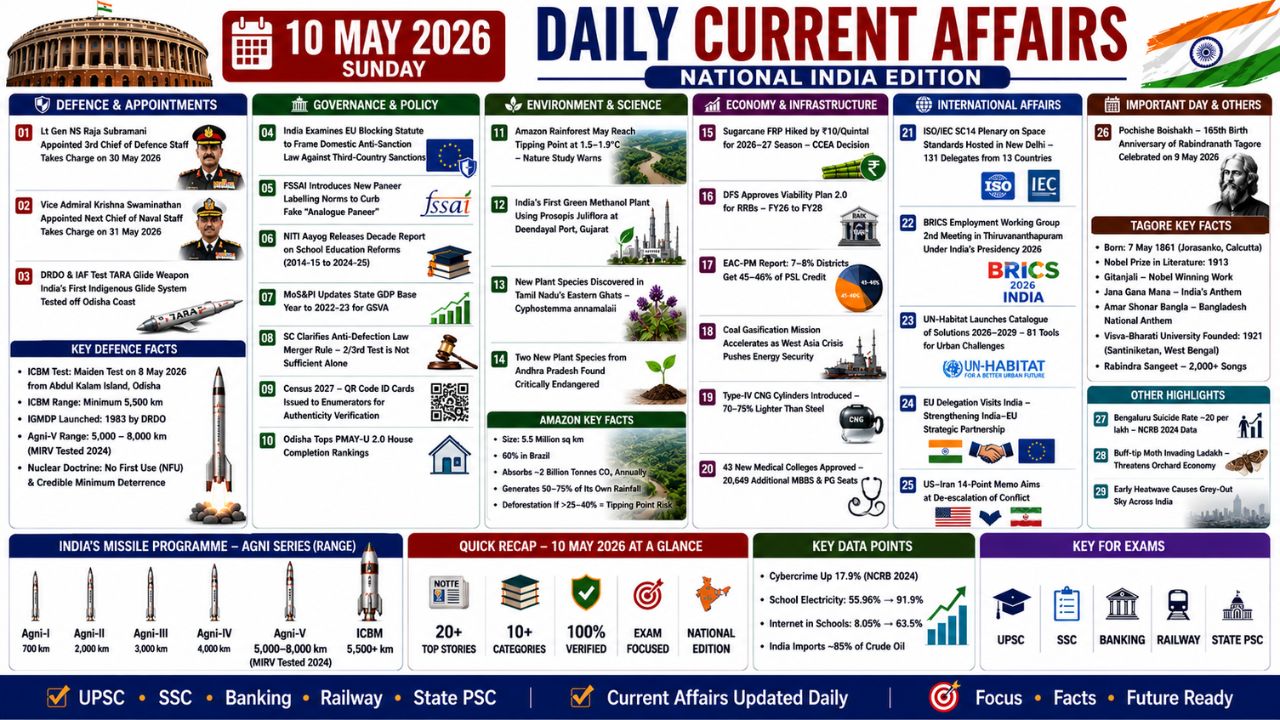
10 May 2026 Current Affairs is a goldmine for UPSC Prelims aspirants — with the exam just two weeks away on May 24. Today's edition covers some of the most conceptually rich topics of the month. India is examining the EU Blocking Statute to create a domestic anti-sanction law — a landmark move for India's economic sovereignty. FSSAI introduced new paneer labelling norms to crack down on fake analogue paneer flooding the market. The Amazon Rainforest may hit a tipping point at just 1.5–1.9°C of warming — a Nature study warns.
India's National Coal Gasification Mission came into sharp focus with West Asian geopolitical instability accelerating energy diversification. UN-Habitat launched its Catalogue of Solutions 2026–2029 with 81 tools for urban challenges. The Buff-tip Moth — an invasive insect — is threatening Ladakh's farm economy. India introduced Type-IV CNG cylinders — 70–75% lighter than steel. Two new plant species from Andhra Pradesh were found critically endangered. And a deadly early heatwave is creating atmospheric grey-out conditions across India. Let's break it all down — section by section.
Governance, Law & International Relations
India Examines EU Blocking Statute — Framing a Domestic Anti-Sanction Law
This is one of the most strategically significant policy moves of 2026 — and it's directly linked to India's growing assertiveness in protecting its economic interests from third-country coercion.
India is examining the European Union Blocking Statute to frame a domestic anti-sanction law against third-country sanctions. The EU statute enacted in 1996 is a legal shield protecting EU companies from extraterritorial foreign laws. It prohibits domestic companies from complying with specified foreign sanctions and invalidates foreign court rulings based on them. The Clawback Provision enables companies to recover losses in local courts from entities that forced compliance with foreign sanctions.
What is the EU Blocking Statute?
The EU Blocking Statute (Council Regulation No. 2271/96) was originally enacted in 1996 to protect European companies from the extraterritorial reach of US sanctions against Cuba, Iran, and Libya. It was significantly updated in 2018 — when the US withdrew from the JCPOA (Iran Nuclear Deal) and reimposed sanctions — to explicitly cover US Iran-related sanctions. The statute operates on three pillars:
Blocking: EU companies are prohibited from complying with listed foreign sanctions
Nullification: Any foreign court ruling based on listed sanctions has no effect in the EU
Clawback: Companies can sue in EU courts to recover damages suffered due to being forced to comply with foreign sanctions
Why is India looking at this?
India has faced increasing pressure from US and Western sanctions regimes — particularly around:
Russia-India trade: India has continued importing Russian oil and arms despite Western pressure
Iran oil imports: India was a significant importer of Iranian oil before US sanctions tightened after 2019
China tech restrictions: US export controls affecting semiconductors and dual-use technologies impact Indian firms too
CAATSA (Countering America's Adversaries Through Sanctions Act): India's S-400 purchase from Russia potentially triggers CAATSA — a US sanction law targeting buyers of Russian military equipment
An Indian Blocking Statute would give Indian companies legal cover to continue trade with sanctioned entities when India has not itself imposed those sanctions — asserting India's strategic autonomy as a matter of domestic law.
Constitutional basis: Article 253 of the Constitution empowers Parliament to enact laws across India to implement international treaties or conference decisions. However, a blocking statute would operate differently — it would be a defensive economic sovereignty law rather than a treaty implementation law, requiring a fresh legislative framework.
The UN vs unilateral sanctions distinction: UN sanctions are binding on all members, unlike unilateral sanctions that aren't legally binding on third-party states. This is the legal bedrock of India's position — if the UN Security Council has not imposed sanctions, India is under no international legal obligation to comply with US or EU unilateral sanctions.
EU Blocking Statute = Council Regulation 2271/96 (enacted 1996, updated 2018). Three pillars: Blocking + Nullification + Clawback. India examining domestic equivalent. CAATSA = US sanction law targeting Russian arms buyers. Article 253 = Parliament can implement international treaties. UN sanctions = binding; Unilateral sanctions = NOT binding on third states. Critical UPSC GS Paper II + III intersection topic.
FSSAI Introduces New Paneer Labelling Norms — Crackdown on Analogue Paneer
The Food Safety and Standards Authority of India (FSSAI) introduced new labelling norms to combat the rise of fake or "analogue" paneer. Key Mandate: Non-milk products cannot be sold as "paneer" and must be labelled "Paneer Analogue" or "Non-dairy". Dairy analogue manufacturers need a separate licence, not basic registration. Under FSS (Food Product Standards and Food Additives) Regulations, 2011, analogues are products that replace milk with cheaper non-dairy ingredients — vegetable oils, starches, and emulsifiers.
What is Analogue Paneer?
Analogue paneer is a product designed to look, feel, and taste like genuine paneer — but is manufactured using non-dairy ingredients such as:
Vegetable oils (palm oil, soybean oil) instead of milk fat
Starches and hydrocolloids instead of milk solids
Emulsifiers and flavouring agents to mimic paneer's texture
It is significantly cheaper to produce than real paneer — which requires 5–6 litres of milk per kg. Analogue paneer exploits this cost difference and has been found flooding restaurants, street food vendors, and packaged food supply chains — often sold without disclosure to consumers.
Why is this harmful?
Consumers pay paneer prices for an inferior non-dairy product — consumer fraud
People with dairy allergies may unknowingly consume dairy-like products
Nutritional deception — real paneer is a rich protein source; analogue is primarily starch and vegetable fat
Economic harm to dairy farmers — reduced demand for genuine milk undermines India's dairy sector, which involves over 80 million dairy farmers
FSSAI background: The Food Safety and Standards Authority of India was established under the Food Safety and Standards Act, 2006. It functions under the Ministry of Health and Family Welfare and is responsible for setting food safety standards, licensing food businesses, and enforcing food labelling regulations across India. The FSS (Labelling and Display) Regulations, 2020 govern how food products must be labelled.
FSSAI = established under FSS Act 2006. Under Ministry of Health and Family Welfare. Analogue paneer = non-dairy substitute using vegetable oils, starches, emulsifiers. Must be labelled "Paneer Analogue" or "Non-dairy." Separate licence (not just registration) required for analogue manufacturers. FSS (Food Product Standards and Food Additives) Regulations 2011 = governing framework. ~80 million dairy farmers in India.
National Plan to Build New Cities — India's Urban Transition Framework
India is examining a National Plan to Build New Cities as part of its broader urban transition strategy.
India's urbanisation challenge: India is urbanising at an unprecedented pace — the 2011 Census showed 31.2% urban population, and projections suggest India will have 600 million urban residents by 2031 — making it the world's most urbanised country by absolute numbers. Existing cities like Delhi, Mumbai, Bengaluru, and Hyderabad are already at or beyond carrying capacity in terms of housing, water, transport, and green space.
The New Cities rationale: India's approach to new city creation has three primary models:
Greenfield cities: Built from scratch on new land — like GIFT City (Gujarat International Finance Tec-City) in Gandhinagar and Amaravati (AP's new capital)
Satellite townships: Planned extensions adjacent to existing metros — reducing pressure on core cities
Smart Cities: Retrofitting and upgrading existing tier-2/tier-3 cities under the Smart Cities Mission (launched June 2015)
Constitutional dimension: Urban governance falls under the 74th Constitutional Amendment Act, 1992 — which gave constitutional status to Urban Local Bodies (ULBs) and the 12th Schedule (18 functions for municipalities).
India = 31.2% urban (2011 Census). 600 million urban residents projected by 2031. GIFT City = Gandhinagar. Smart Cities Mission = June 2015. 74th Amendment = constitutional status for ULBs. 12th Schedule = 18 municipal functions. SDG 11 = Sustainable Cities and Communities.
International Affairs & Environment
Amazon Rainforest May Reach Ecological Tipping Point at 1.5–1.9°C — Nature Study Warning
A new study published in Nature warns that the Amazon Rainforest could approach a critical ecological tipping point much earlier than expected. The Amazon Rainforest may begin self-driven ecological collapse at 1.5–1.9°C warming, shifting large portions of the forest into degraded ecosystems.
This is one of the most alarming environmental findings of 2026 — and here's why every exam aspirant needs to understand it deeply.
What is an ecological tipping point?
A tipping point is a threshold beyond which a system shifts irreversibly to a qualitatively different state. For the Amazon, this means crossing a point where the rainforest can no longer sustain itself through its own water cycle — a process called biotic pump or forest-driven rainfall recycling. The Amazon generates approximately 50–75% of its own rainfall through transpiration — if enough forest is lost, this self-sustaining mechanism collapses, turning the remaining forest into savanna or degraded scrubland.
The 1.5–1.9°C threshold — why it's alarming: The Paris Agreement aims to limit global warming to 1.5°C above pre-industrial levels (ideally) and well below 2°C. Current global warming trajectories put us at approximately 1.2–1.3°C already. The Nature study finding — that Amazon collapse could begin at 1.5–1.9°C — means the Amazon's tipping point lies within the Paris Agreement's own target range. This isn't a distant catastrophe — it's potentially a near-term emergency.
Current Amazon stress factors:
Deforestation: Brazil has lost approximately 17–20% of the Amazon — and scientists warn that 25–40% loss could trigger the tipping point
Climate change: Rising temperatures and changing precipitation patterns stress the ecosystem
Fires: Amazon fires — both natural and human-induced — destroy millions of hectares annually
Illegal mining and agriculture encroachment: Particularly in Brazil, Bolivia, Peru, and Colombia
Amazon quick facts for exams:
Fact | Detail |
|---|---|
Size | ~5.5 million sq km (world's largest tropical rainforest) |
Countries | 9 countries — 60% in Brazil |
CO₂ absorption | ~2 billion tonnes annually |
Biodiversity | ~10% of all species on Earth |
Water cycle | Generates 50–75% of its own rainfall |
Critical deforestation threshold | ~25–40% (scientists' estimate) |
Current deforestation | ~17–20% lost |
India's stakes: Amazon dieback would significantly affect global monsoon patterns — including the South Asian Monsoon. Studies show that Amazon-scale forest loss could reduce monsoon rainfall across South Asia by weakening the global atmospheric circulation that drives moisture from the oceans to the Indian subcontinent.
Amazon tipping point = 1.5–1.9°C (Nature 2026 study). Largest tropical rainforest = 5.5 mn sq km; 60% in Brazil. Amazon generates 50–75% of its own rainfall. Paris Agreement = 1.5°C ideal limit (below 2°C). Current warming = ~1.2–1.3°C. Amazon absorbs ~2 billion tonnes CO₂/year. Loss of Amazon could affect Indian monsoon. Most critical UPSC Environment topic of May 2026.
UN-Habitat Launches Catalogue of Solutions 2026–2029 — 81 Urban Tools
UN-Habitat launched the Catalogue of Solutions 2026–2029 to address challenges related to housing, inequality, and basic urban services. It compiles 81 tools, methodologies, and advisory frameworks, aligned with the UN-Habitat Strategic Plan 2026–2029, the New Urban Agenda and SDG 11. Strategic Focus: Universal access to adequate housing, land, and basic services. Impact Areas: Urban prosperity, crisis recovery, and climate action.
About UN-Habitat: The United Nations Human Settlements Programme (UN-Habitat) was established in 1978 and is headquartered in Nairobi, Kenya — making it one of the few UN agencies headquartered in the Global South. Its mandate is to promote sustainable urban development and adequate housing for all. Key milestones:
Habitat I: Vancouver, 1976
Habitat II: Istanbul, 1996
Habitat III (New Urban Agenda): Quito, Ecuador, 2016 — adopted the New Urban Agenda as the global framework for sustainable urbanisation
SDG 11: "Make cities and human settlements inclusive, safe, resilient and sustainable" — with targets including access to safe housing, public transport, green spaces, and reduction of the urban poor living in slums.
India's urban challenges in context: India has approximately 13.9 million households living in urban slums (Census 2011 data — likely higher now). Schemes like PMAY-U (Pradhan Mantri Awas Yojana-Urban) and the Smart Cities Mission are India's primary responses — but rapid urbanisation continues to outpace infrastructure provision.
UN-Habitat = established 1978. HQ = Nairobi, Kenya. 81 solutions in Catalogue 2026–2029. New Urban Agenda = Habitat III, Quito 2016. SDG 11 = Sustainable Cities. New Urban Agenda + SDG 11 = governing frameworks for urban development globally.
Energy & Economy
Coal Gasification — India's Bridge to Energy Security as West Asia Burns
Geopolitical instability in West Asia has accelerated India's adoption of coal gasification as a bridge between its fossil fuel past and clean energy future. Coal gasification is a thermochemical process that converts coal into synthesis gas (syngas) — a mixture of carbon monoxide (CO), carbon dioxide (CO₂), hydrogen (H₂), and methane (CH₄) — through partial oxidation using oxygen and steam under high temperature and pressure. The syngas can be used for producing Synthetic Natural Gas (SNG), energy fuel (methanol and ethanol), ammonia for fertilisers, and petrochemicals. The National Coal Gasification Mission aims to gasify 100 MT of coal by 2030. India's first coal gasification-based fertiliser plant at Talcher, Odisha, will be operational by December 2027. Jindal Steel & Power (JSPL) in Angul, Odisha is the only commercial-scale coal gasification plant currently operational in India.
Why coal gasification makes sense for India: India sits on the world's 4th largest coal reserves — approximately 319 billion tonnes. Yet India imports significant quantities of natural gas (LNG), fertiliser feedstocks, and petrochemicals. Coal gasification allows India to convert its abundant domestic coal into these products — reducing import bills and strengthening energy security. This is particularly urgent given:
The West Asian crisis threatening LNG supply routes and pricing
India's fertiliser import dependence — India imports nearly 45% of its urea (ammonia-based fertiliser)
The need to reduce crude oil imports (~85% of oil is imported)
Underground Coal Gasification (UCG) — the next frontier: Underground Coal Gasification (UCG) is an in-situ process that converts coal into syngas within underground coal seams — without mining the coal to the surface. Air/oxygen and steam are injected through wells into coal seams, igniting the coal underground to produce syngas which is extracted to the surface. This enables utilisation of deep, thin, or unmineable coal reserves that conventional mining cannot access.
Commercial coal block auctions offer a 50% rebate on revenue share if at least 10% of production is diverted for gasification — a strong financial incentive to integrate gasification into India's coal mining operations.
Key policy framework:
National Coal Gasification Mission — target: 100 MT capacity by 2030
₹37,500 crore coal gasification incentive scheme — approved by Cabinet to support commercial scale-up
Aligns with India's Energy Security Goals under the National Energy Policy
First UCG provisions included in coal mine development agreements under the 14th round of commercial coal auctions — with Reliance Industries and Axis Energy as winners
Coal gasification vs coal burning — what's better?
Coal gasification is not clean energy — it still involves coal, a fossil fuel. But it is significantly cleaner than direct combustion:
Syngas can be cleaned of sulphur and mercury before use (unlike direct combustion emissions)
Carbon Capture and Storage (CCS) is more viable when applied to concentrated syngas streams
Green methanol and green hydrogen production from biomass gasification (like the Deendayal Port green methanol plant) represents the truly clean end of the gasification technology spectrum
Coal gasification = thermochemical process converting coal to syngas (CO + CO₂ + H₂ + CH₄). National Coal Gasification Mission target = 100 MT by 2030. First coal gasification fertiliser plant = Talcher, Odisha (operational Dec 2027). JSPL Angul = only current commercial-scale plant. UCG = in-situ underground process. 50% rebate on revenue share for 10%+ gasification diversion. ₹37,500 crore incentive scheme approved.
Type-IV CNG Cylinders — India Commercialises Indigenous Composite Cylinders
The Technology Development Board (TDB) partnered with NTF Energy Solutions Pvt. Ltd. to commercialise indigenous Type-IV CNG cylinders. Type-IV CNG cylinders are advanced composite gas storage cylinders with a polymer (plastic) liner fully wrapped in carbon fibre, unlike traditional metal cylinders. They are up to 70–75% lighter than steel cylinders, improving vehicle fuel efficiency and reducing emissions. They are designed for high pressure (600+ bar), corrosion resistance, and leak-proof performance.
Why Type-IV matters: India's CNG vehicle fleet is one of the largest in the world — particularly in Delhi, Mumbai, and the National Capital Region. Traditional steel CNG cylinders are heavy, which reduces vehicle fuel efficiency and adds to vehicle dead weight. Type-IV cylinders — made with carbon fibre composite materials — are dramatically lighter while being stronger and more durable. This improves vehicle performance, extends range, and enhances safety.
The carbon fibre advantage: Carbon fibre composites have a tensile strength 5 times stronger than steel at one-fifth the weight — making them ideal for high-pressure gas storage. They are already used extensively in aerospace, defence, and sporting equipment. Commercial CNG cylinder application represents a significant cost reduction in carbon fibre manufacturing at scale — part of India's broader advanced materials industry development.
Technology Development Board: TDB operates under the Department of Science and Technology (DST) and provides financial support to Indian companies for commercialising indigenous technologies developed in Indian research institutions.
Type-IV CNG cylinder = polymer liner + carbon fibre wrap. 70–75% lighter than steel. Handles 600+ bar pressure. TDB = under DST. Technology partner = NTF Energy Solutions. Carbon fibre = 5x stronger than steel at 1/5th the weight. Relevant for Science & Technology and Economy sections.
Environment & Biodiversity
Buff-tip Moth — Invasive Insect Threatening Ladakh's Farm Economy
Scientists have recorded that a new invasive buff-tip moth is threatening Ladakh's farm-based economy. The buff-tip (Phalera bucephala) moth belongs to the family Notodontidae. Distribution: It is native to parts of Africa, East Asia, and Europe. Adults emerge in mid-June, mate quickly, and lay clusters of up to 150 eggs. By July, the larvae hatch and begin feeding in groups. By late summer, the caterpillars burrow underground to pupate, lying dormant through winter before emerging the following year. It blends in perfectly with its surroundings, looking just like the twig of a birch tree. It is a voracious feeder and can strip an entire tree bare in a few weeks. Its polyphagous nature (ability to feed on a wide range of plants) makes it particularly threatening.
The buff-tip moth is threatening Ladakh's economy by rapidly defoliating host trees like White Willow, poplar, apple, walnut, and mountain ash.
Why Ladakh is particularly vulnerable: Ladakh's fragile, high-altitude ecosystem has very limited tree cover. The trees that do exist — particularly White Willows, poplars, and fruit trees — are essential for:
Microclimate regulation — trees prevent soil erosion and regulate temperatures in cold desert conditions
Livelihoods — apple, walnut, and apricot orchards are a primary source of income for Ladakhi farmers
Biodiversity corridors — trees support Ladakh's endemic and migratory bird species
The Buff-tip moth's polyphagous (multi-plant feeding) behaviour means it doesn't spare fruit trees — directly threatening orchard-based incomes. Ladakh's high-altitude ecosystem also has limited natural predators for this invasive species, allowing its population to explode.
Invasive species context: The introduction of invasive species is one of the top 5 drivers of global biodiversity loss (along with habitat destruction, climate change, overexploitation, and pollution) according to the IPBES Global Assessment. India has seen several damaging invasive species cases — Prosopis juliflora in Gujarat's Banni grasslands, Lantana camara in Indian forests, and the Common Myna in urban areas.
Buff-tip moth = Phalera bucephala. Family = Notodontidae. Native to Africa, East Asia, Europe. Polyphagous (eats many plant types). Threatens White Willow, poplar, apple, walnut in Ladakh. Larvae feed July onwards. Defoliates entire trees in weeks. Invasive = top 5 biodiversity threat driver (IPBES). Camouflage = resembles birch twig.
Two New Plant Species from Andhra Pradesh Found Critically Endangered
Two new plant species from Andhra Pradesh were assessed as Critically Endangered under the IUCN Red List criteria. Threats include granite mining, forest fires, grazing, and habitat degradation. Ceropegia andhrica faces overharvesting risk for its edible tubers.
About Ceropegia: Ceropegia is a genus of plants in the family Apocynaceae — known for their distinctive, often ornate tubular flowers. India is a global diversity hotspot for Ceropegia — with several endemic species found in the Western Ghats, Eastern Ghats, and Deccan plateau. Many Ceropegia species have edible tubers — making them targets for over-collection by local communities, compounding their vulnerability to habitat loss.
Eastern Ghats biodiversity: The Eastern Ghats — a discontinuous hill range running through Odisha, Andhra Pradesh, Telangana, and Tamil Nadu — harbour significant endemic biodiversity that remains under-researched compared to the more celebrated Western Ghats. New species discoveries here are scientifically valuable and conservation-critical — each new species found Critically Endangered is an urgent call for targeted protection.
IUCN Red List categories recap:
Category | Abbreviation |
|---|---|
Extinct | EX |
Extinct in the Wild | EW |
Critically Endangered | CR |
Endangered | EN |
Vulnerable | VU |
Near Threatened | NT |
Least Concern | LC |
Data Deficient | DD |
Ceropegia andhrica = AP plant species; family Apocynaceae; IUCN Critically Endangered. Threats: granite mining, forest fires, grazing, overharvesting of edible tubers. Eastern Ghats = under-researched biodiversity hotspot. IUCN Red List CR = Critically Endangered.
India Experiencing Unusually Early and Intense Heatwave — Grey-Out Sky Phenomenon
India is experiencing an unusually early and intense heatwave, resulting in widespread grey or washed-out skies.
What causes the heatwave grey-out?
The grey or washed-out sky during intense heatwaves is caused by a combination of:
High atmospheric aerosol loading: Dust particles suspended in the hot, unstable atmosphere scatter sunlight — creating a milky or grey haze
Increased evaporation: Intense heat causes rapid surface water evaporation, loading the atmosphere with moisture that increases haze
Reduced visibility: Temperature inversions during heatwaves trap pollutants and dust near the surface, reducing sky clarity
India's heatwave pattern — what's changing: India's India Meteorological Department (IMD) defines a heatwave when the maximum temperature is:
45°C or above in the plains
At least 4.5°C above normal for the area
India has been recording heatwaves earlier in the year — what used to be primarily a May–June phenomenon is now beginning in March–April in many states. This is consistent with global warming trends and the IPCC's projection that South Asia will experience more frequent, intense, and longer heatwaves as global temperatures rise.
Health impact: India's Heat Action Plans (HAPs) — adopted by states like Gujarat, Odisha, and Telangana — include early warning systems, cool shelters, rescheduling of outdoor activities, and public health advisories. However, coverage remains incomplete — particularly for informal sector workers who cannot avoid outdoor exposure.
Heatwave = max temp ≥45°C or ≥4.5°C above normal (IMD definition). Grey-out = aerosol scattering + dust haze during intense heat. Heatwave season extending earlier (March-April now). Heat Action Plans = state-level responses. IPCC projects more frequent South Asian heatwaves. Relevant for UPSC Environment + Disaster Management.
Science, Technology & Health
AMOC Slowdown — Climate Tipping Point with Global Consequences
Scientists caution that AMOC (Atlantic Meridional Overturning Circulation) may act as a "climate tipping point", with risk of irreversible collapse affecting global climate systems, monsoons, and extreme weather patterns. The findings are crucial for India, where monsoon-dependent agriculture supports ~50% of workforce and food security.
What is AMOC?
AMOC is a large-scale ocean circulation system acting as a global heat conveyor belt, redistributing heat from the tropics to higher latitudes, thereby regulating global climate patterns. Warm, salty surface water flows northwards — cooling near the Arctic increases density, causing water to sink. Deep cold currents flow southwards and eventually resurface, completing a ~1,000-year cycle. It is driven by temperature (thermal) and salinity (haline) differences — collectively called thermohaline circulation.
Consequences of AMOC collapse: Europe: Loss of AMOC heat transport may lead to colder climates despite global warming. North America: Potential sea-level rise along the eastern coast. Global weather systems: Increased frequency of extreme weather events including droughts, floods, and storms. Climate system instability: Weakening AMOC may destabilise other tipping points like Greenland ice sheet melt and polar feedback loops. AMOC slowdown affects global ocean heat balance, indirectly influencing El Niño cycles, which regulate global weather variability.
India-specific impact: Weakening AMOC disrupts the Inter-Tropical Convergence Zone (ITCZ) — which is directly linked to the South Asian Monsoon. Disrupted monsoon patterns would be catastrophic for India — where over 50% of agricultural land depends on rain-fed farming, and 1.4 billion people depend on monsoon-driven food production.
AMOC = Atlantic Meridional Overturning Circulation = global ocean heat conveyor belt. Thermohaline circulation = driven by temperature and salinity differences. ~1,000-year circulation cycle. Collapse = colder Europe, higher sea levels in North America, disrupted Indian monsoon. India = 50% workforce in monsoon-dependent agriculture. AMOC = climate tipping point. El Niño influenced by AMOC.
Anti-Defection Law — Recent Supreme Court Rulings Clarify Merger Provisions
In recent rulings, the Supreme Court reaffirmed critical principles around the Anti-Defection Law (10th Schedule). In Registrar Cane Cooperative Societies vs Gurdeep Singh Narval, the SC reaffirmed that deeming clauses cannot override substantive realities or expand beyond their statutory purpose. In Rajendra Singh Rana vs Swami Prasad Maurya, the SC clarified that the legislature party cannot independently effect merger — the original political party must take the substantive decision. In Speaker Haryana Vidhan Sabha vs Kuldeep Bishnoi, it was reiterated that legislators alone cannot create merger without party-level decision. The 2/3rd rule is only a test to verify merger, not a mechanism to create it.
Anti-Defection Law — complete exam framework:
Introduced by the 52nd Constitutional Amendment Act, 1985 — adding the 10th Schedule to the Constitution
Named after Haryana MLA Gaya Lal, who switched parties three times in one day in 1967 — giving rise to the phrase "Aaya Ram Gaya Ram"
Grounds for disqualification: Voluntarily giving up party membership, voting against party whip, or abstaining against party direction
Merger exception: A merger is valid if at least 2/3rd of the legislature party merges — but the SC clarification now firmly establishes that the parent political party must also decide to merge
Decision on disqualification: Speaker/Chairman of the House (subject to judicial review)
Kihoto Hollohan case (1992): SC upheld the constitutional validity of the 10th Schedule
Anti-Defection = 10th Schedule. 52nd Amendment 1985. Gaya Lal = "Aaya Ram Gaya Ram" origin. Merger = 2/3rd of legislature party + parent party decision (SC 2026 clarification). Speaker decides disqualification. Kihoto Hollohan (1992) = SC upheld 10th Schedule. This is a perennial UPSC Polity MCQ cluster.
India's Oil Spill Contingency Plan — Coastal Preparedness Update
India's Oil Spill Contingency Plan (OSCP) was discussed in the context of maritime preparedness. Key vulnerabilities highlighted: High vulnerability due to dense maritime traffic and proximity to international oil transport routes. Limited real-time monitoring systems and early warning mechanisms for oil spill detection. Capacity constraints in equipment, trained personnel, and rapid response infrastructure, especially for large-scale spills. Recommendations include strengthening real-time monitoring systems using satellite surveillance, AIS tracking, and early warning technologies.
India's maritime oil spill framework: India's coastline stretches 7,516 km — one of the world's longest. The Indian Coast Guard (ICG) leads oil spill response operations. Key legal frameworks include:
Merchant Shipping Act, 1958 — governs maritime safety and pollution
Environment Protection Act, 1986 — provides powers for emergency environmental response
MARPOL Convention (International Convention for the Prevention of Pollution from Ships) — the primary international treaty, administered by the International Maritime Organisation (IMO)
India's location astride major east-west shipping lanes — including the route from the Persian Gulf to Southeast Asia — means dense traffic of Very Large Crude Carriers (VLCCs) in Indian waters, creating significant oil spill risk.
India coastline = 7,516 km. ICG = lead for oil spill response. MARPOL = IMO convention on ship pollution. OSCP = Oil Spill Contingency Plan. AIS = Automatic Identification System (vessel tracking). Merchant Shipping Act 1958 = governing law.
Species in News
Buff-tip Moth, Ceropegia andhrica — Key Species Summary
Already covered in detail above. Quick reference for revision:
Species | Classification | Status | Location | Threat |
|---|---|---|---|---|
Buff-tip Moth (Phalera bucephala) | Insect; Family Notodontidae | Invasive alien species | Native: Africa, East Asia, Europe; Now: Ladakh | Defoliates apple, walnut, willow, poplar |
Ceropegia andhrica | Plant; Family Apocynaceae | IUCN Critically Endangered | Andhra Pradesh, Eastern Ghats | Granite mining, overharvesting of edible tubers, forest fires |
Economy & Finance
43 New Medical Colleges Approved — 20,649 Additional MBBS and PG Seats
India approved 43 new medical colleges and 20,649 additional MBBS and PG seats for 2025–26.
India's medical education landscape: India currently has approximately 706 medical colleges with roughly 1.1 lakh MBBS seats annually — the world's largest medical education system by number of seats. Yet India's doctor-to-population ratio is approximately 1:834 — still short of the WHO recommendation of 1:1000, and severely skewed towards urban areas.
The addition of 20,649 seats across MBBS and postgraduate programmes is significant — particularly the PG seats, where the bottleneck is most acute. India produces many MBBS doctors but PG speciality training capacity is much smaller, forcing many doctors to either remain as general practitioners or migrate abroad for speciality training.
The rural CHC challenge: Rural Community Health Centres (CHCs) still face significant specialist shortages — even as medical college seats expand. This reflects the core structural challenge: medical education is concentrated in urban areas, and newly minted doctors have limited incentives to serve in rural postings. Addressing this requires bond policies (mandatory rural service after government-funded education), rural health incentive packages, and improved rural health infrastructure.
43 new medical colleges approved. 20,649 additional MBBS + PG seats (2025-26). India total = ~706 medical colleges, ~1.1 lakh MBBS seats. Doctor-population ratio = ~1:834 (WHO recommends 1:1000). PG seat shortage = main bottleneck. CHCs = Community Health Centres (rural health facilities).
Shashi Shekhar Vempati Appointed CBFC Chairperson
Shashi Shekhar Vempati was appointed as the Chairperson of the Central Board of Film Certification (CBFC) for a three-year term starting 6 May 2026, succeeding Prasoon Joshi. Vempati is a former CEO of Prasar Bharati and an IIT Bombay graduate, known for modernising Doordarshan and All India Radio.
About CBFC: The Central Board of Film Certification is a statutory body under the Ministry of Information and Broadcasting — established under the Cinematograph Act, 1952. It is responsible for certifying films for public exhibition in India. Film certifications include:
U: Unrestricted public exhibition
UA: Parental guidance for children under 12
A: Restricted to adults (18+)
S: Restricted to specific professional groups
About Prasar Bharati: The Prasar Bharati Corporation is India's public broadcaster — governing Doordarshan (TV) and All India Radio (AIR). It was established under the Prasar Bharati (Broadcasting Corporation of India) Act, 1990 and became operational in 1997.
CBFC Chairperson = Shashi Shekhar Vempati (from May 6, 2026). Succeeds Prasoon Joshi. Former Prasar Bharati CEO. IIT Bombay. CBFC = under Ministry of I&B. Cinematograph Act 1952. Film certifications: U, UA, A, S. Prasar Bharati = Doordarshan + AIR. Prasar Bharati Act 1990, operational 1997.
FAQs — 10 May 2026 Current Affairs
Q. What is the EU Blocking Statute and why is India studying it?
The EU Blocking Statute (1996, updated 2018) protects EU companies from extraterritorial foreign sanctions through three mechanisms: blocking compliance, nullifying foreign court orders, and clawback of losses. India is studying it to create a domestic legal shield protecting Indian companies from US and Western unilateral sanctions — particularly around Russia oil trade and CAATSA exposure from the S-400 purchase.
Q. What did FSSAI mandate about analogue paneer?
FSSAI mandated that non-milk products cannot be sold as "paneer" and must be clearly labelled as "Paneer Analogue" or "Non-dairy." Manufacturers of analogue dairy products need a separate licence — not just basic registration.
Q. What does the Nature 2026 study warn about the Amazon?
A study in Nature warns that the Amazon Rainforest may begin self-driven ecological collapse at just 1.5–1.9°C of global warming — potentially reaching a tipping point within the Paris Agreement's own temperature target range. At this point, large portions of the forest could shift permanently into degraded savanna-like ecosystems.
Q. What is the National Coal Gasification Mission target?
To gasify 100 million tonnes (MT) of coal by 2030. India's first coal gasification-based fertiliser plant is being set up at Talcher, Odisha, with operations expected from December 2027. Jindal Steel and Power in Angul, Odisha, is currently the only commercial-scale coal gasification plant in India.
Q. What makes Type-IV CNG cylinders different from conventional ones?
Type-IV cylinders use a polymer (plastic) liner fully wrapped in carbon fibre — making them 70–75% lighter than traditional steel cylinders while handling pressures exceeding 600 bar. They are corrosion-resistant and leak-proof, improving vehicle fuel efficiency and safety.
Q. What is the Buff-tip moth and why is it a concern for Ladakh?
Phalera bucephala — a moth of the Notodontidae family, native to Africa, East Asia, and Europe. It is an invasive species in Ladakh that defoliates apple, walnut, White Willow, poplar, and mountain ash trees. Its polyphagous nature and voracious larval feeding directly threaten Ladakh's orchard-based farming economy.
Q. What is AMOC and why does its slowdown concern India?
The Atlantic Meridional Overturning Circulation is a global ocean heat conveyor belt driven by thermohaline circulation (temperature and salinity differences). Its weakening or collapse could disrupt the South Asian Monsoon — on which 50% of India's workforce depends for agriculture — and increase the frequency of extreme weather events globally.
Q. What did the Supreme Court clarify about the Anti-Defection merger rule?
The SC clarified that the 2/3rd legislature party threshold is only a test to verify a merger — it is not sufficient by itself to create one. The original political party must also take the substantive decision to merge. Legislators alone cannot effect a merger without a party-level decision.
Q. What is UN-Habitat's Catalogue of Solutions 2026-2029?
A compilation of 81 tools, methodologies, and advisory frameworks launched by UN-Habitat to address urban housing, inequality, and basic services challenges. It aligns with the New Urban Agenda and SDG 11 (Sustainable Cities and Communities). UN-Habitat is headquartered in Nairobi, Kenya.
Written by
Koti Deva
Digital Marketing Specialist
Koti is a Digital Marketing Specialist with over 10 years of experience and the co-founder of MCQ Orbit — a free exam prep platform built for Indian competitive exam aspirants.
With strong personal knowledge in Quantitative Aptitude, Logical Reasoning, and Mathematics, Koti has a deep understanding of what it takes to crack exams like SSC CGL, IBPS PO, SBI Clerk, UPSC Prelims, NEET, and JEE. Having followed these exams closely for years, he understands the exact topics, patterns, and shortcuts that matter most.
MCQ Orbit was born from a simple desire — to build a platform where every aspirant in India can practice quality MCQs, read reliable current affairs, and prepare confidently, without paying a rupee. Koti combines his digital expertise with his passion for competitive exams to create content that is accurate, practical, and genuinely useful for students.
His mission is straightforward: if the right guidance had been freely available earlier, more students would have cracked their dream exams. MCQ Orbit is his way of making that happen.
Comments
No comments yet.