
NASA Just Created a "Fifth State of Matter" in Space - Here's the Science
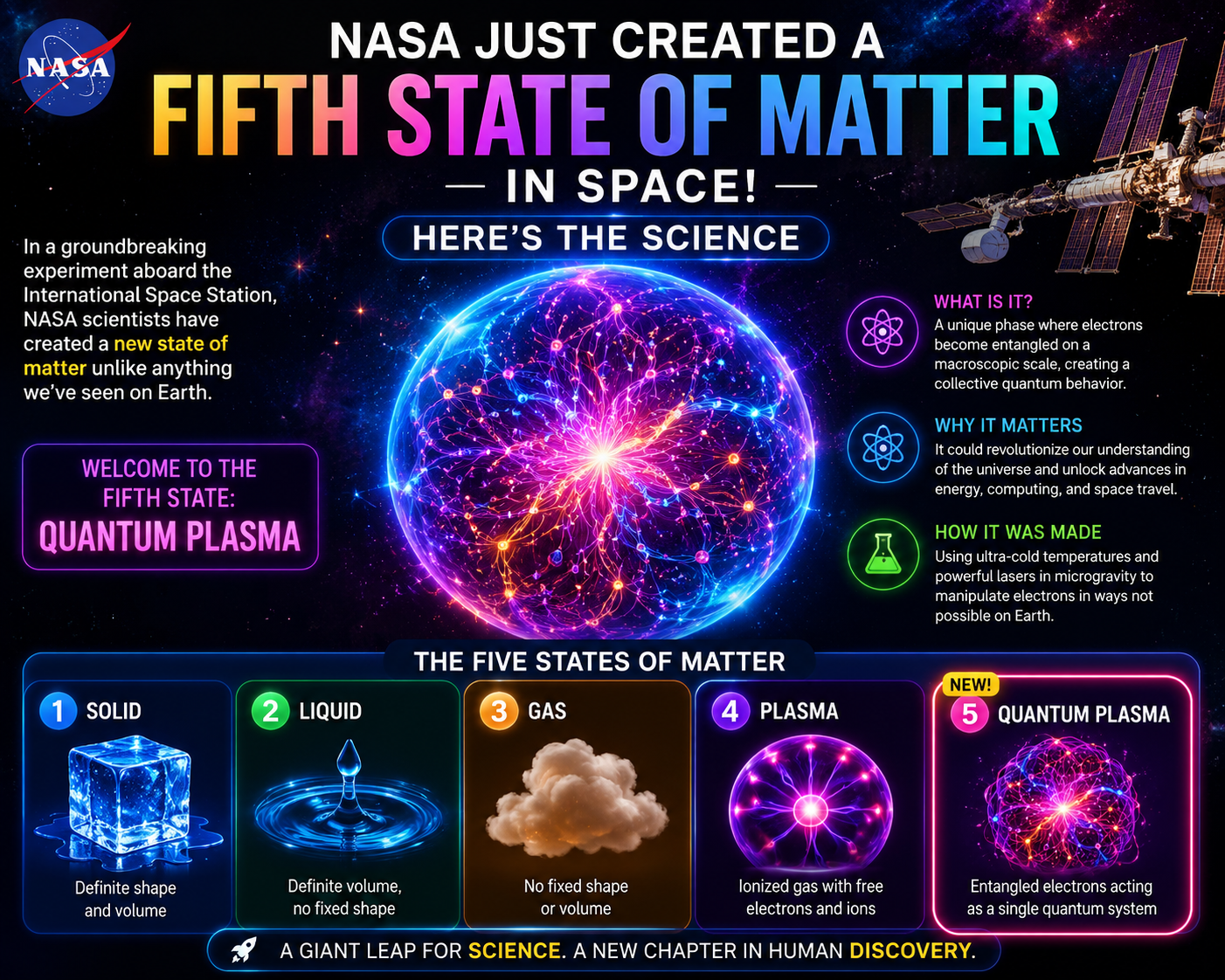
If you've been following science news today, one story is dominating headlines: NASA has successfully created a fifth state of matter aboard the International Space Station. It sounds like science fiction, but it's very real physics.
Let's break down what actually happened, and why this "fifth state of matter" is such a big deal.
Wait — Only Five States of Matter?
Most of us learn the classic three in school: solid, liquid, and gas. Add plasma (the ionized gas found in stars, lightning, and neon signs), and you get the four states most textbooks describe.
The fifth state is called a Bose-Einstein Condensate (BEC) and it behaves nothing like the other four.
What Is a Bose-Einstein Condensate?
A Bose-Einstein Condensate forms when a group of atoms is cooled to temperatures just a fraction of a degree above absolute zero (-273.15°C, the coldest temperature theoretically possible). At that point, the individual atoms stop behaving like separate particles and collapse into a single quantum state essentially becoming one giant "super-atom" that displays quantum effects on a scale large enough for scientists to observe directly.
This exotic state of matter was first predicted in the 1920s by Albert Einstein, building on statistical work by physicist Satyendra Nath Bose. It took over 70 years for anyone to actually produce one in a lab that finally happened in 1995, an achievement that earned its creators the 2001 Nobel Prize in Physics.
Why Did NASA Make One on the ISS?
Here's the twist behind today's headlines: gravity makes BECs frustratingly hard to study on Earth. In a ground-based lab, gravity pulls the ultra-cold cloud of atoms downward, so researchers can only observe it for a fraction of a second before it falls out of view.
Onboard the space station, using the upgraded Cold Atom Laboratory (CAL), scientists get continuous microgravity. That unlocks several advantages:
BECs can be held and studied for far longer than is possible on Earth
Atoms can be cooled to temperatures colder than the vacuum of deep space itself
Researchers can test the fundamental rules of quantum mechanics with far greater precision
This is essentially a orbiting quantum physics lab, floating 400 kilometers above Earth, dedicated to studying matter at temperatures nature itself never reaches.
Why This Discovery Matters
Beyond the "wow factor," BEC research has real potential payoffs:
Ultra-precise sensors BECs are extraordinarily sensitive to gravity and magnetic fields, which could lead to next-generation navigation systems and gravity mapping (useful for detecting things like underground resources or even hidden structures)
Better atomic clocks critical for GPS accuracy and deep-space navigation
Fundamental physics tests probing whether quantum mechanics holds up exactly the same way in space as it does on Earth, and searching for subtle deviations that could point to new physics
Quick Recap
There are (at least) five recognized states of matter: solid, liquid, gas, plasma, and Bose-Einstein Condensate.
A BEC forms near absolute zero, where atoms merge into a single quantum state.
NASA's Cold Atom Laboratory aboard the ISS uses microgravity to study BECs longer and more precisely than any lab on Earth can.
The research could lead to breakthroughs in sensing, navigation, and our basic understanding of quantum physics.
Science doesn't get more current or more genuinely strange than matter that stops acting like separate atoms and starts acting like one collective quantum wave, hundreds of kilometers above our heads.

Written by
Nithin Pallepati
Subject Matter Expert
Nithin Pallepati — Pharmaceutical Scientist, Math Expert & Co-Founder of MCQ Orbit
Nithin Pallepati did not set out to build an exam prep platform. He set out to get things right.
With 12 years in pharmaceutical and scientific research, accuracy is not a habit for Nithin, it is a discipline he lives by. Every article, question set, and topic on MCQ Orbit goes through his personal review: fact-checked, cross-referenced against real exam patterns, and held to a researcher's standard before it ever goes live.
His passion for Mathematics and Quantitative Aptitude runs deep, and so does his understanding of what Indian competitive exam aspirants from SSC CGL and IBPS PO to NEET and JEE actually need to succeed.
MCQ Orbit is completely free. No paywalls. No shortcuts on quality. Just reliable preparation built on one simple belief: every student deserves content that is honest, accurate, and worth their time.
Comments
No comments yet.