
The Universe Beyond Earth: What We Actually Know About Space
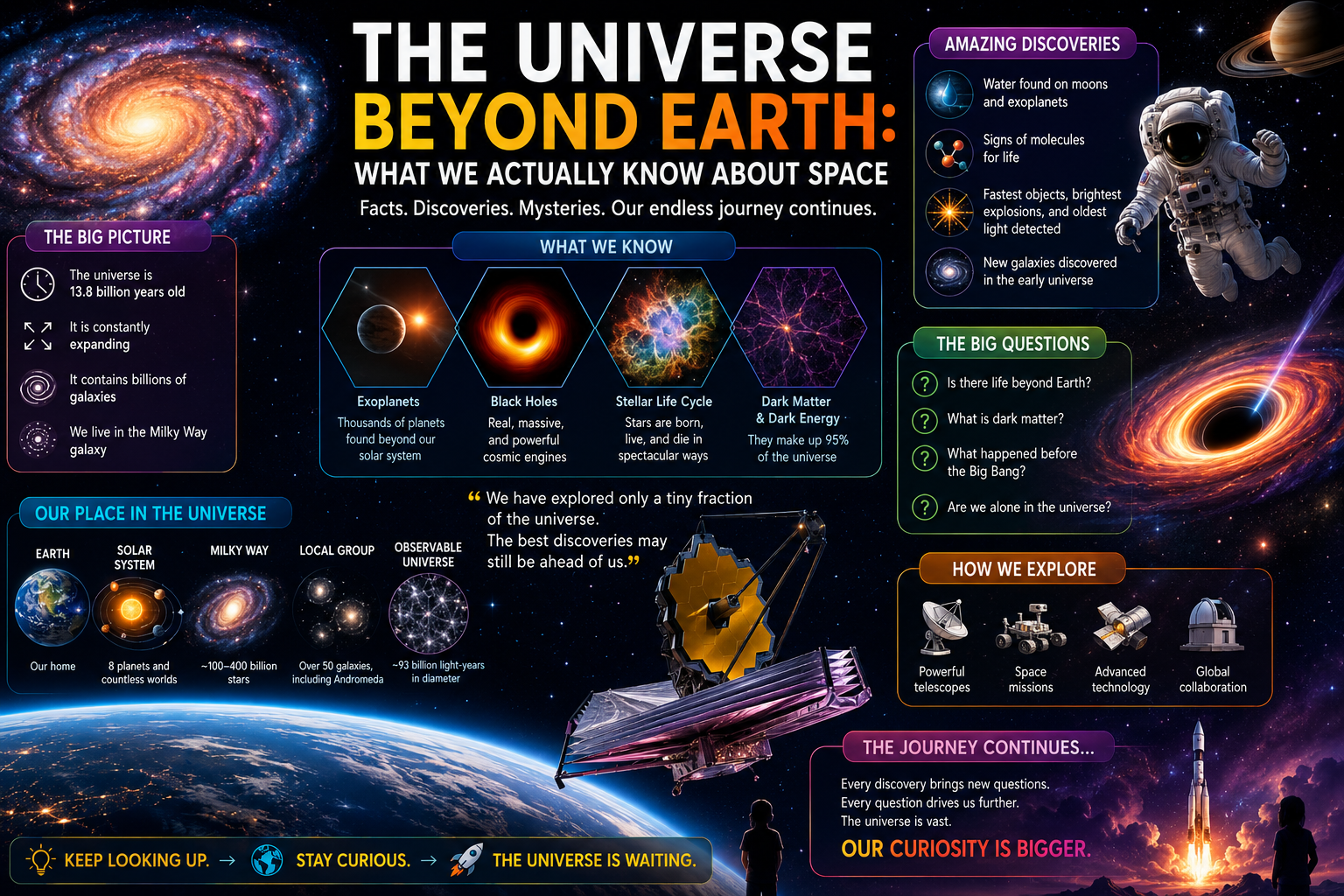
Look up on a clear night, away from city lights, and you'll see maybe two thousand stars with your naked eye. That sounds like a lot until you learn there are somewhere between one hundred billion and four hundred billion stars in the Milky Way alone, and the Milky Way is just one galaxy out of roughly two trillion galaxies that we can currently detect. Most people hear a number like that, nod, and move on with their day. But if you actually sit with it for a minute, it changes how you see everything.
This isn't going to be one of those articles that throws numbers at you and calls it a day. We're going to walk through what space actually is, how far away things really are, why the night sky looks the way it does, and what scientists are still arguing about. No jargon left unexplained. No skipped steps. By the end, you'll understand space the way someone who's actually curious about it should not just memorized facts, but a real sense of the place we live in.
What Is Space, Really?
Space is everything that exists outside Earth's atmosphere. That's the simple version. But the more interesting question is: what's actually in it?
For a long time, people assumed space was empty a black void with stars scattered around like salt thrown on a table. That's not quite right. Space contains gas, dust, radiation, magnetic fields, and a strange substance we call dark matter that we can't see directly but can detect through its gravitational pull. Even the emptiest patches of space aren't truly empty; there are a few atoms floating around per cubic meter, compared to the roughly 25 quintillion molecules in every cubic centimeter of the air you're breathing right now.
The other thing people get wrong is distance. We're used to distances on Earth a few hundred kilometers between cities, a few thousand across a country. Space doesn't work on that scale, so astronomers use a unit called a light-year, which is the distance light travels in one year. Light moves at about 300,000 kilometers per second, so in a year it covers roughly 9.46 trillion kilometers. That single number is our new "kilometer" once we start talking about stars and galaxies.
Here's a way to actually feel that scale. If the Sun were the size of a basketball, Earth would be a grain of sand about 24 meters away. Neptune, the farthest planet, would be nearly 900 meters away almost a full kilometer, for a grain of sand orbiting a basketball. And the nearest star to our Sun, Proxima Centauri, would be roughly 6,500 kilometers away on this scale. That's the actual gap between "our neighborhood" and "the next house over" in cosmic terms.
How Old Is the Universe, and How Do We Even Know That?
The universe is about 13.8 billion years old. Scientists arrived at this number mainly through two independent methods that happen to agree with each other, which is a big deal in science when two completely different approaches give you the same answer, you start trusting the answer.
The first method involves measuring how fast the universe is expanding (more on that shortly) and running the expansion backward like rewinding a video, to see when everything would have been squeezed into a single point. The second method comes from studying the cosmic microwave background leftover heat radiation from the early universe, still detectable today, spread across the entire sky. Both methods land on roughly the same age, give or take a small margin of error that scientists are still working to narrow down.
The event that kicked everything off is called the Big Bang. This name causes more confusion than almost any term in science, because it makes people picture an explosion happening at some point in space, with stuff flying outward into an empty room. That's not what happened. The Big Bang wasn't an explosion into space it was the expansion of space itself. There was no "before," at least not in any sense we currently understand, and there was no center point that everything moved away from. Every point in the universe was moving away from every other point, all at once, everywhere.
Cosmic Microwave Background (CMB): The faint leftover heat from the early universe, discovered accidentally in 1965, that fills the entire sky and gives scientists a snapshot of what things looked like about 380,000 years after the Big Bang.
The Expanding Universe (And Why It's Speeding Up)
In 1929, an astronomer named Edwin Hubble noticed something strange. He was studying distant galaxies and found that nearly all of them were moving away from us and the farther away a galaxy was, the faster it appeared to be receding. This was the first solid evidence that the universe wasn't static. It was expanding.
Think of it like a loaf of raisin bread rising in an oven. As the dough expands, every raisin moves away from every other raisin, not because the raisins are moving through the dough, but because the dough itself is stretching. Space behaves the same way. Galaxies aren't flying through space away from us space itself is stretching between us and them.
Here's the part that actually surprised scientists in the late 1990s. They expected the expansion to be slowing down over time, because gravity from all the matter in the universe should be pulling things back together, like a ball thrown into the air eventually slowing due to gravity. Instead, they found the opposite. The expansion is accelerating. Something is pushing galaxies apart faster and faster, and we don't fully understand what that something is. Scientists gave it a placeholder name: dark energy. It's estimated to make up about 68% of everything in the universe, and we still don't know what it actually is. That's not a comfortable thing for scientists to admit, but it's the honest truth.
Dark Matter: The Universe's Biggest Open Question
While dark energy pushes things apart, dark matter does the opposite it holds things together, or at least it appears to. Here's how we know it exists even though we've never directly seen it.
When astronomers study how galaxies rotate, something doesn't add up. Based on the visible matter in a galaxy stars, gas, dust the outer edges should rotate much slower than the inner regions, the same way outer planets in our solar system orbit the Sun more slowly than inner planets. But that's not what we observe. Galaxies rotate almost like a solid disc, with outer stars moving far faster than they should if only visible matter were providing the gravity.
The explanation scientists arrived at is that there's extra mass we can't see, wrapped around galaxies in a roughly spherical halo, providing the additional gravitational pull needed to explain the rotation speeds. This invisible mass is called dark matter, and current estimates suggest it makes up about 27% of the universe's total content. Regular matter everything you can see, touch, and measure directly, including stars, planets, and you makes up only about 5%.
Read that again. Everything humans have ever studied, built theories about, and understood in detail is a rounding error compared to the rest of the universe.
🖼️ IMAGE PROMPT: "A clean pie chart infographic titled 'What Is the Universe Made Of?' showing three segments: Dark Energy at 68% in deep purple, Dark Matter at 27% in muted blue-grey, and Ordinary Matter (stars, planets, everything visible) at 5% in bright gold. White background, simple bold labels with percentages, small icons next to each segment (a lightning bolt for dark energy, a ghost outline for dark matter, a small star and planet for ordinary matter)." Purpose: Helps readers immediately grasp how small a fraction of the universe we actually understand and can observe directly.
Stars: Birth, Life, and Death
Stars aren't eternal, even though they can seem that way over a human lifetime. Every star follows a life cycle, and understanding it helps explain almost everything else in space, including where the atoms in your own body came from.
A star begins inside a nebula — a massive cloud of gas and dust, mostly hydrogen. Gravity slowly pulls clumps of this material together. As the clump grows denser, pressure and temperature at its core rise until they reach a threshold — about 10 million degrees Celsius — at which point hydrogen atoms start fusing into helium. This process, called nuclear fusion, releases enormous energy, and that's the moment a star is officially born. This is exactly what happens inside our Sun right now, and it's been happening for about 4.6 billion years.
Stars spend most of their life in this stable fusion phase, which astronomers call the main sequence. Our Sun is currently in this phase and will remain here for roughly another 5 billion years. What happens after depends almost entirely on the star's mass.
Smaller stars, like our Sun, eventually run out of hydrogen fuel, swell up into a red giant, and then shed their outer layers, leaving behind a small, dense core called a white dwarf. This core will slowly cool over trillions of years.
Much larger stars — at least eight times the mass of our Sun — meet a far more dramatic end. When they exhaust their fuel, their core collapses under gravity in a fraction of a second, triggering a catastrophic explosion called a supernova. For a brief period, a single exploding star can outshine an entire galaxy. What's left behind depends on the original star's mass: either an incredibly dense neutron star, where a teaspoon of material would weigh about a billion tons, or, if the star was massive enough, a black hole — an object so dense that not even light can escape its gravity.
Here's the part that should genuinely give you chills. Elements like carbon, oxygen, calcium, and iron — the building blocks of your bones, blood, and every living thing on Earth — were forged inside dying stars and scattered across space when those stars exploded. The calcium in your teeth and the iron in your blood were made inside a star that died before our solar system even existed. Carl Sagan put it simply decades ago: we are made of star stuff. It's not poetry. It's chemistry.
Black Holes: Space's Strangest Objects
Few things capture public imagination like black holes, and few things are as widely misunderstood. A black hole is not a cosmic vacuum cleaner sucking in everything nearby, and it's not a hole in the traditional sense at all. It's a region of space where gravity has become so strong that nothing — not even light — can escape once it crosses a boundary called the event horizon.
Here's an important clarification that gets lost in popular science shows: if our Sun were somehow replaced with a black hole of the same mass, Earth wouldn't get sucked in. It would keep orbiting exactly as it does now, just without sunlight. Black holes only become dangerous to nearby objects if you get extremely close to them, closer than the object's original size would have allowed anyway.
📌 DEFINITION Event Horizon: The boundary around a black hole beyond which nothing, including light, can escape its gravitational pull. It's not a physical surface — it's a point of no return.
Black holes form in a few different ways. Stellar black holes form from the collapse of massive dying stars, as we covered above. But there's another category: supermassive black holes, which sit at the center of nearly every large galaxy, including our own Milky Way. Ours is called Sagittarius A*, and it has a mass roughly 4 million times that of our Sun. In 2019, scientists released the first-ever direct image of a black hole's shadow, from a galaxy called M87, using a network of telescopes spread across the planet working together as one giant instrument called the Event Horizon Telescope. In 2022, they did the same for Sagittarius A* itself.
Our Solar System: A Quick Reality Check
It's easy to get lost in galaxies and black holes and forget that our own solar system is strange and fascinating on its own terms.
The Sun makes up about 99.8% of all the mass in our solar system. Everything else — all eight planets, every moon, every asteroid, every comet — is essentially rounding error by comparison. Jupiter alone is more massive than all the other planets combined, roughly two and a half times as massive as everything else put together.
Venus, despite being farther from the Sun than Mercury, is the hottest planet in the solar system, with surface temperatures around 465 degrees Celsius — hot enough to melt lead. This happens because Venus has an incredibly thick atmosphere of carbon dioxide that traps heat through a runaway greenhouse effect. Mercury, despite being closest to the Sun, has no meaningful atmosphere to trap heat, so its dark side actually drops to around minus 180 degrees Celsius.
A day on Venus is longer than its year. Venus takes about 243 Earth days to rotate once on its axis, but only about 225 Earth days to orbit the Sun. That means if you lived on Venus, your birthday would arrive before your day even finished.
🖼️ IMAGE PROMPT: "A simple, clean scale diagram of the solar system showing the Sun and eight planets in order, each labeled with one standout fact: Mercury (closest, no atmosphere), Venus (hottest planet), Earth (only known life), Mars (red, thin atmosphere), Jupiter (largest, more mass than all others combined), Saturn (rings), Uranus (tilted sideways), Neptune (farthest, strongest winds). Flat design, soft pastel color palette for each planet, dark background with small stars scattered, not to true scale but visually proportioned for clarity." Purpose: Anchors readers with concrete, memorable facts about each planet rather than a generic labeled diagram.
Exoplanets: Are We Alone?
For most of human history, we had no direct evidence of planets outside our own solar system. That changed in 1992, when astronomers confirmed the first exoplanets — planets orbiting stars other than our Sun. Since then, the count has exploded. As of recent counts, scientists have confirmed over 5,500 exoplanets, with thousands more candidates awaiting confirmation.
Finding a planet orbiting a star trillions of kilometers away sounds nearly impossible, and in a sense it is — we can't just point a telescope and see a small planet next to a blindingly bright star. Instead, astronomers use clever indirect methods. The most productive one is called the transit method: when a planet passes in front of its star from our point of view, it blocks a tiny fraction of the star's light, causing a small, regular dip in brightness. By measuring how often and how deeply that dip occurs, scientists can work out the planet's size and orbital period.
The search for life-friendly planets focuses on something called the habitable zone — the range of distance from a star where temperatures could allow liquid water to exist on a planet's surface. Too close, and water boils away. Too far, and it freezes solid. Earth sits comfortably inside our Sun's habitable zone, which is a big part of why we're here to think about this at all.
Some standout discoveries include the TRAPPIST-1 system, where seven roughly Earth-sized planets orbit a small, cool star, with three or more sitting inside the habitable zone. None of this proves there's life out there. But it does prove that Earth-sized, potentially habitable planets aren't rare freaks of nature — they seem to be common across the galaxy, and that changes the odds considerably.
Common Misunderstandings People Have About Space
A few myths deserve to be cleared up plainly, because they get repeated so often that people assume they're settled fact.
"There's no gravity in space." This is one of the most repeated space myths, and it's wrong. Astronauts on the International Space Station experience about 90% of the gravity we feel on Earth's surface. What they experience instead is microgravity, caused by the fact that both the station and everything inside it are in a constant state of free-fall around Earth, which creates the sensation of weightlessness even though gravity is very much still acting on them.
"The sound of an explosion in space movies is realistic." Sound needs a medium — air, water, something with molecules close enough together to carry vibrations. Space is a near-vacuum, so sound doesn't travel through it the way it does on Earth. A spaceship exploding in real space would be completely silent to a distant observer.
"Stars twinkle because of something happening to the star itself." Twinkling, technically called stellar scintillation, happens because starlight passes through Earth's turbulent atmosphere before reaching your eyes, bending slightly as it moves through pockets of air at different temperatures and densities. Planets generally don't twinkle as noticeably because they appear as tiny discs rather than pinpoints, so the bending averages out. The star itself is shining perfectly steadily the entire time.
What We're Still Trying to Figure Out
Science doesn't have all the answers, and honestly, the unanswered questions are often more interesting than the settled ones.
We don't know what dark matter and dark energy actually are, despite them making up 95% of the universe. We don't know for certain whether life exists anywhere else, though the ingredients for it appear to be common. We're still debating the exact rate at which the universe is expanding, because two different measurement methods give slightly different answers — a puzzle astronomers call the "Hubble tension," and nobody has definitively cracked it yet. We don't fully understand what happens inside a black hole beyond the event horizon, because our current physics — Einstein's general relativity and quantum mechanics — don't agree with each other at those extreme conditions.
None of this is a failure of science. It's the opposite. Every solid answer we've found opened up three new questions we didn't know to ask before. That's genuinely the appeal of studying space: there's no version of the future where we run out of things to discover.
🖼️ IMAGE PROMPT: "An educational side-by-side comparison graphic titled 'Space Myths vs Reality.' Left column labeled 'What People Think' with simple icon illustrations: an astronaut floating with a 'no gravity' label crossed out, a silent explosion crossed out incorrectly shown as loud. Right column labeled 'What's Actually True' with corrected icons: astronaut in free-fall labeled 'microgravity,' a silent explosion icon with a 'no sound' symbol. Clean flat illustration style, blue and orange color scheme, minimal text per icon." Purpose: Visually reinforces the myth-busting section so readers remember the correction, not just the myth.
How to Actually Start Observing Space Yourself
You don't need a telescope worth lakhs of rupees to start noticing the sky differently. A pair of basic binoculars can already show you the four largest moons of Jupiter, visible as tiny points of light next to the planet. Apps that use your phone's GPS and compass can point you toward exactly which planet or constellation you're looking at in real time, which removes almost all the guesswork that used to put people off stargazing.
The best time to start is during a new moon, when the sky is darkest, away from city light pollution if you can manage it. Give your eyes about twenty minutes to adjust to the dark before you expect to see faint objects clearly — this is called dark adaptation, and checking your phone screen during this period resets the clock, so keep brightness low if you need to check anything.
Meteor showers are one of the easiest entry points, since they need no equipment at all, just patience and a clear sky. The Perseids in August and the Geminids in December are two of the most reliable annual showers, often producing dozens of visible meteors per hour at their peak.
🖼️ IMAGE PROMPT: "A friendly, beginner-focused infographic titled 'Your First Night of Stargazing.' Show four simple numbered steps with icons: 1) Check the moon phase (icon of moon calendar), 2) Find a dark spot away from city lights (icon of a park at night), 3) Let your eyes adjust for 20 minutes (icon of a clock with a moon), 4) Use a stargazing app to identify what you see (icon of a phone with stars). Warm, approachable illustration style, dark blue night sky background with a few scattered stars, soft yellow accent color for icons." Purpose: Turns an abstract, intimidating hobby into a simple four-step action plan a complete beginner can follow tonight.
A Final Thought
Every photon of starlight hitting your eye tonight left its source years, centuries, sometimes millions of years ago. When you look at a distant galaxy, you're not seeing it as it is now — you're seeing light that began its journey before humans existed, before Earth existed in some cases. Looking up isn't just stargazing. It's looking directly into the past, in real time, with your own eyes.
That's not a metaphor scientists made up to sound poetic. It's simply how light and distance work. And once you know that, the night sky never looks quite the same again.
Curious about the missions and organizations that made much of this discovery possible? Read our companion pieces on NASA's history of exploration and how humans have learned to live in space aboard orbiting stations.

Written by
Nithin Pallepati
Subject Matter Expert
Nithin Pallepati — Pharmaceutical Scientist, Math Expert & Co-Founder of MCQ Orbit
Nithin Pallepati did not set out to build an exam prep platform. He set out to get things right.
With 12 years in pharmaceutical and scientific research, accuracy is not a habit for Nithin, it is a discipline he lives by. Every article, question set, and topic on MCQ Orbit goes through his personal review: fact-checked, cross-referenced against real exam patterns, and held to a researcher's standard before it ever goes live.
His passion for Mathematics and Quantitative Aptitude runs deep, and so does his understanding of what Indian competitive exam aspirants from SSC CGL and IBPS PO to NEET and JEE actually need to succeed.
MCQ Orbit is completely free. No paywalls. No shortcuts on quality. Just reliable preparation built on one simple belief: every student deserves content that is honest, accurate, and worth their time.
Comments
No comments yet.