Total Solar Eclipse 2026: The Complete USA Guide to the August 12 Sky Event (Times, Visibility Map, and Safety Tips)
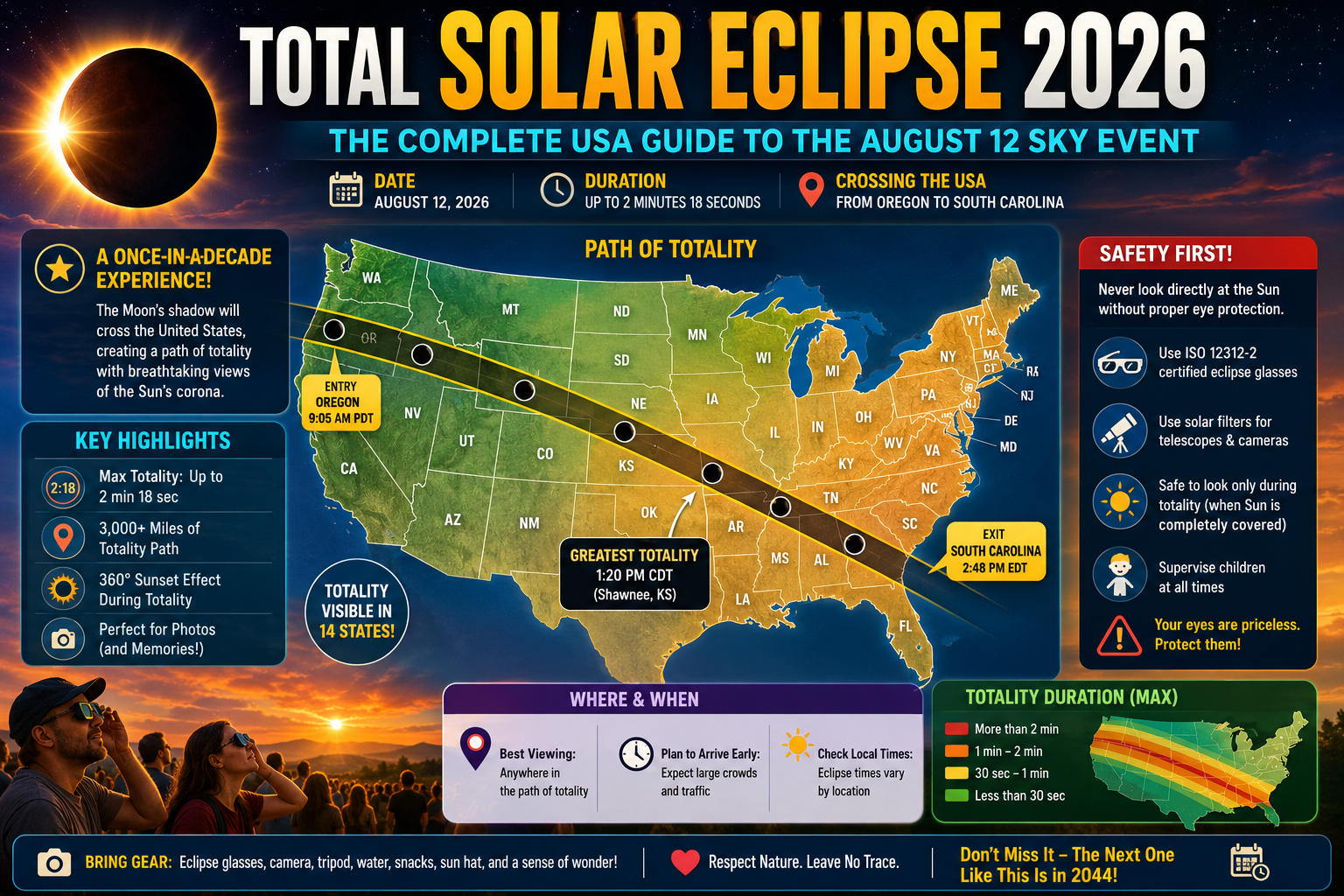
Mark your calendar for Wednesday, August 12, 2026. A total solar eclipse is about to sweep across the Northern Hemisphere, and it's already one of the most searched sky events of the year. If you live in the United States, you've probably seen the headlines and wondered: will I actually get to see this one, or is it another eclipse that skips right over my backyard?
Here's the short answer before we get into the details. If you're anywhere in the lower 48 states, you will not see a total eclipse this time. There's no coast-to-coast blackout like the one that stunned the country back in April 2024. But depending on where you live, especially if you're in the Northeast, you could still catch a partial solar eclipse, and there's a bonus reason to be outside that same night anyway. Let's walk through exactly what's happening, who gets to see what, and how to do it safely.
What Exactly Is Happening on August 12, 2026?
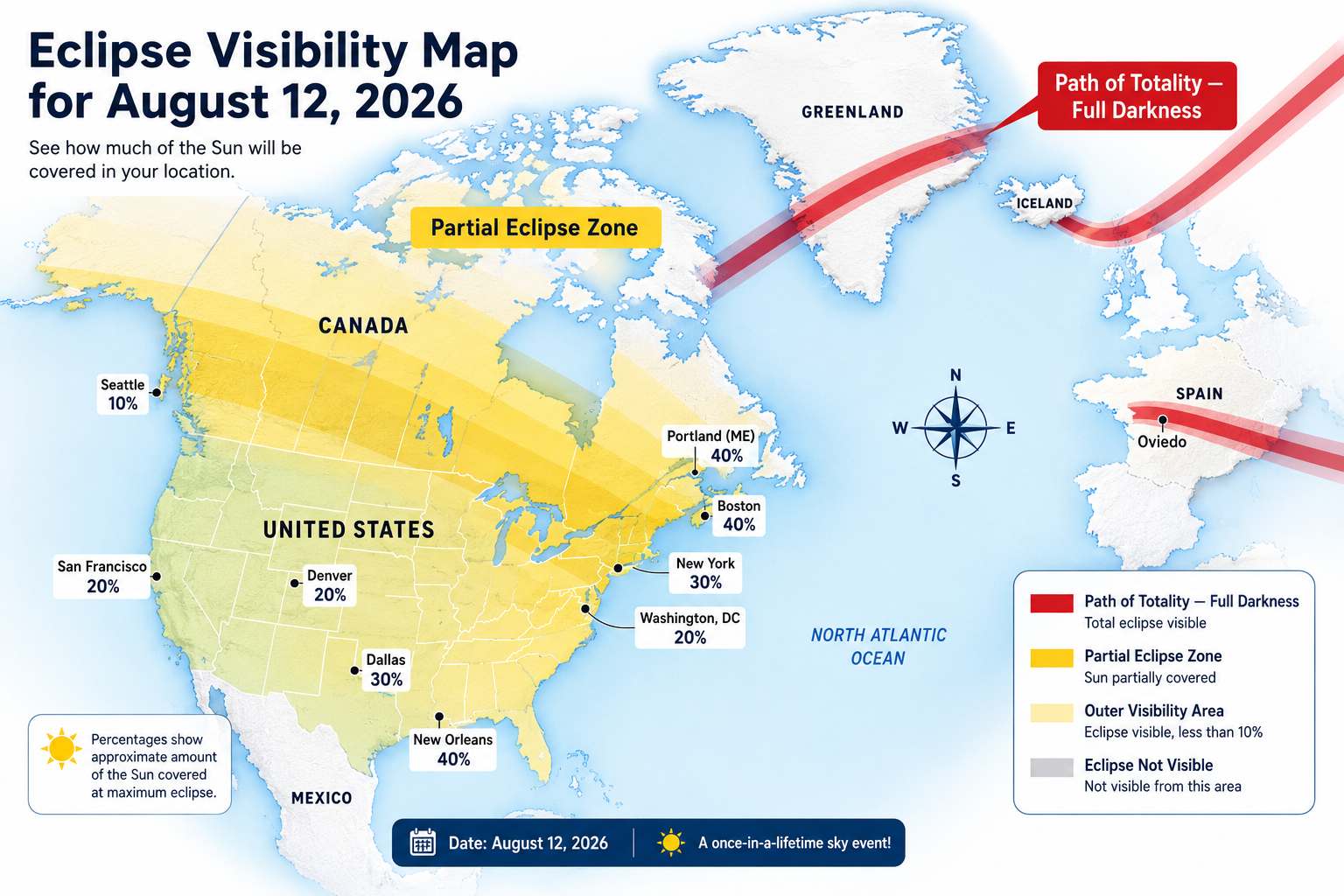
A solar eclipse happens when the Moon passes directly between the Earth and the Sun, blocking out sunlight either partially or completely depending on your location. On August 12, 2026, the Moon's shadow will trace a long, curving path starting near the North Pole in Siberia, sweeping down over the Arctic Ocean, crossing Greenland and Iceland, dipping into the North Atlantic, and finally reaching land again in northern Spain and a sliver of Portugal before the Sun sets.
This is a genuinely big deal for one specific reason: it will be the first total solar eclipse visible from mainland Europe since 1999. Spain hasn't hosted one since 1905. If you have family or friends in Reykjavik, Madrid, or the Azores, this is their moment.
For anyone standing inside that narrow path, called the path of totality, the Moon will completely cover the Sun's bright disk for a short window. Totality lasts under two minutes across most of the path, stretching to a maximum of roughly two minutes and eighteen seconds near the center of the shadow's track over the North Atlantic and Greenland.
Outside that narrow strip, a much larger swath of the planet gets a partial eclipse instead, where the Moon only takes a bite out of the Sun rather than blocking it entirely. That wider partial zone is where most of North America comes into the picture.
Path of totality: The narrow strip on Earth's surface where the Moon completely covers the Sun, turning day briefly into a twilight-like darkness. Step outside this strip and you only get a partial eclipse, no matter how close you are to the edge.
Partial solar eclipse: When the Moon covers only part of the Sun's face, leaving a crescent-shaped sliver of sunlight visible. It never gets fully dark, and eye protection is required at every stage.
Will People in the USA Actually See This Eclipse?
This is the question everyone in America is typing into Google right now, so let's be direct about it. No part of the continental United States will experience totality on August 12, 2026. That headline-grabbing total darkness is reserved for Greenland, Iceland, northern Spain, a corner of Portugal, and parts of Russia.
That said, a partial eclipse will be visible across a meaningful chunk of the country, particularly in the northern and eastern states. States expected to catch at least some part of the partial eclipse include Alaska, Maine, New Hampshire, Vermont, Massachusetts, Rhode Island, Connecticut, New York, New Jersey, Pennsylvania, Delaware, Maryland, Virginia, West Virginia, Ohio, Michigan, Indiana, Illinois, Wisconsin, Minnesota, Iowa, North Dakota, South Dakota, and Montana.
The best partial views in North America will come from two very different places on the map: Alaska, where the eclipse unfolds close to sunrise, and the far Northeastern states along with Atlantic Canada, where the Moon takes a noticeably bigger chunk out of the Sun than it will farther south and west. If you're in states like Texas, California, or Florida, you likely will not see any eclipse effect at all this time around, since the Moon's shadow doesn't reach that far south and west.
One important thing to understand about partial eclipses in general: even when the Moon covers a large percentage of the Sun's surface, daylight does not noticeably dim. The Sun is so intensely bright that even a sliver of its surface still floods the sky with regular daylight. Don't expect the eerie half-darkness you may have seen in eclipse photos from 2024. That effect is reserved for the path of totality.
Why This Eclipse Feels Different From 2024
If you experienced the April 8, 2024 total solar eclipse, you remember what a full-blown American eclipse day looks like. That path of totality crossed 15 states, from Texas up through Maine, and millions of people traveled specifically to stand inside it. Streets filled up, hotels sold out months in advance, and for a few minutes, day turned to night across a strip of the country roughly 100 miles wide.
August 12, 2026 is the opposite kind of eclipse for American sky watchers. It's a reminder that eclipses are a global phenomenon, and this time the Moon's shadow happened to fall on the Atlantic and Europe instead of North America. If you want another coast-to-coast American spectacle, you'll need patience. NASA data shows the next total solar eclipse visible from any part of the United States happens on March 30, 2033, and even then, totality is limited to Alaska. The next one crossing the lower 48 states doesn't arrive until 2044. So if 2024 was your first total eclipse, treasure that memory. It may be a while before it's easy to repeat from home turf.
Exact Timing: When to Look Up
Because the Moon's shadow travels west to east across the globe, the timing of the eclipse depends heavily on where you're standing. Here's the general shape of the day.
The eclipse begins at sunrise in far northern Russia, since that's where the path of totality first touches Earth. In Alaska and northern Canada, the partial eclipse unfolds during the morning hours. Farther east, Canada's Atlantic provinces will see it in the afternoon. Across the northern contiguous United States, the partial eclipse is expected to begin around midday and continue into the mid-afternoon, with timing shifting slightly later the farther east you are. By the time the shadow reaches the United Kingdom, Ireland, mainland Europe, and parts of Africa, the eclipse is happening in the evening, and for many viewers along the western edge of the path, the Sun will actually set while it's still partially eclipsed, creating a striking "sunset eclipse" effect.
Since exact start and end times shift by several minutes depending on your specific city, it's worth checking a dedicated eclipse timing tool closer to the date rather than relying on a single national time. NASA's eclipse pages and timeanddate.com both offer city-specific lookup tools once you're within a few weeks of the event.
How to Watch the Eclipse Safely
This part matters more than any other section of this guide, so read it carefully before eclipse day arrives.
Unlike a lunar eclipse, which is completely safe to stare at with the naked eye all night long, a solar eclipse is dangerous to view directly at almost every stage. The only moment it is ever safe to look at the Sun without protection is during totality itself, when the Moon has fully and completely covered the Sun's bright surface. Since totality isn't visible from the United States this time, that safe window simply doesn't apply to American viewers. If you're watching from anywhere in the U.S., you need eye protection the entire time you're looking at the eclipse.
Safety Rules to Follow
Rule 1: Never look at the partially eclipsed Sun with your bare eyes, even for a second, even if it looks dim through clouds or haze.
Rule 2: Regular sunglasses, no matter how dark, do nothing to protect your eyes from solar radiation. You need eclipse glasses that meet the ISO 12312-2 international safety standard.
Rule 3: Never point a camera, phone, telescope, or binoculars at the Sun without a certified solar filter attached to the front of the lens. Looking through an unfiltered optical device concentrates sunlight and can cause serious eye damage in an instant, even while wearing eclipse glasses over your eyes.
Rule 4: If you don't have eclipse glasses, use an indirect method instead, like a pinhole projector. Poke a small hole in a piece of cardboard, hold it up with the Sun behind you, and let it project an image of the crescent Sun onto a second piece of paper or the ground.
Rule 5: Buy eclipse glasses from a reputable seller well before eclipse day. Counterfeit glasses have shown up online during past eclipses, and they don't actually block enough solar radiation to be safe.
Teacher's Note on Safety
A lot of people assume that because the Sun looks dimmer during a partial eclipse, it must be less intense on your eyes. It isn't. Even when 90 percent of the Sun's disk is covered, the remaining sliver still emits enough concentrated light and invisible radiation to damage your retina, and because it doesn't hurt in the moment, people often don't realize damage is happening until hours later.
A Bonus Reason to Be Outside That Night: The Perseid Meteor Shower
Here's a detail that a lot of eclipse coverage buries: August 12, 2026 also lands right around the peak of the Perseid meteor shower, one of the most reliable and active meteor showers of the entire year. So even if you're outside the partial eclipse zone entirely, or if clouds ruin your daytime view, the same date gives you a second reason to step outside after dark. The Perseids are known for producing bright streaks and the occasional dramatic fireball, and they don't require any special equipment or eye protection to enjoy, just a dark sky and some patience.
If you're planning an eclipse-watching outing anyway, it's worth staying out past sunset to catch a few shooting stars as a bonus.
Photographing the Eclipse Without Ruining Your Camera
If you want to photograph the partial eclipse from the U.S., a few basic rules will save you both your camera sensor and your eyesight.
Attach a certified solar filter to the front of your camera lens before pointing it anywhere near the Sun. This is not optional, and it's not the same as using a filter that screws onto the back of the lens near the sensor, since sunlight needs to be blocked before it enters the lens at all. A basic zoom lens, a solid tripod, and a solar filter sized to fit your lens front will get you a serviceable shot of the crescent Sun. Smartphone photographers can buy small clip-on solar filters designed specifically for phone cameras, which work reasonably well for casual shots, though don't expect the dramatic corona shots you may have seen from the 2024 total eclipse, since that kind of image is only possible during totality.
Frequently Asked Questions
Will any part of the continental United States see a total solar eclipse on August 12, 2026? No. Totality is limited to Greenland, Iceland, northern Spain, a small part of Portugal, and parts of Russia. The continental U.S. will only experience a partial eclipse, and even that is limited mostly to northern and eastern states.
What percentage of the Sun will be covered from places like New York or Boston? Coverage will be modest compared to the path of totality, generally described as a small "bite" taken out of the Sun rather than a dramatic covering. Exact percentages vary by city and are best checked using a location-specific eclipse calculator closer to the date.
Do I need special glasses if I'm only seeing a partial eclipse? Yes, absolutely, and for the entire time you're viewing it. There is no safe window for direct viewing during a partial eclipse anywhere in the U.S. this time, since totality never occurs here.
When is the next total solar eclipse visible from the United States? NASA projects the next one falls on March 30, 2033, though that event is limited to Alaska. The next total eclipse crossing the lower 48 states isn't expected until 2044.
Is this eclipse connected to the Perseid meteor shower? They fall on essentially the same date by coincidence, giving skywatchers a rare double feature: a partial solar eclipse during the day and one of the year's best meteor showers after dark.
What should I do if it's cloudy where I live on eclipse day? Cloud cover is the biggest wildcard for any eclipse viewing plan. Many dedicated eclipse chasers track weather forecasts a few days out and are willing to drive to a clearer patch of sky if their local forecast looks bad. For a partial eclipse from the U.S., though, most people simply accept the local conditions rather than traveling, since the difference between viewing spots within the same region is minor.
Quick Revision Box: Everything You Need to Remember
The total solar eclipse of August 12, 2026 is visible only from Greenland, Iceland, northern Spain, a small part of Portugal, and parts of Russia.
The continental United States will experience a partial eclipse only, mostly visible in northern and eastern states like Maine, New York, Michigan, and Minnesota, plus a stronger view from Alaska.
Eye protection using ISO 12312-2 certified glasses is required at all times if you're watching from the U.S., since no part of the country experiences safe-to-view totality this time.
The same night hosts the peak of the Perseid meteor shower, giving sky watchers a second reason to stay outside after dark.
The next total eclipse visible from the U.S. arrives in 2033 (Alaska only), with the next one crossing the lower 48 states in 2044.
If you're already planning where to stand or what to pack for eclipse day, start with a proper pair of certified eclipse glasses, check your city's exact timing a week or two beforehand, and keep an eye on the local forecast. Whether you catch a small crescent bite out of the Sun in New England or just step outside after dark for a few Perseid shooting stars, August 12, 2026 is shaping up to be a genuinely worthwhile night to look up.

Written by
Nithin Pallepati
Subject Matter Expert
Nithin Pallepati — Pharmaceutical Scientist, Math Expert & Co-Founder of MCQ Orbit
Nithin Pallepati did not set out to build an exam prep platform. He set out to get things right.
With 12 years in pharmaceutical and scientific research, accuracy is not a habit for Nithin, it is a discipline he lives by. Every article, question set, and topic on MCQ Orbit goes through his personal review: fact-checked, cross-referenced against real exam patterns, and held to a researcher's standard before it ever goes live.
His passion for Mathematics and Quantitative Aptitude runs deep, and so does his understanding of what Indian competitive exam aspirants from SSC CGL and IBPS PO to NEET and JEE actually need to succeed.
MCQ Orbit is completely free. No paywalls. No shortcuts on quality. Just reliable preparation built on one simple belief: every student deserves content that is honest, accurate, and worth their time.
Comments
No comments yet.