
Articles — A, An, The: Complete Rules, Exceptions, Zero Article & Exam Practice for SSC/Banking/Exams
Articles — A, An, The: Complete Rules, Exceptions, Zero Article & Exam Practice for SSC/Banking/Exams
Articles — a, an, the — are three of the shortest words in the English language. They are also responsible for some of the most consistent mark losses in SSC and banking exams. Why? Because most Indian students grew up speaking languages that have no articles at all. Hindi doesn't have them. Tamil doesn't. Telugu doesn't. So when you're thinking in your native language and writing in English, your brain simply skips right over them.
The result? Sentences like "She is best student in class" or "He plays sitar very well" — both wrong, both natural-feeling to an Indian ear.
Here's the reassuring part: article errors follow very specific patterns. There are maybe 8 to 10 core traps that examiners recycle every year. Learn those, and this topic becomes a reliable source of marks rather than a source of frustration.
Let's go through it from scratch.
What Are Articles?
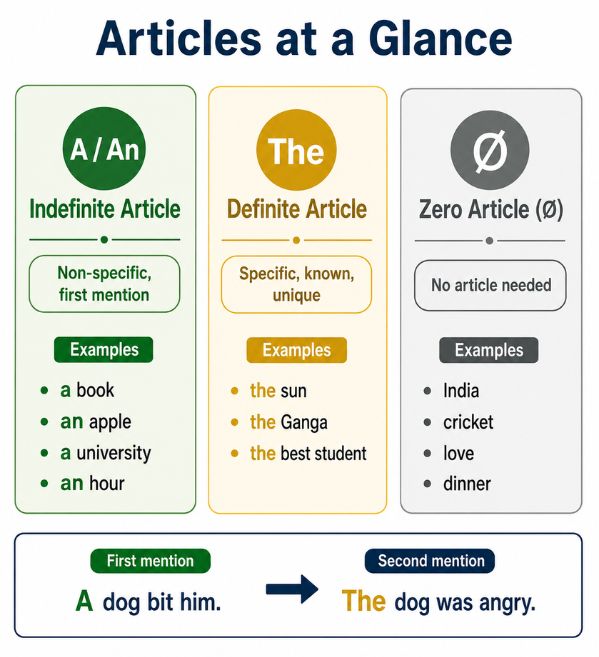
A type of determiner placed before a noun to indicate whether the noun is specific or general, known or unknown. English has three articles — a, an, and the — plus the concept of the Zero Article, which means deliberately using no article at all.
There are two types:
Indefinite Articles: a and an — refer to something non-specific or mentioned for the first time
Definite Article: the — refers to something specific, already known, or unique
A and An: The Indefinite Articles
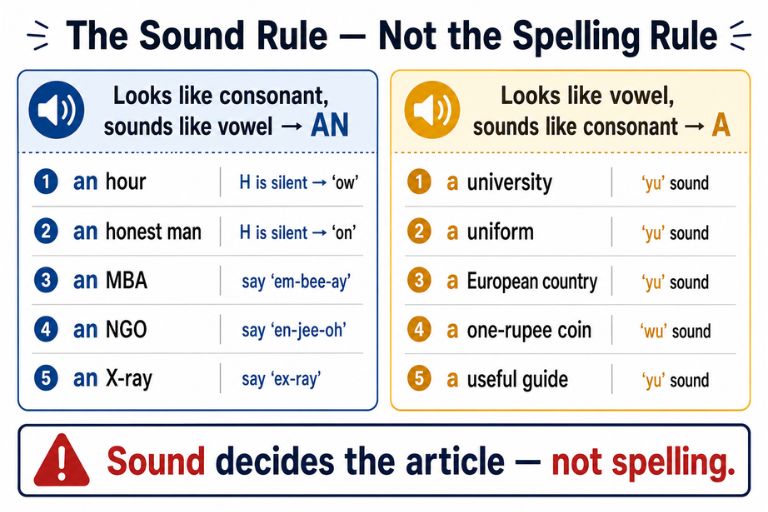
The rule everyone knows: a before consonants, an before vowels. But that's only half the story. The real rule is about sound, not spelling. This is where most students go wrong.
The Sound Rule (The Most Important Rule in This Section)
Use a before words that begin with a consonant sound. Use an before words that begin with a vowel sound. The spelling of the word does not matter — only how the first sound is pronounced.
Look at these carefully:
Word | First sound | Article |
university | "yu" (consonant) | a university |
umbrella | "uh" (vowel) | an umbrella |
hour | "ow" (vowel — H is silent) | an hour |
honest | "on" (vowel — H is silent) | an honest man |
European | "yu" (consonant) | a European country |
one-rupee coin | "wu" (consonant) | a one-rupee coin |
MBA | "em" (vowel — read the letter) | an MBA degree |
uniform | "yu" (consonant) | a uniform |
X-ray | "ex" (vowel — read the letter) | an X-ray |
NGO | "en" (vowel — read the letter) | an NGO |
The abbreviation trap is a favourite in SSC exams. With abbreviations, you don't read the word — you read each letter aloud. MBA → say "em-bee-ay" → first sound is "em" → vowel sound → an MBA.
When to Use A / An
1. First mention of a countable singular noun
The first time you introduce something, the listener doesn't know which specific one you mean — so use a/an.
"I saw a cow on the road." → first mention, any cow
"The cow was blocking traffic." → now we both know which cow → the
2. Meaning "one" or "per"
"Give me a minute." (= one minute)
"The train runs twice a day." (= per day)
"It costs fifty rupees a kilo." (= per kilo)
3. General statements about a class (singular)
"A mango is a sweet fruit." (= all mangoes, as a class)
"A teacher shapes the future." (= teachers in general)
Note: You can also say "Mangoes are sweet fruits" (plural, no article) — both are correct ways to make general statements.
The: The Definite Article
The is used when both the speaker and the listener know exactly which specific thing is being referred to. There are several situations where this happens.
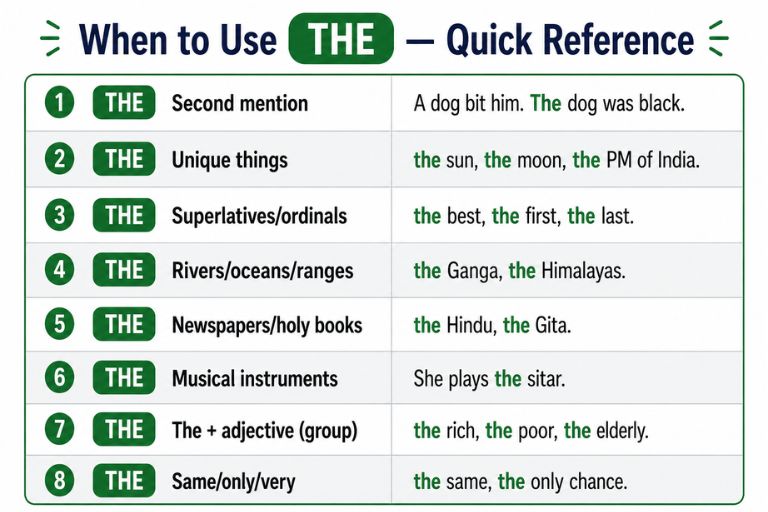
Rule 1: Second Mention
Once something has been introduced, it becomes "known." Switch from a/an to the.
"Rahul bought a phone. The phone was expensive."
Rule 2: Unique Things
When there is only one of something — either in the world or in the immediate context — use the.
"the sun, the moon, the earth, the sky, the equator"
"the Prime Minister of India, the CEO of the company"
Rule 3: Superlatives and Ordinal Numbers
This is a guaranteed exam question. Superlatives (best, worst, tallest, most beautiful) and ordinals (first, second, last, next, only) always take the.
✅ "She is the best student in the class."
✅ "He was the first person to climb this peak."
✅ "This is the only solution."
❌ "She is a best student."
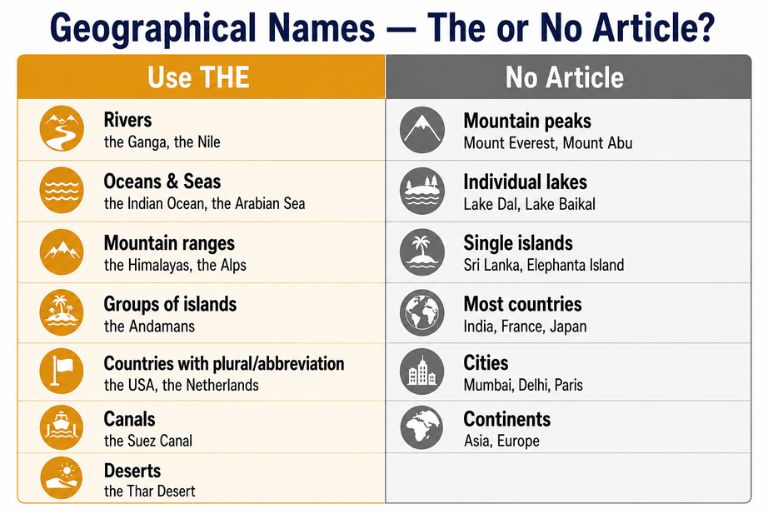
Rule 4: Geographical Names — Know the Pattern
This is one of the most tested areas in error spotting.
Use the with:
Rivers: the Ganga, the Yamuna, the Amazon, the Thames
Oceans and seas: the Indian Ocean, the Arabian Sea, the Bay of Bengal
Mountain ranges: the Himalayas, the Alps, the Vindhyas
Groups of islands: the Andamans, the Lakshadweep
Countries with plural names or abbreviations: the USA, the UAE, the Netherlands, the Philippines
Deserts: the Sahara, the Thar Desert
Canals: the Suez Canal, the Panama Canal
Do NOT use the with:
Individual mountain peaks: Mount Everest (not "the Mount Everest"), Mount Abu
Individual lakes: Lake Dal, Lake Baikal (lake name comes first)
Individual islands: Elephanta Island, Sri Lanka
Most countries: India, France, China, Japan
Continents: Asia, Europe, Africa
Cities: Mumbai, Delhi, London, Paris
Rule 5: Names of Newspapers, Holy Books, Ships
"I read the Hindu every morning."
"The Gita teaches us about duty."
"The INS Vikramaditya is India's aircraft carrier."
Rule 6: Musical Instruments
When talking about playing an instrument — always the.
✅ "Priya plays the sitar beautifully."
✅ "He has been learning the tabla for five years."
❌ "She plays sitar."
Rule 7: "The" + Adjective = A Group of People
"The rich should help the poor."
"The elderly need more medical support."
"The disabled deserve equal opportunities."
Here, the + adjective refers to all people of that type collectively.
Rule 8: "The same / the only / the very"
These three words almost always demand the before them.
"They scored the same marks."
"She is the only candidate who qualified."
"That is the very thing I was looking for." (very here means "exactly this," not degree)
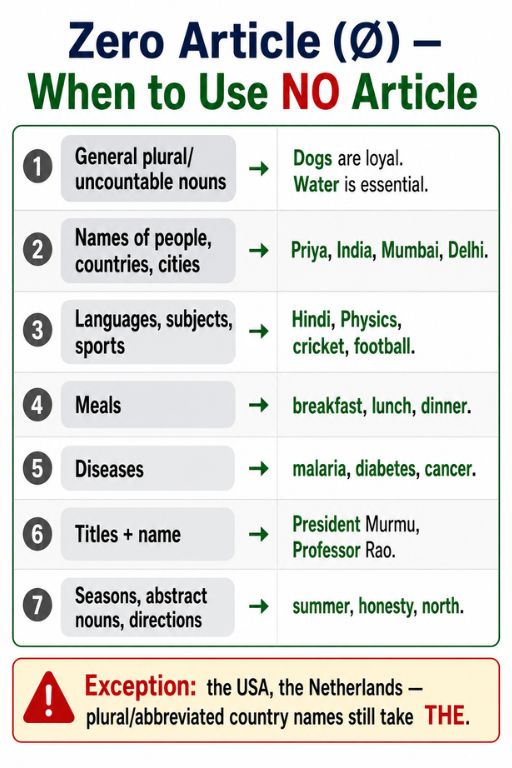
Zero Article: When to Use No Article at All
This is the section most books and teachers rush through. But for Indian students, it's critical — because our instinct is sometimes to add the where English needs nothing at all.
When NO Article Is Used
1. Plural and uncountable nouns used in a general sense
When you're making a general statement about a whole category — use no article.
✅ "Dogs are loyal animals." (dogs in general — no article)
✅ "Water is essential for life." (water in general — no article)
✅ "Rice is the staple food of South India." (rice in general — no article)
Compare: "The water in this glass is cold." — specific water → the
2. Names of people, most countries, and cities
✅ "Rahul is my friend." (not "the Rahul")
✅ "India is a developing country." (not "the India")
✅ "She lives in Delhi." (not "the Delhi")
Exceptions: the USA, the UAE, the Netherlands, the Philippines — because these names are plural or abbreviated forms of longer descriptive names.
3. Languages, academic subjects, and sports
✅ "She speaks Tamil and Hindi." ✅ "He is studying Physics." ✅ "They play cricket every Sunday."
But remember: "She plays the sitar" — an instrument always takes the.
4. Meals
✅ "We had dinner at 8 pm."
✅ "Breakfast is the most important meal."
Exception: "The dinner we had last night was excellent." — referring to a specific meal → the
5. Diseases, conditions
✅ "She has malaria."
✅ "He was diagnosed with diabetes."
Some exceptions exist (a cold, a headache, a fever — these can take a/an because they're more temporary/countable in feel), but the general rule for serious diseases → no article.
6. Titles followed by the person's name
✅ "President Droupadi Murmu addressed the nation."
✅ "Professor Rao teaches at IIT Delhi."
But: "The President addressed the nation." — no name given, referring to the post → the
7. Seasons, abstract nouns, compass directions
✅ "Summer is very hot in Rajasthan."
✅ "Honesty is the best policy." (abstract noun "honesty" — no article)
✅ "Go north for three kilometres."
Worked Examples
EXAMPLE 1 — Sound Rule Trap
Incorrect: "He has a MBA from IIM Ahmedabad."
Correct: "He has an MBA from IIM Ahmedabad."
Step 1: Is "MBA" a word or an abbreviation? → Abbreviation — read each letter aloud.
Step 2: "MBA" → "em-bee-ay" → first sound is "em" → vowel sound.
Step 3: Vowel sound → an.
Rule Applied: Sound rule for abbreviations — read the first letter aloud, not the word.
Same logic applies to: an NGO, an MLA, an FIR, an IAS officer, an X-ray, an LLB degree. In every case, the first letter's pronunciation determines the article.
EXAMPLE 2 — The vs No Article with Geography
Incorrect: "She trekked to the Mount Everest last year."
Correct: "She trekked to Mount Everest last year."
Step 1: Is this a mountain range or an individual peak?
Step 2: Mount Everest = individual peak → no article.
Step 3: Compare: the Himalayas = mountain range → the.
Rule Applied: Individual mountain peaks → no article. Mountain ranges → the.
Students confuse Himalayas (range → the) with Everest (peak → no article). The test is simple: can you count them individually? One Everest, one K2 → individual → no article. The Himalayas = one system made up of many mountains → range → the.
EXAMPLE 3 — Instrument vs Sport
Incorrect: "He plays violin in a band but also plays the cricket."
Correct: "He plays the violin in a band but also plays cricket."
Step 1: "Violin" is a musical instrument → always the → the violin ✓ (already correct)
Step 2: "Cricket" is a sport → no article → plays cricket ✓
Step 3: The sentence has them reversed — this is the deliberate exam trap.
Rule Applied: Musical instruments → the. Sports → no article.
Examiners often put both an instrument and a sport in the same sentence with the articles swapped. Train yourself to check both in one pass.
EXAMPLE 4 — Superlative + Ordinal
Incorrect: "Sachin is a greatest batsman India has ever produced."
Correct: "Sachin is the greatest batsman India has ever produced."
Step 1: "Greatest" is a superlative → always takes the.
Step 2: Superlatives and ordinals never take a/an.
Rule Applied: Superlatives → always the.
"The best", "the worst", "the tallest", "the most intelligent", "the first", "the last" — all superlatives and ordinals are preceded by the without exception. If you see a superlative and no the, that's your error.
EXAMPLE 5 — General vs Specific Meaning
Incorrect: "A tiger that escaped from the zoo was caught near the village."
"Tiger is a dangerous animal."
Step 1: Sentence 1 — "a tiger that escaped from the zoo" — is this specific or general? It's a specific tiger (the one that escaped) → the tiger would be correct once identified, but since this is introducing it as "one specific tiger from the zoo," — actually "The tiger that escaped from the zoo" is the correct form here because the relative clause (that escaped from the zoo) makes it specific.
Correct: "The tiger that escaped from the zoo was caught near the village."
Step 2: Sentence 2 — "Tiger is a dangerous animal" — general statement about all tigers → needs article. "A tiger is a dangerous animal." OR "Tigers are dangerous animals."
Rule Applied: A relative clause (that/which/who + specific information) makes a noun specific → the. General class statements → a (singular) or no article (plural).
Whenever a noun is followed by a defining relative clause, it becomes specific enough for the. "The man who called you is outside." "The book that you recommended was excellent." This is one of the most intellectually rich article questions in SSC exams.
Common Mistakes to Avoid
MISTAKE: "She plays sitar very well."
CORRECT: "She plays the sitar very well."
WHY IT HAPPENS: In Indian languages, we say "sitar bajati hai" — no article equivalent. The brain translates directly and drops the. But musical instruments in English always need the before them.
MISTAKE: "The honesty is the best policy."
CORRECT: "Honesty is the best policy."
WHY IT HAPPENS: Abstract nouns (love, honesty, courage, justice, kindness) don't take an article when used in a general sense. Adding the before them makes them feel specific — as if you're referring to a particular honesty — which doesn't make sense.
MISTAKE: "He is an university student."
CORRECT: "He is a university student."
WHY IT HAPPENS: "University" starts with the letter U, which is a vowel, so the brain reaches for an. But the first sound of "university" is "yu" — a consonant sound — so the correct article is a.
MISTAKE: "The Prime Minister Narendra Modi addressed the nation."
CORRECT: "Prime Minister Narendra Modi addressed the nation."
WHY IT HAPPENS: When a title is directly followed by a person's name, no article is used. But "The Prime Minister addressed the nation" (no name) → the is correct because you're referring to the post, not the person.
MISTAKE: "India is the great country with the rich culture."
CORRECT: "India is a great country with a rich culture."
WHY IT HAPPENS: Students feel that the sounds more respectful or emphatic. But the implies "the one and only great country" — which isn't the meaning here. A great country = one of many great countries. Use the only when something is unique or already identified.
Tricks & Shortcuts
TRICK: The "Sound Test" for A vs An
When to use: Every time you see a or an in an error spotting question
How it works: Say the next word aloud — just the first sound. Consonant sound → a. Vowel sound → an. For abbreviations, say the first letter aloud. Don't look at the spelling at all.
Example: "a/an European trip" → say "European" aloud → starts with "yu" → consonant → a European trip
Time saved: Makes every A/An question a 5-second decision.
TRICK: The "Specific or General?" Test for The vs Zero
When to use: Fill-in-the-blank and error spotting with nouns that could take the or nothing
How it works: Ask yourself — am I talking about a specific, known thing, or the whole category in general? Specific/known → the. General/whole category → no article (with plurals/uncountables) or a/an (with singular countables).
Example: "___ water is essential" → water in general → no article.
"___ water in this bottle is warm" → specific water → the water.
Time saved: Eliminates the most common article confusion in 10 seconds.
TRICK: The "Music vs Sport" Instant Check
When to use: Any sentence mentioning both instruments and sports
How it works: Instrument → the always. Sport → no article always. If both appear in the same sentence, check both.
Example: "He plays ___ guitar and ___ football." → the guitar and football (no article).
Time saved: Turns a potentially confusing double-check into a reflex.
Practice MCQs
Q1. Fill in the blank: "She has been working as ___ MLA for the last five years."
A) a
B) an
C) the
D) No article needed
Q2. Spot the error: "The Everest is the highest peak in the world."
A) The Everest
B) is the highest
C) peak in the world
D) No error
Q3. Fill in the blank: "___ rich should not ignore ___ poor in society."
A) A / a
B) The / the
C) The / a
D) A / the
Q4. Spot the error: "He plays a violin in the school orchestra and also coaches the cricket team."
A) He plays a violin
B) in the school orchestra
C) and also coaches
D) No error
Q5. Fill in the blank: "She is ___ best student who has ever appeared for this examination."
A) a
B) an
C) the
D) No article needed
Q6. Spot the error: "Professor Ramesh Kumar, the head of the department, delivered a lecture on the honesty and integrity."
A) Professor Ramesh Kumar
B) the head of the department
C) delivered a lecture on the honesty
D) No error
Q7. Fill in the blank: "___ Ganga is considered sacred by millions of Hindus."
A) A
B) An
C) The
D) No article needed
Q8. Spot the error: "By the time we reached the hospital, he had a fever and an headache since morning."
A) By the time we reached
B) the hospital, he had
C) a fever and an headache
D) No error
Answer Key
Q1 → B (an)
"MLA" is an abbreviation. Read the first letter aloud: "M" = "em" → vowel sound → an MLA. This is a sound-rule question disguised as a vocabulary test.
Q2 → A (Error: "The Everest" should be "Mount Everest")
Mount Everest is an individual mountain peak — no article. The is used with mountain ranges (the Himalayas), not individual peaks. The correct form is simply "Mount Everest."
Q3 → B (The / the)
"The rich" and "the poor" are examples of the + adjective used as a collective noun (a group of people). Both need the. This is a standard SSC pattern.
Q4 → A (Error: "a violin" should be "the violin")
Musical instruments always take the — not a/an. "He plays the violin" is correct. Note that "the cricket team" in the same sentence is correct — the here refers to a specific team, not the sport.
Q5 → C (the)
"Best" is a superlative — always takes the. "The best student" is correct. Additionally, the relative clause ("who has ever appeared") makes the noun specific, which further confirms the.
Q6 → C (Error: "the honesty" should be "honesty")
Abstract nouns (honesty, integrity, courage, love, justice) used in a general sense take no article. "He delivered a lecture on honesty and integrity" is correct. Adding the implies a specific, identifiable honesty — grammatically wrong here.
Q7 → C (The)
The Ganga is a river — rivers always take the. This is a straightforward geographical article rule.
Q8 → C (Error: "an headache" should be "a headache")
"Headache" starts with the letter H but the H is pronounced — the first sound is a consonant "h" sound, not a vowel. So the correct article is a headache, not an headache. Compare with "an hour" where the H is silent.
QUICK REVISION
A before consonant sounds; an before vowel sounds — sound decides, not spelling
A university, a uniform, a European → "yu" sound = consonant → a
An hour, an honest man → silent H → vowel sound → an
An MBA, an NGO, an MLA, an X-ray → read the first letter aloud
A/an → first mention, non-specific, general singular statements
The → second mention, unique things, superlatives, ordinals
The → rivers, oceans, mountain ranges, groups of islands
No the → individual peaks (Mount Everest), individual lakes (Lake Dal), most countries, cities
The → newspapers, holy books, ships, musical instruments
The + adjective = a group of people: the rich, the poor, the elderly
The → same, only, very (meaning "exactly this")
Zero article → general plural/uncountable nouns, languages, sports, meals, diseases, abstract nouns
Titles + name → no article (President Murmu), but title alone → the (The President)
Crucial exception: the USA, the Netherlands, the Philippines — plural/abbreviated country names
Comments
No comments yet.