
Degrees of Comparison — Full Rules, Concepts, Tricks & Practice
Degrees of Comparison — Full Rules, Concepts, Tricks & Practice
Look at this sentence:
Sachin is the most greatest batsman India has ever produced.
Sound familiar? You've probably written something like this yourself at some point — or at least seen it. And here's the thing: this sentence has a very clear, very specific grammar error that SSC examiners absolutely love to test.
"Greatest" is already a superlative. Adding "most" in front of it is like saying "more better" or "very tallest." It's a double superlative — and it's wrong.
This is the world of Degrees of Comparison, and it's one of the most heavily tested areas in SSC CGL, CHSL, IBPS PO, Railways, and Class 9–12 exams. Error Spotting, Sentence Improvement, Fill in the Blanks — this topic shows up in all three formats. The good news? Once you understand the logic behind these rules, you'll spot the errors in seconds.
Let's go from the absolute beginning.
What Are Degrees of Comparison?
The three forms of an adjective or adverb that show the level of a quality — whether something simply has it (positive), has more of it than something else (comparative), or has the most of it among a group (superlative).
Every adjective you know has three degrees. "Tall" doesn't just mean tall — it can mean taller than someone else, or the tallest of all. That shift in meaning is expressed by changing the form of the adjective itself.
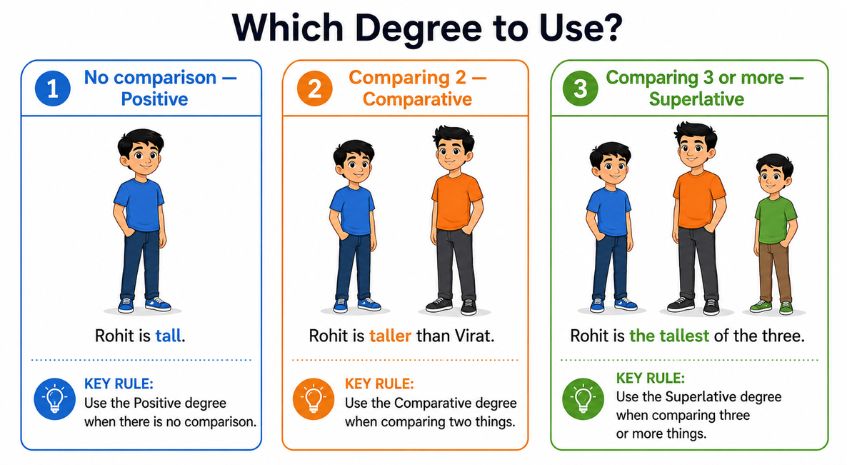
The three degrees:
Degree | What it does | Example |
Positive | States a quality as-is, no comparison | Rahul is tall. |
Comparative | Compares two things | Rahul is taller than Amit. |
Superlative | Picks the best/most/least from a group of 3 or more | Rahul is the tallest in the class. |
Positive Degree
The positive degree is simply the base form of the adjective. No "-er," no "-est," no "more" or "most."
Priya is smart. The mango is sweet. Mumbai is a large city.
The positive degree is used:
When describing a quality without any comparison
In "as...as" structures (equal comparison)
In "not as...as" or "not so...as" structures (inequality)
The "As...As" Rule
Using "as + adjective (positive form) + as" to show two things are equal in some quality.
✅ Virat is as tall as Rohit.
✅ This train is as fast as a plane.
The adjective between the two "as" words must always be in the positive form — never comparative, never superlative.
❌ Virat is as taller as Rohit.
✅ Virat is as tall as Rohit.
For negatives, both "not as...as" and "not so...as" are acceptable in standard grammar:
✅ Delhi is not as cold as Shimla.
✅ Delhi is not so cold as Shimla.
Exams sometimes test which version is "more correct" — both are valid. If the question asks you to fill in a blank, either works. If it's error spotting, the error will be elsewhere.
Comparative Degree
The comparative degree compares exactly two things or people.
The form of an adjective used to compare two things. Formed by adding "-er" to short adjectives or placing "more" before longer adjectives. Always followed by "than."
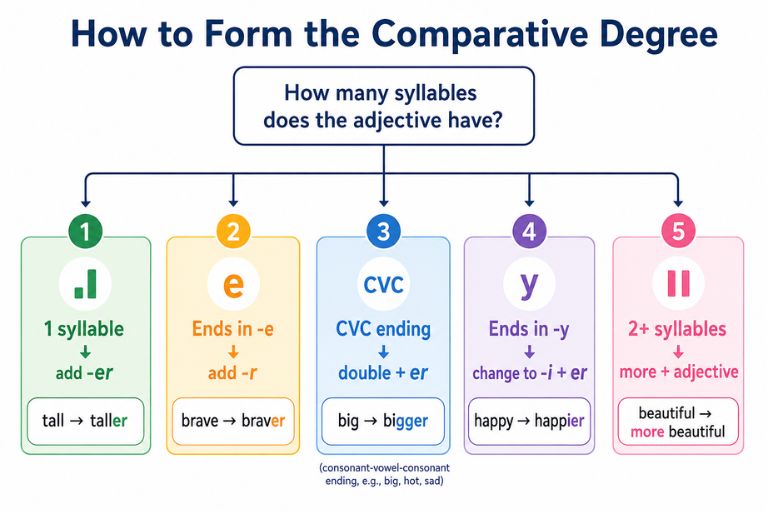
How to Form the Comparative
Rule 1 — Short adjectives (1 syllable): Add "-er" tall → taller | fast → faster | cold → colder | small → smaller
Rule 2 — Adjectives ending in "-e": Just add "-r" large → larger | wise → wiser | brave → braver
Rule 3 — Adjectives ending in consonant-vowel-consonant: Double the final consonant, add "-er" big → bigger | hot → hotter | thin → thinner | fat → fatter
Rule 4 — Adjectives ending in "-y" (preceded by a consonant): Change "y" to "i," add "-er" happy → happier | heavy → heavier | easy → easier | busy → busier
Rule 5 — Longer adjectives (2+ syllables): Use "more" before the adjective beautiful → more beautiful | intelligent → more intelligent | difficult → more difficult | interesting → more interesting
The "Than" Rule — Non-Negotiable
The comparative degree is always followed by "than" when making a direct comparison.
❌ Priya is smarter from Meena.
✅ Priya is smarter than Meena.
❌ This road is more dangerous than to take the highway.
✅ This road is more dangerous than the highway.
The "Other" / "Else" Rule — This One Costs Easy Marks
When you compare something with the rest of its own group, you must use "other" (for things) or "else" (after "anyone/anybody/anything/no one").
❌ Sachin scored more runs than any player in India.
✅ Sachin scored more runs than any other player in India.
Without "other," the sentence implies Sachin is not a player in India — because you're comparing him to "any player in India," which would include himself. "Other" excludes him from the group he's being compared to.
❌ She works harder than anyone in the office.
✅ She works harder than anyone else in the office.
Same logic: "anyone in the office" includes her, so you need "else" to exclude her.
"More" vs "-er" — Never Mix Them
You cannot use "more" AND "-er" on the same adjective. That's a double comparative.
❌ She is more smarter than her sister.
✅ She is smarter than her sister.
❌ This box is more heavier than that one.
✅ This box is heavier than that one.
Superlative Degree
The superlative degree identifies the one item that has the most (or least) of a quality within a group of three or more.
The form of an adjective used to single out one thing from a group of three or more. Formed by adding "-est" to short adjectives or placing "most" before longer adjectives. Always used with "the."
How to Form the Superlative
The formation rules mirror the comparative, but you use "-est" and "most" instead:
Positive | Comparative | Superlative |
tall | taller | the tallest |
large | larger | the largest |
big | bigger | the biggest |
happy | happier | the happiest |
beautiful | more beautiful | the most beautiful |
intelligent | more intelligent | the most intelligent |
"The" Is Mandatory with Superlatives
The superlative always takes the definite article "the."
❌ She is most talented singer in the group.
✅ She is the most talented singer in the group.
❌ Everest is tallest mountain in the world.
✅ Everest is the tallest mountain in the world.
The Group Size Rule
Use the superlative only when three or more things are being compared. For exactly two, use the comparative.
❌ Between Rahul and Amit, Rahul is the tallest.
✅ Between Rahul and Amit, Rahul is the taller.
❌ She is the more intelligent of the three sisters.
✅ She is the most intelligent of the three sisters.
Irregular Forms — Memorise These, No Exceptions
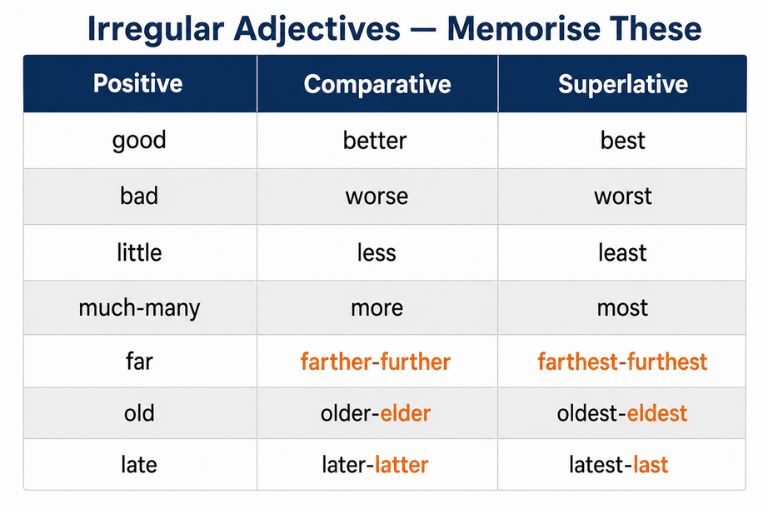
This is where exam setters get really sneaky. Some adjectives don't follow any of the rules above. They change form completely in the comparative and superlative. These are called irregular adjectives, and you simply have to memorise them.
Positive | Comparative | Superlative |
good / well | better | best |
bad / ill | worse | worst |
little | less | least |
much / many | more | most |
far | farther / further | farthest / furthest |
old | older / elder | oldest / eldest |
late | later / latter | latest / last |
near | nearer | nearest / next |
fore | former | foremost / first |
in / inner | — | inmost / innermost |
up | upper | upmost / uppermost |
The Tricky Pairs: "Farther/Further," "Elder/Older," "Later/Latter"
These pairs trip up even advanced students.
Farther vs. Further:
Farther = physical distance (The market is farther than I thought.)
Further = additional / figurative (We need no further proof.)
Note: In modern usage, "further" is increasingly accepted for both senses. But in Indian competitive exams, the distinction above is what gets tested — so stick to it.
Elder vs. Older:
Elder is used only for members of the same family (my elder brother, her elder sister). It cannot be followed by "than."
Older is used for general comparisons and can be followed by "than" (She is older than her colleague.)
❌ My elder brother is elder than his friend.
✅ My elder brother is older than his friend.
✅ He is my elder brother. (family relationship — no "than")
Later vs. Latter:
Later = relating to time (The later version is better. / She arrived later.)
Latter = the second of two things just mentioned (Between tea and coffee, I prefer the latter.)
❌ Of the two plans, the later is more practical.
✅ Of the two plans, the latter is more practical.
Conversion Between Degrees
One common question type asks you to rewrite a sentence in a different degree without changing the meaning. Here's the conversion framework:
Original (Superlative): Everest is the highest mountain in the world.
→ Comparative: Everest is higher than any other mountain in the world.
→ Positive: No other mountain in the world is as high as Everest.
Original (Positive): Very few cities in India are as large as Mumbai.
→ Comparative: Mumbai is larger than most other cities in India.
→ Superlative: Mumbai is one of the largest cities in India.
The meaning stays the same; only the grammatical structure changes. These conversions are formula-based — practise them until they feel automatic.
Worked Examples
EXAMPLE 1
Incorrect: She is more taller than her mother.
Correct: She is taller than her mother.
Step 1: Identify the comparative form used — "taller" (already comparative, -er added to "tall").
Step 2: Check if "more" is also present — yes, it is. That's a double comparative.
Rule Applied: Never use "more" with an adjective that already has "-er." Use one or the other.
This is the single most common Degrees of Comparison error in Class 9–10 exams. Train your eye to spot "-er" + "more" combinations instantly.
EXAMPLE 2
Incorrect: Of the two brothers, Rohan is the tallest.
Correct: Of the two brothers, Rohan is the taller.
Step 1: Count the items being compared — "the two brothers." Exactly two.
Step 2: For exactly two items, use the comparative degree ("taller"), not the superlative ("tallest").
Step 3: When comparative is used with "the" to mean "the one that is more," it takes "the" — so "the taller" is correct.
Rule Applied: Superlative is for 3 or more. For exactly 2, use the comparative.
The phrases "between the two," "of the two," "the two" are your trigger words to switch from superlative to comparative.
EXAMPLE 3
Incorrect: Sachin scored more centuries than any cricketer in the world.
Correct: Sachin scored more centuries than any other cricketer in the world.
Step 1: Sachin is a cricketer in the world. So comparing him to "any cricketer in the world" includes himself in the group he's being measured against.
Step 2: Insert "other" to exclude Sachin from the comparison group.
Rule Applied: When comparing a member to its own group using the comparative, add "other" (or "else" after anyone/anything/no one).
Read the sentence and ask: "Is the subject part of the group being compared to?" If yes, you need "other" or "else."
EXAMPLE 4
Incorrect: My elder brother is elder than your brother.
Correct: My elder brother is older than your brother.
Step 1: "Elder" is used for family relationships and cannot be followed by "than."
Step 2: When making a direct comparison using "than," use "older," even if both people are from the same family.
Rule Applied: "Elder" = family relationship only, no "than." "Older" = general comparison with "than."
You can say "She is my elder sister" (relationship), but you must say "She is older than me" (comparison with "than").
EXAMPLE 5
Incorrect: Iron is more useful than any other metal but gold is the most useful of the two.
Correct: Iron is more useful than any other metal, but gold is the more useful of the two.
Step 1: First clause — "more useful than any other metal" compares iron to a whole group. This is correct as-is (it should have "other" to exclude iron, and it does).
Step 2: Second clause — "the most useful of the two." Only two metals are being compared here (iron vs. gold). Superlative cannot be used for two.
Fix: "the more useful of the two."
Rule Applied: "Of the two" always triggers comparative, never superlative. "The most" requires three or more.
Exam sentences sometimes have one correct clause and one incorrect clause. Never assume the error is in the obvious place — read every clause separately.
Common Mistakes to Avoid — The Indian Student Traps
MISTAKE: Using "more + -er" together (double comparative): "more taller," "more faster," "more heavier."
CORRECT APPROACH: Use either "-er" OR "more," never both. Short adjectives (1–2 syllables) take "-er"; longer ones take "more."
WHY IT HAPPENS: In many Indian languages, adding emphasis to comparison is natural phrasing — the doubling feels like adding emphasis, not a grammar violation.
MISTAKE: Using "most + -est" together (double superlative): "most greatest," "most tallest," "most finest."
CORRECT APPROACH: Same rule — "-est" OR "most," never both. This is the Sachin/Tendulkar error from our opening example.
WHY IT HAPPENS: Students want to convey extreme emphasis ("he is the MOST greatest ever!") and reach for both forms without realising that "-est" already carries the full superlative meaning.
MISTAKE: Forgetting "other/else" when comparing a member to its own group: "She is smarter than anyone in the class" (when she is in the class).
CORRECT APPROACH: Add "other" after "any/every" or "else" after "anyone/anything/no one."
WHY IT HAPPENS: The sentence sounds perfectly fine in casual speech and in most Indian language equivalents. The illogical self-inclusion only becomes visible when you slow down and reason through it.
MISTAKE: Using "elder" with "than": "He is elder than me."
CORRECT APPROACH: "He is older than me." Use "elder" only when stating a family relationship without "than."
WHY IT HAPPENS: "Elder" sounds more formal and respectful to Indian students ("bade bhai" culture), so they reach for it even in comparative contexts. But the grammar rule is non-negotiable in exams.
MISTAKE: Omitting "the" before superlatives: "She is most intelligent student in the school."
CORRECT APPROACH: "She is the most intelligent student in the school." "The" is mandatory with all superlatives.
WHY IT HAPPENS: In everyday speech, we sometimes drop "the" in informal sentences. In writing and in exams, it is never optional with superlatives.
Tricks & Shortcuts — Exam-Ready Hacks
TRICK: The "More/Most + -er/-est" Scan
When to use: In every Error Spotting or Sentence Improvement question involving adjectives.
How it works: In about 5 seconds, scan the sentence for any adjective that has both "more/most" AND an "-er/-est" ending. If you spot both on the same adjective, that IS the error. No further analysis needed.
Example: She is the most cleverest girl in class. → "most" + "cleverest" = double superlative. Error confirmed.
Time saved: 20–25 seconds. This is the fastest catch in the entire topic.
TRICK: The "Of the Two" Trigger
When to use: Any sentence containing the phrase "of the two," "between the two," or comparing exactly two named people/things.
How it works: These phrases are automatic signals to use the comparative, never superlative. If the option says "most/best/worst," eliminate it. The answer will always have "more/better/worse."
Example: Of the two sisters, Meena is the ___. (talented) Options: A) most talented B) more talented C) talented D) very talented → "Of the two" = exactly two = comparative. Answer: B.
Time saved: Eliminates 2–3 wrong options in under 5 seconds.
TRICK: The "Any Other / Anyone Else" Reflex
When to use: Comparative degree sentences where the subject is compared to a group it belongs to.
How it works: Ask yourself: "Is [subject] part of the group after 'than'?" If yes → add "other" (after any/every/no + noun) or "else" (after anyone/anything/nobody/nothing). Make it a reflex.
Example: Dhoni is a better finisher than any captain in cricket. → Is Dhoni a captain in cricket? Yes. → Add "other": "any other captain in cricket."
Time saved: Turns a tricky logic question into a pattern-matching reflex — 15 seconds saved.
Practice MCQs
Q1. Identify the error in the sentence: He is the most cleverest student in our class.
A) He is
B) the most cleverest
C) student in
D) No error
Q2. Fill in the blank with the correct form: Between Priya and Meena, Priya is the ______ of the two.
A) most intelligent
B) more intelligent
C) intelligent
D) much intelligent
Q3. Find the error: No other city in India is as larger as Mumbai.
A) No other city
B) in India is
C) as larger as
D) No error
Q4. Identify the error: My elder sister is elder than all the girls in her college.
A) My elder sister
B) is elder than
C) all the girls in her college
D) No error
Q5. Choose the correct sentence:
A) Ravi is more intelligent than any student in the class.
B) Ravi is more intelligent than any other student in the class.
C) Ravi is the most intelligent than any other student in the class.
D) Ravi is more intelligent than every other students in the class.
Answer Key
Q1 → B (the most cleverest)
"Cleverest" is already the superlative form of "clever." Adding "most" creates a double superlative, which is always wrong. Correct: "the cleverest student."
Q2 → B (more intelligent)
"Between Priya and Meena" signals exactly two people. For two, use the comparative — "more intelligent." "Most intelligent" (superlative) is only for groups of three or more.
Q3 → C (as larger as)
In "as...as" comparisons, the adjective must be in the positive (base) form. "Larger" is already the comparative form of "large." Correct: "as large as Mumbai."
Q4 → B (is elder than)
"Elder" cannot be used with "than." It is only used to state a family relationship: "my elder sister." When making a comparison with "than," use "older." Correct: "is older than all the girls in her college."
Q5 → B
Option A is wrong — Ravi is a student in the class, so "any other" is needed. Option C wrongly mixes comparative "more intelligent" with superlative structure "than." Option D uses "every other students" (wrong — "every" takes a singular noun: "every other student"). Only B is correct.
QUICK REVISION — The 10-Minute Exam Cheat Sheet
Three degrees: Positive (base), Comparative (two things + than), Superlative (three or more + the)
Short adjectives (1 syllable): add -er / -est. Long adjectives (2+ syllables): use more / most
Double comparative = always wrong: ❌ more taller, more smarter
Double superlative = always wrong: ❌ most greatest, most tallest
Superlative always takes "the" — never optional
"Of the two / between the two" → always comparative, never superlative
Comparing a member to its own group → add "other" (any other/every other) or "else" (anyone else/nobody else)
"Elder" = family relationship only, no "than" | "Older" = general comparison with "than"
"Farther" = physical distance | "Further" = additional/figurative • "Latter" = second of two things mentioned | "Later" = relating to time
As...as always takes positive (base) form: ❌ as taller as | ✅ as tall as
Key irregular forms: good→better→best | bad→worse→worst | little→less→least | many/much→more→most
Comments
No comments yet.