
Prepositions — Complete Guide: Time, Place, Direction & Confused Pairs for SSC/Banking/Exams
Prepositions — Complete Guide: Time, Place, Direction & Confused Pairs for SSC/Banking/Exams
Here's something humbling: preposition errors are among the most common mistakes made not just by students but by people who have spoken English their entire lives. Why? Because prepositions are almost completely arbitrary. There is no deep logical reason why we say interested in and not interested at, or why we say die of a disease but die in an accident. You just have to know.
For Indian students, this is doubly tricky. In Hindi, postpositions come after the noun instead of before it. In Tamil and Telugu, they're built into the word itself. So when you're thinking in your native language and writing in English, the brain either skips the preposition or drops in the wrong one.
The good news: examiners test the same 15 to 20 preposition patterns again and again. Learn those patterns — not every possible preposition, just the exam-tested ones — and this topic becomes a reliable source of marks.
What Is a Preposition?
A word placed before a noun or pronoun to show its relationship to another word in the sentence — typically showing time, place, direction, cause, manner, or possession. Examples: in, on, at, to, from, by, with, of, between, among, since, for, during, beside, besides
The name tells you what it does: pre (before) + position = placed before its object.
"She sat at the desk in the corner of the room." — three prepositions, three different relationships in one sentence.
Prepositions of Time: AT, ON, IN
This is the most tested group. The rule is beautifully systematic once you see the pattern.
Think of time as three sizes of container — and match the preposition to the container size.
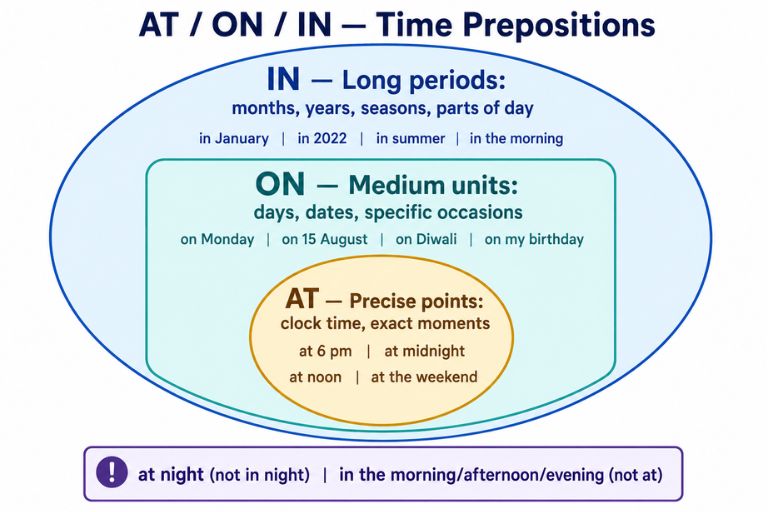
AT — for exact time points
Use at for specific clock times and precise moments.
"The train departs at 7:30 am."
"The match ended at midnight."
"Let's meet at noon."
Fixed phrases with at you must memorise: at night (NOT "in night"), at present, at the moment, at the weekend (British English), at Christmas, at Diwali, at dawn, at sunrise, at the same time
ON — for days and dates
Use on for any named day, specific calendar date, or special occasion.
"The exam is on Monday."
"India became independent on 15 August 1947."
"We visit relatives on Diwali."
"She was born on a rainy Tuesday."
The pattern: on + any named day or date. If you can put it on a calendar square, it takes on.
IN — for longer time periods
Use in for months, years, decades, centuries, seasons, and parts of the day.
"He was born in March."
"The company was founded in 1998."
"Cricket was different in the 1980s."
"She studies in the morning."
The parts-of-day rule: in the morning, in the afternoon, in the evening — but at night (exception, memorise it).
The "Since vs For" and "By vs Until" Pairs
These two pairs cause more fill-in-the-blank errors than almost anything else in the time category.
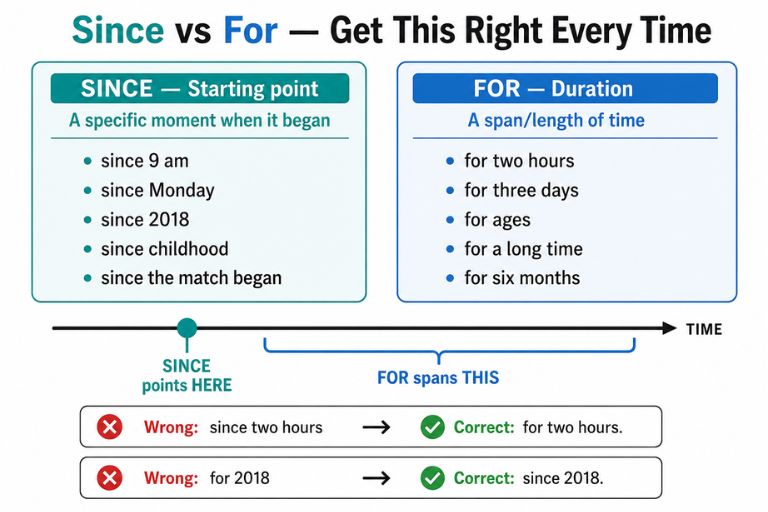
SINCE vs FOR
Both are used with perfect tenses to talk about duration. The difference is what follows them.
Since → a specific starting point in time
For → a duration, a span of time
"She has been working here since 2019." (2019 = starting point)
"She has been working here for five years." (five years = duration)
The quick test: can you replace it with from the moment of? → since. Can you replace it with a span of? → for.
❌ "She has been waiting since two hours."
✅ "She has been waiting for two hours."
❌ "He has been ill for last Monday."
✅ "He has been ill since last Monday."
BY vs UNTIL / TILL
These look interchangeable but they are not. Using the wrong one changes the meaning completely.
By → a deadline — the action must be completed not later than this point
Until/Till → continuity — the action continues right up to this point
"Submit the form by Friday." (Finish before or on Friday — you don't continue until Friday.)
"I will wait until Friday." (I keep waiting, continuously, right up to Friday.)
"She will have left by 5 pm." (She'll be gone before 5 pm arrives.)
"She worked until 5 pm." (She kept working, and stopped at 5 pm.)
❌ "Submit the form until Friday." (Wrong — suggests you keep submitting until Friday.)
❌ "I will wait by Friday." (Wrong — suggests your waiting has a deadline, not a duration.)
DURING vs WHILE
This pair trips students up because both translate to the same word in many Indian languages.
During → preposition → followed by a noun
While → conjunction → followed by a clause (subject + verb)
✅ "She slept during the lecture." (during + noun)
✅ "She slept while the lecturer was speaking." (while + clause)
❌ "She slept during the lecturer was speaking."
❌ "She slept while the lecture."
The test: what comes after? A noun → during. A subject + verb → while.
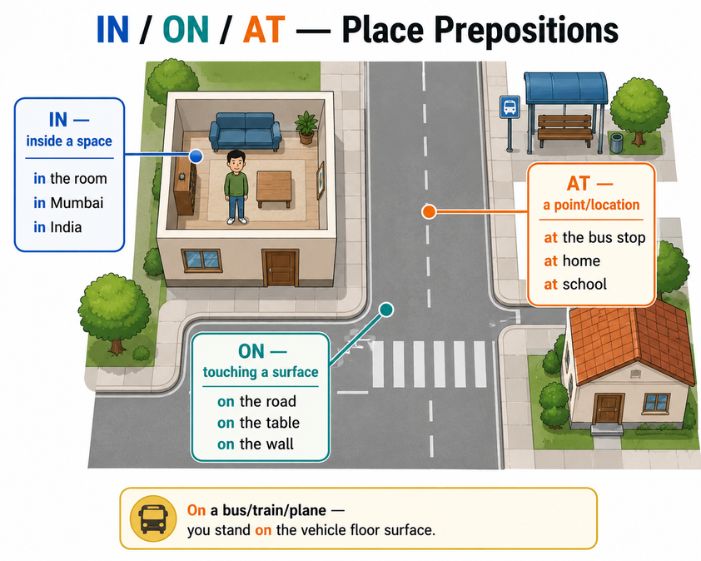
Prepositions of Place: AT, ON, IN
The same three prepositions work for place — but the logic shifts slightly.
IN — enclosed or contained space
Use in when something is inside a three-dimensional enclosed space — a room, a building, a city, a country, a box.
"She is in the kitchen."
"He lives in Delhi."
"India is in Asia."
"The keys are in the drawer."
ON — surface contact
Use on when something is touching or resting on a surface — a flat, two-dimensional plane.
"The book is on the table."
"The poster is on the wall."
"There is a crack on the ceiling."
"Turn right on the third floor."
Also: on a bus, on a train, on a plane, on a ship — you're on top of the vehicle's floor.
AT — a specific point or location
Use at when you're treating a place as a point on a map, rather than as an enclosed space.
"She is at the bus stop."
"We met at the market."
"He is at home."
"She is at work."
The distinction between in and at for buildings can be subtle: "She is in the hospital" (she's admitted, inside the building for a reason) vs "She is at the hospital" (she's there — possibly visiting, possibly outside it). In exams, context will make it clear.
BETWEEN vs AMONG
This pair is simple but tested constantly.
Between → exactly two people or things
Among → three or more people or things, or a group
"Divide the prize money between the two winners."
"Distribute sweets among all the children." "The secret was shared among the five team members."
"There is a wall between my house and his."
Note: between can sometimes be used for more than two when each item is considered individually. "An agreement between the three companies" — each company is distinct, so between is acceptable. But in exams, stick to the simple rule: two = between, many/group = among.
Prepositions of Direction: TO, TOWARDS, INTO, ONTO
TO vs TOWARDS
To → reaching a destination
Towards → moving in the direction of (but not necessarily arriving)
"She went to the market." (She reached the market.)
"She walked towards the market." (She was moving in that direction — we don't know if she arrived.)
This distinction is tested in sentence improvement questions. If the sentence says someone arrived or reached, use to. If the sentence is about movement that's in progress or uncertain, towards is possible.
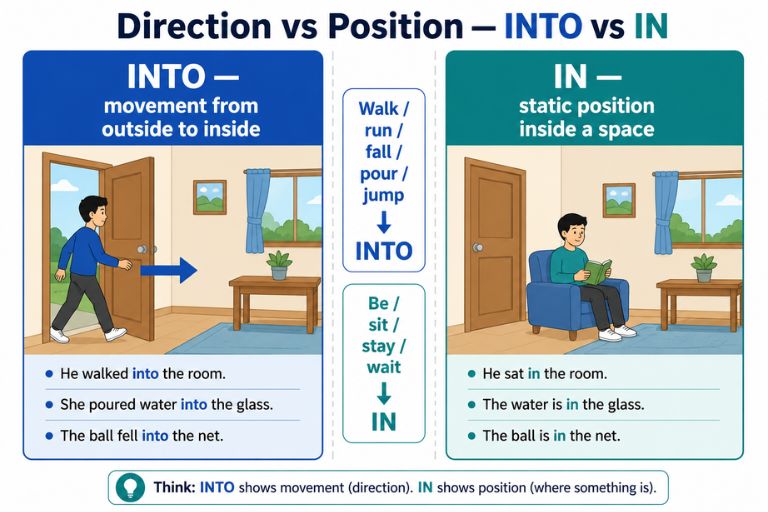
INTO vs IN
Into → movement from outside to inside (direction)
In → static position (location)
"He walked into the room." (Movement — he entered.)
"He was sitting in the room." (Position — where he was.)
Verbs of movement almost always demand into: walk into, run into, fall into, jump into, dive into, pour into, put into.
❌ "She walked in the classroom." (if entry is meant)
✅ "She walked into the classroom."
ONTO vs ON
Same logic as into/in but for surfaces:
Onto → movement to a surface
On → position on a surface
"He jumped onto the stage." (He moved and landed on it.)
"He stood on the stage." (He was already there.)
Part 5 — Commonly Confused Pairs
This is where the real exam marks are won and lost. These pairs look similar, sound similar, or feel interchangeable — but they're not.
BESIDE vs BESIDES
One letter difference. Completely different meanings. This is one of the most reliably tested traps in SSC error spotting.
Beside → next to, at the side of (place)
Besides → in addition to, apart from (meaning "also")
"Come and sit beside me." (next to me)
"Besides Hindi, she speaks Tamil and English." (in addition to Hindi)
"Besides being intelligent, Rahul is also hardworking." (apart from / in addition to)
❌ "Come and sit besides me."
❌ "Besides means next to in this sentence." — no it doesn't, it means "in addition to."
A memory trick: beside has no s at the end, and it means a simple single position — next to. Besides has an s, meaning it adds something more.
BETWEEN vs AMONG (revisited)
Covered in Place, but so frequently tested it deserves a direct reminder here:
Two people/things → between Group of three or more → among
❌ "Distribute the sweets between all the students." (if there are more than two students)
✅ "Distribute the sweets among all the students."
IN vs INTO (revisited)
Direction/entry → into Static position → in
❌ "She dipped her hand in the bucket." (if she moved her hand from outside to inside)
✅ "She dipped her hand into the bucket."
SINCE vs FROM
Both deal with a starting point, but they work with different tenses.
Since → used with perfect tenses (has/have/had)
From → used with simple tenses (is/was/will be)
"She has been working here since 2019." (present perfect + since ✓)
"She worked here from 2015 to 2020." (simple past + from...to ✓)
❌ "She has been working here from 2019." (perfect tense + from = wrong)
❌ "She worked here since 2015 to 2020." (simple past + since = wrong)
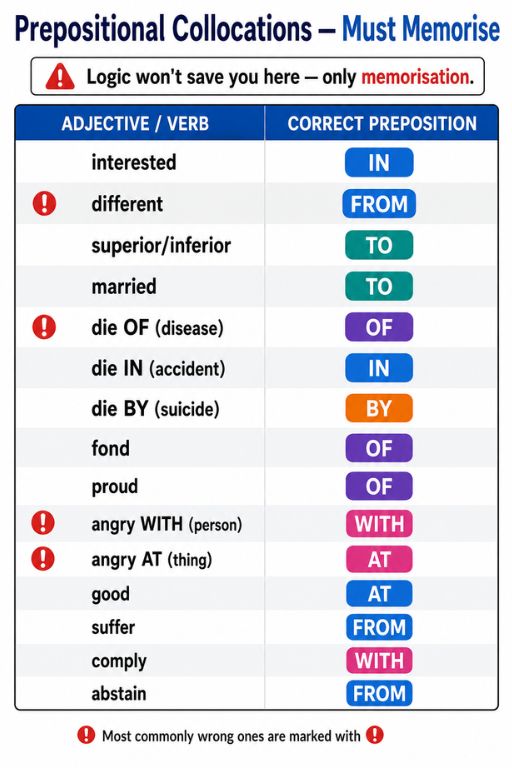
Prepositional Collocations — The Must-Memorise List
These are fixed combinations. Logic won't help you here — only memorisation will. These are the most frequently tested preposition errors in SSC CGL, IBPS PO, and Railways exams.
Expression | Correct preposition | Wrong version students write |
interested ___ | in | interested at/on |
different ___ | from | different than/to |
superior/inferior ___ | to | superior/inferior than |
married ___ | to | married with |
die ___ (disease) | of | die from/with |
die ___ (accident) | in | die of/from |
die ___ (suicide) | by | die of/from |
fond ___ | of | fond about/for |
proud ___ | of | proud about/for |
angry ___ (person) | with | angry on/at |
angry ___ (thing/situation) | at | angry on/with |
good ___ | at | good in |
deal ___ | with | deal at/in |
suffer ___ | from | suffer with/of |
comply ___ | with | comply to/of |
abstain ___ | from | abstain of/against |
blind ___ | to (a fact) / in (an eye) |
|
compare ___ (similarities) | to |
|
compare ___ (differences) | with |
|
Worked Examples
EXAMPLE 1 — AT / ON / IN for Time
Incorrect: "She will arrive on 6 pm."
Correct: "She will arrive at 6 pm."
Step 1: "6 pm" is a specific clock time — an exact point.
Step 2: Exact time points → at. Days and dates → on. Months and years → in.
Step 3: at 6 pm.
Rule Applied: AT for clock times and precise moments.
Students reach for on because they're thinking of "on a particular day." But clock times are points, not days. The moment you see hours and minutes, your answer is at.
EXAMPLE 2 — SINCE vs FOR
Incorrect: "He has been teaching since twenty years."
Correct: "He has been teaching for twenty years."
Step 1: "Twenty years" — is this a specific point in time, or a duration?
Step 2: "Twenty years" is a span/duration → for.
Step 3: since needs a specific starting point: since 2004, since childhood, since Monday.
Rule Applied: FOR + duration. SINCE + starting point.
This error happens because in Hindi we say "बीस साल से" (bees saal se) — se functions like both since and for. In English, these are two separate words with two separate jobs.
EXAMPLE 3 — BESIDE vs BESIDES
Incorrect: "Besides the river, there is a small temple."
Correct: "Beside the river, there is a small temple."
Step 1: What is the sentence saying? The temple is located next to the river — a place relationship.
Step 2: Beside = next to (place). Besides = in addition to (extra information).
Step 3: We need "next to" here → beside.
Rule Applied: BESIDE = next to. BESIDES = in addition to.
This is the sneakiest trap in the prepositions chapter. "Besides the river" sounds completely natural to most students — but it means "in addition to the river," which makes no sense here. Always ask: does this mean "next to" or "in addition to"?
EXAMPLE 4 — INTO vs IN
Incorrect: "She poured the milk in the cup."
Correct: "She poured the milk into the cup."
Step 1: "Poured" is a verb of movement/transfer — something is moving from one place to another.
Step 2: Movement from outside to inside → into.
Step 3: in would be correct only if the milk was already inside: "The milk is in the cup."
Rule Applied: INTO for movement of entry. IN for static position.
Verbs like pour, walk, run, fall, jump, dive, dip, throw almost always signal into, not in. Make this a reflex — see a movement verb, think into.
EXAMPLE 5 — Prepositional Collocation
Incorrect: "She is married with a well-known surgeon."
Correct: "She is married to a well-known surgeon."
Step 1: "Married" requires a fixed preposition — this is a collocation.
Step 2: The correct phrase is married to, not married with.
Step 3: In English, marriage is expressed as a relationship directed towards the person (to), not with them.
Rule Applied: Fixed collocation: married TO.
In Hindi, "se shaadi ki" (with = se) translates directly to "married with" in most students' minds. Don't translate — recall the fixed English phrase. This exact error appeared in SSC CGL papers in multiple recent years.
EXAMPLE 6 — BY vs UNTIL
Incorrect: "Please submit your assignment until Monday."
Correct: "Please submit your assignment by Monday."
Step 1: Is the action continuing until Monday, or does it need to be completed before Monday?
Step 2: Submitting has a deadline, not a duration. You submit once — it doesn't continue until Monday.
Step 3: Deadline → by. Continuous action up to a point → until.
Rule Applied: BY = deadline. UNTIL = continuous up to that point.
This is a genuine meaning difference, not just a style preference. "Work until Monday" = keep working all the way to Monday. "Finish it by Monday" = make sure it's done before Monday arrives. Examiners use this in sentence improvement questions by presenting the wrong preposition in a logically coherent sentence.
Common Mistakes to Avoid
MISTAKE: "She reached at the station late."
CORRECT: "She reached the station late."
WHY IT HAPPENS: "Reach" is a transitive verb — it takes a direct object without any preposition. Students add at or to after "reached" out of habit. "Reach" needs no preposition. Other transitive verbs with no preposition: approach, enter, discuss, resemble, comprise.
MISTAKE: "He is good in mathematics."
CORRECT: "He is good at mathematics."
WHY IT HAPPENS: In Hindi, "maths mein accha hai" (in = mein) maps directly to "good in." But the English collocation is good at — for skills and subjects. "Good at cricket, good at cooking, good at English."
MISTAKE: "She died from cancer."
CORRECT: "She died of cancer."
WHY IT HAPPENS: Die from is sometimes used in informal American English but Indian exam boards follow British standard: die of a disease. Memorise: die of a disease, die in an accident, die by one's own hand.
MISTAKE: "The match will start in 5 pm."
CORRECT: "The match will start at 5 pm."
WHY IT HAPPENS: Students sometimes reason: "5 pm is in the evening, so it should be in." The evening uses in, but 5 pm is a specific clock time — a precise point — which always takes at.
MISTAKE: "He has been living here from 2015."
CORRECT: "He has been living here since 2015."
WHY IT HAPPENS: From is used with simple tenses (He lived here from 2015 to 2020). With perfect tenses, since is the correct word. The tense in the sentence (has been living = present perfect continuous) is the clue.
Tricks & Shortcuts
TRICK: The "Container Size" Test for AT / ON / IN (Time)
When to use: Any fill-in-the-blank with a time expression
How it works: Ask — how big is this time unit? Clock time / exact moment → tiny point → at. Named day / specific date → medium unit → on. Month / year / season / part of day → large container → in.
Example: "___ the morning" → large container → in. "___ Monday morning" → named day → on. "___ 9 am" → clock time → at.
Time saved: Makes at/on/in time questions a 5-second decision every time.
TRICK: The "Movement or Position?" Test for INTO vs IN
When to use: Any sentence with a person or object and a location
How it works: Look at the main verb. Is it a movement verb (walk, run, fall, jump, pour, dip, throw)? → into. Is it a state verb (sit, stand, be, stay, wait, lie)? → in.
Example: "She ___ the water" (dipped) → movement → into the water. "She was standing ___ the water" → position → in the water.
Time saved: Eliminates guessing between into/in in under 3 seconds.
TRICK: The "Next to OR In Addition to?" Test for BESIDE vs BESIDES
When to use: Any error spotting sentence with beside or besides
How it works: Mentally replace the word with "next to." Does the sentence still make sense? → beside is correct. Does "in addition to" make better sense? → besides is correct.
Example: "Besides the school, there is a park." → replace with "next to the school" → makes sense → but wait, is the meaning "next to" or "in addition to the school, there is also a park"? Context decides. Two meanings are possible — examiners test whether you notice the difference.
Time saved: Prevents the single most common preposition error in SSC error spotting.
Practice MCQs
Q1. Fill in the blank: "The meeting has been scheduled ___ Monday ___ 10 am."
A) on / in
B) in / at
C) on / at
D) at / on
Q2. Spot the error: "She has been working in this organisation since five years."
A) She has been working
B) in this organisation
C) since five years
D) No error
Q3. Fill in the blank: "___ cricket, Rahul also plays badminton and chess."
A) Beside
B) Besides
C) Between
D) Among
Q4. Spot the error: "The thief jumped in the compound and ran towards the exit."
A) The thief jumped
B) in the compound
C) and ran towards
D) No error
Q5. Fill in the blank: "You must submit your application ___ 5 pm today."
A) until
B) till
C) by
D) up to
Q6. Spot the error: "She is suffering with fever and has not attended school since Monday."
A) She is suffering
B) with fever
C) and has not attended
D) No error
Q7. Fill in the blank: "The gold medal was divided ___ the two finalists after the tie."
A) among
B) between
C) within
D) in between
Q8. Spot the error: "He has been married with a doctor for the past ten years."
A) He has been married
B) with a doctor
C) for the past
D) No error
Answer Key
Q1 → C (on / at)
"Monday" is a named day → on Monday. "10 am" is a clock time → at 10 am. This is a double-blank that tests both at and on in a single question — a favourite SSC pattern.
Q2 → C (Error: "since five years" should be "for five years")
"Five years" is a duration of time, not a specific starting point → for five years. Since is used with a specific point: since 2019, since Monday, since childhood.
Q3 → B (Besides)
The sentence means "In addition to cricket, he also plays..." → besides (in addition to). "Beside cricket" would mean "next to cricket," which makes no sense. This is the classic beside/besides trap.
Q4 → B (Error: "in the compound" should be "into the compound")
"Jumped" is a verb of movement — the thief moved from outside to inside the compound. Movement of entry → into, not in. "Into the compound" is correct. The rest of the sentence is fine.
Q5 → C (by)
"Submit" implies a deadline — a one-time action that must be completed before a certain point. By = deadline. Until would mean the action of submitting continues until 5 pm, which makes no sense for a submission.
Q6 → B (Error: "with fever" should be "from fever")
The fixed collocation is suffer from, not suffer with. "She is suffering from fever" is correct. This collocation is tested regularly — suffer from illness, suffer from depression, suffer from poverty.
Q7 → B (between)
"The two finalists" — exactly two people → between. Among is for three or more. This is the most straightforward between/among question type.
Q8 → B (Error: "married with a doctor" should be "married to a doctor")
The fixed collocation is married to, not married with. This is one of the most commonly tested prepositional collocations in SSC and banking exams, appearing in almost every recent paper.
QUICK REVISION
AT → clock times, exact moments, specific points (at 6 pm, at night, at home)
ON → days and dates (on Monday, on 15 August, on Diwali)
IN → months, years, seasons, parts of day (in January, in 2022, in the morning)
Exception: at night (not "in night"); in the morning/afternoon/evening (not "at morning")
FOR + duration (for two hours). SINCE + starting point (since 2018)
BY = deadline (complete before this point). UNTIL = continuous up to this point
DURING + noun. WHILE + subject + verb
IN = static position inside space. INTO = movement of entry
ON = position on surface. ONTO = movement onto a surface
BESIDE = next to. BESIDES = in addition to
BETWEEN = two people/things. AMONG = three or more
Must-know collocations: interested IN, different FROM, superior/inferior TO, married TO, die OF (disease), die IN (accident), good AT, suffer FROM, comply WITH, angry WITH (person), angry AT (thing)
"Reach" takes no preposition — reach the station, never reach at/to the station
SINCE for perfect tenses. FROM for simple tenses (from 2015 to 2020)
Comments
No comments yet.