Conjunctions & Connectors — Full Rules, Concepts, Tricks & Practice
Conjunctions & Connectors — Full Rules, Concepts, Tricks & Practice
Every SSC CGL paper has 3–5 questions where the error is hiding right inside a connector — a missing "that", a wrong "either/or" pair, or a "although...but" double-up that Indian students write almost by reflex. IBPS PO Mains had a fill-in-the-blank series last year where four out of six blanks needed a conjunction choice. Railways Group D error-spotting? Same story.
Here's the honest truth: most students lose marks here not because they don't know the conjunction — they use it every day in conversation! They lose marks because they never learned the rule behind it. Let's fix that today, from scratch.
What Is a Conjunction?
A word (or a pair of words) that connects two words, phrases, or clauses. Think of it as the bridge between ideas. Example: Rahul studied hard and he passed the exam.
Without conjunctions, you'd have to write sentences like a telegram. "Rahul studied. He passed. Priya helped him. She is his sister." Painful, right? Conjunctions let you stitch all of that into flowing, meaningful language.
There are three families of conjunctions you need to master for exams:
1. Coordinating Conjunctions
2. Subordinating Conjunctions
3. Correlative Conjunctions
Let's go through each one — rules, traps, and all.
Coordinating Conjunctions
Connects two grammatically equal parts — two nouns, two verbs, two phrases, or two independent clauses (sentences that could stand alone).
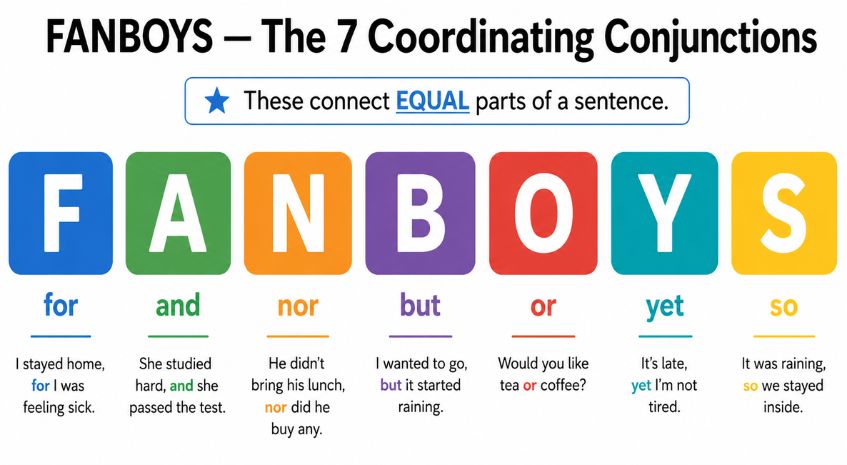
The seven coordinating conjunctions can be memorized with the acronym FANBOYS:
Letter | Conjunction | What it expresses |
F | For | Reason (like "because") |
A | And | Addition |
N | Nor | Addition (negative) |
B | But | Contrast |
O | Or | Choice / Alternative |
Y | Yet | Contrast (despite) |
S | So | Result / Effect |
The Rule That Kills Exam Marks: "And" Cannot Replace "But"
This sounds obvious. But look at this sentence:
Amit is poor and he is happy.
In Hindi or Tamil, this phrasing is natural — "Amit gareeb hai aur khush hai." But in standard English, you're joining a contrast. The correct word is yet or but:
✅ Amit is poor but he is happy.
This "translation trap" from regional languages costs Indian students easy marks. Keep this in mind.
"Nor" — The One Everyone Forgets
When you use "neither...nor" or after a negative statement, "nor" carries the negative forward. You don't need "not" again.
❌ He did not eat, nor he did not sleep.
✅ He did not eat, nor did he sleep.
Notice the inversion: "nor did he sleep" — not "nor he did sleep." After nor, the auxiliary verb comes before the subject.
Subordinating Conjunctions
Connects a main clause (complete thought) with a subordinate clause (dependent thought that cannot stand alone). The subordinate clause gives extra information — time, reason, condition, contrast, purpose, or result.
This is a large family. Let's organise them by function:
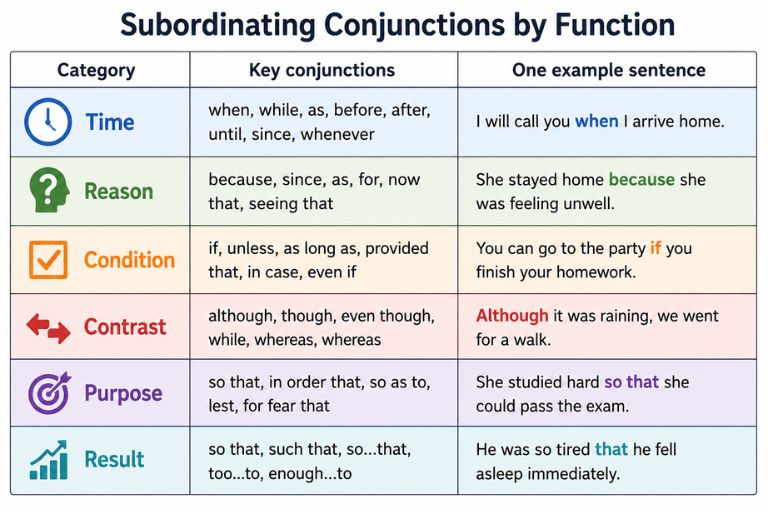
By Category
Time: after, before, when, while, since, until, as soon as, once, by the time The train left before Priya reached the station.
Reason: because, since, as He failed because he did not practise.
Condition: if, unless, provided that, in case, as long as You will pass if you study regularly.
Contrast/Concession: although, though, even though, even if, while, whereas She won the match although she was unwell.
Purpose: so that, in order that, lest Speak clearly so that everyone can understand.
Result: so...that, such...that It was so hot that we cancelled the cricket match.
Comparison: than, as...as Rohit is taller than Virat.
The "Although...But" Double Error — India's Favourite Grammar Mistake
This is the single most common conjunction error Indian students make. Write it on a sticky note.
In English, "although" and "but" are both contrast markers. You use ONE, not both.
❌ Although Priya studied hard, but she failed.
✅ Although Priya studied hard, she failed.
✅ Priya studied hard, but she failed.
The same rule applies to these pairs — use only ONE from each:
Though / Even though + ...BUT ❌
Because + ...therefore ❌
Since / As + ...so ❌
If + ...then ❌ (in most exam contexts)
This happens because in Hindi: "Agar... toh..." is a natural pair. But in English, the "if" itself already sets up the condition. The "then" is redundant.
Correlative Conjunctions
A pair of conjunctions that work together to join equal grammatical parts. They always appear as a duo — if you use the first word, you must use the second.
The main pairs you need for exams:
Pair | Function |
either...or | Choice between two options |
neither...nor | Negative — ruling out both options |
both...and | Including both |
not only...but also | Emphasis — adding to the first point |
whether...or | Expressing alternatives |
so...that | Result |
such...that | Result |
hardly/scarcely...when | Sequence (very quick events) |
no sooner...than | Sequence (very quick events) |
The Parallelism Rule — This Is Everything
Here's the core rule for correlative conjunctions and exams love testing it:
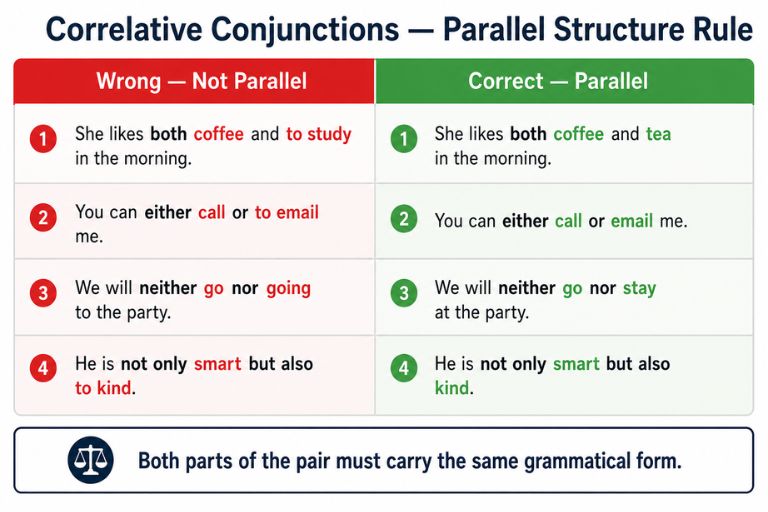
Whatever grammatical form comes after the first word of the pair MUST come after the second word too.
This is called parallel structure.
✅ She is both talented and dedicated. (adjective + adjective ✓)
❌ She is both talented and a dedication. (adjective + noun ✗)
✅ He can either sing or dance. (verb + verb ✓)
❌ He can either sing or is a dancer. (verb + verb phrase ✗)
"Not Only...But Also" — The Trap Inside the Trap
Students often get the structure right but place the pair incorrectly in the sentence. The rule: the part of the sentence that gets emphasised must come after "not only."
❌ He not only is hardworking but also is smart.
✅ He is not only hardworking but also smart.
Also: "but also" can be shortened to just "but" in modern usage — both are acceptable. But "not only...but also" is what exams expect unless they specify otherwise.
"No Sooner...Than" and "Hardly/Scarcely...When"
These test two things at once: the correct pairing AND subject-verb inversion.
Rule: When the sentence starts with "No sooner" or "Hardly/Scarcely," the auxiliary verb must come BEFORE the subject (inverted structure).
❌ No sooner I reached the station than the train left.
✅ No sooner had I reached the station than the train left.
❌ Hardly she had sat down when the phone rang.
✅ Hardly had she sat down when the phone rang.
The inversion ("had I" instead of "I had") is mandatory when these phrases open a sentence. This is a favourite SSC and Banking question type.
Worked Examples
EXAMPLE 1
Incorrect: Although he was tired, but he completed his work.
Correct: Although he was tired, he completed his work.
Step 1: Identify the conjunction structure. The sentence uses "although" — a subordinating conjunction showing contrast.
Step 2: Apply the rule. "Although" and "but" cannot both be used. Remove "but."
Rule Applied: Double connector error — "although...but" is incorrect. Use only one.
If you see "although/though/even though" in an error spotting question, immediately check if "but" appears later in the same sentence.
EXAMPLE 2
Incorrect: Either Amit or his friends is coming.
Correct: Either Amit or his friends are coming.
Step 1: Spot the correlative pair — "either...or."
Step 2: Apply Subject-Verb Agreement rule for "either...or" — the verb agrees with the subject closer to it (i.e., the subject that comes just before the verb). Here, "friends" is plural, so the verb must be "are."
Rule Applied: With "either...or" / "neither...nor," the verb agrees with the nearest subject.
This is a combo question — it tests both correlative conjunctions AND subject-verb agreement in one go.
EXAMPLE 3
Incorrect: She is both intelligent and has creativity.
Correct: She is both intelligent and creative.
Step 1: Find the correlative pair — "both...and."
Step 2: Check parallel structure. After "both" comes an adjective: intelligent. So after "and," you also need an adjective: creative, not the noun phrase "has creativity."
Rule Applied: Parallel structure — both parts of "both...and" must carry the same grammatical form.
The phrase "has creativity" sounds perfectly natural in speech, which is why students miss this. Slow down and check the grammatical category, not just the meaning.
EXAMPLE 4
Incorrect: No sooner I opened the door than the cat ran out.
Correct: No sooner had I opened the door than the cat ran out.
Step 1: Sentence opens with "No sooner" — this triggers a mandatory inversion.
Step 2: In inverted structure, the auxiliary verb comes before the subject. "I had opened" becomes "had I opened."
Step 3: Check the second part of the pair — "than" is correct (not "when").
Rule Applied: "No sooner...than" requires subject-auxiliary inversion when it opens the sentence.
Many students write "No sooner...when" by mixing it up with "Hardly/Scarcely...when." Drill the pairs: No sooner = than. Hardly/Scarcely = when.
EXAMPLE 5
Incorrect: Not only did he fail the exam but he also didn't apologised to his teacher.
Correct: Not only did he fail the exam, but he also did not apologise to his teacher.
Step 1: "Not only...but also" structure — check that the structure after each part is parallel.
Step 2: "Did he fail" (past simple) should match "did not apologise" — the "did" auxiliary is already doing the work, so the main verb should be the base form "apologise," not "apologised."
Step 3: "didn't apologised" is doubly wrong: double past marking (did + -ed) AND informal contraction in a formal sentence.
Rule Applied: Parallel structure in "not only...but also" + no double past marking (did + V2 is incorrect; did + V1 is correct).
"He didn't apologised" is incredibly common in Indian student writing — direct translation from regional language structure. Remember: with "did/does/do," the main verb ALWAYS stays in base form.
Common Mistakes to Avoid — The Indian Student Traps
MISTAKE: Using "although...but" or "though...but" together.
CORRECT APPROACH: Use either "although" alone with a comma, or "but" alone.
WHY IT HAPPENS: In Hindi and many Indian languages, the equivalent of "although" and "but" naturally pair up ("Bhale hi... lekin..."). Students carry this pattern directly into English.
MISTAKE: Writing "because...therefore" or "since...so" in the same sentence.
CORRECT APPROACH: Use only one causal connector per clause pair.
WHY IT HAPPENS: Same translation issue — "Kyunki... isliye..." is standard in Hindi, and students mirror this structure in English.
MISTAKE: "No sooner...when" instead of "No sooner...than."
CORRECT APPROACH: No sooner = than | Hardly/Scarcely = when. Memorise as a fixed pair, not interchangeable.
WHY IT HAPPENS: Students mix the two patterns because both express quick sequences. The logic feels the same, but the pairing rules are different.
MISTAKE: Not inverting after "No sooner," "Hardly," or "Scarcely."
CORRECT APPROACH: Hardly had she entered (not: Hardly she had entered).
WHY IT HAPPENS: Subject-before-verb is the default word order students are used to. Inversion feels unnatural until you practise it intentionally.
MISTAKE: Breaking parallel structure in "not only...but also," "both...and," "either...or."
CORRECT APPROACH: Identify what grammatical form comes after the first word. Match it exactly after the second word.
WHY IT HAPPENS: Students focus on meaning rather than grammar form. Both parts mean something similar, so the imbalance doesn't sound wrong in their head.
Tricks & Shortcuts — Exam-Ready Hacks
TRICK: The Double Connector Detector
When to use: Error Spotting questions with sentences showing contrast, reason, or condition.
How it works: As soon as you see "although," "though," "even though," "because," "since," or "if" in a sentence, immediately scan the rest of the sentence for "but," "therefore," "so," or "then." If you find one, it's almost certainly the error.
Example: Although she practised daily, but she could not qualify. → Remove "but."
Time saved: 15–20 seconds on every error spotting question involving contrast or cause-effect.
TRICK: The Parallel Structure Bracket Test
When to use: Fill in the Blanks or Error Spotting with correlative conjunctions (both...and, not only...but also, either...or).
How it works: Put a mental bracket around what comes after the first word and after the second word.
Ask: "Are both brackets the same grammatical type?" — noun+noun ✓, adjective+verb phrase ✗.
Example: She is both [intelligent] and [has creativity].
Brackets: adjective vs. verb phrase — mismatch! Fix: both [intelligent] and [creative].
Time saved: Instantly eliminates 2–3 wrong options in a Fill in the Blanks set.
TRICK: The "Inversion Alert" Trigger Words
When to use: Any sentence beginning with Hardly, Scarcely, No sooner, Never, Rarely, Seldom, Nor, Not only (at the sentence start).
How it works: These words, when used at the beginning of a sentence, always demand that the auxiliary verb comes before the subject. Check: does the option have inversion? If not, eliminate it.
Example: Seldom [have I seen / I have seen] such dedication. → Only "have I seen" is correct (inverted). Eliminate "I have seen."
Time saved: Saves you from overthinking — the opening word is your trigger. No analysis needed.
Practice MCQs
Q1. Choose the correct option to fill in the blank: She was exhausted, ______ she kept working.
A) because
B) so
C) yet
D) for
Q2. Identify the error in the sentence: He not only won the gold medal but also got a cash prize of rupees ten thousand.
A) He not only won
B) but also got
C) a cash prize of
D) No error
Q3. Choose the correct option: No sooner ______ the match started than it began to rain.
A) did
B) had
C) has
D) was
Q4. Find the error: Although Priya had all the qualifications, but the company rejected her application because of her lack of experience.
A) Although Priya had all the qualifications
B) but the company rejected her application
C) because of her lack of experience
D) No error
Q5. Which sentence is grammatically correct?
A) Hardly had I reached the station when the train left.
B) Hardly I had reached the station when the train left.
C) Hardly had I reached the station than the train left.
D) Hardly I reached the station when the train left.
Answer Key
Q1 → C (yet)
"Yet" means "despite this" and connects a contrast. She was exhausted, yet she continued — a contrast. "So" would mean she stopped because of exhaustion. "Because" shows reason (backward logic here). "For" as a coordinating conjunction means "because of" but sounds archaic here.
Q2 → D (No error)
"Not only...but also" is used correctly. The structure after "not only" is a verb phrase (won the gold medal), and after "but also" is also a verb phrase (got a cash prize) — parallel structure is maintained.
Q3 → B (had)
"No sooner...than" triggers past perfect + inversion. "No sooner had the match started than..." — auxiliary "had" comes before subject for proper inversion in this structure.
Q4 → B (but the company rejected)
"Although...but" is the classic double connector error. Since "although" already signals contrast, "but" is redundant and incorrect. The sentence should read: "Although Priya had all the qualifications, the company rejected her..."
Q5 → A
"Hardly had I reached" = correct inversion. "When" = correct pair for "hardly." Option C uses "than" (wrong — that's for "no sooner"). Options B and D have no inversion.
QUICK REVISION — The 10-Minute Exam Cheat Sheet
FANBOYS = For, And, Nor, But, Or, Yet, So — the 7 coordinating conjunctions
Never use "although/though" AND "but" in the same clause — one contrast marker only
Never use "because/since/as" AND "therefore/so" together — one causal marker only
Correlative pairs: either...or | neither...nor | both...and | not only...but also | no sooner...than | hardly/scarcely...when
With "either...or" / "neither...nor" — verb agrees with the NEARER subject
Parallel structure rule: what comes after the first word of a pair must match the grammatical form of what comes after the second
Inversion is MANDATORY when a sentence starts with: Hardly, Scarcely, No sooner, Never, Rarely, Seldom, Nor, Not only
"No sooner" pairs with "than" — NOT "when"
"Hardly/Scarcely" pair with "when" — NOT "than" • "Did/Does/Do" + base form of verb (V1) — never "did + V2" (e.g., "did not apologise" ✓, "did not apologised" ✗)
Comments
No comments yet.