
Subject-Verb Agreement — 20 Rules, Common Errors & Exam-Type Error Spotting for SSC/Banking/Exams
Subject-Verb Agreement — 20 Rules, Common Errors & Exam-Type Error Spotting for SSC/Banking/Exams
Go through any SSC CGL or IBPS PO paper from the last five years. Count the error spotting questions. You'll find Subject-Verb Agreement hiding in at least 3 to 4 of them — sometimes disguised as a long, winding sentence where the real subject is buried three words from the verb.
Students lose these marks not because the rule is hard. The basic rule — singular subject takes singular verb, plural subject takes plural verb — everyone knows that. The problem is what happens when the examiner puts a juicy distractor phrase right between the subject and the verb. Suddenly your brain latches onto the wrong noun, and you pick the wrong answer.
This lesson fixes that. We go through all 20 rules that actually show up in exams, with the exact sentence traps examiners love to set.
The Core Rule — Everything Else Builds on This
The grammatical rule that requires the verb in a sentence to match its subject in number (singular or plural) and person (first, second, third). A singular subject takes a singular verb; a plural subject takes a plural verb.
The baseline:
Rahul runs. → singular subject (Rahul) + singular verb (runs)
They run. → plural subject (they) + plural verb (run)
Simple enough. Now let's go through what happens when it gets complicated.
Basic Rules
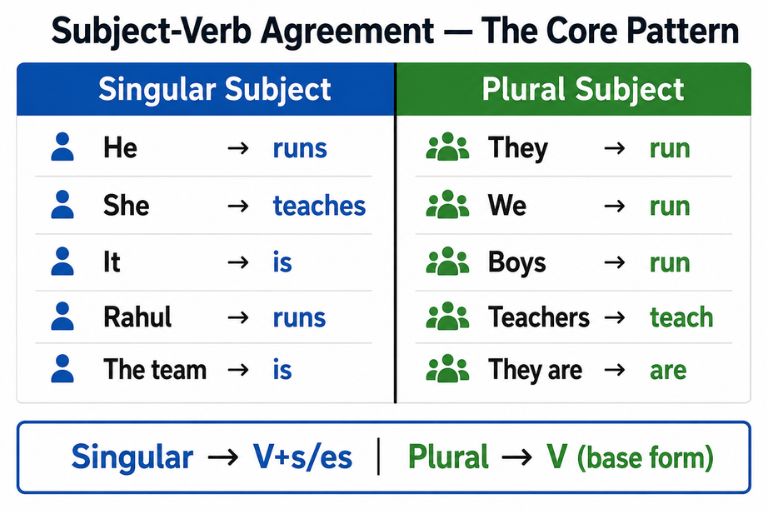
Rule 1: Singular subject → singular verb
Every he/she/it and every singular noun takes V1+s/es in the simple present.
✅ "The train arrives at 6 pm."
❌ "The train arrive at 6 pm."
Rule 2: Plural subject → plural verb
We/you/they and plural nouns take the base form — no s.
✅ "The students were waiting outside."
❌ "The students was waiting outside."
Joining Words
This group causes more errors than any other. The examiner's strategy here is always the same: put two subjects joined by different connectors and wait to see which noun your verb agrees with.
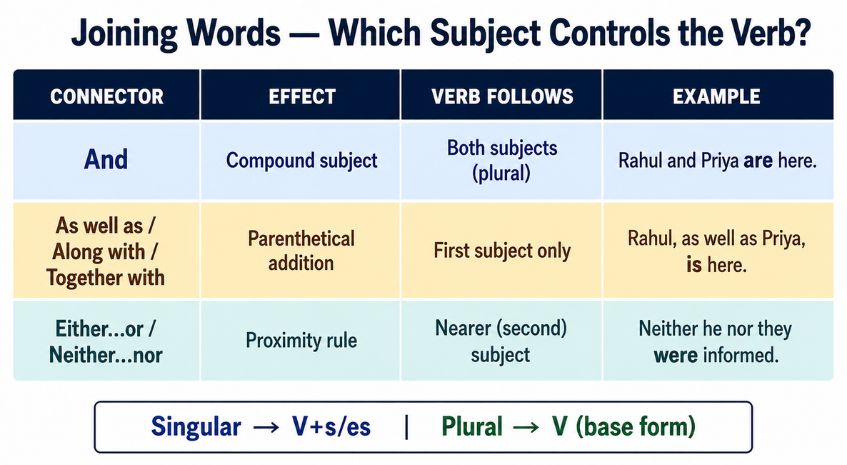
Rule 3: "And" joins two subjects → plural verb
When two subjects are joined by and, they form a compound subject. Compound = plural.
✅ "Rahul and Priya are going to Delhi."
❌ "Rahul and Priya is going to Delhi."
Now here's the exception — and it's tested regularly. Some pairs joined by and refer to a single concept or thing. These take a singular verb:
bread and butter, law and order, trial and error, slow and steady, a horse and carriage
✅ "Bread and butter is his only food." (one food item, not two)
Rule 4: "As well as / along with / together with / in addition to" → verb follows the FIRST subject
These phrases look like and but they aren't. They are parenthetical additions. The real subject is the one that comes BEFORE the phrase. That subject governs the verb.
✅ "The captain, as well as his players, was present at the ceremony."
❌ "The captain, as well as his players, were present at the ceremony."
The trick: mentally put brackets around the middle phrase. "The captain [as well as his players] was present." — subject is "the captain" (singular) → was.
Rule 5: "Either...or / Neither...nor" → verb agrees with the NEARER subject
When two subjects are joined by either...or or neither...nor, the verb agrees with whichever subject is closer to it.
✅ "Neither the manager nor the employees were informed." (employees = plural, closer = were)
✅ "Neither the employees nor the manager was informed." (manager = singular, closer = was)
This is one of the most common error spotting traps. The examiner often reverses the order to confuse you.
Rule 6: "Or / nor" (both singular) → singular verb
When both subjects joined by or/nor are singular, use a singular verb.
✅ "Either Rahul or Priya is the class monitor."
❌ "Either Rahul or Priya are the class monitor."
Tricky Nouns
These are the words that look plural or feel plural but grammatically demand singular verbs. Indian students get trapped here because the noun's appearance overrides the grammar rule.
Rule 7: Uncountable nouns → always singular
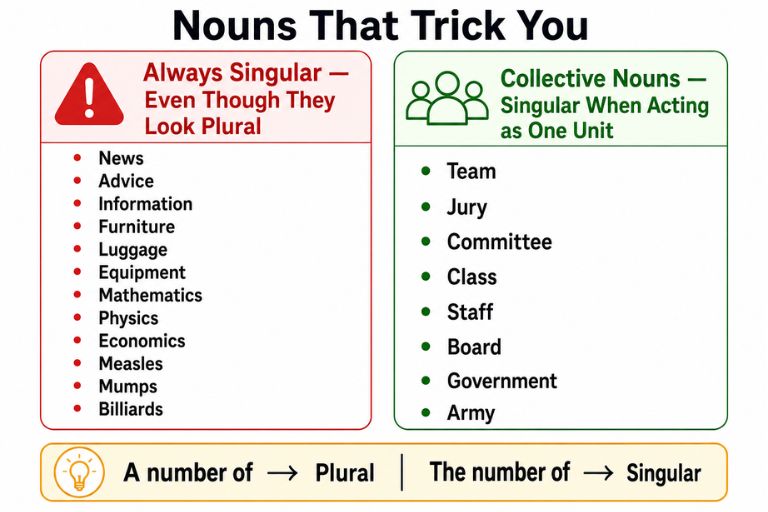
News, advice, information, furniture, luggage, equipment, work, knowledge, traffic, scenery, poetry, music, homework
All of these are uncountable. No a/an before them, no plural form. Always singular verb.
✅ "The news from the border is disturbing."
❌ "The news from the border are disturbing."
✅ "Her advice was valuable."
❌ "Her advice were valuable."
Rule 8: Collective nouns → singular verb (when acting as a unit)
Team, jury, committee, class, crowd, army, crew, staff, panel, board, government, family
When the group acts together as one body → singular verb.
✅ "The jury has delivered its verdict."
✅ "The team is playing well this season."
Rule 9: Plural-looking subjects → singular verb
Some words end in -s but refer to a single subject: Mathematics, Physics, Economics, Ethics, Politics, News, Mumps, Measles, Billiards, Innings
✅ "Politics is a dirty game."
✅ "Measles is a contagious disease."
❌ "Mathematics are difficult."
Rule 10: "A number of" vs "The number of"
This is a guaranteed exam question. Learn it cold.
A number of = several/many → plural verb
The number of = a count → singular verb
✅ "A number of students were absent today."
✅ "The number of accidents is increasing."
The logic: a number of students means "many students" — plural in meaning → plural verb. The number refers to the count itself — a single figure → singular verb.
Rule 11: Titles of books, films, countries → singular
Even if the title sounds plural, treat it as one entity.
✅ "Three Idiots is a brilliant film."
✅ "The United States has its own foreign policy."
❌ "Three Idiots are a brilliant film."
Distance Traps
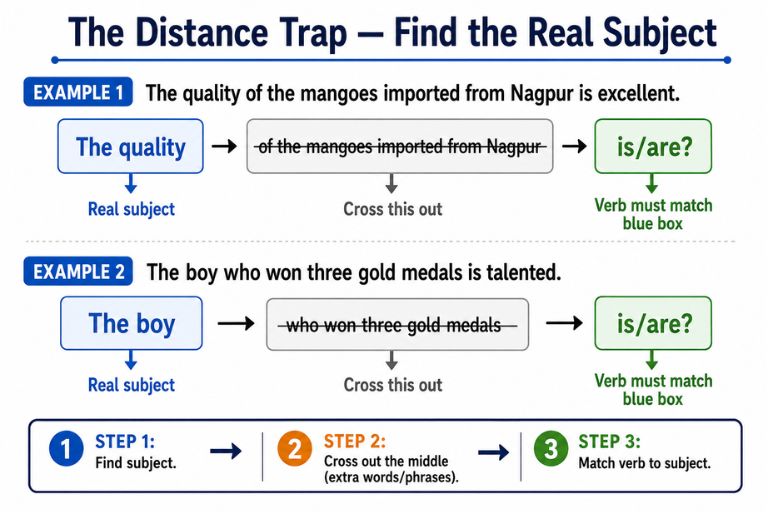
This is where the examiner's favourite trick lives. A long phrase is placed between the subject and the verb, hoping you'll agree with the nearest noun instead of the actual subject.
Rule 12: Ignore prepositional phrases between subject and verb
Phrases beginning with of, in, with, on, at, by, near, along with etc. are not part of the subject.
✅ "The quality of the mangoes is poor."
❌ "The quality of the mangoes are poor."
Subject = quality (singular). "Of the mangoes" is a prepositional phrase — cross it out mentally.
✅ "One of the students was absent."
❌ "One of the students were absent."
Subject = one (singular). "Of the students" is the distractor.
Rule 13: Ignore relative clauses between subject and verb
Relative clauses (who/which/that + extra information) are not the subject.
✅ "The boy who won three gold medals is my cousin."
❌ "The boy who won three gold medals are my cousin."
Subject = boy (singular). The relative clause is a distractor.
Rule 14: "Each" and "every" → always singular
Even when each/every connects two or more subjects with and, the verb is singular.
✅ "Each boy and girl is expected to participate."
✅ "Every student and teacher was informed."
❌ "Each boy and girl are expected to participate."
Pronouns
Rule 15: "None" → singular (competitive exam standard)
In Indian competitive exams, none is treated as "not one" → singular verb.
✅ "None of the information is accurate."
✅ "None of the candidates was selected."
Rule 16: Indefinite pronouns ending in -one / -body / -thing → singular
Everyone, everyone, someone, anyone, no one, everybody, somebody, anybody, nobody, everything, something, anything, nothing
All of these are singular. No exceptions.
✅ "Everyone has completed the assignment."
✅ "Nobody was hurt in the accident."
❌ "Everyone have completed the assignment."
Rule 17: "Both / few / many / several / all (of plural)" → plural
✅ "Both the options are incorrect."
✅ "Several members were absent."
❌ "Both the options is incorrect."
Special Cases
Rule 18: "There is / there are" → verb matches the real subject after "there"
In sentences beginning with there, the grammatical subject comes after the verb. The verb must match that real subject.
✅ "There is a problem with the application." (one problem → is)
✅ "There are five errors in this paragraph." (five errors → are)
❌ "There is five errors in this paragraph."
Rule 19: Relative pronoun (who/which/that) → verb matches the antecedent
The antecedent is the noun that the relative pronoun refers back to. The verb inside the relative clause must agree with that noun.
✅ "She is one of those players who perform well under pressure."
❌ "She is one of those players who performs well under pressure."
Here, who refers to players (plural) → perform (plural verb). Most students make "she" or "one" the subject — that's the trap.
Rule 20: Fractions and percentages → verb matches the noun after "of"
✅ "Two-thirds of the work is complete." (work = uncountable → singular)
✅ "Fifty percent of the students have passed." (students = plural → plural)
✅ "Half of the milk was spilt." (milk = uncountable → singular)
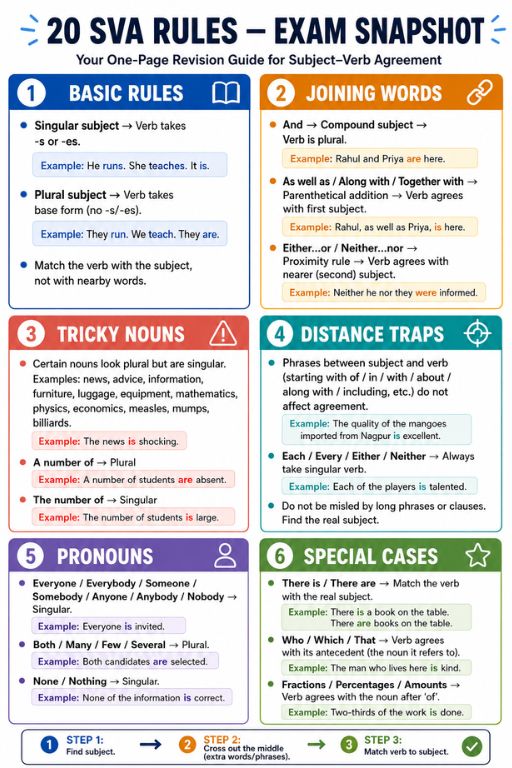
Worked Examples
EXAMPLE 1
Incorrect: "The furniture in all the rooms were damaged."
Correct: "The furniture in all the rooms was damaged."
Step 1: Find the subject. What is the sentence about? → "The furniture"
Step 2: Is "furniture" singular or plural? → Uncountable noun — always singular.
Step 3: "In all the rooms" is a prepositional phrase — distractor. Cross it out.
Step 4: Singular subject → singular verb → was.
Rule Applied: Rule 7 (uncountable nouns) + Rule 12 (ignore prepositional phrase)
The examiner placed "all the rooms" right before the verb to make "rooms" feel like the subject. This is the most common structure in SSC error spotting. Train yourself to find and cross out the "of/in/with" phrase first.
EXAMPLE 2
Incorrect: "The committee along with its members have submitted the report."
Correct: "The committee along with its members has submitted the report."
Step 1: Subject before "along with" = "The committee" (singular collective noun)
Step 2: "Along with its members" is a parenthetical phrase — not part of the subject.
Step 3: Subject = "committee" → singular → has.
Rule Applied: Rule 4 (along with → verb follows first subject) + Rule 8 (collective noun = singular)
Students see "members" and immediately think plural. The examiner is counting on exactly that. Rule 4 is one of the top 3 SVA traps in the exam — memorize it separately.
EXAMPLE 3
Incorrect: "A number of applications was rejected by the board."
Correct: "A number of applications were rejected by the board."
Step 1: Is this "a number of" or "the number of"?
Step 2: A number of = many/several → plural meaning → plural verb.
Step 3: Applications → plural → were.
Rule Applied: Rule 10 ("a number of" = plural)
The phrase "a number of applications" sounds singular because "a number" starts with "a". Don't let it fool you. The test: can you replace it with "many"? "Many applications were rejected." → yes → plural verb.
EXAMPLE 4
Incorrect: "She is one of those teachers who teaches with great passion."
Correct: "She is one of those teachers who teach with great passion."
Step 1: What does who refer to? → "teachers" (plural)
Step 2: The verb inside the relative clause must agree with "teachers", not "she" or "one".
Step 3: Teachers (plural) → teach (plural verb).
Rule Applied: Rule 19 (relative pronoun → verb matches antecedent)
This is the single most debated SVA rule in competitive exams and the one most students get wrong. The key is finding what who points back to. In "one of those teachers who...", who always refers to "teachers" — not "one."
EXAMPLE 5
Incorrect: "Neither the principal nor the teachers was present at the function."
Correct: "Neither the principal nor the teachers were present at the function."
Step 1: Two subjects joined by "neither...nor" → apply Rule 5 (nearer subject governs verb).
Step 2: Which subject is closer to the verb? → "teachers" (plural).
Step 3: Plural subject → plural verb → were.
Rule Applied: Rule 5 (neither/nor → nearer subject)
Examiners deliberately put the singular subject first and the plural subject second (or vice versa) to confuse. Always identify the subject CLOSEST to the verb — that's the one that matters.
Common Mistakes to Avoid
MISTAKE: "The news about the floods have shocked everyone."
CORRECT: "The news about the floods has shocked everyone."
WHY IT HAPPENS: "Floods" is plural, so the brain attaches the verb to "floods" instead of "news." But "news" is the subject — and it's uncountable and singular, always.
MISTAKE: "Both Amit as well as Priya are good singers."
CORRECT: "Both Amit and Priya are good singers." OR "Amit as well as Priya is a good singer."
WHY IT HAPPENS: "Both...and" and "as well as" are two separate structures. Mixing them creates a redundant, ungrammatical sentence. Choose one or the other.
MISTAKE: "The team are playing brilliantly."
CORRECT: "The team is playing brilliantly."
WHY IT HAPPENS: In British English, collective nouns can take plural verbs when members are acting individually — but Indian competitive exams follow the rule that a collective noun acting as a unit = singular verb. Stick to singular in exams.
MISTAKE: "Everyone of the candidates have been shortlisted."
CORRECT: "Every one of the candidates has been shortlisted."
WHY IT HAPPENS: "Everyone" (one word) = singular. But here "every one" is written as two words (meaning "each individual one") — still singular. Both forms take singular verbs. The "of the candidates" is a prepositional distractor.
MISTAKE: "There was several complaints about the paper."
CORRECT: "There were several complaints about the paper."
WHY IT HAPPENS: Sentences starting with "there" feel like the verb should come first. Students default to "was" without checking the real subject. "Complaints" is plural → "were."
Tricks & Shortcuts
TRICK: The "Cross Out the Middle" Method
When to use: Any long error-spotting sentence where a phrase sits between the subject and verb
How it works: Identify and mentally cross out everything between the subject and the verb — prepositional phrases (of/in/with/on/by), relative clauses (who/which/that...), and parenthetical phrases (along with/as well as/together with). What remains is subject + verb. Do they match?
Example: "The quality [of the mangoes imported from Nagpur] poor." → Cross out bracket → "The quality poor." → singular → "is"
Time saved: 20–30 seconds per error spotting question — makes long, winding sentences feel short.
TRICK: The "FANBOYS vs Parenthetical" Test
When to use: Sentences with two subjects joined by a connecting phrase
How it works: Ask — is the connector and? If yes → compound subject → plural.
Is it as well as / along with / together with / in addition to / besides / with?
If yes → parenthetical → verb follows FIRST subject only.
Example: "The PM along with the ministers __ attending." — "along with" = parenthetical → subject is "PM" (singular) → "is attending"
Time saved: Eliminates confusion on Rule 3 vs Rule 4 questions in under 5 seconds.
TRICK: The "Replace with Many/One" Test for "A number of / The number of"
When to use: Any sentence with "a number of" or "the number of"
How it works: Replace mentally — if a number of can be swapped with many, it's plural. If the number of refers to a count/statistic, it's singular.
Example: "A number of trains __ delayed." → "Many trains were delayed." → plural → were.
"The number of trains __ increasing." → a count → singular → is.
Time saved: Instant — makes this rule foolproof.
Practice MCQs
Q1. Spot the error: "The committee along with its members have submitted the final report to the chairman."
A) The committee along with
B) its members have submitted
C) the final report
D) No error
Q2. Fill in the blank: "A number of complaints ___ received by the grievance cell last week."
A) was
B) were
C) has been
D) is
Q3. Spot the error: "She is one of those officers who works tirelessly for the public."
A) She is one of
B) those officers who
C) works tirelessly
D) No error
Q4. Fill in the blank: "Neither the captain nor the players ___ satisfied with the umpire's decision."
A) was
B) is
C) were
D) has been
Q5. Spot the error: "The news about the earthquake and the floods were disturbing for the entire nation."
A) The news about
B) the earthquake and the floods
C) were disturbing
D) No error
Q6. Fill in the blank: "Three-fourths of the budget ___ been allocated to infrastructure."
A) have
B) has
C) were
D) are
Q7. Spot the error: "Each of the students who participated in the competition were given a certificate."
A) Each of the students
B) who participated
C) in the competition were given
D) No error
Answer Key
Q1 → B ("have submitted" should be "has submitted")
"Along with its members" is a parenthetical phrase. The subject is "the committee" — a collective noun acting as a unit → singular → "has submitted."
Q2 → B (were)
"A number of complaints" = many complaints → plural meaning → plural verb. "Were" is correct. Note: "last week" makes it simple past, ruling out C.
Q3 → C ("works" should be "work")
"Who" refers to "officers" (plural) → the verb in the relative clause must be plural → "work." This is Rule 19 — the antecedent of who is "officers", not "she" or "one."
Q4 → C (were)
"Neither...nor" → verb agrees with the nearer subject → "players" (plural) → "were." The singular "captain" is farther from the verb, so it doesn't govern it.
Q5 → C ("were disturbing" should be "was disturbing")
"News" is the subject — uncountable, always singular → "was disturbing." "The earthquake and the floods" is a prepositional phrase modifying "news," not a compound subject.
Q6 → B (has)
"Three-fourths of the budget" — the noun after "of" is "budget" (uncountable/singular) → singular verb → "has been allocated."
Q7 → C ("were given" should be "was given")
The subject is "each" — singular, regardless of what follows. "Each of the students" → "each" governs the verb → "was given." Rule 14: each always takes a singular verb.
QUICK REVISION
Basic rule: singular subject → singular verb (V+s/es); plural subject → plural verb (base form)
And = compound subject = plural verb. Exception: fixed pairs (bread and butter, law and order) = singular
As well as / along with / together with → verb agrees with FIRST subject only
Either...or / Neither...nor → verb agrees with the NEARER (second) subject
Uncountable nouns (news, advice, information, furniture, luggage) → always singular
A number of → plural verb. The number of → singular verb
Collective nouns (team, jury, committee) → singular verb when acting as a unit
Words ending in -s but singular in meaning (Mathematics, Physics, Economics, News) → singular verb
Each, every, everyone, somebody, nobody, anyone, anything → always singular
Both, few, many, several → always plural
Relative pronoun who/which/that → verb matches the antecedent (the noun it refers back to)
Fractions/percentages → verb matches the noun AFTER "of"
Cross out middle phrases (of/in/with...) to find the real subject → the most important exam skill
Comments
No comments yet.