
Tenses — All 12 Tenses, Formation Rules, Common Errors & Practice for SSC/Banking/Exams
Tenses — All 12 Tenses, Formation Rules, Common Errors & Practice for SSC/Banking/Exams
Ask any SSC CGL topper — tenses alone account for 4 to 6 marks every single paper. Fill in the blanks, error spotting, sentence improvement — tenses are hiding inside all three. And the frustrating thing? Most students think they know tenses. They've studied them since Class 6. But when they sit in the exam hall and see "She has left the office ___ two hours ago", they freeze.
That's because there's a big difference between knowing what a tense is and knowing which one to use in 30 seconds under pressure.
That's exactly what this lesson fixes. We go through all 12 tenses — not just the names, but the structure, the signal words, the traps, and the shortcuts that actually save time in the exam hall.
First, Let's Get the Big Picture Straight
A grammatical form of a verb that tells us when an action happens (past, present, or future) and how it happens — whether it is simple, ongoing (continuous), completed (perfect), or ongoing until a point (perfect continuous).
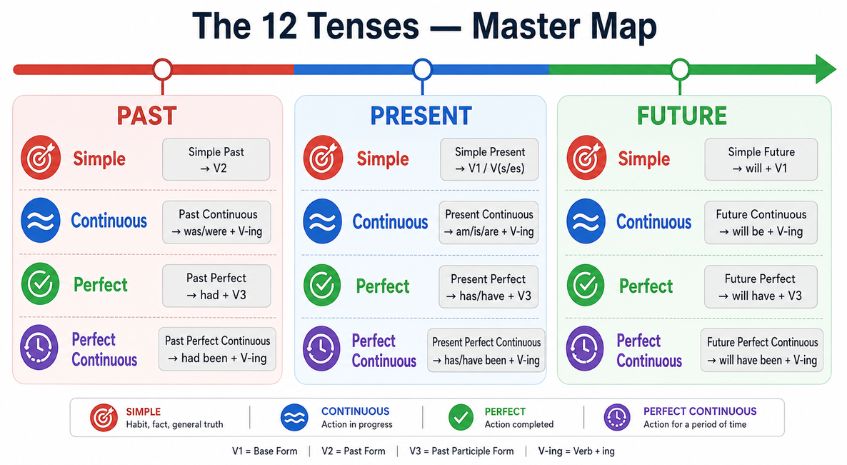
There are 3 time frames × 4 aspects = 12 tenses in English. That's the entire system. Learn the pattern once, and you never have to memorize all 12 separately.
The 4 aspects work the same way across all three time frames:
Aspect | What it shows | Key structure |
Simple | A bare fact or habit | Subject + basic verb form |
Continuous | Action in progress | Subject + be + V-ing |
Perfect | Completed action, linked to another time | Subject + have/has/had + V3 |
Perfect Continuous | Duration leading up to a point | Subject + have/has/had been + V-ing |
Now let's go through all 12 — group by group.
The 4 Present Tenses
Simple Present
Formula: Subject + V1 (add s/es for he/she/it/singular noun)
Used for: habits, universal truths, permanent situations, scheduled future events.
"Priya teaches at a government school."
"The sun rises in the east."
"The train leaves at 6 pm tomorrow."
Signal words: always, usually, often, sometimes, never, every day/week/year, generally, on Mondays
The exam trap here is the third-person singular rule. When the subject is he/she/it or any singular noun — the verb gets an s or es. No exceptions.
❌ "He go to the market every Sunday."
✅ "He goes to the market every Sunday."
Present Continuous
Formula: Subject + is/am/are + V1-ing
Used for: actions happening right now, temporary situations, annoying habits (with "always"), confirmed future plans.
"She is preparing for her UPSC exam."
"He is always losing his admit card." (annoying habit)
Signal words: now, at this moment, currently, at present, look!, listen!, these days
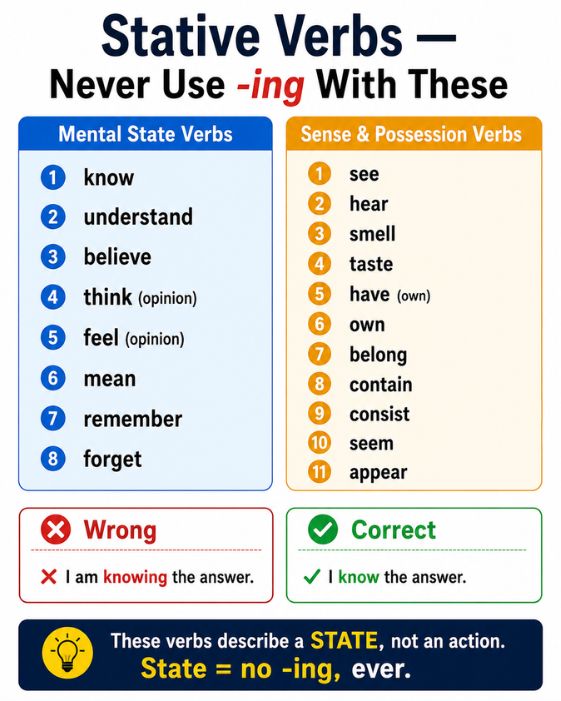
Now here's the trick that SSC examiners love — stative verbs. These are verbs that describe a state, not an action. They NEVER take the -ing form.
The most important ones: know, understand, believe, think (opinion), feel (opinion), love, hate, like, want, need, prefer, see, hear, smell, taste, have (possession), own, belong, consist, contain, appear, seem, mean
❌ "I am knowing the answer."
✅ "I know the answer."
❌ "She is having a car."
✅ "She has a car."
Present Perfect
Formula: Subject + has/have + V3 (third form of verb)
has → he, she, it, singular noun have → I, we, you, they, plural noun
Used for: past actions with present relevance, life experience (ever/never), recently completed actions, actions that started in past and continue now.
"She has qualified the SSC CGL exam." (recent achievement, relevant now)
"Have you ever visited Jaipur?" (life experience)
"I have lived in Chennai since 2018." (started past, still true now)
Signal words: ever, never, already, yet, just, recently, so far, till now, lately, since, for (with duration)
The killer exam rule: never use "ago" with present perfect.
❌ "I have met him two years ago." ✅ "I met him two years ago." (Simple Past)
✅ "I have met him before." (Present Perfect, no specific time)
Present Perfect Continuous
Formula: Subject + has/have been + V1-ing
Used for: showing how long an action has been continuing up to now.
"Rahul has been studying for five hours."
"It has been raining since morning."
Signal words: for (duration) + since (starting point)
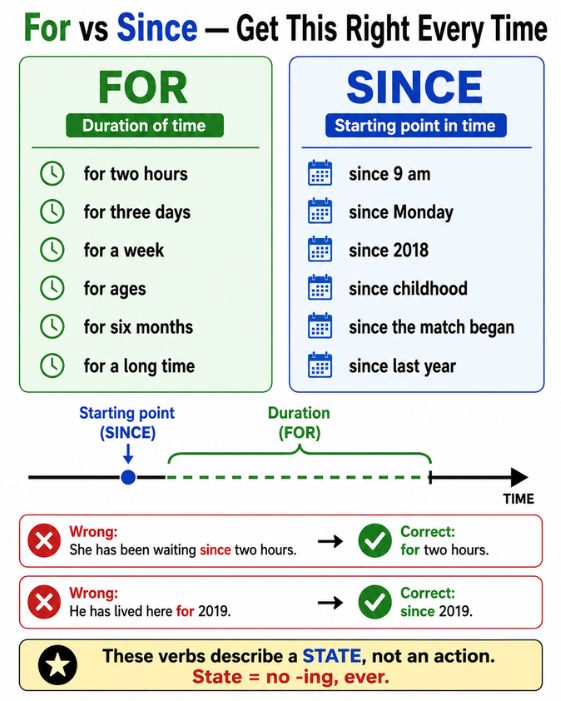
This is where for vs since becomes critical:
· for + duration of time → for two hours, for three days, for ages
· since + specific starting point → since 9 am, since Monday, since 2019, since childhood
❌ "She has been working since three hours."
✅ "She has been working for three hours."
The 4 Past Tenses
Simple Past
Formula: Subject + V2 (second form of verb)
Used for: completed actions at a specific past time.
"She won the gold medal in 2022."
"Amit went to Varanasi last month."
Signal words: yesterday, last week/month/year, ago, in [past year], once, formerly, that day
The most common student error: using did + V2 together.
❌ "She did went to the market."
✅ "She went to the market."
When you use did (in negatives/questions), the main verb goes back to V1.
✅ "She did not go to the market."
✅ "Did she go to the market?"
Past Continuous
Formula: Subject + was/were + V1-ing
was → I, he, she, it, singular noun were → we, you, they, plural noun
Used for: an action in progress at a past time, or an ongoing action interrupted by another.
"I was watching the match when the power went out."
"They were playing cricket at 5 pm yesterday."
Signal words: while, when, at that time, at [specific time] yesterday, as
Classic exam structure: "While she was cooking, he arrived." — one continuous action (cooking) interrupted by a simple past action (arrived).
Past Perfect
Formula: Subject + had + V3
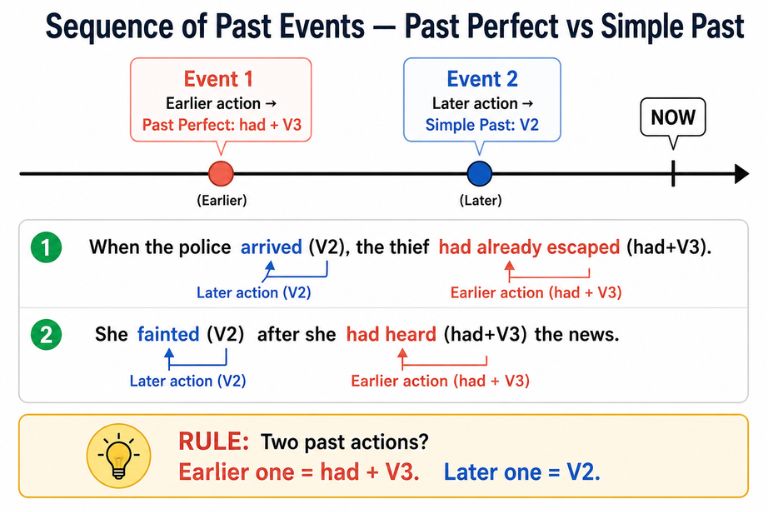
Used for: when two things happened in the past and you want to show which one happened FIRST — the first action takes past perfect.
"By the time Priya reached the station, the train had already left." (Train left first → past perfect. Priya reached second → simple past.)
Signal words: before, after, already, by the time, as soon as, when (with sequence meaning), no sooner...than, hardly/scarcely...when
❌ "When I reached, he left." (Both simple past — unclear sequence)
✅ "When I reached, he had already left." (He left first — past perfect)
This is one of the top 3 tense errors in SSC error spotting. Examiners set up a sequence of two past events and wait to see if you correctly identify which one gets had + V3.
Past Perfect Continuous
Formula: Subject + had been + V1-ing
Used for: showing how long an action had been continuing before another past event.
"She had been waiting for two hours before the doctor finally arrived."
Signal words: for, since (with past reference)
Less frequently tested than the others but appears in harder fill-in-the-blank questions. The structure is unmistakable — if you see had been + V-ing, that's this tense.
The 4 Future Tenses
Simple Future
Formula: Subject + will + V1
shall can be used with I/we in formal writing — both are acceptable in exams.
Used for: predictions, decisions made at the moment of speaking, promises, offers.
"She will clear the exam this time."
"I will help you with the application."
Signal words: tomorrow, next week/month/year, soon, in the future, later, shortly
Future Continuous
Formula: Subject + will be + V1-ing
Used for: an action that will be in progress at a specific future time.
"This time tomorrow, I will be sitting in the exam hall."
Signal words: at this time tomorrow, at [specific future time], by this evening
Future Perfect
Formula: Subject + will have + V3
Used for: an action that will be completed before a specific point in the future.
"By the time you read this, she will have left for Delhi."
"He will have finished the project by Friday."
Signal words: by, by the time, before (future reference)
This is the future tense that appears most in SSC and banking exams. The word "by" followed by a future time is almost always a future perfect signal.
Future Perfect Continuous
Formula: Subject + will have been + V1-ing
Used for: duration of an action up to a specific future point.
"By next month, he will have been working here for ten years."
Signal words: for + duration + by [future point]
Rarely tested directly, but understanding it helps with sentence correction options.
Worked Examples
EXAMPLE 1 — Signal Word Test
Incorrect: "She is living here since 2015."
Correct: "She has been living here since 2015."
Step 1: "Since 2015" is a signal word. An action that started in the past and still continues = present perfect or present perfect continuous.
Step 2: "Since" + specific starting point + ongoing duration → Present Perfect Continuous.
Step 3: "Is living" (present continuous) is wrong here — it ignores the connection to a past starting point.
Final Rule Applied: Ongoing action with "since/for" = Present Perfect Continuous (has/have been + V-ing)
The word "since" is one of the most powerful tense signals in the language. Every time you see "since" in a fill-in-the-blank, your first instinct should be: present perfect or present perfect continuous.
EXAMPLE 2 — Sequence of Past Events
Incorrect: "When the police arrived, the thief escaped."
Correct: "When the police arrived, the thief had already escaped."
Step 1: Two past events. Which happened first? The thief escaped — THEN the police arrived.
Step 2: The earlier of two past actions needs Past Perfect (had + V3).
Step 3: "Escaped" → "had already escaped."
Final Rule Applied: Earlier of two past actions = Past Perfect. Later one = Simple Past.
The word "already" isn't always there — sometimes you have to figure out the sequence from context. "When she arrived, he cooked dinner" vs "When she arrived, he had cooked dinner" — totally different meanings.
EXAMPLE 3 — Stative Verb Trap
Incorrect: "I am understanding this concept now." Correct: "I understand this concept now."
Step 1: "Understand" is a stative verb — it describes a mental state, not an action.
Step 2: Stative verbs never take the -ing form regardless of how "in progress" the situation feels.
Step 3: Use simple present even when you mean "right now."
Final Rule Applied: Stative verbs (know, understand, believe, want, love, etc.) → always simple present, never continuous.
In Hindi, we say "मैं अभी समझ रहा हूँ" — which literally translates to "I am understanding right now." That's the trap. English doesn't work this way for mental state verbs.
EXAMPLE 4 — "Ago" with Present Perfect
Incorrect: "The government has launched this scheme two years ago."
Correct: "The government launched this scheme two years ago."
Step 1: "Ago" indicates a specific past time. Present Perfect cannot be used with specific past time expressions.
Step 2: "Has launched" → simple past "launched."
Step 3: The logic: "ago" closes off the past. Present Perfect keeps the connection to now open. They contradict each other.
Final Rule Applied: Never use Present Perfect (has/have + V3) with: ago, yesterday, last week/month/year, in [specific year], that day, then.
This is a guaranteed 1-mark question in nearly every SSC/banking paper. The examiner's trap is always the same: a recent achievement phrased with "ago." Learn this rule cold.
EXAMPLE 5 — "By" and Future Perfect
Incorrect: "By the time Amit reaches, she will leave."
Correct: "By the time Amit reaches, she will have left."
Step 1: "By the time" + future reference = the action will be completed before that future point.
Step 2: Future Perfect (will have + V3) is needed to show completion before a future deadline.
Step 3: "Will leave" = simple future, which doesn't convey completion. "Will have left" = definitely done before he reaches.
Final Rule Applied: "By" or "by the time" + future point → Future Perfect (will have + V3).
"By" is the single most reliable future perfect signal. If you spot "by" before a future time expression, immediately think: will have + V3.
Common Mistakes to Avoid
MISTAKE: "She did not went to school yesterday."
CORRECT: "She did not go to school yesterday."
WHY IT HAPPENS: When did is used as an auxiliary (in negatives/questions), the main verb must return to its base form (V1). Using did + V2 is a double-past — a very common error.
MISTAKE: "I have met him last year."
CORRECT: "I met him last year."
WHY IT HAPPENS: "Last year" is a specific past time. Present Perfect cannot co-exist with definite past time expressions. The brain uses have because the event still feels relevant, but grammar doesn't run on feeling.
MISTAKE: "She is knowing the answer."
CORRECT: "She knows the answer."
WHY IT HAPPENS: Direct translation from Hindi ("वो जानती है" feels like an ongoing state). Mental state verbs in English are always simple present, never continuous.
MISTAKE: "She is working here since five years."
CORRECT: "She has been working here for five years."
WHY IT HAPPENS: Two errors in one:
(1) Present continuous used instead of present perfect continuous for an ongoing action, and
(2) "since" used with a duration instead of "for."
"Since" = starting point. "For" = duration.
MISTAKE: "No sooner he entered the room than everyone stood up."
CORRECT: "No sooner had he entered the room than everyone stood up."
WHY IT HAPPENS: "No sooner...than" and "Hardly/Scarcely...when" are inverted constructions that require Past Perfect + inversion. Most students use simple past because the sentence sounds complete without the inversion.
Tricks & Shortcuts
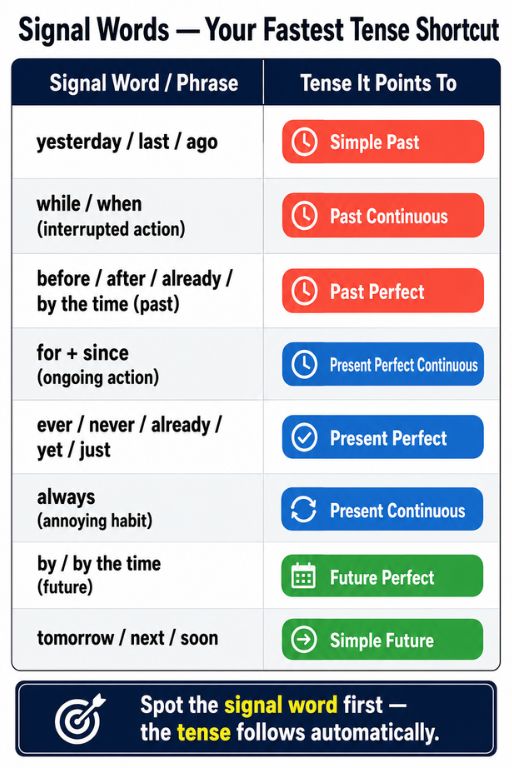
TRICK: The Signal Word Shortcut
When to use: Fill in the blanks and error spotting questions
How it works: Before trying to figure out the tense by logic, look for signal words in the sentence. They almost always point directly to the correct tense.
yesterday / last / ago → Simple Past
since / for (ongoing) → Perfect or Perfect Continuous
by / by the time + future → Future Perfect
while / when (interrupted action) → Past Continuous + Simple Past
ever / never / already / yet / just → Present Perfect
always (annoying habit) → Present Continuous Example: "She ___ here since 2010" — spot "since" → Present Perfect Continuous → has been living Time saved: 20–30 seconds per question
TRICK: The "Two Past Events" Sequence Test
When to use: Error spotting sentences with two past actions
How it works: When a sentence has two past actions, ask yourself: which happened FIRST? The first action → Past Perfect (had + V3). The second action → Simple Past (V2).
Example: "She fainted after she ___ the news." → Heard the news first → had heard. Then she fainted → fainted (simple past).
Time saved: Eliminates guessing on sequence questions entirely.
TRICK: The Stative Verb Quick-Check List
When to use: Any -ing form in the options or underlined in error spotting
How it works: Before accepting a continuous tense, quickly check: is this verb on the stative list?
The 10 you must remember: know, understand, believe, love, hate, want, need, see, hear, have (possession). If yes → remove the -ing, use simple form.
Example: "He is wanting a new job" → "want" is stative → "He wants a new job"
Time saved: Catches a guaranteed trap in under 5 seconds.
Practice MCQs
Q1. Fill in the blank: "By the time the results are declared, she ___ for her next exam."
A) will prepare
B) will have been preparing
C) is preparing
D) would prepare
Q2. Spot the error: "Hardly had she entered the room when everyone stood up and started clapping."
A) Hardly had she
B) entered the room
C) when everyone stood up
D) No error
Q3. Fill in the blank: "I ___ this novel three times. It is brilliant."
A) read
B) was reading
C) have read
D) had read
Q4. Spot the error: "She has been working in this company since ten years."
A) She has been
B) working in this company
C) since ten years
D) No error
Q5. Fill in the blank: "When I arrived at the party, Rahul ___ already ___ home."
A) has / gone
B) had / gone
C) was / going
D) will have / gone
Q6. Spot the error: "No sooner she left the office than it started raining heavily."
A) she left
B) the office than it started
C) raining heavily.
D) No error
Answer Key
Q1 → B (will have been preparing)
"By the time" + future point signals Future Perfect. But since the action has ongoing duration (preparing), Future Perfect Continuous is the most precise choice. "Will prepare" is simple future and ignores the completed-duration aspect.
Q2 → D (No error)
"Hardly had she entered...when everyone stood up" is correct. "Hardly/Scarcely" + Past Perfect in the first clause + "when" + Simple Past in the second clause = perfect inversion structure.
Q3 → C (have read)
"This novel three times" + no specific time mentioned = life experience → Present Perfect. "Have read" is correct. If the sentence said "I read it last year," then simple past would be used.
Q4 → C (Error: "since" should be "for")
"Ten years" is a duration of time, not a specific starting point. Use for + duration. "Since" goes with a specific point: since 2014, since childhood, since morning. Correct: "for ten years."
Q5 → B (had / gone)
Two past events: Rahul left home → FIRST (past perfect). I arrived → SECOND (simple past). So: had already gone.
Q6 → B (Error: "she left" should be "had she left")
"No sooner...than" requires inversion + Past Perfect in the first clause. Correct structure: "No sooner had she left the office than it started raining." This is the most commonly tested inverted construction in SSC exams.
QUICK REVISION
12 tenses = 3 times (Past/Present/Future) × 4 aspects (Simple/Continuous/Perfect/Perfect Continuous)
Simple Present: V1 / V1+s/es — for habits and facts
Present Continuous: is/am/are + V-ing — NOT for stative verbs (know, want, love, see, hear...)
Present Perfect: has/have + V3 — NEVER with ago, yesterday, last week/year
Present Perfect Continuous: has/have been + V-ing — use for + duration, since + starting point
Simple Past: V2 — do NOT use "did + V2" together
Past Perfect: had + V3 — for the FIRST of two past events
Future Perfect: will have + V3 — triggered by "by" + future time
Signal words are your fastest shortcut in the exam hall — learn them cold
Crucial exception: No sooner had she...than and Hardly had he...when require Past Perfect + inversion
"For" = duration. "Since" = starting point. Mixing these is a guaranteed error-spotting trap
Comments
No comments yet.