Modals (Can, Could, Should, Must…) — Meaning, Usage & Exam Fill-in-the-Blanks
Modals (Can, Could, Should, Must…) — Meaning, Usage & Exam Fill-in-the-Blanks
Read these three sentences carefully:
You must carry your ID to the exam hall. You should carry your ID to the exam hall. You may carry your ID to the exam hall.
All three are grammatically correct. All three are about the same action — carrying an ID. But they mean completely different things. The first is a strict rule. The second is advice. The third is permission.
That's what modals do. They don't describe actions — they describe the nature of the action. Is it allowed? Is it obligatory? Is it possible? Is it likely?
And this is exactly why SSC CGL, IBPS PO, SBI Clerk, and Railways exams test modals so heavily in Fill-in-the-Blanks. The correct answer is never about grammar structure — it's always about meaning. One wrong choice changes the entire tone of the sentence. You have to know not just what each modal is but what each modal means.
Let's go through every modal you need, one by one, from the ground up.
What Is a Modal Verb?
A special type of auxiliary (helping) verb that is placed before the main verb to express meanings like ability, permission, obligation, possibility, advice, or intention. Modals never change form — no -s, no -ing, no -ed. They are always followed by the base form (V1) of the main verb.
The complete list of modals you need for Indian competitive exams:
Can
Could
May
Might
Shall
Will
Would
Should
Must
Ought to
Need
Dare
Used to
Three Rules That Apply to ALL Modals
Before we go modal by modal, burn these three rules into your memory:
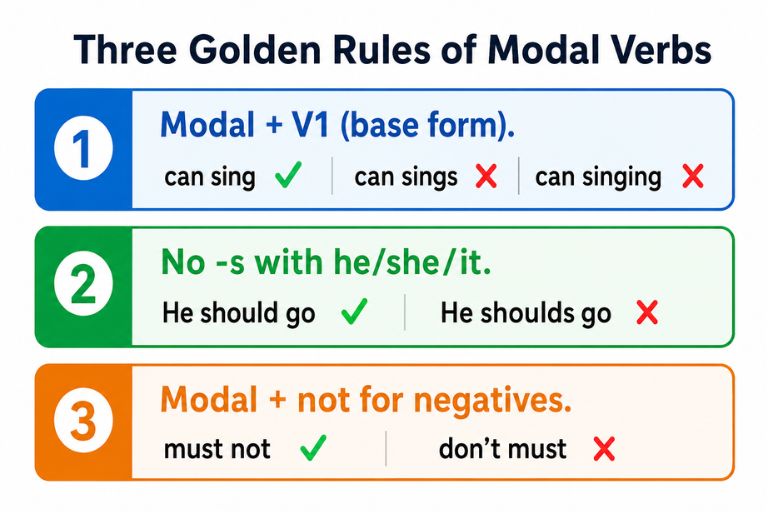
Rule 1: Modal + base form (V1). Never Modal + V2 or Modal + V-ing.
✅ She can sing.
❌ She can sings / can singing / can sang.
Rule 2: Modals do not take -s with third-person singular subjects.
✅ He should go.
❌ He shoulds go.
Rule 3: For negatives, add "not" directly after the modal.
✅ You must not do this.
❌ You don't must do this.
CAN — Ability, Permission, Possibility
Used to express present ability (something someone is capable of doing), informal permission, or general possibility.
Three Jobs of CAN
1. Present Ability
Priya can speak three languages. Rahul can run 10 km without stopping. → This means the person has this skill right now.
2. Informal Permission
You can use my pen. Students can bring water bottles into the exam hall. → "Can" for permission is informal/conversational. In formal contexts, "may" is preferred — but exams now accept both.
3. General Possibility
Too much sugar can cause diabetes. Hard work can change your destiny. → Something that is generally possible or true under certain conditions.
CAN vs MAY for Permission — The Exam Favourite
In formal written English and in exam answer keys:
May = formal permission
Can = informal permission
"May I come in, sir?" → Formal, correct in an exam or office setting. "Can I come in?" → Informal, used in conversation.
When the exam sentence involves a formal situation (asking a teacher, an official, a senior), the answer is almost always may, not can.
COULD — Past Ability, Polite Requests, Possibility
The past form of "can." Used to express past ability, polite/tentative requests, and theoretical or uncertain possibility.
Three Jobs of COULD
1. Past Ability
When he was young, Amit could climb any tree. She could solve any maths problem in seconds. → He had this ability in the past — he may or may not have it now.
2. Polite Requests (Present/Future)
"Could you please pass the water?" "Could you help me with this form?" → This is present tense! "Could" makes a request sound more polite and tentative than "can." This is a very common exam trap — students think "could" is always past, but in requests it works in the present.
3. Theoretical Possibility
We could try a different approach. That noise could be a train. → Something that is possible but not certain.
CAN vs COULD — Ability: The Time Trap
❌ Thinking "could" is always past and "can" is always present.
"Could" in requests and possibilities works in the present: "Could you do me a favour?" — This is a present request, not past.
But for ability, the time distinction is clear: She can drive. (She has the ability now.) She could drive when she was fifteen. (She had the ability then.)
MAY — Formal Permission, Present Possibility
Used to express formal permission or present possibility/probability (something that might happen).
Two Jobs of MAY
1. Formal Permission
"May I use your phone?" Students may leave after the bell rings. → More polite and formal than "can." Use "may" whenever the situation involves asking permission from someone in authority.
2. Present Possibility (around 50% chance)
It may rain this evening. She may arrive late — the trains are delayed. → There is a reasonable chance of this happening, but it's not certain.
MIGHT — Remote Possibility, Uncertain Situations
The past form of "may," but in modern usage it expresses a lower degree of possibility than "may" — something that is less likely or more uncertain.
It might rain, but I doubt it. He might come to the party — he hasn't confirmed. She might have missed the bus.
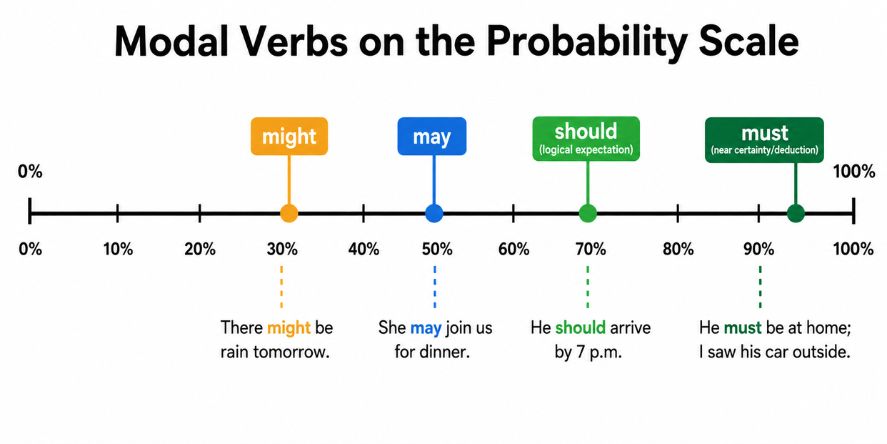
MAY vs MIGHT — The Probability Scale
This is one of the most tested distinctions in competitive exams.
Modal | Probability | Example |
May | ~50% chance — fairly likely | It may rain tonight. |
Might | ~30% chance — less certain, more doubtful | It might rain, but the sky looks clear. |
Think of it this way: may is "there's a good chance." Might is "there's a chance, but don't count on it."
SHALL — Future (Formal), Offers, Suggestions
Traditionally used with I/We to express the simple future. In modern usage, it is mainly used for offers, suggestions, and formal future statements. Rarely used with he/she/they/you in modern English.
Three Jobs of SHALL
1. Formal Future (I / We)
I shall return by 6 PM. We shall overcome all difficulties. → In Indian English and formal writing, "shall" with I/We is still widely used and accepted.
2. Offers and Suggestions
"Shall I carry your bag?" "Shall we go to the market now?" → This is the most common modern use of "shall" — making an offer or suggesting a joint action.
3. Rules, Laws, and Strong Obligations (in formal documents)
The candidate shall report at 9 AM. Members shall follow the code of conduct. → In legal and official language, "shall" means it is mandatory.
SHALL vs WILL
SHALL | WILL |
I/We — formal future | All persons — general future |
Offers: "Shall I help?" | Promises: "I will help you." |
Formal documents | Everyday conversation |
In modern English, will has largely replaced shall for most future uses. But shall is still expected in:
Formal offers ("Shall I open the window?")
Indian formal writing and legal documents
SSC/Banking error spotting questions that test this distinction
WILL — Future, Promises, Willingness, Instant Decisions
The most common way to express the future in English. Also used for promises, willingness, and decisions made at the moment of speaking.
Four Jobs of WILL
1. General Future
The exam results will be announced tomorrow. Priya will join the new office next Monday.
2. Promises
I will definitely return your money by Friday. "I will always support you," he said.
3. Willingness
I will help you with the application form. "Will you carry this for me?" "Yes, I will."
4. Instant Decisions (at the moment of speaking)
"The phone is ringing." "I will get it." "We've run out of tea." "I will buy some on the way back."
WOULD — Past of WILL, Polite Requests, Hypothetical Situations
The past form of "will." Used for past habitual actions, polite requests, preferences, and hypothetical/conditional situations.
Four Jobs of WOULD
1. Past Habitual Actions (things done regularly in the past)
When he was a child, Rahul would wake up at 5 AM every day. Every summer, the family would visit their village. → "Would" here is interchangeable with "used to" — but "would" is only for repeated actions, not for past states.
2. Polite Requests (more polite than "will")
"Would you please send me the report?" "Would you mind closing the window?"
3. Preferences (with "like," "love," "prefer")
I would like a cup of tea. She would prefer to stay at home. → "Would like" is the polite way to express a wish or preference. Much more formal than "I want."
4. Hypothetical / Conditional Situations
If I had more time, I would read more books. If Priya were here, she would know the answer. → This is the classic "second conditional" — imagining an unreal or unlikely situation.
WOULD vs USED TO — The Subtle Difference
Both express past habits, but there's one critical difference exams love:
Used to can describe both past habits AND past states.
Would can only describe past habits (repeated actions), NOT past states.
❌ I would live in Delhi. (living in Delhi is a state, not a repeated action)
✅ I used to live in Delhi.
✅ He would go for a walk every evening. (walking every evening is a repeated action — both work)
✅ He used to go for a walk every evening.
SHOULD — Advice, Duty, Logical Expectation
Used to express advice (what is recommended), moral duty/obligation (lighter than "must"), and logical expectation (what we expect will happen).
Three Jobs of SHOULD
1. Advice / Recommendation
You should drink more water. Students should revise their notes before the exam. → "Should" is softer than "must." It says "this is a good idea" without commanding.
2. Duty / Moral Obligation
We should respect our elders. Citizens should follow traffic rules. → Not a command — more of an expectation about responsible behaviour.
3. Logical Expectation (something that is expected to happen)
Meena left at 8 AM — she should reach the office by 9. The package was dispatched two days ago. It should arrive today. → "Should" here says "based on logic, I expect this to be true."
MUST — Strong Obligation, Prohibition, Logical Deduction
Used to express strong obligation (an internal or authoritative command), prohibition (in the negative), or logical deduction/certainty (when you're almost sure something is true).
Three Jobs of MUST
1. Strong Obligation / Compulsion
You must submit your application before 5 PM. All passengers must carry a valid ticket. → This is stronger than "should." It says "there is no choice here."
2. Prohibition (MUST NOT)
You must not use your phone during the exam. Visitors must not enter the restricted area. → "Must not" = it is forbidden. This is stronger than "should not."
3. Logical Deduction (near certainty based on evidence)
He has been working for 18 hours — he must be exhausted. She scored 99% — she must have studied very hard. → You're not 100% certain, but the evidence makes it almost a logical conclusion.
MUST vs HAVE TO — The Difference Exams Test
Both express obligation, but the source of obligation differs:
MUST | HAVE TO |
Internal/personal obligation or authority command | External obligation — rules, laws, circumstances |
I must finish this today. (I'm telling myself) | I have to finish this today. (my boss said so / the deadline is fixed) |
Prohibition: must not = forbidden | No obligation: don't have to = not necessary |
This is critical: "Must not" and "don't have to" are NOT the same thing. You must not go there. = It is forbidden. You cannot. You don't have to go there. = It is not necessary. You have a choice.
OUGHT TO — Moral Duty, Strong Advice
Very similar to "should" in meaning, but slightly stronger — it carries a sense of moral duty or what is right. Always followed by "to" (unlike other modals).
We ought to help those in need. You ought to apologise for your behaviour. She ought to have informed us earlier. (past — she didn't, but she should have)
"Ought to" is the only modal that is regularly followed by "to." Do not add "to" after any other modal.
❌ You must to go.
❌ She can to sing.
✅ You ought to go.
✅ She ought to practise.
NEED — Necessity (Modal vs Main Verb)
"Need" is tricky because it can work as both a modal and a main verb, and the structure is different in each case.
Need as Modal | Need as Main Verb |
Need + V1 (no "to") | Need + to + V1 |
You need not worry. | You don't need to worry. |
Mainly in negatives and questions | Used in all sentence types |
No -s with he/she/it: He need not go. | Takes -s: He doesn't need to go. |
In modern exam usage, "need not" (modal) is the preferred form in formal sentences. Both are correct, but error spotting questions often test whether you've added "to" after the modal "need."
❌ You need not to go. (modal — no "to")
✅ You need not go.
USED TO — Past Habits and Past States
Expresses something that was true or happened regularly in the past but does not happen/is not true now.
I used to cycle to school every day. (I don't anymore) There used to be a post office here. (there isn't one now) She used to be very shy. (a past state — she isn't anymore)
Common Error: "Use to" in Negatives and Questions
In negatives and questions, "used to" becomes "use to" (the "d" disappears because "did" carries the past):
❌ Did you used to play cricket?
✅ Did you use to play cricket?
❌ He didn't used to smoke.
✅ He didn't use to smoke.
This catches students every single time. When "did" appears, the "d" goes from "used."
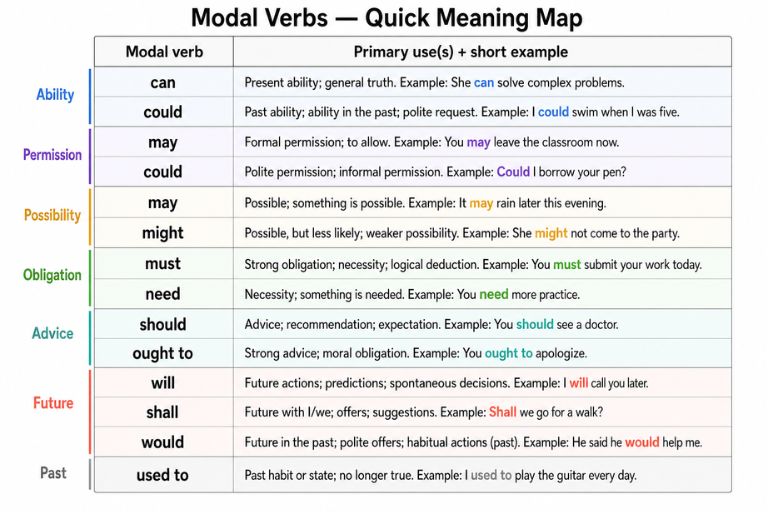
Summary Reference Table
Modal | Primary Meanings | Example |
can | Ability (now), informal permission, possibility | She can drive. |
could | Past ability, polite request, possibility | Could you help me? |
may | Formal permission, possibility (~50%) | May I come in? |
might | Lower possibility (~30%), uncertainty | It might rain. |
shall | Formal future (I/We), offers, suggestions | Shall I help? |
will | Future, promise, willingness, instant decision | I will call you. |
would | Past habit, polite request, hypothetical, preference | I would like tea. |
should | Advice, duty, logical expectation | You should rest. |
must | Strong obligation, prohibition, deduction | He must be tired. |
ought to | Moral duty, strong advice | We ought to help. |
need | Necessity (mainly negatives) | You need not worry. |
used to | Past habit or past state (no longer true) | I used to live here. |
Worked Examples
EXAMPLE 1
You ______ not enter the examination hall without your admit card.
A) can
B) should
C) must
D) might
Step 1: Read the context. This is a strict rule about entry to an exam hall — a prohibited action.
Step 2: "Should not" = advice against it. "Might not" = possibility of not doing it. "Can not" = informal prohibition. "Must not" = it is strictly forbidden.
Step 3: An exam hall rule is not advice — it's a strict prohibition.
Answer: C (must)
Rule Applied: "Must not" = strict prohibition/ban. Used for rules and regulations.
Anywhere you see official rules, regulations, or strict conditions, "must" is almost always the answer — not "should."
EXAMPLE 2
______ I borrow your dictionary for a few minutes?
A) Will
B) Shall
C) Must
D) May
Step 1: The speaker is asking for permission from someone else.
Step 2: "Will" = expressing future/willingness, not permission. "Shall" = offers or formal future, not asking permission. "Must" = obligation. "May" = formal request for permission.
Step 3: This is a polite, formal request for permission.
Answer: D (May)
Rule Applied: "May I...?" is the standard formal expression for asking permission.
Whenever you see a blank before "I" in a question asking for permission, the answer is almost always "May." "Can I" is informal and marked wrong in formal exam contexts.
EXAMPLE 3
She looks very pale. She ______ be unwell.
A) can
B) must
C) shall
D) would
Step 1: The speaker is looking at evidence (she looks pale) and drawing a conclusion.
Step 2: "Can" = general possibility. "Shall" = future/offer. "Would" = hypothetical. "Must" = logical deduction based on evidence.
Step 3: "Looks pale" is visible evidence. The speaker is almost certain of a conclusion.
Answer: B (must)
Rule Applied: "Must" for logical deduction — when evidence strongly points to a conclusion.
"Must" has two very different jobs: obligation ("You must go") and deduction ("She must be tired"). In fill-in-the-blank questions, the clue for deduction is always evidence in the same sentence — look for physical descriptions, facts, or situations that point to a conclusion.
EXAMPLE 4
When Amit was young, he ______ spend hours reading comics.
A) will
B) would
C) should
D) must
Step 1: "When Amit was young" tells us this is about the past.
Step 2: "Will" = future or present. "Should" = advice. "Must" = obligation or deduction. "Would" = past habit. Step 3: Reading comics every day in the past = a repeated past action = past habit.
Answer: B (would)
Rule Applied: "Would" for repeated past habits. The phrase "when he was young" is the trigger.
"Would" for past habits only works for actions, not states. "He would be shy" is wrong — use "He used to be shy" for past states.
EXAMPLE 5
You ______ have informed me earlier — I had been waiting for two hours.
A) must
B) should
C) might
D) would
Step 1: The speaker is expressing regret or criticism about something that did NOT happen. The person did not inform the speaker.
Step 2: This is a "modal + have + V3" structure, which refers to a past situation that didn't happen.
Step 3: "Must have" = past deduction (used when you're sure about something that happened). "Would have" = hypothetical past. "Might have" = uncertain past possibility. "Should have" = past advice that was NOT followed — expressing criticism or regret about a past action.
Answer: B (should)
Rule Applied: "Should have + V3" = criticism or regret about something that should have happened but didn't.
"Should have V3" is one of the most tested modal structures. It always implies the action didn't happen. "You should have called" means you didn't call, and I'm pointing that out. Master this structure separately — it appears in almost every Banking English paper.
Common Mistakes to Avoid — The Indian Student Traps
MISTAKE: Using "must" for advice instead of "should." You must exercise daily if you want to stay fit. (sounds overly forceful)
CORRECT APPROACH: You should exercise daily. — "Should" for advice. "Must" for strict rules and obligations.
WHY IT HAPPENS: In Hindi and many regional languages, "chahiye" (should/must) covers both advice and obligation. English separates them with different modals, but students reach for "must" because it feels stronger.
MISTAKE: Adding "to" after modals (other than "ought to"). She can to speak French. / You must to come.
CORRECT APPROACH: Modal + V1 directly. She can speak. You must come.
WHY IT HAPPENS: Direct translation from Hindi/regional languages: "Woh bol sakti hai" doesn't have a separate "to," but students over-correct based on the "to" in infinitives they've learned.
MISTAKE: Writing "did you used to" in questions and negatives. Did you used to go there?
CORRECT APPROACH: Did you use to go there? — "did" already carries the past; the verb becomes base form.
WHY IT HAPPENS: "Used to" looks and sounds like a fixed phrase, so students keep the "d" even when "did" is already there. It's purely a visual memorisation issue.
MISTAKE: Confusing "must not" (forbidden) with "need not" (not necessary). You must not bring ID. (This means it's forbidden — a completely different message!) You need not bring ID.
(This means it's not necessary but allowed.)
WHY IT HAPPENS: Both are negative forms. But their meanings are opposite in force. This is a classic exam trap where all four options look similar.
MISTAKE: Using "would" for past states instead of "used to." When I was in school, I would be very nervous before exams.
CORRECT APPROACH: When I was in school, I used to be very nervous before exams. — "Would" is for repeated actions; "used to" covers both actions and states.
WHY IT HAPPENS: Students learn that "would" = past habit and apply it everywhere, without knowing the action vs. state distinction.
Tricks & Shortcuts — Exam-Ready Hacks
TRICK: The Evidence Test for MUST vs MAY vs MIGHT
When to use: Fill-in-the-blank sentences where the context gives you clues about how certain the speaker is.
How it works: Ask: "How much evidence is in the sentence?" Strong physical evidence (looks pale, hasn't eaten, been working 18 hours) → must (logical deduction). Moderate chance, reasonable expectation → may. Uncertain, vague chance → might.
Example: "He hasn't slept in two days. He _____ be exhausted." → Strong evidence → must.
Time saved: Eliminates 2–3 wrong options immediately by reading tone, not just grammar.
TRICK: The "Past + Not Happened" Detector for SHOULD HAVE / MUST HAVE
When to use: Any blank in a sentence with "have + V3" where something in the past is being discussed.
How it works: Check whether the action happened or didn't happen.
Action DIDN'T happen + regret/criticism → should have (You should have told me.)
Action DID happen + you're deducing → must have (She must have left already.)
Example: "The letter was sent a week ago. It _____ arrived by now." → You expect it to have arrived (logical deduction about something that should have happened) → should have.
Time saved: Removes all ambiguity from "modal + have + V3" questions. 20–25 seconds saved per question.
TRICK: The Formality Ladder for Permission
When to use: Any fill-in-the-blank asking about permission.
How it works: Match the level of formality in the sentence to the correct modal.
Formal situation (asking a teacher, official, senior) → May
Informal situation (asking a friend, peer) → Can
Offering help → Shall (Shall I carry this for you?)
Example: "_____ I speak to the Principal, please?" → Formal → May.
Time saved: No analysis needed — the social context of the sentence tells you the answer.
Practice MCQs
Q1. Fill in the blank: Vehicles ______ not be parked in front of the emergency exit.
A) should
B) might
C) must
D) could
Q2. Choose the correct option: "______ you please repeat the question?" the student asked the examiner.
A) Will
B) Shall
C) Could
D) Must
Q3. Identify the error: When Priya was a child, she would be very afraid of dogs.
A) When Priya was a child
B) she would be
C) very afraid of dogs
D) No error
Q4. Fill in the blank: It is only 6 AM and Rahul has already finished his assignment. He ______ have started very early.
A) should
B) might
C) must
D) would
Q5. Fill in the blank: You ______ have submitted the form yesterday — the deadline has passed and now your application is invalid.
A) must
B) could
C) should
D) would
Answer Key
Q1 → C (must)
This is an official rule about parking near an emergency exit — a strict prohibition. "Must not" is used for rules and regulations where no alternative is permitted. "Should not" would mean it's inadvisable; "must not" means it is forbidden.
Q2 → C (Could)
This is a polite request from a student to an examiner — a formal situation. "Could" is the most polite way to make a request (more tentative than "will"). "Will" is correct but less polite. "Must" is wrong (obligation, not request). "Shall" is for offers, not requests.
Q3 → B (she would be)
"Would" is used for past repeated actions, not past states. "Being afraid of dogs" is a past state, not a repeated action. The correct modal for past states is "used to": she used to be very afraid of dogs.
Q4 → C (must)
The evidence is clear: it is only 6 AM and the assignment is done. The speaker is drawing a logical deduction — almost certain of a conclusion based on visible evidence. "Must have" = logical deduction about the past.
Q5 → C (should)
The action of submitting the form did NOT happen (the deadline has passed, the application is invalid). The speaker is expressing regret/criticism about something that should have happened but didn't. "Should have + V3" = past advice not followed / regret about a missed action.
QUICK REVISION — The 10-Minute Exam Cheat Sheet
Modal + V1 (base form). Never -s, -ing, or past form after a modal
"Ought to" is the ONLY modal followed by "to"
can = ability now | could = past ability / polite request
may = formal permission / ~50% possibility | might = lower possibility / ~30% • must = strong obligation OR logical deduction (based on evidence)
must not = forbidden | need not / don't have to = not necessary (completely different!)
should = advice / duty / logical expectation | should have + V3 = regret/criticism (action didn't happen)
must have + V3 = past deduction (you're almost certain something happened)
would = past habit (actions only) | used to = past habit OR past state
"Did you use to...?" NOT "Did you used to...?" — "did" removes the "d"
For permission: May = formal | Can = informal | Shall = offering help
shall = formal future with I/We, or making offers ("Shall I help?")
will = general future, promises, willingness, instant decisions
Comments
No comments yet.