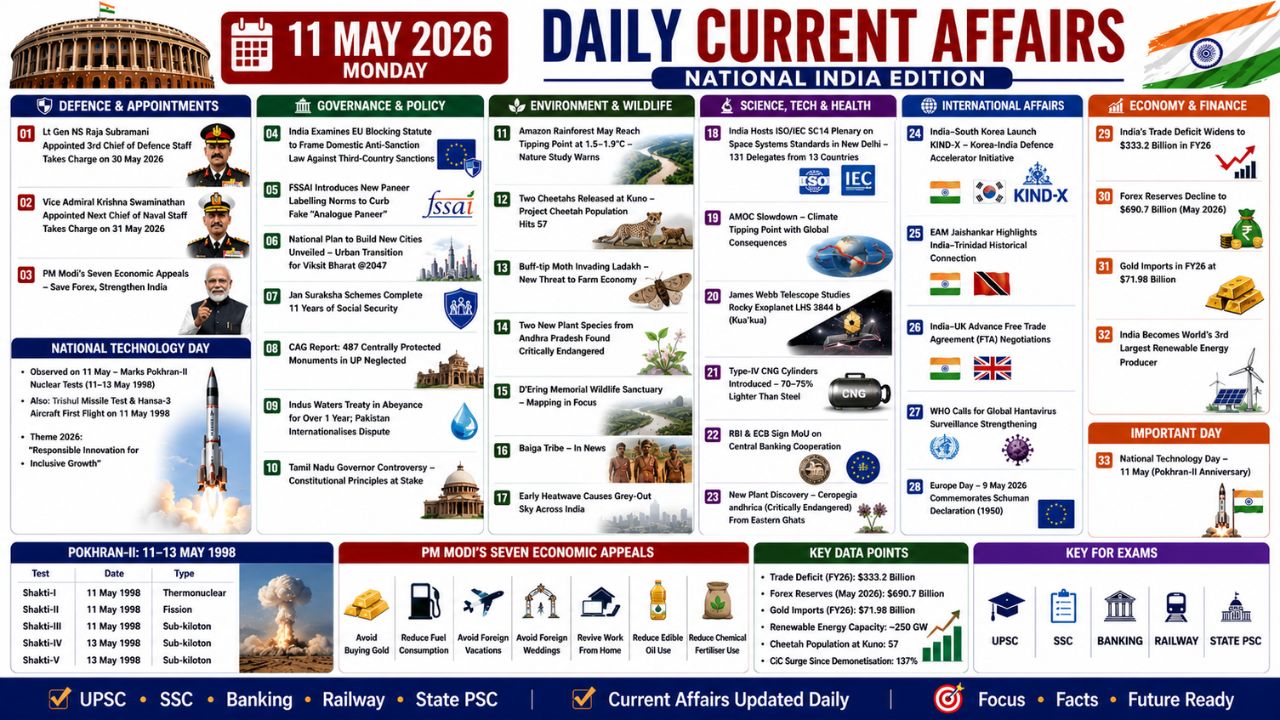
11 May 2026 Current Affairs is headlined by one of the most significant moments in the exam calendar — National Technology Day — observed every May 11 to mark the anniversary of India's Pokhran-II nuclear tests of 1998. But today's edition goes far beyond that. PM Modi made seven historic economic appeals to citizens — including not buying gold for a year, reducing fuel consumption, and avoiding foreign vacations — in response to India's widening trade deficit and West Asian energy crisis.
The Indus Waters Treaty remains in abeyance — one year after Operation Sindoor — with Pakistan internationalising the dispute at the UNSC and ICJ. Jan Suraksha Schemes completed 11 years. Two cheetahs were released into the wild at Kuno National Park as Project Cheetah's population hit 57. CAG flagged 487 neglected centrally protected monuments in UP. RBI and ECB signed an MoU on central banking cooperation. India-South Korea launched the KIND-X defence innovation initiative. And Tamil Nadu's Governor controversy deepened into a constitutional flashpoint. A landmark day — let's break it all down.
Important Day — National Technology Day, May 11
National Technology Day 2026 — 28 Years of Pokhran-II, Theme: "Responsible Innovation for Inclusive Growth"
May 11 marks one of India's most defining scientific milestones — the Pokhran-II nuclear tests in 1998, which established the country as a nuclear-capable nation.
The same day also saw the test-firing of the Trishul missile and the first flight of the Hansa-3 aircraft — making it a landmark moment for indigenous innovation.
A year later, in 1999, the Indian government officially declared May 11 as National Technology Day to honour scientific excellence and innovation.
National Technology Day 2026 Theme: "Responsible Innovation for Inclusive Growth" — reflecting India's ambition to ensure that its technological advances benefit all sections of society, not just the privileged few.
The Pokhran-II story — complete exam framework:
On May 11–13, 1998, India conducted a series of underground nuclear tests at the Pokhran Test Range (PTR) in Rajasthan's Thar Desert — code-named Operation Shakti. The tests comprised:
Test | Date | Type |
|---|---|---|
Shakti-I | May 11, 1998 | Thermonuclear (hydrogen bomb) device |
Shakti-II | May 11, 1998 | Fission device |
Shakti-III | May 11, 1998 | Sub-kiloton device |
Shakti-IV | May 13, 1998 | Sub-kiloton device |
Shakti-V | May 13, 1998 | Sub-kiloton device |
Key personalities:
Scientific leadership: Dr. APJ Abdul Kalam (DRDO), Dr. R. Chidambaram (DAE — Department of Atomic Energy), Dr. K. Santhanam
Prime Minister: Atal Bihari Vajpayee
The tests were preceded by Pokhran-I (Smiling Buddha) — India's first nuclear test on May 18, 1974, under PM Indira Gandhi
What else happened on May 11, 1998?
Trishul missile test-fire: Trishul is a short-range surface-to-air missile developed under the Integrated Guided Missile Development Programme (IGMDP) — one of the five flagship IGMDP missiles (Agni, Prithvi, Akash, Trishul, Nag)
Hansa-3 first flight: India's first indigenously designed and manufactured 2-seater light aircraft — developed by the National Aerospace Laboratories (NAL), Bengaluru
India's technology journey since 1998: India's technology journey has advanced significantly since the late 1990s. From nuclear capability to aerospace development, the focus has shifted to startups, deep-tech research, digital public infrastructure, culture and next-generation manufacturing.
Recent discussions around National Technology Day have centred on artificial intelligence, semiconductor ecosystems, cybersecurity, climate-tech solutions and sustainable digital infrastructure.
India's nuclear doctrine — quickly reviewed:
No First Use (NFU): India will not use nuclear weapons first — but will retaliate massively if attacked
Credible Minimum Deterrence: India maintains only as many nuclear weapons as needed for effective deterrence
Nuclear Command Authority (NCA): The body that controls nuclear weapons — chaired by the Prime Minister, with the National Security Adviser as the Executive Council head
India is not a signatory to the NPT (Non-Proliferation Treaty) — but participates in nuclear safety forums
National Technology Day = May 11 (since 1999). Pokhran-II = Operation Shakti (May 11–13, 1998). 5 tests. PM = Atal Bihari Vajpayee. Scientists = APJ Abdul Kalam + R. Chidambaram. Also: Trishul test + Hansa-3 first flight on same day. Theme 2026 = "Responsible Innovation for Inclusive Growth." Pokhran-I = Smiling Buddha, May 18, 1974, PM Indira Gandhi. India = not NPT signatory.
Economy & Governance
PM Modi's Seven Economic Appeals — "Save Foreign Exchange, Strengthen India"
This is the most significant governance story of May 11, 2026 — and a landmark example of nudge-based governance in action.
Citizens were asked to reduce petrol and diesel consumption by using public transport, metro rail, carpooling, and electric vehicles to cut fuel imports. People were urged to avoid buying gold for one year, especially for discretionary purchases, to reduce dollar outflows from non-essential imports. The Prime Minister advised against unnecessary foreign vacations and destination weddings abroad, promoting domestic tourism and spending within India. Revival of work-from-home, online meetings, and video conferencing was encouraged to reduce commuting and save fuel.
The Prime Minister further asked citizens to reduce edible oil consumption and urged farmers to cut dependence on chemical fertilisers imported from abroad. Championing the 'Vocal for Local' movement, he stressed that self-reliance and organic farming are essential for India to achieve its Viksit Bharat goal by 2047.
PM Modi's Seven Economic Appeals — summarised:
# | Appeal | Sector Targeted |
|---|---|---|
1 | Avoid buying gold for one year | Non-oil imports, CAD |
2 | Reduce petrol and diesel use; use public transport/EV | Energy imports |
3 | Avoid unnecessary foreign vacations | Invisible account outflows |
4 | Avoid destination weddings abroad | Forex outflows |
5 | Revive work-from-home and video conferencing | Fuel conservation |
6 | Reduce edible oil consumption | Agricultural imports |
7 | Farmers: reduce dependence on imported chemical fertilisers | Urea/fertiliser imports |
The macroeconomic context — why these appeals were made:
India's trade deficit widened to $333.2 billion in 2025–26. Forex reserves declined from $728.5 billion (February 2026 peak) to $690.7 billion in early May 2026. Gold imports in FY 2025–26 were approximately $71.98 billion. India imports about 85% of crude oil and over 90% of gold demand is met through imports.
Key economic concepts this story tests:
Current Account Deficit (CAD): The CAD arises when the value of a country's imports of goods, services, and transfers exceeds its exports and inflows. A widening CAD puts downward pressure on the currency (rupee), raises imported inflation, and drains forex reserves.
Forex Reserves: India's foreign exchange reserves — held by the RBI — serve as a buffer against external shocks. At $690.7 billion (May 2026), India still has comfortable reserves, but the rapid decline from the $728.5 billion peak signals stress.
Gold imports and CAD: Gold accounts for a significant share of India's non-oil import bill. Gold is largely a store of value rather than a productive input. High imports increase the import bill, worsen CAD, and intensify pressure on the rupee during periods of global uncertainty.
Nudge-based governance: The appeal represents a form of nudge-based governance — encouraging voluntary behavioural changes rather than imposing formal restrictions. Similar strategies were used during COVID-19 to reduce travel and increase digital adoption. Public participation can complement macroeconomic management during periods of geopolitical and market volatility.
Why these appeals matter beyond economics: The call links personal consumption decisions with broader national interests, reinforcing the idea of responsible citizenship. It promotes moderation, domestic tourism, and support for local industries while encouraging awareness of collective economic vulnerabilities.
India trade deficit = $333.2 billion (FY26). Forex reserves = $690.7 billion (May 2026), down from $728.5 billion peak. Gold imports = $71.98 billion (FY26). India imports 85% crude + 90% gold demand. CAD = imports exceed exports + inflows. Nudge governance = voluntary behaviour change (no legal compulsion). Seven appeals cover: gold, fuel, foreign trips, WFH, edible oil, chemical fertilisers. Vocal for Local + Viksit Bharat 2047 context.
Jan Suraksha Schemes Complete 11 Years — PMJJBY, PMSBY and APY Impact
The three flagship Jan Suraksha Schemes — Pradhan Mantri Jeevan Jyoti Bima Yojana (PMJJBY), Pradhan Mantri Suraksha Bima Yojana (PMSBY), and Atal Pension Yojana (APY) — completed 11 years of providing affordable social security.
All three were launched simultaneously on May 9, 2015 by PM Modi in Kolkata. They were designed to extend financial and social security to India's unbanked and underbanked population — crores of informal workers, daily wage earners, and rural households who had no access to insurance or pension products.
Complete framework for all three schemes:
Scheme | Full Name | Coverage | Premium | Benefit |
|---|---|---|---|---|
PMJJBY | PM Jeevan Jyoti Bima Yojana | Life Insurance | ₹436/year | ₹2 lakh on death (any cause) |
PMSBY | PM Suraksha Bima Yojana | Accidental Insurance | ₹20/year | ₹2 lakh (accidental death/total disability); ₹1 lakh (partial disability) |
APY | Atal Pension Yojana | Pension | Contribution-based | ₹1,000–₹5,000/month pension after age 60 |
Eligibility:
PMJJBY: Age 18–50 years, bank account holder
PMSBY: Age 18–70 years, bank account holder
APY: Age 18–40 years, not an income tax payer (originally)
Nodal agencies:
PMJJBY and PMSBY: Administered through banks and insurance companies; overseen by Ministry of Finance
APY: Regulated by PFRDA (Pension Fund Regulatory and Development Authority) under the NPS (National Pension System) framework
Impact after 11 years:
PMJJBY: Over 20 crore+ enrolments, providing life insurance to the previously uninsured
PMSBY: Over 40 crore+ enrolments — the world's largest accidental insurance scheme
APY: Over 7 crore+ subscribers securing old-age income for unorganised workers
All three launched May 9, 2015, Kolkata. PMJJBY = life insurance, ₹436/year, ₹2 lakh benefit, age 18–50. PMSBY = accident insurance, ₹20/year, ₹2 lakh benefit, age 18–70. APY = pension ₹1k–₹5k/month after 60, age 18–40. PFRDA regulates APY. Three schemes = 11 years in 2026.
CAG Report — 487 Centrally Protected Monuments in UP Severely Neglected
A 2026 Comptroller and Auditor General (CAG) report highlighted severe neglect of 487 Centrally Protected Monuments (CPMs) in Uttar Pradesh, including 31 untraceable monuments, 96 encroached sites, and only 31 monuments (6.4%) with proper ownership documentation.
What are Centrally Protected Monuments? CPMs are archaeological and historical monuments of national importance protected under the Ancient Monuments and Archaeological Sites and Remains (AMASR) Act, 1958. They are under the jurisdiction of the Archaeological Survey of India (ASI) — which functions under the Ministry of Culture. There are approximately 3,693 CPMs across India — Uttar Pradesh has the highest concentration of any state, given its extraordinary heritage legacy spanning the Mughal era, Buddhist, Hindu, and pre-historic periods.
The encroachment and documentation crisis:
31 untraceable monuments: Heritage sites that ASI's field officers could not physically locate — suggesting either complete destruction, illegal demolition, or gross record-keeping failure
96 encroached sites: Sites where illegal construction, squatting, or commercial encroachment has occurred within the protected boundary zone
Only 31 of 487 monuments (6.4%) have proper ownership documentation — a fundamental governance failure
Why this matters: India's heritage sector generates significant tourism revenue and represents irreplaceable cultural capital. The CAG finding reflects a systemic failure — underfunded ASI, inadequate staffing, corruption in local administration, and weak enforcement of the prohibited zone (100 metres from monument boundary) and regulated zone (200 metres) under the AMASR Act.
CAG 2026 report: 487 CPMs in UP neglected. 31 untraceable, 96 encroached. Only 6.4% have proper documentation. ASI = Archaeological Survey of India, under Ministry of Culture. AMASR Act 1958 = governing law. ~3,693 CPMs total in India. UP = highest CPM concentration. CAG = Comptroller and Auditor General — reports to Parliament under Article 148.
Indus Waters Treaty — One Year in Abeyance, Pakistan Internationalises the Dispute
It has been over a year since India placed the Indus Waters Treaty in abeyance following the Pahalgam terror attack, with the Ministry of External Affairs reiterating that the Treaty will remain suspended until Pakistan credibly abjures cross-border terrorism.
Complete IWT framework for exams:
The Indus Waters Treaty (IWT) is a water-sharing agreement signed between India and Pakistan on September 19, 1960, with the World Bank acting as a facilitator. The Treaty was signed by Prime Minister Jawaharlal Nehru and Pakistani President Mohammed Ayub Khan, after nearly nine years of negotiations brokered by the World Bank.
The Treaty governs the sharing of waters of six major transboundary rivers of the Indus river system:
Eastern Rivers: Ravi, Beas, and Sutlej — allocated to India for unrestricted use
Western Rivers: Indus, Jhelum, and Chenab — allocated to Pakistan, with India allowed limited non-consumptive use (hydropower, not irrigation)
Pakistan's internationalisation strategy:
As a non-permanent UNSC member since January 2025, Pakistan has repeatedly raised the issue at the UNSC, even during unrelated discussions. Pakistan has sought ICJ intervention, although such a referral remains unlikely. Pakistan has approached the World Bank seeking mediation. At the UN Human Rights Council, Pakistan framed the issue as a human rights concern, leading UN Special Rapporteurs to send communications to India — which India has ignored.
Pakistan's core argument is that the Treaty contains no provision allowing either country to keep it in abeyance — only a dispute resolution mechanism exists. India's position: the Treaty will remain suspended until Pakistan ends cross-border terrorism.
The strategic dimension: India's decision sets a precedent for linking transboundary water cooperation to national security concerns like terrorism. This is a landmark shift in India's water diplomacy — using upstream riparian advantage as a strategic lever.
Key institutions for dispute resolution under IWT:
Permanent Indus Commission: A bilateral body with a Permanent Indus Commissioner from each country — for routine coordination
Neutral Expert: For technical disputes
Court of Arbitration: For legal disputes (Pakistan triggered this in 2016 over Kishanganga and Ratle hydropower projects)
IWT signed September 19, 1960. Nehru + Ayub Khan. World Bank = facilitator. Eastern (Ravi, Beas, Sutlej) = India. Western (Indus, Jhelum, Chenab) = Pakistan. India placed IWT in abeyance post-Pahalgam attack. Pakistan raising at UNSC, ICJ, World Bank, UNHRC. Permanent Indus Commission = bilateral body. Nine years of negotiations.
Polity & Constitutional Issues
Tamil Nadu Governor Controversy — A Constitutional Flashpoint
The 2026 Tamil Nadu Assembly election created a major constitutional controversy concerning the powers of the Governor, the meaning of democratic mandate, and the functioning of parliamentary democracy in India. TVK (Tamilaga Vettri Kazhagam), led by C. Joseph Vijay, emerged as the single largest party with 108 seats in the 234-member Assembly. However, the Governor of Tamil Nadu refused to immediately invite Vijay to form the government and instead demanded signed letters from 118 MLAs before administering the oath.
This decision raised serious questions regarding constitutional morality, federalism, and the neutrality of constitutional authorities.
What does the Constitution say? Under Article 164, the Chief Minister is appointed by the Governor. The established constitutional convention — backed by decades of Supreme Court judgments — is that the leader of the single largest party or coalition that can demonstrate majority support should be invited first to form the government and prove majority on the floor of the House. The Governor is not constitutionally empowered to demand pre-oath letters from MLAs — this has no basis in the Constitution or in the Sarkaria Commission (1983) or Punchhi Commission (2010) recommendations on Governor-Centre-State relations.
Constitutional morality vs conventional morality: The concept of constitutional morality — drawn from Dr. B.R. Ambedkar's constituent assembly speeches — refers to adherence to the letter and spirit of the Constitution even when it conflicts with popular or political sentiment. Governors demanding proof of majority before inviting someone to form government violates constitutional morality — the correct test is the floor test after oath, not pre-oath letter collection.
Relevant Supreme Court judgments:
Rameshwar Prasad vs Union of India (2006): Governor cannot act as an agent of the ruling party at the Centre
Nabam Rebia vs Deputy Speaker (2016): Governor's powers to summon Assembly are limited and must follow constitutional convention
S.R. Bommai vs Union of India (1994): Majority must be tested on the floor of the House, not in the Raj Bhavan
Respect for constitutional morality, democratic mandate, and parliamentary democracy is essential for preserving India's federal structure. Governors are expected to function as impartial guardians of the Constitution rather than instruments of political strategy.
Article 164 = CM appointed by Governor. Single largest party = invited first (convention). Governor CANNOT demand pre-oath letters — unconstitutional. S.R. Bommai (1994) = majority tested on floor, not Raj Bhavan. Constitutional morality = Ambedkar's concept. Sarkaria Commission 1983 + Punchhi Commission 2010 = Governor-Centre-State relations. Tamil Nadu assembly = 234 seats; TVK = 108 (single largest).
Wildlife & Environment
Two Cheetahs Released at Kuno — Project Cheetah Population Hits 57
Madhya Pradesh Chief Minister will release two cheetahs into the wild at Kuno National Park. This event marks a continuing milestone for Project Cheetah, which has seen the park's cheetah population grow to 57 individuals.
Kuno National Park — complete exam profile:
Kuno National Park is a premier wildlife destination and the site of the world's first intercontinental big cat relocation project. Originally established as a sanctuary of 350 sq. km in 1981, it was upgraded to a National Park in 2018 to meet the conditions for hosting Asiatic Lions. It now spans 748 sq. km of pristine forest within a larger 1,235 sq. km wildlife division. State: Madhya Pradesh (Sheopur and Morena districts). Region: Vindhyan hill range — historically part of the Gwalior princely state.
Flora: The park is dominated by Kardhai, Khair, and Salai trees. The Kardhai tree is unique for its ability to turn green just from atmospheric humidity even before the first monsoon rains. Terrain: A mix of sparse forests, rocky hills, and wide river valleys typical of the Central Indian highlands.
Kuno is at the heart of the world's most ambitious big cat relocation effort, successfully reintroducing cheetahs to Asia after 70 years of extinction. The park serves as a vital laboratory for restoring the grassland-forest ecosystem and provides a potential future home for the Asiatic Lion, aiming to create a second population.
Project Cheetah — complete timeline:
Date | Event |
|---|---|
1947 | Last wild cheetahs recorded in India (Koriya, then MP) |
1952 | Cheetah declared extinct in India |
September 17, 2022 | First batch of 8 cheetahs from Namibia arrived at Kuno on PM Modi's birthday |
February 18, 2023 | Second batch of 12 cheetahs from South Africa arrived |
2024–2026 | Births in captivity + additional transfers; population grew to 57 |
Why cheetahs were extinct in India: Cheetahs were hunted to extinction — primarily by Mughal emperors who used them for coursing (hunting with trained cheetahs), combined with habitat loss and prey base depletion. The Asiatic Cheetah (Acinonyx jubatus venaticus) — the subspecies native to India — is now found only in Iran (fewer than 50 individuals). The cheetahs reintroduced to Kuno are African Cheetahs (Acinonyx jubatus jubatus) — a different subspecies.
India's other landmark projects for comparison:
Project | Species | Launch Year |
|---|---|---|
Project Tiger | Bengal Tiger | 1973 |
Project Elephant | Asian Elephant | 1992 |
Project Snow Leopard | Snow Leopard | 2009 |
Project Dolphin | River Dolphin | 2020 |
Project Cheetah | African Cheetah | 2022 |
Kuno NP = Sheopur + Morena, MP. 748 sq km. Established 1981 (sanctuary), 2018 (NP). Vindhyan hill range. Kardhai, Khair, Salai trees. Project Cheetah = world's first intercontinental big cat relocation. First 8 cheetahs from Namibia (Sept 17, 2022). 12 from South Africa (Feb 2023). Cheetah population 2026 = 57. Cheetah extinct in India since 1952. Asiatic Cheetah = only in Iran (<50 individuals). Reintroduced = African Cheetah.
D'Ering Memorial Wildlife Sanctuary — Mapping in Focus
D'Ering Memorial Wildlife Sanctuary was highlighted in current affairs mapping discussions.
About D'Ering Memorial Wildlife Sanctuary:
Located in Lohit and East Siang districts of Arunachal Pradesh
Situated at the confluence of the Siang and Lohit rivers — near where they join to form the Brahmaputra
Named after Frederick William Rowland D'Ering — a British-era administrator
Known for: Gangetic river dolphins, elephants, Hoolock gibbons, tigers, and exceptional bird diversity — particularly water birds and migratory species
Located in the extreme eastern tip of India — geographically and ecologically one of the most unique sanctuaries
Part of India's Indo-Burma Biodiversity Hotspot zone
D'Ering Memorial WLS = Arunachal Pradesh (Lohit + East Siang districts). At Siang-Lohit confluence near Brahmaputra formation. Named after British administrator F.W.R. D'Ering. Habitats: Gangetic dolphins, elephants, gibbons, tigers. Part of Indo-Burma Biodiversity Hotspot.
Baiga Tribe — In News
The Baiga tribe was highlighted in current affairs discussions around tribal welfare and forest rights.
About the Baiga Tribe:
Particularly Vulnerable Tribal Group (PVTG) — one of India's 75 PVTGs identified by the government
Found in: Madhya Pradesh (primarily Balaghat, Dindori, Mandla, Umaria districts), Chhattisgarh, and parts of Uttar Pradesh and Jharkhand
The Baigachak — a defined area in MP — is their traditional homeland
Traditional livelihood: Bewar (shifting cultivation) — a form of slash-and-burn agriculture that is now legally restricted
Special feature: Baiga women traditionally wear distinctive tattoo patterns as cultural identity markers
Protected under the Forest Rights Act (FRA) 2006 and the Scheduled Tribes and Other Traditional Forest Dwellers Act
The Baiga are deeply associated with forests — they are traditionally considered guardians of the forest in Central Indian folk tradition
Baiga = PVTG. Found in MP, Chhattisgarh, UP, Jharkhand. Traditional practice = Bewar (shifting cultivation). Baigachak = their homeland in MP. FRA 2006 protects their forest rights. India has 75 PVTGs. PVTGs = most vulnerable tribal communities with declining or stagnant population.
International Affairs
India-South Korea Launch KIND-X — Korea-India Defence Accelerator
During the 2026 India-South Korea Summit between PM Modi and President Lee Jae Myung, the two countries announced a new defence innovation initiative called the Korea-India Defence Accelerator (KIND-X). KIND-X aims to strengthen defence innovation cooperation by connecting defence startups, research institutions, and industry across both countries. It is expected to be jointly led by the Defense Acquisition Program Administration (DAPA) of South Korea and the Defence Innovation Organisation (DIO) of India. It supports the broader objectives of the 2020 India-South Korea Roadmap for Defence Industries Cooperation.
India-South Korea relations — key facts:
Bilateral relationship elevated to Special Strategic Partnership in 2015
Bilateral trade: approximately $25 billion annually
South Korea is a key partner in shipbuilding, electronics, automobiles, and steel sectors
Korean companies like Samsung, Hyundai, LG, POSCO, and Kia have major India operations
South Korea was the first country to sign an FTA with India (CEPA — Comprehensive Economic Partnership Agreement — in 2009)
What is DIO? The Defence Innovation Organisation is India's nodal body for fostering defence-related startups and technology innovation — established in 2022 under the Ministry of Defence. It operates the iDEX (Innovations for Defence Excellence) platform — a flagship scheme that challenges Indian startups and MSMEs to develop solutions for defence and aerospace needs.
KIND-X = Korea-India Defence Accelerator. India-South Korea Special Strategic Partnership (2015). DAPA (South Korea) + DIO (India) = joint leadership. DIO = Defence Innovation Organisation, India (established 2022). iDEX = Innovations for Defence Excellence. India-South Korea CEPA = 2009 (India's first FTA). Bilateral trade = ~$25 billion.
RBI and ECB Sign MoU on Central Banking Cooperation
The Reserve Bank of India (RBI) and the European Central Bank (ECB) signed a Memorandum of Understanding (MoU) to enhance cooperation in central banking.
About the European Central Bank (ECB): Recent Additions: Croatia joined the Eurozone in January 2023, and Bulgaria became the latest Eurozone member in January 2026. Ownership: Its capital stock (€11 billion) is owned by the central banks of all 27 EU member states as shareholders, with shares determined by each nation's population and GDP. Monetary Policy: The Governing Council defines monetary policy for the Eurozone. Currency Issuance: Holds the exclusive right to authorise the issuance of Euro banknotes. Foreign Exchange Management: Administers the foreign exchange reserves of EU member states.
ECB at a glance:
Fact | Detail |
|---|---|
Established | 1998 |
Headquarters | Frankfurt, Germany |
President | Christine Lagarde |
Eurozone members | 20 (Croatia = Jan 2023; Bulgaria = Jan 2026 = latest) |
Capital stock | €11 billion |
Function | Central bank for Eurozone countries |
Why RBI-ECB MoU matters: The MoU will facilitate cooperation on monetary policy research, financial stability monitoring, digital currency development (India's e-Rupee and the ECB's Digital Euro are both in advanced stages), banking supervision, and payment systems interoperability — particularly relevant as India-EU trade expands under the India-EU Free Trade Agreement negotiations.
ECB = established 1998. HQ = Frankfurt. President = Christine Lagarde. Eurozone = 20 members. Bulgaria = latest member (Jan 2026). Capital = €11 billion. RBI-ECB MoU = central banking cooperation. e-Rupee (India) + Digital Euro (ECB) = both in development. ECB's Governing Council sets monetary policy.
EAM Jaishankar Highlights India-Trinidad Connection
External Affairs Minister S. Jaishankar highlighted India's deep historical and cultural connection with the Indo-Trinidadian community.
About Trinidad and Tobago and the Indian diaspora:
Capital: Port of Spain
An estimated 35–40% of Trinidad's population is of Indian origin — descendants of indentured labourers brought by the British from India between 1845 and 1917
This period of indentured labour — often called a "new system of slavery" — was the post-abolition mechanism by which British colonies maintained their plantation labour supply
Trinidad and Tobago is a member of CARICOM (Caribbean Community)
India has been deepening engagement with the Caribbean Indian diaspora through the Pravasi Bharatiya Divas (PBD) platform and bilateral diplomatic frameworks
Indo-Trinidadian community = ~35–40% of Trinidad's population. Descended from indentured labourers (1845–1917). Capital = Port of Spain. Trinidad = CARICOM member. Indentured labour = post-slavery plantation workforce system. EAM Jaishankar highlighted historical connection = relevant for India's diaspora diplomacy.
Economy & Finance
India's Fake Currency Problem — CiC Surges 137% Since Demonetisation
Despite digital pushes, Currency in Circulation (CiC) has surged by 137% to ₹42.12 lakh crore as of May 2026, compared to ₹17.74 lakh crore in November 2016 (the time of demonetisation). Advanced printing technologies allow criminals to mimic complex security features of the new Mahatma Gandhi (New) Series. New ₹200 and ₹500 notes now account for a significant portion of detected counterfeits. Hostile neighbours and international crime syndicates use porous borders to pump fake notes into the Indian economy — high-quality Super Notes are often smuggled through the Three Frontiers and traditional transit routes in the Northeast.
Key facts on demonetisation and its aftermath:
Demonetisation was announced on November 8, 2016 — withdrawing ₹500 and ₹1,000 notes
Despite the stated objective of eliminating fake currency, CiC has more than doubled since then
The Mahatma Gandhi (New) Series was introduced post-demonetisation with advanced security features — but counterfeiters have adapted
FICN (Fake Indian Currency Notes) is a recognised national security threat — the National Investigation Agency (NIA) handles major FICN cases under the NIA Act, 2008
The Three Frontiers: A term referring to the porous border region where India, Bangladesh, and Myanmar meet in Northeast India — a well-documented corridor for smuggling FICN, drugs, weapons, and human trafficking.
CiC = ₹42.12 lakh crore (May 2026) vs ₹17.74 lakh crore (Nov 2016) = 137% increase. Demonetisation = November 8, 2016. FICN = Fake Indian Currency Notes. NIA handles FICN cases (NIA Act 2008). Three Frontiers = India-Bangladesh-Myanmar border zone. New ₹200 and ₹500 = most counterfeited.
India Becomes World's 3rd Largest Renewable Energy Producer
India has become the world's 3rd largest renewable energy producer.
India's renewable energy journey — key milestones:
Year | Milestone |
|---|---|
2015 | India sets solar target of 100 GW by 2022 |
2022 | India surpasses 100 GW solar capacity (ahead of revised targets) |
2023 | India sets 500 GW non-fossil fuel target by 2030 |
2026 | India = world's 3rd largest RE producer |
Current India RE capacity (approximate as of 2026):
Total installed RE capacity: ~250 GW (excluding large hydro)
Including large hydro: ~300+ GW
Solar: ~180 GW (largest single RE source)
Wind: ~50 GW
Small hydro + bioenergy + others: ~20 GW
India's RE ranking progression:
India surpassed Germany and Japan to become the 3rd largest renewable energy producer after the USA (1st) and China (2nd)
Key government schemes driving India's RE growth:
PM-KUSUM (solar pumps for farmers)
Production Linked Incentive (PLI) scheme for Solar PV Modules — ₹4,500 crore
National Solar Mission — under National Action Plan on Climate Change (NAPCC)
Green Energy Corridor — transmission infrastructure for RE evacuation
One Sun One World One Grid (OSOWOG) — India's global solar grid initiative
India = 3rd largest RE producer (2026). After USA (1st) and China (2nd). Total RE ~250 GW (excl large hydro). Solar = ~180 GW. India's 2030 target = 500 GW non-fossil fuel capacity. NDC target = 50% electricity from non-fossil by 2030. NAPCC = India's climate action framework.
Amur Falcon "Apapang" Tracked to Myanmar — Conservation Milestone
A tagged Amur Falcon named Apapang reached eastern Myanmar during its migratory journey. The bird was fitted with a satellite transmitter in Manipur, helping researchers track its long-distance migration route.
About Amur Falcons:
One of the world's longest-distance migratory birds — travelling from breeding grounds in East Asia (Russia's Amur River region and China) to wintering grounds in Sub-Saharan Africa — a journey of approximately 22,000 km annually
Their route passes through Northeast India — particularly Nagaland and Manipur — where they roost in their millions at places like Doyang Reservoir, Nagaland (called the "Falcon Capital of the World")
IUCN Status: Least Concern
Conservation significance: Nagaland communities — particularly the Poumai Naga — transformed from mass hunters of Amur Falcons to their protectors, in one of India's most celebrated community conservation success stories
The satellite tracking of Apapang contributes to understanding the specific migration corridors, stopover sites, and threats along this extraordinary flyway
Amur Falcon = long-distance migrant (East Asia → Africa; ~22,000 km). Nagaland + Manipur = key India stopover. Doyang Reservoir, Nagaland = "Falcon Capital of the World." Apapang = satellite-tagged falcon tracked to Myanmar (May 2026). Poumai Naga = community conservation example. IUCN = Least Concern.
Baksa Honey — One District One Product in Focus
Baksa Honey was highlighted in the context of the One District One Product (ODOP) scheme.
About Baksa Honey:
Baksa district is located in Assam — part of the Bodo Territorial Region
Baksa honey — particularly from the Bor Momi (Giant Rock Bee — Apis dorsata) species — is a premium forest honey known for its medicinal properties and distinct flavour
It is a GI (Geographical Indication) tagged product — giving it legal protection as a product uniquely associated with its geographic origin
About ODOP:
The One District One Product (ODOP) scheme was launched by the Ministry of Commerce and Industry under the PM Formalisation of Micro Food Processing Enterprises (PM FME) scheme — with the aim of identifying, promoting, and branding one signature product per district for national and global markets.
Baksa Honey = Assam (Baksa district, Bodo Territorial Region). From Apis dorsata (Giant Rock Bee). GI tagged. ODOP = One District One Product = Ministry of Commerce. PM FME scheme = micro food processing formalisation.
FAQs — 11 May 2026 Current Affairs
Q. Why is May 11 observed as National Technology Day?
May 11, 1998 was the day India successfully conducted the Pokhran-II nuclear tests (Operation Shakti) under PM Atal Bihari Vajpayee, establishing India as a nuclear-capable nation. The same day also saw the Trishul missile test and the Hansa-3 aircraft's first flight. The government declared May 11 as National Technology Day in 1999. The 2026 theme is "Responsible Innovation for Inclusive Growth."
Q. What were PM Modi's seven economic appeals on May 11, 2026?
Avoid buying gold for a year; reduce petrol/diesel use; avoid unnecessary foreign vacations; avoid destination weddings abroad; revive work-from-home to save fuel; reduce edible oil consumption; farmers should reduce dependence on imported chemical fertilisers. The context is India's trade deficit of $333.2 billion in FY26 and declining forex reserves.
Q. What are the Jan Suraksha Schemes and what milestone did they cross?
Three flagship schemes — PMJJBY (life insurance), PMSBY (accident insurance), and APY (pension) — completed 11 years in 2026. Launched May 9, 2015. PMJJBY costs ₹436/year for ₹2 lakh life cover; PMSBY costs just ₹20/year for ₹2 lakh accident cover; APY provides ₹1,000–₹5,000/month pension after age 60.
Q. What did the CAG report say about UP's monuments?
A 2026 CAG report found 487 Centrally Protected Monuments in UP severely neglected — 31 were untraceable, 96 were encroached, and only 31 (6.4%) had proper ownership documentation. CPMs are governed by the AMASR Act 1958 and managed by ASI under the Ministry of Culture.
Q. What is the current status of the Indus Waters Treaty?
India placed the IWT in abeyance after the Pahalgam terror attack (April 2025), stating it will remain suspended until Pakistan credibly abjures cross-border terrorism. Pakistan has been internationalising the dispute through the UNSC, ICJ, World Bank, and UNHRC. The IWT was signed on September 19, 1960, with the World Bank as facilitator.
Q. What controversy did the Tamil Nadu Governor create?
After TVK won 108 seats (single largest party) in the 234-seat TN assembly, the Governor refused to immediately invite Vijay to form the government and demanded signed letters from 118 MLAs. Constitutional experts and courts have consistently held that the floor test — not pre-oath letter collection — is the correct test for majority, per the S.R. Bommai (1994) judgment.
Q. What is the cheetah population at Kuno National Park?
As of May 2026, Kuno National Park hosts 57 cheetahs — up from the initial 8 that arrived from Namibia on September 17, 2022 under Project Cheetah. Two more were released into the wild on May 11. Cheetahs were extinct in India since 1952.
Q. What rank has India achieved in renewable energy production?
India has become the world's 3rd largest renewable energy producer in 2026, after the USA and China, with approximately 250 GW of RE capacity (excluding large hydro). India's 2030 target is 500 GW of non-fossil fuel power capacity.
Q. What is the significance of the Amur Falcon Apapang being tracked to Myanmar?
Apapang is a satellite-tagged Amur Falcon fitted with a transmitter in Manipur. Its tracking to eastern Myanmar provides crucial data on migration corridors of this remarkable species that travels ~22,000 km annually from East Asia to Sub-Saharan Africa, passing through Northeast India — particularly Nagaland's Doyang Reservoir, the "Falcon Capital of the World."
Written by
Koti Deva
Digital Marketing Specialist
Koti is a Digital Marketing Specialist with over 10 years of experience and the co-founder of MCQ Orbit — a free exam prep platform built for Indian competitive exam aspirants.
With strong personal knowledge in Quantitative Aptitude, Logical Reasoning, and Mathematics, Koti has a deep understanding of what it takes to crack exams like SSC CGL, IBPS PO, SBI Clerk, UPSC Prelims, NEET, and JEE. Having followed these exams closely for years, he understands the exact topics, patterns, and shortcuts that matter most.
MCQ Orbit was born from a simple desire — to build a platform where every aspirant in India can practice quality MCQs, read reliable current affairs, and prepare confidently, without paying a rupee. Koti combines his digital expertise with his passion for competitive exams to create content that is accurate, practical, and genuinely useful for students.
His mission is straightforward: if the right guidance had been freely available earlier, more students would have cracked their dream exams. MCQ Orbit is his way of making that happen.
Comments
No comments yet.