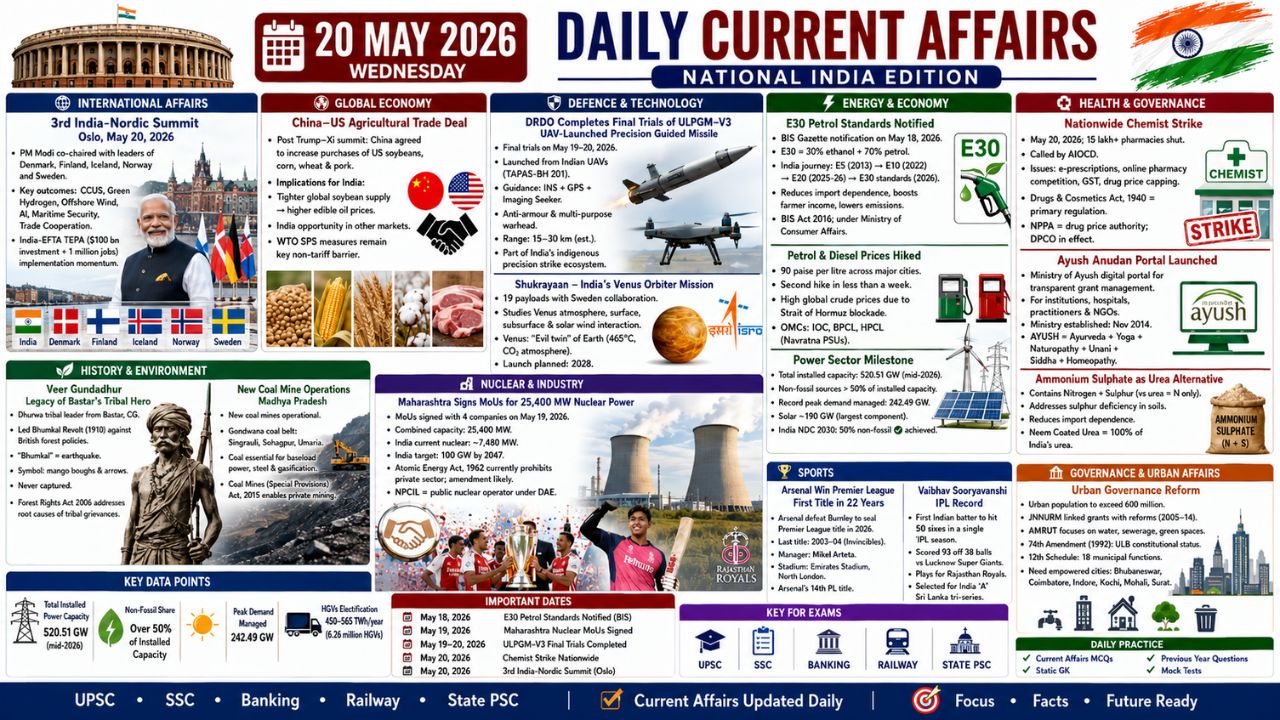
20 May 2026 Current Affairs is the last full daily edition before UPSC Prelims on May 24 — make every fact count. Today's biggest stories: PM Modi co-chaired the 3rd India-Nordic Summit in Oslo — bringing together India and all five Nordic nations for landmark cooperation on green technology, AI, and maritime security. DRDO completed final trials of ULPGM-V3 — India's unmanned aerial vehicle launched precision guided missile.
India notified E30 petrol standards — clearing the path for 30% ethanol blending in petrol. Over 15 lakh pharmacies went on a nationwide chemist strike. Petrol and diesel prices hiked by 90 paise per litre — second hike in a week. India's total installed power capacity hit 520.51 GW — non-fossil sources now over 50% of installed capacity. Shukrayaan (Venus Orbiter Mission) details confirmed — 19 payloads, Sweden collaboration. Maharashtra signed MoUs for 25,400 MW nuclear power. Arsenal won the Premier League after 22 years. And Vaibhav Sooryavanshi set an IPL record with 50 sixes in a single season. Let's get into every story.
International Affairs
3rd India-Nordic Summit — Oslo, May 20, 2026
Prime Minister of India co-chaired the 3rd India-Nordic Summit in Oslo, Norway, alongside the heads of government from Denmark, Norway, Finland, Iceland, and Sweden.
What is the India-Nordic Summit? The India-Nordic Summit brings together India and the five Nordic nations — Denmark, Finland, Iceland, Norway, and Sweden — for high-level discussion on trade, clean technology, digital governance, maritime security, and global governance reform.
Summit history:
Edition | Year | Host |
|---|---|---|
1st India-Nordic Summit | May 2018 | Stockholm, Sweden (PM Modi) |
2nd India-Nordic Summit | May 2022 | Copenhagen, Denmark |
3rd India-Nordic Summit | May 20, 2026 | Oslo, Norway |
Key outcomes of the 3rd India-Nordic Summit:
1. Green Technology Cooperation: The 3rd India-Nordic Summit strengthened cooperation in green technology, AI, maritime security, and trade, while supporting India's global strategic ambitions.
Carbon Capture, Utilisation and Storage (CCUS): Norway is a global CCUS pioneer — the Sleipner project (operational since 1996) was the world's first commercial-scale offshore carbon capture project. India's coal-dominated power sector needs CCUS to meet net-zero goals
Green Hydrogen: Denmark and Norway are global leaders — Denmark through its Power-to-X (converting renewable electricity to hydrogen) approach; Norway through offshore platform hydrogen production
Offshore Wind: Denmark developed the world's first offshore wind farm (Vindeby, 1991); Sweden and Finland have major offshore wind capacity — directly applicable to India's 30 GW offshore wind target
2. Artificial Intelligence: Nordic countries rank among the world's most advanced in responsible AI governance:
Finland's Elements of AI — a free online AI education course adopted globally — has been studied as a model for India's AI literacy campaign
Sweden's AI National Strategy and Denmark's Digital Strategy offer governance templates
Cooperation on AI-enabled maritime surveillance — tracking vessels in the Indian Ocean
3. Maritime Security:
Norway manages ~10% of world's merchant fleet
Denmark is home to Maersk — world's largest container shipping company
Sweden and Finland (both NATO members) bring strategic depth to Indo-Pacific maritime discussions
Joint focus on Arctic shipping routes — as climate change opens the Northern Sea Route (Arctic passage), India's connectivity interests are directly affected
4. Trade — India-EFTA TEPA linkage: Norway and Iceland are EFTA members — the India-EFTA TEPA (signed March 2024) commits $100 billion investment + 1 million jobs. The Nordic Summit provides political momentum for TEPA implementation.
Nordic countries — quick reference:
Country | Capital | PM/Leader | NATO? | EU? |
|---|---|---|---|---|
Denmark | Copenhagen | Mette Frederiksen | ✅ Yes | ✅ Yes |
Finland | Helsinki | Petteri Orpo | ✅ Yes (2023) | ✅ Yes |
Iceland | Reykjavik | Bjarni Benediktsson | ✅ Yes | ❌ No (EFTA) |
Norway | Oslo | Jonas Gahr Støre | ✅ Yes | ❌ No (EFTA/EEA) |
Sweden | Stockholm | Ulf Kristersson | ✅ Yes (2024) | ✅ Yes |
India's "Sambandh" approach: PM Modi's framing of India-Nordic relations under "Sambandh" (Sanskrit for connection) — announced at the 2nd Summit — was deepened at Oslo with concrete deliverables across technology, trade, and strategic cooperation.
3rd India-Nordic Summit = May 20, 2026, Oslo. India + Denmark + Finland + Iceland + Norway + Sweden. 1st = Stockholm 2018. 2nd = Copenhagen 2022. Key outcomes: CCUS + Green Hydrogen + Offshore Wind + AI + Maritime Security. Sleipner = world's first commercial offshore carbon capture (Norway, 1996). Denmark = Vindeby = world's first offshore wind farm (1991). India-EFTA TEPA = $100 billion + 1 million jobs. Finland's Elements of AI = global AI literacy model.
China-US Agricultural Trade Deal — Impact on India
A China-US agricultural trade deal was concluded — with implications for global commodity markets and India's agricultural export competitiveness.
Background: Following the Trump-Xi summit in Beijing (May 14), the US and China reached a partial agricultural trade deal — where China agreed to increase purchases of US soybeans, corn, wheat, and pork in exchange for some tariff relief on Chinese manufactured goods.
Implications for India:
Soybean: India is a significant soybean importer — a US-China deal that redirects US soybeans to China could tighten global soybean supply, raising edible oil prices in India (soybean oil = major imported edible oil)
Wheat: India is both a producer and occasional exporter — global wheat price movements directly affect India's export competitiveness and domestic food inflation
Cotton: US cotton diverted to China could reduce availability for India's textile sector
India's opportunity: If US-China deal creates space, India could increase its own agricultural exports to markets where US had previously been dominant
WTO SPS measures context: SPS Measures — Sanitary and Phytosanitary standards — are a key non-tariff barrier affecting India's agricultural trade. India's agricultural exports face stringent SPS measures in EU, US, and Japan markets.
China-US agri trade deal = post-Trump-Xi summit. China increases US soybean + corn + wheat + pork purchases. Impact on India: tighter global soybean supply = higher edible oil prices. India already imports 56%+ of edible oils. WTO SPS measures = key non-tariff barrier for India's farm exports.
Defence & Technology
DRDO Completes Final Trials of ULPGM-V3 — UAV-Launched Precision Guided Missile
The Defence Research and Development Organisation (DRDO) completed the final development trials of the Unmanned Aerial Vehicle Launched Precision Guided Missile (ULPGM)-V3 on 19 and 20 May 2026.
About ULPGM-V3: The Unmanned Aerial Vehicle Launched Precision Guided Missile (ULPGM) is an indigenously developed air-to-ground missile designed to be launched from armed drones (UAVs). The V3 designation indicates the third generation of this system — with significantly improved capabilities over previous versions.
Key specifications and capabilities:
Platform: Launched from Indian UAVs — including the TAPAS-BH 201 (Indian MALE drone) and future Archer-NG armed drones
Guidance: Combined INS (Inertial Navigation System) + GPS + terminal imaging seeker — enabling precision strike even on moving targets
Warhead: Anti-armour and multi-purpose — capable of defeating main battle tanks and hardened targets
Range: Extended compared to ULPGM-V1/V2 — classified but estimated at 15–30 km
Standoff capability: Can be fired from beyond enemy air defence range
Why ULPGM-V3 matters strategically: The February 2019 Balakot airstrike and the May 2025 Operation Sindoor demonstrated India's willingness to strike beyond its borders with precision munitions. ULPGM-V3 adds a drone-launched precision strike capability — enabling:
Persistent surveillance + immediate strike (loiter-to-strike concept)
Reduced pilot risk — no Indian aircrew exposed to enemy air defences
Cost-effective strikes — drones are far cheaper than manned aircraft
Swarm tactics — multiple drones simultaneously launching missiles on dispersed targets
DRDO's precision munitions ecosystem: India is building a complete indigenous precision munitions portfolio:
ULPGM-V3: UAV-launched (May 2026 — trials complete)
TARA: Glide weapon kit for unguided bombs (May 2026 — tested)
Rudram series: Anti-radiation missiles (targeting enemy radars)
SAAW (Smart Anti-Airfield Weapon): Glide bomb for airfield destruction
BrahMos-NG: Next-generation cruise missile (lighter, faster)
ULPGM-V3 = UAV Launched Precision Guided Missile, Version 3. DRDO completed final trials May 19-20, 2026. Launched from Indian armed drones (TAPAS-BH 201). Guidance = INS + GPS + imaging seeker. Anti-armour + multi-purpose warhead. Complements TARA (glide weapon) and Rudram (anti-radiation) in India's indigenous precision strike ecosystem. Atmanirbhar Bharat in defence.
Shukrayaan — India's Venus Orbiter Mission Details Confirmed
India's Venus orbiter mission, also called Shukrayaan, is a planned interplanetary mission to Venus with international collaboration from Sweden. The mission will carry 19 payloads and will study the Venusian atmosphere, surface, and subsurface.
Shukrayaan — complete exam profile:
Parameter | Detail |
|---|---|
Mission name | Shukrayaan-1 |
Target | Venus (Shukra = Venus in Sanskrit) |
Type | Venus Orbiter |
Payloads | 19 (Indian + international) |
International partner | Sweden (SwRI instruments) |
Proposed launch | 2028 (pending final approval) |
Agency | ISRO |
Orbit | Elliptical orbit around Venus |
What will Shukrayaan study?
Venusian atmosphere: Venus has a dense CO₂ atmosphere with sulphuric acid clouds — studying it helps understand runaway greenhouse effect
Surface mapping: Using Synthetic Aperture Radar (SAR) to penetrate Venus's thick cloud cover and map the surface
Subsurface: Probing below the surface to understand geological activity
Solar wind interaction: How Venus (which lacks a global magnetic field) interacts with the solar wind
Why Venus is important scientifically: Venus is often called Earth's "evil twin" — similar size, mass, and composition, but with a runaway greenhouse effect that made it uninhabitable (surface temperature ~465°C, atmospheric pressure 90x Earth's). Understanding why Venus became so different from Earth helps scientists model climate change on Earth.
India's planetary exploration history:
Mission | Target | Year | Status |
|---|---|---|---|
Chandrayaan-1 | Moon | 2008 | Successfully discovered water on Moon |
Mangalyaan (MOM) | Mars | 2013 | First Asian mission to Mars; succeeded first attempt |
Chandrayaan-2 | Moon | 2019 | Orbiter success; lander partial |
Chandrayaan-3 | Moon | 2023 | First soft landing near south pole |
Aditya-L1 | Sun (L1 point) | 2023 | India's first solar observatory mission |
Shukrayaan-1 | Venus | 2028 (planned) | Planning stage |
Shukrayaan-1 = India's Venus Orbiter. 19 payloads. Sweden collaboration. Studies atmosphere + surface + subsurface + solar wind interaction. Venus = "evil twin" of Earth (runaway greenhouse). ISRO launch planned 2028. Previous ISRO firsts: Mangalyaan = first Asian Mars mission; Chandrayaan-3 = first soft landing near Moon's south pole; Aditya-L1 = India's first solar observatory.
Energy & Economy
E30 Petrol Standards Notified — Path to 30% Ethanol Blending Cleared
India has notified new petrol standards for ethanol blends up to E30, with the Bureau of Indian Standards issuing a Gazette notification on 18 May 2026.
What is E30? E30 refers to petrol blended with 30% ethanol — up from the current E20 standard (20% ethanol). The Bureau of Indian Standards (BIS) notification means:
Fuel dispensing stations can now supply E30
Vehicle manufacturers are on notice to produce E30-compatible engines
Oil marketing companies (IOC, BPCL, HPCL) can blend and sell E30
India's ethanol blending journey:
Year | Target | Status |
|---|---|---|
2013-14 | 5% blending (E5) | Partially achieved |
2022 | 10% blending (E10) | ✅ Achieved |
2025-26 | 20% blending (E20) | Substantially achieved |
2026+ | E30 standard notified | Standards in place |
2030 | E20 nationwide + selective E30 | Target |
Why E30 matters:
Energy security: Every 1% increase in ethanol blending reduces petrol import dependence by approximately 60 crore litres of petrol annually
Farmer income: India's ethanol primarily comes from sugarcane molasses and surplus food grains — higher blending = higher demand = better farm incomes
Emissions: Ethanol burns cleaner than petrol — E30 reduces particulate matter, CO, and hydrocarbon emissions
Import savings: At current crude prices, E20 saves India approximately ₹30,000 crore in annual foreign exchange — E30 would save significantly more
Engine compatibility challenge: Higher ethanol blends require "flex-fuel" compatible engines — which can run on any ethanol-petrol blend from E0 to E100. India's automakers (Maruti, Hyundai, Tata, Toyota) are transitioning to flex-fuel platforms. The Toyota Corolla Altis Flex and Maruti Suzuki CNG Flex variants are among the first flex-fuel vehicles in India.
BIS — about: The Bureau of Indian Standards operates under the Bureau of Indian Standards Act, 2016 — under the Ministry of Consumer Affairs. BIS sets technical standards for products, services, and processes in India.
E30 petrol standards notified = BIS Gazette notification, May 18, 2026. E30 = 30% ethanol + 70% petrol. India's ethanol blending: E5 (2013) → E10 (2022) → E20 (2025-26) → E30 standards (2026). E20 saves ~₹30,000 crore/year in forex. Sugarcane molasses + surplus foodgrains = primary ethanol sources. BIS = Bureau of Indian Standards, under Ministry of Consumer Affairs, BIS Act 2016. Flex-fuel engines needed for E30.
Petrol and Diesel Prices Hiked — 90 Paise Per Litre, Second Hike in a Week
Petrol and diesel prices have been hiked by 90 paise per litre across major cities, marking the second increase in less than a week.
Context — why back-to-back hikes? The Strait of Hormuz blockade has pushed global crude prices significantly higher. With LPG now deregulated (May 17 current affairs) and petroleum export duties revised (May 15-16), the government has also allowed Oil Marketing Companies (OMCs) to pass on higher import costs to consumers through retail price hikes.
India's fuel pricing mechanism:
Petrol and diesel are deregulated (petrol since 2010, diesel since 2014) — OMCs theoretically revise prices daily based on a 15-day rolling average of international crude prices
In practice, OMCs defer hikes during politically sensitive periods and then implement catch-up hikes
The West Asian crisis has created an extraordinary situation requiring rapid price adjustments
Impact on inflation: Fuel price hikes have a cascading inflationary effect:
Direct: Transport costs rise
Indirect: Food prices rise (agricultural inputs, distribution)
Core inflation: Manufacturing costs rise (fuel-intensive industries)
This is cost-push inflation — driven by supply-side factors (global crude prices) rather than excess demand
OMCs — India's three major:
IOC (Indian Oil Corporation): India's largest OMC — refining + pipelines + retail
BPCL (Bharat Petroleum Corporation Limited)
HPCL (Hindustan Petroleum Corporation Limited)
All three are Navratna PSUs under the Ministry of Petroleum and Natural Gas
Petrol + diesel hike = 90 paise/litre (May 20, 2026). Second hike in less than a week. Petrol deregulated 2010; diesel 2014. OMCs = IOC + BPCL + HPCL = Navratna PSUs under Ministry of Petroleum. Strait of Hormuz blockade = driving global crude prices. Cost-push inflation = supply-driven. 15-day rolling average = mechanism for OMC price revision.
India's Power Sector Milestone — 520.51 GW Installed Capacity, Non-Fossil > 50%
As of mid-2026, India's total installed power generation capacity stands at 520.51 GW, successfully managing a record peak power demand of 242.49 GW with non-fossil sources making up over 50% of installed capacity.
This is a landmark milestone — India's non-fossil power (solar, wind, hydro, nuclear, biomass) has crossed 50% of total installed capacity for the first time — a major step toward India's 2030 NDC target of 50% non-fossil electricity capacity.
India's installed capacity breakdown (approximate, mid-2026):
Source | Capacity (GW) | % of total |
|---|---|---|
Solar | ~190 GW | ~36.5% |
Wind | ~55 GW | ~10.6% |
Large Hydro | ~47 GW | ~9% |
Nuclear | ~8 GW | ~1.5% |
Biomass/Small Hydro | ~12 GW | ~2.3% |
Total Non-Fossil | ~312 GW | ~60% |
Coal + Gas + Diesel | ~208 GW | ~40% |
Total Installed | 520.51 GW | 100% |
EV Grid Strategy — the next challenge:
While India's 6.26 million Heavy Goods Vehicles (HGVs) represent barely 2% of the registered national fleet, electrifying them alone would consume 450 TWh to 565 TWh annually due to high energy intensities. Current Power Baseline: As of mid-2026, India's total installed power generation capacity stands at 520.51 GW, successfully managing a record peak power demand of 242.49 GW.
The EV electricity demand challenge: India has approximately 340 million registered vehicles — electrifying even a fraction requires massive grid expansion:
E-trucks (HGVs alone): 450–565 TWh annually (more than India's current total electricity generation from coal in a year)
Golden Quadrilateral electrification: Electrifying India's major highway arteries requires megawatt-level high-tension connections at regular intervals
Charging infrastructure: India needs 10 lakh+ public EV charging stations by 2030 (currently far below this)
India's NDC targets (updated 2022):
50% non-fossil electricity capacity by 2030 ✅ (already achieved in installed capacity terms by mid-2026)
500 GW non-fossil capacity by 2030 (still being worked toward)
Reduce emissions intensity by 45% from 2005 levels by 2030
India total installed power = 520.51 GW (mid-2026). Non-fossil = over 50% of installed capacity. Peak demand managed = 242.49 GW. Solar = ~190 GW (largest component). India NDC = 50% non-fossil capacity by 2030 ✅ achieved. 500 GW non-fossil by 2030 = still in progress. HGVs (6.26 million) electrification = 450-565 TWh annually = massive grid challenge. Golden Quadrilateral = major highway network for EV corridor.
Maharashtra — 25,400 MW Nuclear Power MoUs Signed
Maharashtra signed Memorandums of Understanding with four companies on 19 May 2026 for nuclear energy generation projects with a combined capacity of 25,400 MW.
This is one of India's most ambitious nuclear energy announcements — a combined capacity of 25,400 MW would more than triple India's current nuclear power installed capacity (~8 GW).
India's nuclear power landscape:
Current installed capacity: approximately 7,480 MW (as of early 2026) across 24 reactors
Target: 100 GW nuclear by 2047 (announced by PM Modi — covered in April 2026 current affairs)
Atomic Energy Act, 1962: Governs nuclear energy in India — only government entities can operate nuclear plants (private sector excluded until a proposed amendment)
Department of Atomic Energy (DAE): Oversees India's nuclear programme
Nuclear Power Corporation of India Limited (NPCIL): Builds and operates nuclear power plants
The Private Sector Nuclear Amendment: Maharashtra's MoUs with private companies for nuclear power generation signals a potential amendment to the Atomic Energy Act to allow private sector participation — a historic policy shift that would unlock private capital for India's nuclear ambitions. The Atomic Energy Act currently prohibits private ownership of nuclear facilities.
Companies signed MoUs with: The four companies likely include Indian conglomerates (Tata, Adani, Reliance) and potentially foreign nuclear technology providers (Westinghouse, EDF, Rosatom) — though specific names were not confirmed in available sources.
India's three-stage nuclear programme (recap):
Stage 1: PHWRs (natural uranium) — operational
Stage 2: Fast Breeder Reactors (plutonium from Stage 1) — Prototype FBR at Kalpakkam under commissioning
Stage 3: Thorium-based reactors — future; India has world's largest thorium reserves
Maharashtra nuclear MoUs = 25,400 MW combined capacity with 4 companies (May 19, 2026). India current nuclear = ~7,480 MW. India nuclear target = 100 GW by 2047. Atomic Energy Act 1962 = currently prohibits private nuclear. NPCIL = public nuclear plant operator. DAE = Department of Atomic Energy. Three-stage programme: PHWR → FBR (Kalpakkam) → Thorium. Proposed amendment = allow private sector.
Health & Governance
Nationwide Chemist Strike — 15 Lakh Pharmacies Shut
A nationwide chemist strike is planned with over 15 lakh pharmacies expected to remain shut on 20 May to protest regulatory and policy issues, relevant for health policy, pharmaceutical regulation and service delivery topics.
Why are chemists striking? The strike — called by the All India Organisation of Chemists and Druggists (AIOCD) — protested:
Mandatory digital prescriptions: The government's push to implement e-prescriptions nationwide threatens traditional prescription-based business models
Online pharmacy regulation: Unregulated online pharmacies (1mg, PharmEasy, Netmeds) competing unfairly with brick-and-mortar chemists
GST on medicines: Chemists' demand for reduced GST on essential medicines
Drug price capping: NPPA (National Pharmaceutical Pricing Authority) price controls on essential medicines reducing margins
India's pharmacy regulation:
Drugs and Cosmetics Act, 1940: Primary legislation governing drugs, cosmetics, and medical devices
Pharmacy Act, 1948: Governs the pharmacy profession and registration
NPPA (National Pharmaceutical Pricing Authority): Under Ministry of Chemicals — controls prices of essential medicines under the DPCO (Drug Price Control Order)
National Medical Devices Policy, 2023: Governs medical devices regulation
The online pharmacy challenge: India's online pharmacy market has grown rapidly — estimated at ₹50,000 crore by 2026. Traditional chemists argue online platforms:
Dispense prescription drugs without valid prescriptions
Undercut prices through VC-funded subsidies
Lack proper storage conditions for temperature-sensitive medicines
Nationwide chemist strike = May 20, 2026. 15 lakh+ pharmacies shut. AIOCD = All India Organisation of Chemists and Druggists. Issues: e-prescriptions, online pharmacy competition, GST, drug price capping. Drugs and Cosmetics Act 1940 = primary drug regulation. Pharmacy Act 1948 = profession governance. NPPA = drug price authority. DPCO = Drug Price Control Order.
Ayush Anudan Portal — Transparent Grant Management
The launch of the Ayush Anudan Portal for transparent grant management was highlighted on May 20.
About the Ayush Anudan Portal: The Ayush Anudan Portal is a digital platform launched by the Ministry of Ayush to streamline and ensure transparency in grant disbursement to:
Ayush educational institutions
Research institutions and hospitals
Practitioners and practitioners' organisations
NGOs working in traditional medicine promotion
Why transparency is needed: Grant management in the Ayush sector has historically suffered from:
Manual application processes prone to delays
Lack of real-time tracking of grant utilisation
Opacity in selection criteria
Duplication of grants across overlapping institutions
The portal creates an end-to-end digital workflow — from application to release to utilisation certificate submission — with real-time dashboards for monitoring.
Ministry of Ayush — overview:
Established as a separate ministry in November 2014 (elevated from AYUSH Department under MoHFW)
Governs: Ayurveda, Yoga and Naturopathy, Unani, Siddha, and Homeopathy
Flagship schemes: National AYUSH Mission (NAM), AYUSH Wellness Centres (under PM-ABHIM), Meditation and Yoga through AYUSH (MYA) initiative
AYUSH exports — India's traditional medicine products exported globally — have grown significantly post-COVID-19
Ayush Anudan Portal = Ministry of Ayush digital grant management platform. Ministry of Ayush = established November 2014. AYUSH = Ayurveda + Yoga + Naturopathy + Unani + Siddha + Homeopathy. National AYUSH Mission = flagship scheme. Portal = end-to-end digital workflow for transparent grant disbursement.
Ammonium Sulphate as Urea Alternative — Soil Health and Import Reduction
Ammonium sulphate as a urea alternative was highlighted in policy discussions — relevant to reducing India's 50%+ fertiliser import dependency.
Why ammonium sulphate vs urea? Urea is India's most widely used nitrogenous fertiliser — but has several problems:
India imports approximately 50%+ of its urea requirement (covered in May 19 current affairs)
Urea is excessively subsidised — farmers overuse it, causing soil acidification and nitrogen toxicity
Urea has only nitrogen (N) — provides no sulphur, which Indian soils are increasingly deficient in
Ammonium Sulphate advantages:
Contains nitrogen (N) + sulphur (S) — addressing India's growing sulphur deficiency
Lower nitrogen content per kg — encourages more balanced application
Can be produced domestically as a byproduct of caprolactam and coke oven gas production — reducing import dependence
Sulphur improves oil content in oilseeds (sunflower, soybean, mustard) — directly relevant to India's edible oil self-sufficiency push
India's fertiliser policy:
Neem Coated Urea (NCU): 100% of urea sold in India is neem-coated — slows nitrogen release, reduces theft for industrial use, improves soil health
New Urea Policy 2015: Energy efficiency norms for domestic urea plants
PMFBY (Pradhan Mantri Fasal Bima Yojana): Crop insurance linked to soil health recommendations
Soil Health Card Scheme: Provides farmers with soil nutrient status — guides balanced fertiliser use
Ammonium sulphate = alternative to urea. Contains N + S (vs urea = only N). India's sulphur deficiency in soils growing. Urea import share may exceed 50% (FY26). Neem Coated Urea = 100% of India's urea; slows nitrogen release. Ammonium sulphate byproduct of caprolactam + coke oven gas. Soil Health Card Scheme = guides balanced fertiliser use.
Environment & History
Veer Gundadhur — Legacy of Bastar's Tribal Hero
Tribal leader Veer Gundadhur's legacy was highlighted — particularly relevant given Amit Shah's declaration of India as "Naxal-free" from Bastar (Jagdalpur) on May 18.
About Veer Gundadhur:
A legendary tribal leader from the Dhurwa tribe of Bastar, Chhattisgarh
Led the Bhumkal Revolt (1910) — also called the Bastar Rebellion — one of the most significant tribal uprisings against British colonial rule
"Bhumkal" means earthquake in the local dialect — used to describe the intensity of the revolt
The revolt was triggered by the British-imposed forest reservation policies under the Indian Forest Act, 1878 — which denied tribals their traditional access to forests for cultivation, grazing, and firewood
Gundadhur organised thousands of tribal warriors from across Bastar under the symbol of mango boughs and arrows — a traditional call to arms
The British suppressed the revolt, and Gundadhur was never captured — his fate remains unknown, making him a legendary figure
Significance today: Gundadhur represents the legitimate tribal grievances that the Naxal movement later exploited. India's success in becoming Naxal-free is linked to addressing these root causes through FRA 2006, PMJDY, and PMGSY
Forest Rights Act 2006 — the resolution: The Forest Rights Act (FRA) 2006 — in some ways — represents belated justice for what Gundadhur fought for in 1910: recognising tribal communities' rights to forest land they have traditionally inhabited and cultivated.
Veer Gundadhur = Dhurwa tribe leader, Bastar, CG. Led Bhumkal Revolt (1910) against British forest reservation policies. "Bhumkal" = earthquake (local dialect). Symbol = mango boughs + arrows. Never captured. Relevant context for Naxal-free declaration. Forest Rights Act 2006 = addresses root causes of tribal discontent. Indian Forest Act 1878 = colonial law that triggered the revolt.
New Coal Mine Operations — Madhya Pradesh
New coal mine operations in Madhya Pradesh were flagged in current affairs — relating to India's energy security strategy and coal gasification mission.
Context: India's coal sector continues to expand production — even as renewable energy grows — because coal remains essential for:
Baseload power generation — solar and wind are intermittent; coal provides 24/7 power
Steel production — coking coal is essential for blast furnace steel-making
Coal gasification mission — requiring 100 MT of gasification capacity by 2030
Madhya Pradesh's coal sector: MP is part of India's Gondwana coal belt — one of the world's most significant coal-bearing geological formations spanning central India. Key coal fields in MP:
Singrauli (shared with UP) — one of India's largest coalfields
Sohagpur — in Shahdol district
Umaria — in central MP
Coal Mines (Special Provisions) Act, 2015: This Act allowed commercial coal mining by private companies in India — ending Coal India's near-monopoly on coal mining. The 14th round of commercial coal auctions (referenced in May 8-9 current affairs in context of coal gasification) is ongoing.
New coal mines in MP = Gondwana belt (Singrauli, Sohagpur, Umaria). Coal still needed for baseload power + steel + coal gasification. Coal Mines (Special Provisions) Act 2015 = allowed private commercial mining. CIL = Coal India Limited (near-monopoly broken). 14th round commercial coal auctions ongoing.
Sports
Arsenal Win Premier League — First Title in 22 Years
Arsenal have sealed their first Premier League title in 22 years after defeating Burnley.
Arsenal's Premier League triumph — context:
Fact | Detail |
|---|---|
Club | Arsenal FC |
Based in | North London (Islington) |
Stadium | Emirates Stadium (capacity ~60,704) |
Manager | Mikel Arteta (Spanish) |
Previous PL title | 2003-04 (the famous "Invincibles" season — 38 games unbeaten) |
2026 title | First since 2003-04 — 22-year wait |
Defeated | Burnley (final confirmation match) |
About the Premier League:
English Premier League (EPL) — formed in 1992 when top-tier clubs broke away from the Football League
20 clubs compete in a 38-game season (home and away against each other)
Most successful clubs: Manchester United (20 titles), Liverpool (20), Arsenal (14 including 2026)
Premier League is broadcast in 189 countries — world's most watched football league
India-Premier League connection:
Indian Super League (ISL) modelled partly on Premier League format
Several Indian football players have trained at PL academies
PL broadcasts are hugely popular in India — Star Sports/Disney+Hotstar hold Indian broadcast rights
Arsenal = Premier League title 2026 (first in 22 years). Last title = 2003-04 (Invincibles season). Stadium = Emirates. Manager = Mikel Arteta. Defeated Burnley. PL founded 1992. 20 clubs, 38 games. Manchester United = most PL titles (20, joint with Liverpool). Arsenal's 14th PL title.
Vaibhav Sooryavanshi — IPL Record: First Indian to Hit 50 Sixes in a Single Season
Vaibhav Sooryavanshi created IPL history by becoming the first Indian batter to hit 50 sixes in a single season, scoring 93 off 38 balls for Rajasthan Royals against Lucknow Super Giants.
About Vaibhav Sooryavanshi:
Indian batting prodigy — one of cricket's most exciting young talents
Plays for Rajasthan Royals in IPL 2026
Known for extraordinary hitting ability — his 93 off 38 balls against Lucknow Super Giants featured 50 sixes in a single IPL season — a first for an Indian batter
Also selected for India 'A' Sri Lanka tri-series (covered May 15 current affairs)
Rajasthan Royals — quick facts:
IPL franchise based in Jaipur, Rajasthan
IPL champions: 2008 (inaugural season — under Shane Warne)
Home ground: Sawai Mansingh Stadium, Jaipur
One of the original 8 IPL franchises
IPL — key facts:
Founded: 2008 by BCCI under initiative of Lalit Modi (first IPL Commissioner)
Format: T20 franchise cricket
Teams: Currently 10 teams
Most IPL titles: Mumbai Indians (5)
Broadcast: Star Sports/JioCinema (India)
Vaibhav Sooryavanshi = first Indian batter with 50 sixes in single IPL season. Scored 93 off 38 balls for Rajasthan Royals vs Lucknow Super Giants. Rajasthan Royals = IPL 2008 champions (Shane Warne era). IPL = founded 2008 by BCCI (Lalit Modi). Most IPL titles = Mumbai Indians (5). Sawai Mansingh Stadium = Rajasthan Royals home.
Governance & Urban Affairs
Urban Governance Reform — AMRUT, JNNURM, and City Empowerment
India's urban population is projected to exceed 600 million in the coming decades, increasing demand for housing, mobility, water supply, and waste management. Bhubaneswar, Coimbatore, Indore, Kochi, Mohali and Surat are emerging as alternative growth centres requiring empowered city governments.
Jawaharlal Nehru National Urban Renewal Mission linked central grants with urban reforms, including e-governance, property tax reform, and user charges. Atal Mission for Rejuvenation and Urban Transformation focuses on water supply, sewerage, and green spaces but remains largely top-down.
India's urban governance evolution:
Mission | Period | Focus |
|---|---|---|
JNNURM | 2005–2014 | Urban infrastructure + governance reforms |
AMRUT 1.0 | 2015–2021 | Water + sewerage + green spaces (500 cities) |
Smart Cities Mission | 2015–2024 | 100 smart cities technology integration |
AMRUT 2.0 | 2021–2026 | Water security for all urban households |
PM SVANidhi | 2020+ | Street vendor micro-credit |
The empowerment gap: India's 74th Constitutional Amendment (1992) gave constitutional status to Urban Local Bodies and mandated the 12th Schedule (18 functions). However, in practice:
Most ULBs have inadequate financial resources (own revenue = <25% of expenditure)
Staff shortages — many ULBs lack urban planners, engineers, and data analysts
State-level interference — functions nominally devolved to ULBs are often retained by state departments
Property tax reform stalled — India's ULB property tax collection is among the world's lowest as % of GDP
Emerging alternative growth centres: Cities like Indore, Surat, Coimbatore, Kochi are growing as secondary economic hubs — relieving pressure on mega-cities. Indore's Swachh Bharat Mission ranking (consistently ranked India's cleanest city) shows what empowered, committed city governance can achieve.
India urban population target = 600 million. 74th Amendment (1992) = constitutional status for ULBs. 12th Schedule = 18 municipal functions. JNNURM = 2005-2014. AMRUT = 2015-2021; AMRUT 2.0 = 2021-2026. Smart Cities Mission = 100 cities (2015-2024). ULBs suffer from: inadequate finances, staff shortages, state interference. Indore = Swachh Survekshan top performer.
FAQs — 20 May 2026 Current Affairs
Q. What were the key outcomes of the 3rd India-Nordic Summit in Oslo?
PM Modi co-chaired the 3rd India-Nordic Summit on May 20, 2026, in Oslo with leaders of Denmark, Finland, Iceland, Norway, and Sweden. Key outcomes: CCUS cooperation (Norway's Sleipner project — world's first commercial offshore carbon capture since 1996); green hydrogen and offshore wind; AI governance (Finland's Elements of AI model); maritime security; and India-EFTA TEPA ($100 billion investment commitment) implementation momentum. Previous summits: 1st in Stockholm (2018), 2nd in Copenhagen (2022).
Q. What is ULPGM-V3 and why is it strategically significant?
ULPGM-V3 (UAV Launched Precision Guided Missile Version 3) is an indigenous DRDO missile launched from Indian armed drones (like TAPAS-BH 201). Final development trials were completed May 19-20, 2026. It uses INS+GPS+imaging seeker guidance for precision strikes on armoured targets. It enables drone-launched precision strikes — reducing pilot risk, enabling persistent surveillance-to-strike capability, and forming part of India's indigenous precision munitions ecosystem alongside TARA (glide weapon) and Rudram (anti-radiation missiles).
Q. What is Shukrayaan-1 and what makes it significant?
Shukrayaan-1 is India's planned Venus Orbiter Mission — carrying 19 payloads with Sweden's collaboration, planned for 2028. It will study Venus's thick CO₂ atmosphere, surface (using SAR), subsurface, and solar wind interaction. Venus is Earth's "evil twin" (similar size but 465°C surface temperature due to runaway greenhouse). Following Mangalyaan (first Asian Mars mission), Chandrayaan-3 (first south pole lunar landing), and Aditya-L1 (solar observatory), Shukrayaan would make India one of few nations with multi-planetary exploration capability.
Q. What is the significance of India's power sector crossing 520.51 GW with non-fossil exceeding 50%?
India's total installed power generation capacity reached 520.51 GW by mid-2026, with non-fossil sources (solar ~190 GW, wind ~55 GW, hydro ~47 GW, nuclear ~8 GW) exceeding 50% of installed capacity — achieving India's 2030 NDC target of 50% non-fossil capacity early. India also managed a record peak demand of 242.49 GW. However, the 500 GW non-fossil target (2030) still needs work. EV grid demands are the next challenge — electrifying 6.26 million HGVs alone would require 450-565 TWh annually.
Q. What is the Maharashtra nuclear MoU and why is 25,400 MW significant?
Maharashtra signed MoUs with four companies for nuclear projects totalling 25,400 MW — which would more than triple India's current ~7,480 MW nuclear capacity. This may signal an amendment to the Atomic Energy Act 1962 (which currently prohibits private sector nuclear ownership) to allow private participation. India's nuclear target is 100 GW by 2047, and NPCIL alone cannot deliver this scale. The three-stage programme (PHWR→FBR→Thorium) remains the long-term framework.
Q. Why is the E30 petrol standard notification important?
BIS notified E30 petrol standards (30% ethanol blend) via Gazette notification on May 18, 2026. India's ethanol blending journey: E5 (2013) → E10 (2022) → E20 (substantially achieved 2025-26) → E30 standards now in place. E20 already saves ~₹30,000 crore in annual forex. E30 would reduce petrol import dependence further, benefit sugarcane farmers, and reduce vehicular emissions. Flex-fuel compatible engines are needed — Indian automakers are transitioning. BIS operates under the BIS Act 2016, Ministry of Consumer Affairs.
Q. Who was Veer Gundadhur and why is his legacy relevant to India's Naxal-free declaration?
Veer Gundadhur was a Dhurwa tribal leader from Bastar who led the Bhumkal Revolt (1910) — one of India's most significant tribal uprisings against British colonial rule. The revolt was triggered by forest reservation policies under the Indian Forest Act 1878 that denied tribals forest access. He was never captured — becoming a legendary figure. His legacy is relevant because the legitimate tribal grievances he fought for (forest rights, land rights) were exploited by Naxals in the 20th century. India's Naxal-free achievement is linked to addressing these root causes through FRA 2006, PMGSY, and PMJDY.
Q. What is the significance of Arsenal's 2026 Premier League title?
Arsenal won their first Premier League title in 22 years after defeating Burnley in 2026. Their previous title was in 2003-04 — the famous "Invincibles" season where they went 38 league games unbeaten under Arsène Wenger. Under current manager Mikel Arteta, Arsenal play at Emirates Stadium in North London. The Premier League was founded in 1992 with 20 clubs playing 38 games each. Arsenal's 14th PL title makes them joint-third most successful PL club.
Written by
Koti Deva
Digital Marketing Specialist
Koti is a Digital Marketing Specialist with over 10 years of experience and the co-founder of MCQ Orbit — a free exam prep platform built for Indian competitive exam aspirants.
With strong personal knowledge in Quantitative Aptitude, Logical Reasoning, and Mathematics, Koti has a deep understanding of what it takes to crack exams like SSC CGL, IBPS PO, SBI Clerk, UPSC Prelims, NEET, and JEE. Having followed these exams closely for years, he understands the exact topics, patterns, and shortcuts that matter most.
MCQ Orbit was born from a simple desire — to build a platform where every aspirant in India can practice quality MCQs, read reliable current affairs, and prepare confidently, without paying a rupee. Koti combines his digital expertise with his passion for competitive exams to create content that is accurate, practical, and genuinely useful for students.
His mission is straightforward: if the right guidance had been freely available earlier, more students would have cracked their dream exams. MCQ Orbit is his way of making that happen.
Comments
No comments yet.