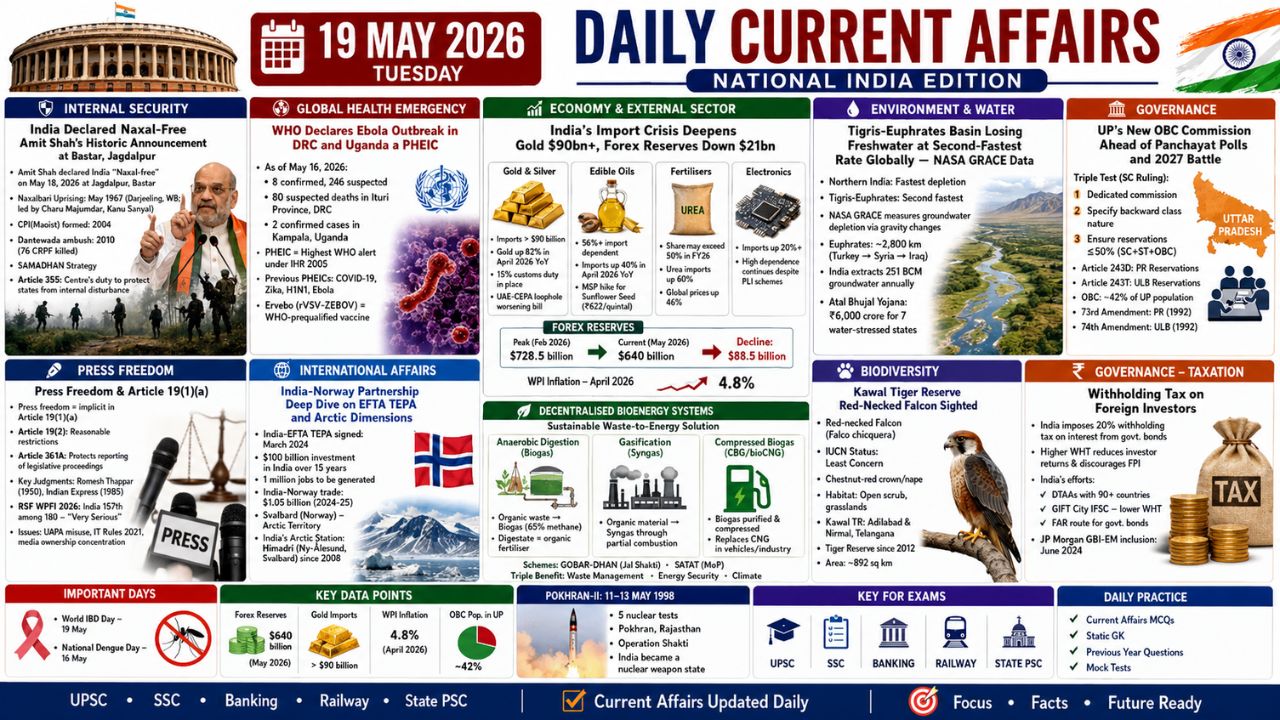
19 May 2026 Current Affairs is critical for every aspirant — with UPSC Prelims just 5 days away on May 24. Today's biggest stories: India declared Naxal-free by Home Minister Amit Shah — a historic milestone in the country's decades-long battle against Left-Wing Extremism. WHO declared the Ebola outbreak in DRC and Uganda a PHEIC — the highest global health emergency alert. India's gold and silver imports exceeded $90 billion amid record forex reserve depletion of $21 billion since February.
WPI inflation data for April 2026 confirmed at 4.8%. India-Norway Green Strategic Partnership details deepened — including CCUS, offshore wind, and green hydrogen. India's import dependence on edible oils, fertilisers, and electronics was comprehensively analysed. Press Freedom and Article 19(1)(a) came under focus. Tigris-Euphrates basin losing freshwater at second-fastest rate globally. And UP's new OBC Commission was formed ahead of Panchayat polls. Let's get into every story.
Internal Security
India Declared Naxal-Free — Amit Shah's Historic Announcement at Bastar, Jagdalpur
This is one of the most significant internal security milestones in India's post-independence history.
Union Home Minister Amit Shah, during his visit to Jagdalpur in Bastar on 18 May 2026, declared that India has become "Naxal-free", marking a major milestone in the country's decades-long campaign against Left-Wing Extremism (LWE).
What does "Naxal-free" mean? The declaration does not mean zero presence of LWE ideology — it means that organised armed Naxal groups no longer control any significant territorial area in India and have been operationally degraded to a point where they no longer pose a structured threat to the State. Specifically:
All Naxal-affected districts have been removed from the Ministry of Home Affairs' LWE-affected district list
The Red Corridor — which at its peak spanned parts of Chhattisgarh, Jharkhand, Odisha, Andhra Pradesh, Telangana, Maharashtra, and Bihar — has been effectively dismantled
Chhattisgarh's Bastar division — the last major Naxal stronghold — has been cleared through sustained security operations
The history of the Naxal movement in India:
The Naxalite movement traces its origins to the Naxalbari uprising of May 1967 — a peasant revolt in Naxalbari village, Darjeeling district, West Bengal — led by Charu Majumdar and Kanu Sanyal. The uprising was inspired by Maoist ideology — armed agrarian revolution to overthrow the state and redistribute land.
Key milestones:
Year | Event |
|---|---|
1967 | Naxalbari peasant uprising — movement's origin |
1969 | CPI(ML) formed — first organised Naxal party |
2004 | CPI(Maoist) formed — merger of PWG + MCCI |
2006 | PM Manmohan Singh called Naxalism "single biggest internal security challenge" |
2010 | Dantewada ambush — 76 CRPF personnel killed (deadliest Naxal attack) |
2026 | India declared Naxal-free |
Why Bastar matters: Bastar in Chhattisgarh was the epicentre of Naxal resistance — a dense forested region covering approximately 39,000 sq km, home to tribal communities whose legitimate grievances (land rights, forest rights, displacement) the Naxals exploited. The Abujhmarh forest within Bastar was considered an "inaccessible" Naxal zone for decades.
What broke the Naxal movement:
SAMADHAN strategy: India's comprehensive counter-LWE strategy — Smart leadership, Aggressive strategy, Motivation and training, Actionable intelligence, Dashboard-based KPIs, Harnessing technology, Action plan for each theatre, No access to financing
PMAY and tribal welfare: Addressing the root causes — land rights under FRA 2006, PMJDY bank accounts, road connectivity under PMGSY, and healthcare
PVTG outreach: Specifically targeting the most vulnerable tribal groups in LWE areas
Drone surveillance: Deployment of surveillance drones in dense forest areas
Surrender and rehabilitation policy: Generous surrender-rehabilitation packages for Naxal cadres
Constitutional dimension: India's counter-Naxal strategy invokes:
Article 355: Central government's duty to protect states against internal disturbance
Seventh Schedule, List I, Entry 2A: Deployment of armed forces in states
UAPA (Unlawful Activities Prevention Act): CPI(Maoist) designated as a terrorist organisation
India declared Naxal-free = May 18, 2026, Amit Shah at Jagdalpur, Bastar, Chhattisgarh. Naxalbari = 1967 origin (Darjeeling, WB). CPI(Maoist) formed 2004. PM Manmohan Singh called it "biggest internal security challenge" (2006). Dantewada ambush = 2010 (76 CRPF killed). SAMADHAN = counter-LWE strategy. Red Corridor = effectively dismantled. Article 355 = Centre's duty to protect states from internal disturbance. UAPA = CPI(Maoist) designated terrorist.
Global Health Emergency
WHO Declares Ebola Outbreak in DRC and Uganda a PHEIC
The World Health Organization declared the Ebola outbreak in the Democratic Republic of the Congo and Uganda a Public Health Emergency of International Concern (PHEIC), the highest alert under the International Health Regulations. As of 16 May 2026, WHO reported 8 laboratory-confirmed cases, 246 suspected cases, and 80 suspected deaths in Ituri Province, DRC, along with 2 confirmed cases in Kampala, Uganda, highlighting the risk of cross-border transmission.
What is a PHEIC? A Public Health Emergency of International Concern (PHEIC) is the highest level of global health alert that the WHO can declare — defined under the International Health Regulations (IHR), 2005. A PHEIC is declared when:
There is an extraordinary event that constitutes a public health risk to other states through international spread
Requires a coordinated international response
Decision made by the WHO Director-General based on advice from an Emergency Committee of independent experts
Previous PHEICs declared by WHO:
Year | Event |
|---|---|
2009 | H1N1 Influenza (Swine Flu) |
2014 | Polio |
2014–2016 | Ebola (West Africa) |
2016 | Zika Virus |
2018–2019 | Ebola (DRC) |
2020–2023 | COVID-19 |
2022 | Mpox (Monkeypox) |
2024 | Mpox (new clade) |
2026 | Ebola (DRC + Uganda) |
The cross-border dimension — DRC to Uganda: The 2 confirmed cases in Kampala, Uganda are particularly alarming — suggesting that Ebola has crossed an international border. Kampala is Uganda's capital city with a population of approximately 4 million — a densely populated urban environment where Ebola containment would be extraordinarily difficult if community transmission were to begin.
About Ituri Province, DRC: Ituri Province is located in northeastern DRC — bordering Uganda. It has experienced multiple Ebola outbreaks before (including a 2020 outbreak). The region has been affected by ongoing armed conflict — making health worker access and contact tracing extremely difficult.
WHO's response framework:
GOARN (Global Outbreak Alert and Response Network): Deploys rapid response teams
Strategic Advisory Group of Experts (SAGE): Advises on vaccine deployment — the Ervebo vaccine (rVSV-ZEBOV) is WHO-prequalified for Ebola
IHR (2005): Member states obligated to report PHEICs and implement recommended measures
India's preparedness: India has established Ebola preparedness protocols at major international airports and seaports — including:
Thermal screening for passengers from affected countries
Isolation facilities at designated hospitals
National Centre for Disease Control (NCDC) surveillance coordination
Training of healthcare workers in PPE use and case management
WHO declared Ebola PHEIC = May 2026. As of May 16: 8 lab-confirmed + 246 suspected + 80 suspected deaths in Ituri Province, DRC + 2 cases in Kampala, Uganda. PHEIC = highest WHO alert under IHR 2005. Previous PHEICs include COVID-19, Zika, H1N1. WHO DG declares PHEIC based on Emergency Committee advice. Ervebo = WHO-prequalified Ebola vaccine. GOARN = rapid response network. DRC = most Ebola outbreaks globally.
Economy & External Sector
India's Import Crisis Deepens — Gold $90bn+, Forex Reserves Down $21bn, Edible Oil 56%, Fertiliser 50%
This is the most comprehensive economic stress story of May 2026 — and directly relevant to every section of the competitive exam economy paper.
The four-pillar import vulnerability:
1. Gold and Silver: India's gold import dependence remains a major concern, with gold imports rising 82% in April 2026 compared to the previous year, despite the government increasing customs duty on gold and silver to 15% and urging citizens to defer non-essential purchases.
Gold and silver imports exceeded US$90 billion.
Gold imports up 82% in April 2026 YoY — despite 15% customs duty
Continued stock market volatility has pushed retail investors toward gold as a safe asset, both in physical form and through Gold ETFs. Higher duties on physical gold may further encourage investment through ETFs rather than significantly reducing overall demand.
The UAE-CEPA gold round-tripping loophole (discussed May 13) continues to worsen the import bill
2. Edible Oils: Imports satisfy over 56% of India's edible oil demand. Edible oil imports increased by more than 12% in 2025–26 and accelerated by 40% in April 2026.
India imports edible oils primarily from Indonesia (palm oil), Malaysia (palm oil), Ukraine and Russia (sunflower oil)
West Asian disruptions have spiked sunflower oil prices — accelerating India's import bill
The MSP hike for Sunflower Seed (₹622/quintal — highest among Kharif 2026–27 crops) is a direct policy response
3. Fertilisers: India imported between 31–37% of fertilizer needs over the past five years, but this share may exceed 50% in 2025–26 as urea imports rose by over 60%.
Rising fertilizer and fuel subsidies increase government expenditure, especially as global fertilizer prices rose by 46% and urea prices doubled between December 2025 and April 2026.
Urea imports surge driven by disruption to Russian and Belarusian potash and nitrogen exports
4. Electronics: Imports of electronic components grew by more than 20%, indicating continued dependence despite production-linked incentive schemes and Atmanirbhar Bharat initiatives.
The forex reserve crisis: Foreign exchange reserves declined by over US$21 billion since February 2026.
The Reserve Bank of India (RBI) has been selectively intervening in currency markets to prevent a sharp depreciation of the rupee. Declining Forex Reserves — However, RBI's ability to continue such interventions is constrained, as foreign exchange reserves have fallen by over $21 billion since the end of February 2026, making further reserve depletion a matter of concern.
Updated forex reserve picture:
Peak: $728.5 billion (February 2026)
Current: USD 640 billion (May 2026)
Decline: $88.5 billion from peak — a significant erosion
Policy responses being examined:
Higher duties on physical gold may further encourage investment through ETFs rather than significantly reducing overall demand.
India is expanding city gas distribution networks and promoting bioCNG and green hydrogen to reduce LPG dependence. Diversification of energy imports and strengthening of strategic reserves are underway to enhance resilience.
WPI Inflation — April 2026 data: The Wholesale Price Index (WPI) inflation rose to 4.8% in April 2026, partly due to global commodity volatility.
Note: This is the April 2026 WPI data officially released on May 19 — different from the 8.3% WPI mentioned in May 15 current affairs (which was May 2026 provisional data). The 4.8% April figure is the official monthly release.
Key import dependency ratios — exam-ready data table:
Import Category | Dependency | FY26 Change |
|---|---|---|
Crude Oil | ~85% of requirement | Rising (Hormuz blockade) |
Gold + Silver | ~90% of demand | +82% April YoY |
Edible Oil | 56%+ of demand | +40% April YoY |
Urea/Fertiliser | 50%+ (FY26 est.) | Urea +60% |
Electronics | Significant | +20% |
LPG | 55–60% | Volatile |
Gold + silver imports = $90 billion+. Gold up 82% April 2026 YoY. Edible oil = 56%+ dependency; +40% April 2026. Urea imports up 60%; fertiliser share may exceed 50%. Electronics imports up 20%. Forex reserves = $640 billion (May 2026) — down $88.5 billion from $728.5 billion February peak. RBI intervening to defend rupee. WPI April 2026 = 4.8%. UAE-CEPA gold loophole worsening gold imports. PLI schemes not yet sufficient to offset electronics import dependence.
Environment & Water
Tigris-Euphrates Basin Losing Freshwater at Second-Fastest Rate Globally — NASA GRACE Data
Data from NASA's GRACE satellites has confirmed that the Tigris-Euphrates river basin is losing freshwater reserves at the second-fastest rate in the world, trailing only northern India.
About the NASA GRACE satellites: GRACE (Gravity Recovery and Climate Experiment) — and its successor GRACE-FO (Follow-On) — are NASA satellites that measure tiny variations in Earth's gravitational field caused by changes in water mass distribution. By tracking these gravity changes over time, scientists can calculate how much groundwater is being depleted globally — providing the world's most comprehensive view of aquifer depletion.
The finding — two fastest-depleting regions:
Northern India — fastest depleting (Indo-Gangetic Plain aquifers)
Tigris-Euphrates basin — second fastest
Why the Tigris-Euphrates matters for India: Euphrates River, the longest in Western Asia, flows ~2,800 km through Turkey, Syria, and Iraq, running parallel to the Tigris River. The river originated in the mountains of eastern Turkey, at the confluence of the Karasu and Murat rivers.
The Tigris-Euphrates basin is the agricultural heartland of Iraq, Syria, and Turkey — losing its freshwater means agricultural collapse, food insecurity, and forced migration
The region is already under severe water stress from upstream dams (Turkey's GAP project), climate change, and overextraction
Food insecurity in the Tigris-Euphrates region will drive global food price inflation — affecting India's import bill
The finding that northern India tops the global groundwater depletion list is a stark warning for India's own water security
India's groundwater crisis: India extracts approximately 251 billion cubic metres of groundwater annually — the world's highest. The Indo-Gangetic Plain — India's agricultural heartland covering Punjab, Haryana, UP, Bihar — is experiencing the world's fastest groundwater depletion. Consequences:
Falling water table depths making pumping increasingly expensive
Arsenic and fluoride contamination as shallow aquifers are exhausted and deeper, naturally mineralised aquifers are tapped
Food security risk: Punjab and Haryana alone produce ~50% of India's wheat procurement
Policy responses:
Jal Shakti Abhiyan: Targeted water conservation campaign
Atal Bhujal Yojana (ABY): ₹6,000 crore groundwater conservation scheme for 7 water-stressed states
MGNREGA water conservation works: Check dams, percolation ponds, well recharging
NASA GRACE = measures groundwater depletion via gravity changes. Tigris-Euphrates = 2nd fastest depletion globally. Northern India = fastest groundwater depletion globally. Euphrates = longest West Asian river (~2,800 km); Turkey → Syria → Iraq. Tigris + Euphrates = ancient Mesopotamia (Iraq). India groundwater = 251 BCM/year extraction. Atal Bhujal Yojana = ₹6,000 crore for 7 water-stressed states.
Decentralised Bioenergy Systems — Sustainable Waste-to-Energy
Decentralized bioenergy systems as a sustainable solution for waste management, energy security, and reducing pollution through technologies like gasification and anaerobic digestion was highlighted on May 19.
What are decentralised bioenergy systems? Rather than large centralised power plants, decentralised bioenergy generates energy from organic waste at the local level — villages, districts, or municipal clusters:
Anaerobic Digestion (Biogas): Organic waste (agricultural residue, cattle dung, food waste, sewage) is broken down by microorganisms in the absence of oxygen — producing biogas (65% methane, 35% CO₂) used for cooking and electricity, and digestate (nutrient-rich fertiliser)
Gasification: Organic material is converted to syngas through partial combustion — as covered in the May 8 and May 13 coal gasification stories
Compressed Biogas (CBG/bioCNG): Biogas purified and compressed to natural gas standards — can replace CNG in vehicles and industry
Key government schemes:
GOBAR-DHAN (Galvanising Organic Bio-Agro Resources — DHAn): Under Ministry of Jal Shakti — converts cattle dung and agricultural waste into biogas and organic fertiliser. Target: 500 CBG plants by 2023 (now expanded)
Sustainable Alternative Towards Affordable Transportation (SATAT): Under Ministry of Petroleum — setting up 5,000 CBG plants to produce 15 million MT/year of CBG by 2023-24
Triple benefit of decentralised bioenergy:
Waste management: Reduces open burning of agricultural stubble (Punjab-Haryana stubble burning crisis)
Energy security: Reduces LPG and CNG import dependence
Climate: Reduces methane emissions from unmanaged organic waste
Decentralised bioenergy = local-scale energy from organic waste. Anaerobic digestion = biogas (65% methane). Gasification = syngas. GOBAR-DHAN = under Jal Shakti Ministry. SATAT = 5,000 CBG plants under Ministry of Petroleum. Triple benefit: waste management + energy security + climate. Stubble burning = Punjab-Haryana problem addressed by bioCNG.
Governance
UP's New OBC Commission — Ahead of Panchayat Polls and 2027 Battle
Why UP's new OBC commission is crucial for panchayat polls — and the 2027 battle was highlighted on May 19.
Background — the OBC reservation in Panchayati Raj: The Supreme Court's triple test for implementing OBC reservation in local body elections — established through a series of judgments — requires:
A dedicated commission to collect contemporaneous empirical data on OBC backwardness in local bodies
Specification of backward class nature and implications of reservation proposed
Ensure reservations do not exceed 50% aggregate (SC+ST+OBC combined)
Uttar Pradesh's challenge: UP has the largest OBC population of any Indian state — approximately 42% of the population is classified as OBC under state lists. With Panchayat elections due in 2026-27 and the 2027 UP Assembly elections on the horizon, the OBC commission's work is both constitutionally required and politically significant.
Why the commission matters for 2027: The Yogi Adityanath government's ability to deliver OBC representation in Panchayati Raj institutions will directly influence OBC voter sentiment — a key constituency in UP's complex caste arithmetic.
Constitutional framework:
Articles 243D and 243T: Reservation for SC, ST, and women in Panchayati Raj and Urban Local Bodies
OBC reservation in local bodies is not constitutionally mandated (unlike SC/ST) — it is a state government discretion subject to the triple test
The 74th and 73rd Constitutional Amendments (1992) provided the framework for local body elections but left OBC reservation to state governments
OBC commission in UP = triple test requirement (SC ruling). Triple test: dedicated commission + specify backward class nature + ensure reservations ≤50% (SC+ST+OBC). Article 243D = PR institution reservations. Article 243T = ULB reservations. OBC = ~42% of UP population. 73rd Amendment = Panchayati Raj. 74th Amendment = Urban Local Bodies. Both 1992.
Press Freedom & Article 19(1)(a)
India's Press Freedom — Ranked 157th, Article 19(1)(a) and Judicial Framework
Freedom of press is implicit under Article 19(1)(a), while Article 361A protects substantially true reports of legislative proceedings. Judicial Basis: Supreme Court rulings in Romesh Thappar v. State of Madras, 1950 and Indian Express Newspapers v. Union of India, 1985 linked press freedom to Article 19(1)(a). India's ranked 157th among 180 countries in WPFI 2026. It falls in the "very serious" category, but the government often dismisses such rankings as biased. Legal Misuse: India faces misuse of laws like the UAPA, colonial-era provisions, IT Rules, and the Telecommunications Act, fueling self-censorship. Media Ownership is concentrated within major networks controlled by a few politically aligned corporate groups, thereby diluting pluralism.
India's press freedom framework — complete exam profile:
Constitutional basis:
Article 19(1)(a): Freedom of speech and expression — press freedom is implicit (not explicitly mentioned)
Article 19(2): Reasonable restrictions on press freedom — grounds include sovereignty, security, public order, decency, contempt of court, defamation, incitement to offence
Article 361A: Protects publication of substantially true reports of proceedings of Parliament and State Legislatures
Key judicial precedents:
Case | Year | Ruling |
|---|---|---|
Romesh Thappar vs State of Madras | 1950 | Press freedom = essential part of Article 19(1)(a) |
Brij Bhushan vs State of Delhi | 1950 | Prior restraint on press is unconstitutional |
Indian Express Newspapers vs UoI | 1985 | Press has right to free circulation and distribution |
Shreya Singhal vs UoI | 2015 | Section 66A IT Act = unconstitutional (chilling effect on speech) |
RSF World Press Freedom Index 2026:
India = 157th among 180 countries
Category: "Very serious" situation
Issues flagged: UAPA misuse against journalists, IT Rules 2021, sedition-adjacent provisions in BNS, concentration of media ownership, attacks on regional journalists
Laws affecting press freedom in India:
UAPA (Unlawful Activities Prevention Act): Used against journalists covering conflict zones
IT Rules, 2021: Government's Grievance Appellate Committee can order content removal
Telecommunications Act, 2023: Broad government powers over telecom networks
Official Secrets Act, 1923: Colonial-era law restricting disclosure of government information
Press freedom = implicit in Article 19(1)(a) (not explicit). Article 19(2) = reasonable restrictions. Article 361A = legislative proceedings reporting protection. Romesh Thappar (1950) + Indian Express (1985) = key judicial precedents. RSF WPFI 2026 = India 157th among 180. "Very serious" category. UAPA + IT Rules + Telecom Act = laws affecting press freedom. Shreya Singhal (2015) = Section 66A IT Act struck down.
International Affairs
India-Norway Partnership — Deep Dive on EFTA TEPA and Arctic Dimensions
EFTA TEPA Implementation: Strengthens the India-EFTA trade deal targeting $100 billion investment and one million jobs over 15 years.
Norway exercises absolute sovereignty over remote, ecologically critical territories, including the glaciated Svalbard Archipelago and Jan Mayen Island in the Arctic Ocean.
India-Norway economic relations have expanded significantly in recent years. Bilateral Trade: Bilateral trade between India and Norway was US $1.05 billion in 2024-25.
India-EFTA Trade and Economic Partnership Agreement (TEPA): The India-EFTA TEPA — signed in March 2024 — is India's FTA with the four EFTA countries: Switzerland, Norway, Iceland, and Liechtenstein. Key provisions:
$100 billion investment commitment from EFTA countries in India over 15 years
1 million jobs to be generated through this investment
Preferential tariff treatment on manufactured goods, services, and investment
Includes binding investment commitments — a first for India in an FTA
Why the EFTA TEPA is unique: Most FTAs focus on tariff reductions — the India-EFTA TEPA goes further by binding investment targets. If EFTA countries fail to deliver the $100 billion investment, punitive measures apply — making it a results-oriented trade agreement.
Norway's Arctic territories — key geography:
Territory | Location | Significance |
|---|---|---|
Svalbard Archipelago | High Arctic (~78°N) | Coal, tourism, research stations |
Jan Mayen Island | North Atlantic | Volcanic island; meteorological station |
Bouvet Island | South Atlantic | World's most remote island |
Peter I Island | Antarctic | Norwegian claim |
Svalbard Treaty (1920): The Svalbard Treaty (Spitsbergen Treaty) of 1920 governs Svalbard — all signatory nations (including Russia, India) have the right to conduct commercial activities there, though Norwegian sovereignty is recognised. India has an Arctic research station — Himadri — located at Ny-Ålesund, Svalbard since 2008.
India-EFTA TEPA = signed March 2024. EFTA = Switzerland + Norway + Iceland + Liechtenstein. $100 billion investment + 1 million jobs over 15 years. Binding investment targets = unique. India-Norway bilateral trade = $1.05 billion (2024-25). Svalbard = Norwegian Arctic territory. Svalbard Treaty 1920 = multi-nation access. India's Arctic station = Himadri (Ny-Ålesund, Svalbard) since 2008. Jan Mayen = North Atlantic volcanic island.
Kawal Tiger Reserve — Red-Necked Falcon Sighted
The rare Red-necked Falcon was recently sighted in Kawal Tiger Reserve.
About the Red-necked Falcon (Falco chicquera):
A medium-sized falcon — one of India's most striking raptors, known for its chestnut-red crown and nape (giving it the "red-necked" name)
IUCN Status: Least Concern globally, but increasingly rare in many parts of India
Habitat: Open scrub, grasslands, and dry deciduous forests — often nesting in palm trees
Preys primarily on small birds and bats — caught in fast aerial pursuits
Sighting in Kawal signals the reserve's improving grassland ecosystem health
About Kawal Tiger Reserve:
Located in Adilabad and Nirmal districts, Telangana
Declared a Tiger Reserve in 2012
Area: approximately 892 sq km (core + buffer)
Located in the Sahyadri-Deccan transition zone — dry deciduous forests
Part of the Central Indian Tiger Landscape — connected to Tadoba (Maharashtra) and Pench (MP/Maharashtra) through wildlife corridors
Rivers: Kawal and Peddavagu drain the reserve
Red-necked Falcon = Falco chicquera. IUCN = Least Concern. Chestnut-red crown/nape. Sighted in Kawal Tiger Reserve. Kawal TR = Adilabad + Nirmal, Telangana. Tiger Reserve since 2012. ~892 sq km. Part of Central Indian Tiger Landscape corridor.
Governance — Withholding Tax on Foreign Investors
In India, foreign investors pay up to 20% withholding tax on income such as interest earned from govt. bonds. Impact: Higher withholding tax reduces investor returns and may discourage foreign investment inflows.
What is Withholding Tax? Withholding Tax (WHT) — also called Tax Deducted at Source (TDS) for cross-border payments — is a tax deducted at the source of income before payment reaches the recipient. For foreign investors earning interest from Indian government bonds:
India deducts 20% WHT from interest payments
The foreign investor receives net interest after this deduction
This reduces effective yield — making Indian bonds less attractive compared to bonds from countries with lower WHT rates
India's WHT reduction push: India has been progressively reducing WHT through:
Double Taxation Avoidance Agreements (DTAAs): Bilateral treaties reducing WHT rates — India has DTAAs with 90+ countries
GIFT City (IFSC) concessions: Foreign investors investing through GIFT City's International Financial Services Centre enjoy reduced WHT rates — a key incentive for channelling foreign capital
FAR (Fully Accessible Route): Foreign investors can invest in certain Indian government bonds without WHT restrictions
India's bond market inclusion: India was included in JP Morgan's Government Bond Index-Emerging Markets (GBI-EM) from June 2024 and is being added to Bloomberg's EM indices — attracting billions in passive foreign investment. Reducing WHT is critical for making Indian bonds competitive in these global indices.
Withholding tax = tax deducted at source of income (= TDS for cross-border). India WHT on foreign investor interest = 20%. Higher WHT = reduces foreign investment attractiveness. DTAA = reduces WHT (India has 90+ DTAAs). GIFT City IFSC = lower WHT rates. JP Morgan GBI-EM inclusion = June 2024. India's bond market attractiveness = WHT reduction key.
FAQs — 19 May 2026 Current Affairs
Q. What is the significance of India being declared Naxal-free?
Home Minister Amit Shah declared India "Naxal-free" at Jagdalpur, Bastar, Chhattisgarh on May 18, 2026 — meaning organised armed Naxal groups no longer control any significant territorial area. The movement began with the Naxalbari uprising of 1967 (Darjeeling, WB; led by Charu Majumdar and Kanu Sanyal). CPI(Maoist) was formed in 2004. The 2010 Dantewada ambush (76 CRPF killed) was the deadliest attack. India's SAMADHAN strategy — combining security operations, tribal welfare (FRA 2006, PMJDY, PMGSY), and surrender-rehabilitation — achieved this milestone. Article 355 provides the constitutional basis for Centre's internal security role.
Q. What is a PHEIC and why did WHO declare one for Ebola?
PHEIC (Public Health Emergency of International Concern) is the highest alert under the International Health Regulations (IHR) 2005 — declared by the WHO Director-General. WHO declared one for Ebola in May 2026 after 8 confirmed cases, 246 suspected cases, 80 suspected deaths in DRC's Ituri Province, and 2 confirmed cases in Kampala, Uganda — indicating dangerous cross-border spread. Ervebo (rVSV-ZEBOV) is the WHO-prequalified vaccine. Previous PHEICs include COVID-19, Zika, H1N1, and multiple Ebola outbreaks.
Q. How serious is India's import dependency crisis?
Extremely serious. Gold and silver imports exceeded $90 billion (gold up 82% April 2026 despite 15% customs duty). Edible oils = 56%+ import dependent (up 40% April 2026). Fertiliser imports may exceed 50% (urea up 60%). Electronics up 20%. The forex reserves have declined by $88.5 billion from the February 2026 peak of $728.5 billion to $640 billion. RBI is intervening to defend the rupee. WPI inflation for April 2026 = 4.8%.
Q. What does NASA GRACE data show about global freshwater depletion?
NASA's GRACE gravity satellites confirm that Northern India is losing groundwater at the world's fastest rate — followed by the Tigris-Euphrates basin (second fastest). India extracts 251 BCM of groundwater annually (world's highest). The Euphrates is the longest West Asian river (~2,800 km, Turkey → Syria → Iraq). India's Atal Bhujal Yojana (₹6,000 crore) targets groundwater conservation in 7 water-stressed states.
Q. What is the India-EFTA TEPA and what is unique about it?
The India-EFTA Trade and Economic Partnership Agreement was signed in March 2024 with the four EFTA nations (Switzerland, Norway, Iceland, Liechtenstein). Unlike conventional FTAs, it includes a binding commitment of $100 billion investment in India over 15 years generating 1 million jobs — with punitive measures if targets are not met. India-Norway bilateral trade is $1.05 billion (2024-25). India's Arctic research station Himadri is located at Ny-Ålesund, Svalbard, since 2008 — under the Svalbard Treaty (1920).
Q. What is the constitutional framework for press freedom in India?
Press freedom is implicit under Article 19(1)(a) — freedom of speech and expression. Article 19(2) provides grounds for reasonable restrictions. Article 361A protects reporting of legislative proceedings. Key judgments: Romesh Thappar vs State of Madras (1950) and Indian Express Newspapers vs UoI (1985). India ranks 157th among 180 countries in RSF's World Press Freedom Index 2026 in the "very serious" category — citing UAPA misuse, IT Rules 2021, and media ownership concentration.
Written by
Koti Deva
Digital Marketing Specialist
Koti is a Digital Marketing Specialist with over 10 years of experience and the co-founder of MCQ Orbit — a free exam prep platform built for Indian competitive exam aspirants.
With strong personal knowledge in Quantitative Aptitude, Logical Reasoning, and Mathematics, Koti has a deep understanding of what it takes to crack exams like SSC CGL, IBPS PO, SBI Clerk, UPSC Prelims, NEET, and JEE. Having followed these exams closely for years, he understands the exact topics, patterns, and shortcuts that matter most.
MCQ Orbit was born from a simple desire — to build a platform where every aspirant in India can practice quality MCQs, read reliable current affairs, and prepare confidently, without paying a rupee. Koti combines his digital expertise with his passion for competitive exams to create content that is accurate, practical, and genuinely useful for students.
His mission is straightforward: if the right guidance had been freely available earlier, more students would have cracked their dream exams. MCQ Orbit is his way of making that happen.
Comments
No comments yet.