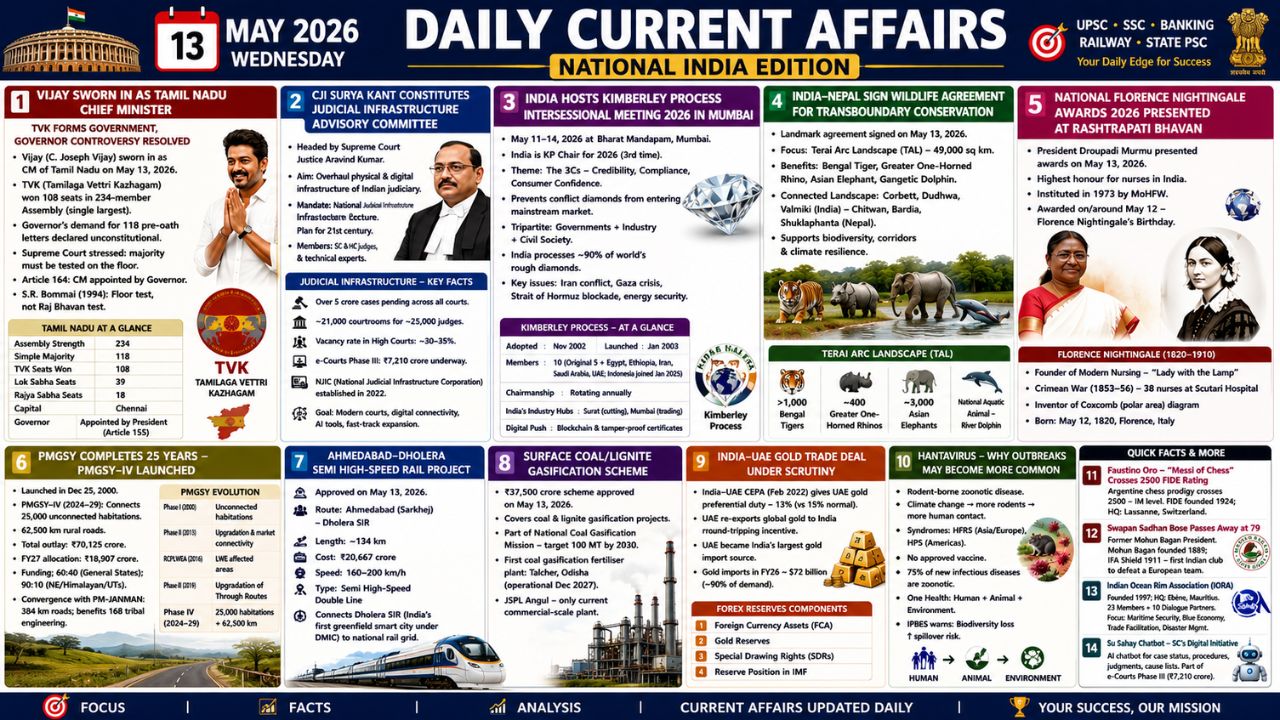
14 May 2026 Current Affairs is one of the most diplomatically significant editions of the month — with UPSC Prelims just 10 days away on May 24. The biggest story of the day is India hosting the BRICS Foreign Ministers' Meeting at Bharat Mandapam, New Delhi — the first major ministerial gathering under India's BRICS 2026 Chairship — with the Iran-US conflict, Strait of Hormuz blockade, and Gaza crisis dominating discussions. Simultaneously, NEET-UG 2026 was declared compromised — with NTA announcing a re-test for 22.79 lakh candidates after a large-scale paper leak.
The LEADS 2025 Logistics Report was released — ranking India's states on logistics performance. India and IFAD launched the COSOP 2026–2033 framework for rural development. The India-Nordic Summit came into focus for strategic cooperation. Great Nicobar Island's Nicobarese community opposed wildlife sanctuary boundaries linked to the mega infrastructure project. And Uzbekistan came up in mapping discussions. A packed, high-stakes edition — let's get into every story.
International Affairs
BRICS Foreign Ministers' Meeting — New Delhi, May 14–15, 2026
This is the most significant diplomatic story of May 2026 — and a near-certain UPSC Prelims question.
BRICS foreign ministers have gathered in New Delhi for a crucial two-day meeting focused on the Iran conflict, Gaza crisis, trade disruptions, energy security, and deeper cooperation among emerging economies ahead of the 18th BRICS Summit to be hosted by India in September 2026.
The BRICS Foreign Ministers' Meeting is scheduled for May 14–15 under India's 2026 Chairship, chaired by External Affairs Minister S. Jaishankar. The high-level gathering brings together foreign ministers and senior representatives from BRICS member and partner countries. The meeting will mark the first major ministerial-level engagement under India's current BRICS chairship and is expected to play a key role in shaping the agenda for the BRICS Leaders' Summit scheduled later this year.
Sessions took place at Bharat Mandapam in New Delhi. The first ministerial session began at 10:30 AM on May 14, followed by a joint call on Prime Minister Modi at Seva Teerth. A formal dinner was hosted by EAM Jaishankar in the evening.
India's BRICS 2026 Chairship — complete framework:
India recently unveiled the official logo and website for its BRICS 2026 chairship under the theme "Building for Resilience, Innovation, Cooperation and Sustainability." The theme reflects India's "Humanity First" and people-centric approach that was championed by PM Modi during the 2025 BRICS Summit in Rio de Janeiro.
Breaking down India's 2026 BRICS theme:
Building = Infrastructure, manufacturing, development finance
Resilience = Supply chain resilience, climate adaptation, financial stability
Innovation = Digital public infrastructure, AI, space technology
Cooperation = Multilateral frameworks, South-South cooperation
Sustainability = Green energy, circular economy, climate goals
The Iran-US conflict shadow:
The ongoing war on Iran is likely to dominate, with discussions set to shape the agenda for the September BRICS Summit. Iranian FM Abbas Araghchi called on fellow BRICS member states to condemn the US and Israel over what he described as their "unlawful aggression" against Tehran.
Jaishankar called for "safe, unimpeded maritime flows" through international waters, as the Strait of Hormuz — through which a fifth of global oil and gas passes — remains under blockade.
China was represented by its Indian ambassador Xu Feihong rather than FM Wang Yi — because Wang Yi was attending US President Donald Trump's state visit to China coinciding with the BRICS meeting.
Key discussion themes at the BRICS FM meeting:
Jaishankar stressed the need for deeper cooperation among emerging economies to tackle conflicts, economic instability, supply-chain disruptions, climate challenges, and technological competition. He also highlighted the importance of collaboration in energy security, food supply, fertiliser access, healthcare, financial stability, and counterterrorism while advocating inclusive technological growth and transparent global governance.
BRICS — complete exam framework:
Original BRICS (5 members):
Brazil, Russia, India, China, South Africa
Term coined by Goldman Sachs economist Jim O'Neill in 2001
First formal summit: Yekaterinburg, Russia, 2009
BRICS+ expansion (January 2024):
Egypt, Ethiopia, Iran, Saudi Arabia, UAE joined as full members
Indonesia joined in January 2025 (approved at 2023 Johannesburg Summit)
Total current members: 10
BRICS 2026 hosting sequence:
2024: Russia (Kazan Summit — 16th)
2025: Brazil (Rio de Janeiro — 17th)
2026: India (New Delhi — 18th BRICS Summit, September 2026)
New Development Bank (NDB):
Established by BRICS nations in 2015 under the Fortaleza Declaration (2014)
Headquarters: Shanghai, China
President (current): Dilma Rousseff (former President of Brazil)
Provides infrastructure and sustainable development financing to BRICS and other emerging economies
India's share: ~20% of NDB capital
BRICS Contingent Reserve Arrangement (CRA):
A $100 billion financial safety net for BRICS members facing balance of payments crises
Provides emergency liquidity without full IMF conditionality
Why the BRICS FM meeting is strategically significant for India: India's BRICS Chairship in 2026 comes at a uniquely consequential moment — the West Asia conflict is straining global energy markets (critical for India's oil-import-dependent economy), the global multilateral order is under stress, and the BRICS+ grouping now represents over 40% of global GDP and more than 50% of the world's population. India's ability to build consensus among a deeply diverse group — spanning democratic India, authoritarian Russia and China, theocratic Iran, and Gulf monarchies — will test its diplomatic sophistication and strategic autonomy.
BRICS FM Meeting = May 14–15, 2026, Bharat Mandapam, New Delhi. India BRICS Chairship 2026. Theme = "Building for Resilience, Innovation, Cooperation and Sustainability." EAM Jaishankar = chair. 18th BRICS Summit = September 2026. BRICS = 10 members (original 5 + Egypt, Ethiopia, Iran, Saudi Arabia, UAE; Indonesia joined Jan 2025). China represented by Xu Feihong (ambassador) as Wang Yi was with Trump. Strait of Hormuz = ~20% global oil. NDB = est. 2015, Shanghai. CRA = $100 billion safety net. Jim O'Neill coined "BRICS" in 2001.
India-Nordic Summit — Turning "Sambandh" into Strategy
At the India-Nordic Summit, the focus was on turning "sambandh" (connection/relationship) into strategy across trade, technology, and security cooperation.
What is the India-Nordic Summit? The India-Nordic Summit brings together India and the five Nordic countries — Denmark, Finland, Iceland, Norway, and Sweden — for high-level discussions on trade, clean technology, maritime cooperation, and global governance. The first India-Nordic Summit was held in May 2022 in Copenhagen, Denmark — hosted by Danish PM Mette Frederiksen.
Why Nordic countries matter for India:
Clean technology: Nordic countries are global leaders in wind energy, offshore platforms, green shipping, and sustainable urban planning — critical for India's clean energy transition
Maritime expertise: Norway is the world's largest maritime nation by tonnage managed — highly relevant for India's coastal shipping and port development
Digital governance: Sweden and Finland are global benchmarks for digital public services — aligned with India's Digital India and DPI ambitions
Defence technology: Finland and Sweden (both now NATO members since 2023–24) are significant defence tech partners
Arctic cooperation: As climate change opens Arctic shipping routes, India's Arctic Policy (2022) gains strategic relevance — Nordic partners are essential for this
The "Sambandh" framework: "Sambandh" — a Sanskrit word meaning relationship, connection, or bond — reflects India's civilisational approach to diplomacy. At the India-Nordic Summit, this was articulated as moving beyond cultural and historical connections toward concrete strategic partnerships in climate, technology, maritime security, and supply chain resilience.
India-Nordic Summit = India + 5 Nordic nations (Denmark, Finland, Iceland, Norway, Sweden). First summit = May 2022, Copenhagen. "Sambandh" = Sanskrit for connection/relationship. Nordic strengths: wind energy, green shipping, digital governance. Norway = largest maritime nation. Finland + Sweden = NATO members (2023–24). India Arctic Policy = 2022.
Trump's State Visit to China — BRICS Geopolitical Backdrop
US President Donald Trump's state visit to China was occurring simultaneously with the BRICS FM meeting in New Delhi — a remarkable geopolitical coincidence that significantly shaped dynamics at the meeting. Trump was expected to press Chinese President Xi Jinping to use Beijing's influence over Iran to help resolve the Strait of Hormuz blockade and reduce regional tensions.
Analysts noted that China's absence at the FM level (represented by ambassador rather than Wang Yi) reduced the weight of Beijing's voice in BRICS deliberations — potentially allowing India greater agenda-setting room for the September summit.
India's strategic positioning: India's stance at the BRICS FM meeting was carefully calibrated — calling for maritime safety (implicitly criticising Iran's blockade) without joining any US-led condemnation of Iran. This reflects India's "strategic autonomy" doctrine — maintaining equidistance from competing power blocs while protecting core national interests (energy security, trade flows, diaspora safety).
Trump state visit to China = simultaneous with BRICS FM meeting May 14. China represented by ambassador (not Wang Yi). Trump sought Chinese pressure on Iran. Strait of Hormuz = under blockade; ~20% global oil. India's position = maritime safety without US alignment. Strategic autonomy = India's core foreign policy doctrine.
Governance & Examinations
NEET-UG 2026 Paper Leak — 22.79 Lakh Students to Re-Sit India's Biggest Exam
This is the most consequential domestic governance story of May 14 — and directly relevant to GS Paper II (Governance) and the broader debate about examination reform in India.
The National Testing Agency (NTA) announced a re-test for NEET-UG 2026 after admitting that the examination process had been compromised amid allegations of a large-scale paper leak.
Massive Scale: The 2026 re-test affects nearly 22.79 lakh candidates — the largest such exercise in the history of competitive exams in India. Recurrent Failure: In 2024, investigations revealed 155 beneficiaries of a leak, while the 2026 leak involved a guess paper circulating 120 out of 410 questions weeks in advance.
Rank Inflation: The 2024 results saw an unprecedented 67 students scoring full marks, compared to only two in 2023, leading to massive hyper-competition for 1.1 lakh MBBS seats.
NEET-UG — complete exam framework:
What is NEET-UG? The National Eligibility cum Entrance Test (Undergraduate) is the single entrance test for admission to MBBS, BDS, BAMS, BSMS, BUMS, and BHMS courses (allopathy, dentistry, and AYUSH streams) across all medical colleges in India — government, private, and deemed. It was made the sole gateway for medical admissions through a 2016 amendment to the Indian Medical Council Act, 1956.
NTA — background: The National Testing Agency was established in 2017 under the Ministry of Education as an autonomous organisation to conduct entrance examinations including NEET-UG, JEE-Main, CUET, CMAT, and others. It was formed to professionalise examination conduct — but has faced repeated controversy over paper leaks and administrative lapses.
The 2026 crisis — systemic failures identified:
The 2026 NEET-UG crisis represents a systemic failure in the high-stakes examination framework of India. It highlights the inability of NTA to secure confidential materials, leading to a breakdown of student trust and a chequered past of recurring leaks, rank inflation, and administrative lapses that threaten the meritocratic basis of medical admissions.
Why NEET-UG matters so deeply:
1.1 lakh MBBS seats across ~706 medical colleges compete for students from a pool of 20+ lakh aspirants annually
A single exam determines access to the medical profession for millions — the stakes create a massive incentive for criminal networks to compromise the paper
Paper leak networks typically involve: printing press employees, courier/logistics personnel, and local coaching centres with political connections
The Supreme Court (2024) had already directed a comprehensive overhaul of NTA after the 2024 controversy
The reform debate: Two schools of thought have emerged:
Pro-NTA reform: Keep centralised exam but overhaul NTA — new leadership, end-to-end digital question paper generation, blockchain-secured distribution, decentralised printing
Decentralisation: Allow states to conduct their own medical entrance tests (as was the case pre-NEET) — the Tamil Nadu Dr. Ambedkar Law University model that argued state-specific exams better serve regional students
Constitutional angle: Education is in the Concurrent List (List III, Seventh Schedule, Entry 25) — both Centre and States have legislative competence. The Centre's assertion of NEET as a national standard is constitutionally valid — but states like Tamil Nadu have persistently challenged it, arguing that NEET disadvantages rural and vernacular-medium students.
NEET-UG 2026 re-test = 22.79 lakh candidates (largest re-test in India's history). 2026 leak = 120 of 410 questions circulated in advance. 2024 = 155 beneficiaries + 67 full-mark scorers (vs 2 in 2023). NTA = established 2017 under Ministry of Education. NEET = single medical entrance since 2016 (amendment to IMC Act 1956). 1.1 lakh MBBS seats in ~706 colleges. Education = Concurrent List Entry 25. Tamil Nadu challenged NEET nationally.
Economy & Logistics
LEADS 2025 Report Released — Gujarat, Chandigarh Top Rankings
The Union Minister of India released the LEADS 2025 Report and felicitated the winners of the LEAPS 2025 Awards in New Delhi. LEADS (Logistics Ease Across Different States) is the flagship annual assessment and benchmarking tool for India's logistics sector. It evaluates the logistics ecosystem of each State and Union Territory (UT) across various parameters like infrastructure, services, and regulatory environment. Published by: Department for Promotion of Industry and Internal Trade (DPIIT), Ministry of Commerce and Industry.
LEADS framework — complete exam profile:
What does LEADS measure? The LEADS index assesses states and UTs on:
Infrastructure: Road, rail, waterway, air connectivity; warehousing capacity
Services: Freight forwarding, customs, last-mile delivery, cold chain
Regulatory environment: Ease of doing business in logistics, time for clearances
Digital integration: E-way bill compliance, TMS/WMS adoption
Sustainability: Green logistics adoption
State categories in LEADS: States are divided into three categories for fair comparison:
Coastal states (with port access)
Land-locked states
Union Territories and Hill States
LEADS 2025 top performers:
Gujarat — consistently ranks as India's top logistics state (coastal category)
Chandigarh — top UT/Hill State category
Why LEADS matters: India's logistics cost as a percentage of GDP stands at approximately 13–14% — compared to 8–9% in developed economies like the USA and Germany. Reducing logistics costs is central to Make in India competitiveness. India's National Logistics Policy (NLP), 2022 — launched on September 17, 2022 — aims to reduce logistics costs to <8% of GDP by 2030 through infrastructure development, process reengineering, and digital integration.
PM Gati Shakti linkage: The PM Gati Shakti National Master Plan — launched October 13, 2021 — is a digital platform integrating data from 16 ministries to enable coordinated infrastructure planning. LEADS assessment feeds into the PM Gati Shakti framework to identify state-level logistics gaps and investment priorities.
LEAPS Awards: The LEAPS (Logistics Ease Award for Pioneering States) recognise outstanding state-level initiatives in logistics improvement — creating competitive incentives for state governments to reform their logistics ecosystems.
LEADS = Logistics Ease Across Different States. Published by DPIIT under Ministry of Commerce. Annual report. Gujarat = top coastal state. Chandigarh = top UT. India logistics cost = 13–14% of GDP. NLP 2022 target = <8% of GDP by 2030. PM Gati Shakti = October 13, 2021. 16 ministries integrated. LEAPS = state logistics awards.
India-IFAD COSOP 2026–2033 — Eight Years of Rural Development Partnership
The Government of India and the International Fund for Agricultural Development (IFAD) launched a new eight-year Country Strategic Opportunities Programme (COSOP) for the period 2026–2033. COSOP is a strategic investment and development framework that defines the long-term partnership between a host country and IFAD. It serves as an operational blueprint to modernise rural livelihoods, moving beyond simple poverty alleviation toward building market-oriented, climate-resilient rural systems. The programme aims to enhance rural incomes and scale sustainable livelihood opportunities by connecting grassroots institutions to finance, technology, and global markets, while ensuring they are resilient to economic and climate shocks.
About IFAD:
Fact | Detail |
|---|---|
Full name | International Fund for Agricultural Development |
Type | UN Specialised Agency |
Established | 1977 (following the 1974 World Food Conference) |
Headquarters | Rome, Italy |
Mandate | Financing agricultural development and rural poverty reduction |
Unique feature | Majority of governance rests with developing country members |
IFAD vs FAO vs WFP — a common exam confusion:
Organisation | HQ | Mandate |
|---|---|---|
FAO | Rome | Food and Agriculture policy + standards |
WFP | Rome | Emergency food assistance |
IFAD | Rome | Financing rural agriculture development |
All three are headquartered in Rome — part of the "Rome-based food agencies" cluster.
COSOP — significance for India: India is one of IFAD's largest borrowing countries — with IFAD-financed projects covering tribal livelihoods, dryland farming, women's self-help groups, and rural financial inclusion across states like Jharkhand, Odisha, Uttarakhand, and Andhra Pradesh. The 2026–2033 COSOP shifts focus toward:
Value chain development — connecting smallholder farmers to premium markets
Climate-resilient agriculture — drought-tolerant varieties, soil health management
Digital financial inclusion — rural credit through fintech and SHG-bank linkage
Women's economic empowerment — building on India's SHG network (the world's largest)
COSOP = Country Strategic Opportunities Programme. India-IFAD COSOP 2026–2033 (8 years). IFAD = UN Specialised Agency, est. 1977, HQ Rome. Mandate = rural development financing. Rome-based food agencies = FAO + WFP + IFAD. All three HQ = Rome. COSOP = operational blueprint for India-IFAD rural partnership. Focus: climate resilience, value chains, digital financial inclusion, women's empowerment.
Environment & Conservation
Great Nicobar Island — Nicobarese Community Opposes Wildlife Sanctuary Boundaries
The Nicobarese indigenous community opposed wildlife sanctuary boundaries linked to the Great Nicobar Island mega infrastructure project — expressing concern that sanctuary demarcation was being used to restrict their traditional territory access rather than genuinely protect ecosystems.
Great Nicobar Island — complete exam profile:
About Great Nicobar Island:
India's southernmost island — located at the tip of the Andaman and Nicobar archipelago
Distance from Sri Lanka: ~530 km; from Sumatra (Indonesia): ~150 km
Capital of Andaman and Nicobar Islands: Port Blair
Great Nicobar is part of the Nicobar group — the southern section of the archipelago
Indira Point — India's southernmost land point — is located on Great Nicobar
The Great Nicobar Project: The Great Nicobar Holistic Development Project — approved by the Ministry of Environment, Forest and Climate Change in 2023 — is a ₹72,000 crore integrated project comprising:
Transshipment Port — designed to compete with Singapore's transshipment hub position
International Airport
Defence Base (tri-services — Army, Navy, Air Force)
Township for 3.5 lakh population
Power Plant (township support)
Environmental concerns: The project has attracted significant environmental opposition because:
Great Nicobar is a biodiversity hotspot — hosting the Leatherback Sea Turtle (the world's largest sea turtle; IUCN Critically Endangered), Nicobar Megapode (endemic bird), Nicobar Tree Shrew, and several endemic plant species
The island has tropical rainforest covering ~85% of its area — including mangroves and coral reefs
Galathea Bay — where the port is planned — is the primary nesting beach for Leatherback Sea Turtles in India
The project requires felling of approximately 10 lakh trees in the initial phase
Campbell Bay National Park and Galathea National Park — both within Great Nicobar — have overlapping boundaries with project areas
The Indigenous community dimension: Nicobarese opposition to wildlife sanctuary designations reflects the classic tension between conservation and indigenous rights — where external-imposed boundaries restrict traditional livelihoods.
The Nicobari people are the indigenous inhabitants of the Nicobar Islands — with a Scheduled Tribe status and special protections under the Andaman and Nicobar Islands (Protection of Aboriginal Tribes) Regulation, 1956. They have traditionally inhabited coastal areas, practised subsistence fishing and agriculture, and maintained a distinctive Malayo-Polynesian cultural heritage. The wildlife sanctuary boundary controversy reflects a deeper concern: that the mega infrastructure project is driving environmental regulations that end up restricting indigenous communities while allowing large-scale commercial development.
📌 Great Nicobar = India's southernmost island. Indira Point = India's southernmost point. Great Nicobar Project = ₹72,000 crore (transshipment port + airport + defence base + township). Leatherback Sea Turtle = IUCN Critically Endangered; primary nesting beach at Galathea Bay. Nicobar Megapode = endemic bird. 10 lakh trees to be felled. Campbell Bay + Galathea NPs affected. Nicobari people = ST with 1956 Regulation protection. Distance from Sumatra = ~150 km (strategic chokepoint).
Geography in Focus — Uzbekistan
Uzbekistan came up in mapping discussions for competitive exam preparation.
Uzbekistan — complete exam profile:
Fact | Detail |
|---|---|
Capital | Tashkent |
Largest city | Tashkent |
President | Shavkat Mirziyoyev |
Geography | Double land-locked — one of only two countries in the world (other: Liechtenstein) |
Borders | Kazakhstan, Kyrgyzstan, Tajikistan, Afghanistan, Turkmenistan |
Language | Uzbek |
Currency | Uzbekistani Som |
Region | Central Asia |
Former status | Part of Soviet Union (USSR) until independence in 1991 |
Famous cities | Samarkand, Bukhara, Khiva — all on the ancient Silk Road |
Religion | Predominantly Islam (Sunni) |
Economy | Cotton, gold, natural gas, uranium |
Why Uzbekistan matters for India:
India-Uzbekistan relations have deepened significantly — Uzbekistan is a key node in India's Connect Central Asia policy
Chabahar Port (Iran) — once the Strait of Hormuz situation stabilises — is India's gateway for trade routes to Central Asia including Uzbekistan
India and Uzbekistan are both members of the Shanghai Cooperation Organisation (SCO)
Uzbekistan has significant cotton production — relevant to India's textile supply chain
India-Uzbekistan bilateral trade crossed $1 billion for the first time in recent years
Samarkand hosted the 2022 SCO Summit — where PM Modi made the notable "not an era of war" statement
Double land-locked significance: Uzbekistan is surrounded entirely by land-locked countries — meaning it must cross at least two international borders to reach any ocean. This makes it one of the most geographically isolated major economies in the world — giving Chabahar Port and connectivity corridors extraordinary strategic value for Uzbekistan's trade.
Uzbekistan = double land-locked (only 2 such countries: Uzbekistan + Liechtenstein). Capital = Tashkent. President = Shavkat Mirziyoyev. Borders = Kazakhstan, Kyrgyzstan, Tajikistan, Afghanistan, Turkmenistan. Independence = 1991 from USSR. Silk Road cities = Samarkand, Bukhara, Khiva. SCO member. India gateway to Uzbekistan = Chabahar Port. 2022 SCO Summit = Samarkand ("not an era of war" — PM Modi).
Technology & Governance
AI-Powered Financial Inclusion — Aadhaar, UPI, and AI-Based Credit Systems
AI-driven financial inclusion through Aadhaar, UPI, and AI-based credit systems was highlighted as a transformative policy area in current affairs discussions on May 14.
India's DPI (Digital Public Infrastructure) — the JAM Trinity and beyond:
India's digital financial inclusion journey has three foundational layers:
JAM Trinity:
J — Jan Dhan: Pradhan Mantri Jan Dhan Yojana (PMJDY) — launched August 28, 2014 — universal basic banking with zero-balance accounts. Over 55 crore accounts opened as of 2026.
A — Aadhaar: 12-digit biometric identity for 130+ crore Indians — enables eKYC and Direct Benefit Transfer (DBT)
M — Mobile: Mobile penetration enabling digital payments and financial services delivery
UPI's global dominance:
UPI (Unified Payments Interface) — launched April 11, 2016 by NPCI
Processes over 1,000 crore transactions monthly in 2026 (approximately)
UPI is now live in countries including Singapore, UAE, France, Sri Lanka, Mauritius, Nepal, Bhutan, and Malaysia
RuPay cards and UPI are India's primary digital payments infrastructure — alternatives to Visa and Mastercard
AI in credit — the transformative step: Traditional credit assessment requires documented income proof, credit history, and collateral — excluding hundreds of millions of informal workers, farmers, and micro-entrepreneurs. AI-based credit systems use alternative data — mobile recharge patterns, utility bill payments, e-commerce purchase history, UPI transaction frequency — to assess creditworthiness. This is called "thin-file lending" — extending credit to people with little formal financial history.
Key AI credit platforms:
PM Vishwakarma Yojana — uses digital tools to extend credit to artisans and craftspeople
OCEN (Open Credit Enablement Network) — a framework for embedded lending through digital platforms
Account Aggregator (AA) framework — allows individuals to share financial data across institutions for credit assessment with consent
JAM Trinity = Jan Dhan + Aadhaar + Mobile. PMJDY = August 28, 2014. 55+ crore accounts. UPI launched April 11, 2016 by NPCI. 1,000+ crore monthly transactions. UPI global = 10+ countries. OCEN = Open Credit Enablement Network. Account Aggregator = consent-based financial data sharing. AI credit = alternative data for thin-file lending. DPI = Digital Public Infrastructure.
Parmenides — Ancient Greek Philosophy in Modern Policy Discourse
Philosophical insights from Greek thinker Parmenides were referenced in policy discussions.
About Parmenides:
Ancient Greek philosopher from Elea (Southern Italy) — lived approximately 5th century BCE
Founder of the Eleatic School of philosophy
Most famous for his philosophical poem "On Nature" (Peri Physeos) — arguing that "Being" is eternal, unchanging, and indivisible
His core insight: "Nothing comes from nothing" — existence is continuous and change is illusory
Parmenides' ideas directly influenced Plato (theory of Forms) and through him, Western philosophy's entire rational tradition
His student Zeno of Elea developed the famous paradoxes (Achilles and the Tortoise) to defend Parmenides' position
Relevance in policy context: References to Parmenides in contemporary policy discourse typically invoke his insight about the nature of reality vs appearance — particularly relevant when analysing whether policy metrics (like GDP growth or poverty reduction numbers) reflect actual ground realities or a constructed narrative of change.
Parmenides = ancient Greek philosopher, Elea, ~5th century BCE. Founder of Eleatic School. Work = "On Nature (Peri Physeos)." Core thesis = Being is eternal and unchanging; change is illusory. Influenced Plato. Student = Zeno of Elea (Achilles paradox). Relevant for UPSC Essay Paper and GS Paper IV (Ethics — concept of truth and reality).
Governance & Culture
Global Kashmiri Pandit Heritage Tour Conclave 2026 — June 6–14 in Kashmir
The first-ever Global Kashmiri Pandit Heritage Tour Conclave 2026 will be held in Kashmir from June 6 to 14. It will culminate in a two-day conclave at the Sher-i-Kashmir International Convention Centre on June 13 and 14. The initiative aims to reconnect displaced Kashmiri Pandits with their ancestral roots, sacred spaces, and cultural memory. The programme includes a curated heritage tour across temples, cultural landmarks, and historically important sites. Organisers described it as a journey of remembrance, reconnect, revival, and return.
The Kashmiri Pandit exodus — historical context: The Kashmiri Pandits — the Hindu minority indigenous to the Kashmir Valley — experienced a mass exodus in January–February 1990 during the height of the Kashmiri insurgency. Estimates vary — between 1 lakh and 5 lakh Pandits (various estimates) fled the Valley following targeted killings, threats, and religious persecution. They have primarily settled in Jammu, Delhi, and other parts of India, as well as in the United States and other countries.
Key locations in the Kashmiri Pandit cultural landscape:
Shankaracharya Temple (Jyeshteswara) — Srinagar
Kheer Bhawani Temple — dedicated to Goddess Ragnya Devi
Martand Sun Temple — ancient 8th century ruins near Anantnag (Mattan)
Amarnath Cave — the holiest Shaivite pilgrimage site
Tulmul (Kheer Bhawani) — the most sacred Pandit pilgrimage
Policy context: PM Modi's government has taken several steps to facilitate Kashmiri Pandit return — including the Prime Minister's Development Package (PMDP) 2015 that provided housing, employment, and transit camps. However, the pace of return has remained slow due to security concerns and socio-political conditions on the ground.
Global Kashmiri Pandit Heritage Conclave 2026 = June 6–14, Kashmir. Culminates at Sher-i-Kashmir International Convention Centre (June 13–14). 4 Rs: Remembrance, Reconnect, Revival, Return. Kashmiri Pandit exodus = January–February 1990. Key temples: Kheer Bhawani, Shankaracharya, Martand. PMDP 2015 = PM's package for Pandit return.
Lt Gen Rana Pratap Kalita Appointed Chancellor of Pragjyotishpur University
Retired Indian Army officer Lt Gen Rana Pratap Kalita has been appointed the new Chancellor of Pragjyotishpur University.
About Pragjyotishpur University:
Located in Guwahati, Assam
Named after Pragjyotishpur — the ancient name of Guwahati (meaning "City of Eastern Astrology/Light")
A state university in Assam
About Lt Gen Rana Pratap Kalita:
Former Commander-in-Chief of Eastern Command — the Indian Army command responsible for India's northeastern borders, including the Line of Actual Control (LAC) with China
Retired from active service and now appointed to this academic governance role
Eastern Command HQ: Fort William, Kolkata
Pragjyotishpur = ancient name of Guwahati (City of Eastern Astrology). Lt Gen Rana Pratap Kalita = former Eastern Command C-in-C. Eastern Command = India's NE border command (includes China LAC). HQ = Fort William, Kolkata.
Article 371(A) — Nagaland's Constitutional Safeguard in Focus
Article 371(A) — applicable to Nagaland — was discussed in the context of constitutional safeguards for tribal communities. It is intended to safeguard the traditional and customary identity of the Naga people.
Article 371(A) — complete framework:
Article 371(A) was inserted into the Constitution through the 13th Constitutional Amendment Act, 1962, recognising the special status of Nagaland. It provides that:
Customary law and procedure: No Act of Parliament shall apply to Nagaland in respect of religious or social practices of the Nagas, customary law and procedure, administration of civil and criminal justice involving decisions according to Naga customary law — unless the Nagaland Legislative Assembly so decides
The Governor of Nagaland has special responsibility for law and order in the state
The Nagaland Village Council Act, 1978 governs traditional tribal village governance
Special provisions for other states (companion articles):
Article | State |
|---|---|
371 | Maharashtra and Gujarat |
371A | Nagaland |
371B | Assam |
371C | Manipur |
371D | Andhra Pradesh |
371E | Central University in AP |
371F | Sikkim |
371G | Mizoram |
371H | Arunachal Pradesh |
371I | Goa |
371J | Hyderabad-Karnataka region |
Article 371(A) = Nagaland. 13th Constitutional Amendment Act, 1962. Protects Naga customary law + religious/social practices from Parliamentary legislation without LA's consent. Governor has special law & order responsibility. Nagaland Village Council Act 1978. Learn all 371 variants — they appear frequently in UPSC Prelims.
Environment — Mumbai's Water Security Crisis
"Mumbai is India's richest city — why does it depend entirely on rain for its water?" — a detailed analysis emerged on May 14 highlighting Mumbai's structural water vulnerability.
Mumbai's water supply system: Mumbai gets its water entirely from seven lakes/reservoirs in the surrounding hills — primarily the Bhatsa, Upper Vaitarna, Middle Vaitarna, Modak Sagar (Tansa), Vihar, Tulsi, and Powai lakes. These are entirely rain-fed — dependent on monsoon rainfall in the Western Ghats catchment areas.
Why this is structurally fragile:
A single poor monsoon can drop reservoir levels to critical thresholds
Mumbai has zero groundwater extraction (unlike Delhi or Bengaluru, which supplement with groundwater)
Leakage in the distribution network loses approximately 25–30% of treated water
Per capita water supply: Mumbai supplies approximately 170–175 litres per capita per day (LPCD) — but distribution is extremely unequal; slum residents may receive as little as 30–40 LPCD
Climate change: Increasingly erratic and concentrated rainfall in the Western Ghats is disrupting the reliability of monsoon recharge
SDG 6 connection: SDG 6 — Clean Water and Sanitation — is directly relevant. India's Jal Jeevan Mission (JJM) addresses rural water supply — but urban water security for megacities like Mumbai requires a separate, comprehensive framework.
Mumbai water = 100% rain-fed from 7 reservoirs. Zero groundwater. 25–30% distribution leakage. Per capita = 170–175 LPCD (but slums get 30–40 LPCD). Climate change = erratic Western Ghats monsoon = risk. SDG 6 = Clean Water and Sanitation. Jal Jeevan Mission = rural focus. Urban water security = separate challenge.
Indian Ocean Dialogue — India's Maritime Governance Role
The Indian Ocean Dialogue came into focus in current affairs discussions on May 14 — particularly in the context of the Strait of Hormuz blockade and India's maritime interests.
India's Indian Ocean strategic framework:
The Indian Ocean is not just geography for India — it is existential:
85% of India's crude oil transits through Indian Ocean shipping lanes
India's $900+ billion export economy depends on Indian Ocean trade routes
The Indian Ocean hosts 90% of India's trade by volume
India's western coast faces the Arabian Sea; eastern coast faces the Bay of Bengal
India's multilateral maritime architecture:
Forum | Focus |
|---|---|
IORA (Indian Ocean Rim Association) | 23 members; trade, maritime security, blue economy |
IONS (Indian Ocean Naval Symposium) | Naval cooperation; India initiated in 2008 |
Quad (India-US-Japan-Australia) | Indo-Pacific security; China containment dimension |
SAGAR doctrine | PM Modi's "Security and Growth for All in the Region" (2015) |
MAHASAGAR | Updated maritime vision (2025) |
The Strait of Hormuz blockade — India's compulsion: The ongoing blockade is creating severe pressure on India's energy import bill and threatening to push crude prices higher — at a time when India's forex reserves are already declining. India's call for "safe maritime flows" at the BRICS FM meeting is directly tied to this existential economic concern.
Indian Ocean = 85% of India's crude transit + 90% of trade by volume. IORA = 23 members, Mauritius HQ (1997). IONS = Indian Ocean Naval Symposium (India initiated 2008). SAGAR = India's 2015 Indian Ocean doctrine. MAHASAGAR = 2025 update. Strait of Hormuz blockade = direct threat to India's energy security.
FAQs — 14 May 2026 Current Affairs
Q. What is the significance of the BRICS Foreign Ministers' Meeting in New Delhi on May 14–15, 2026?
This is the first major ministerial-level engagement under India's BRICS 2026 Chairship — chaired by EAM Jaishankar at Bharat Mandapam. The meeting prepares the agenda for the 18th BRICS Leaders' Summit in September 2026. Key issues dominated: Iran-US conflict, Strait of Hormuz blockade, Gaza crisis, and global governance reform. BRICS has 10 members — the original 5 plus Egypt, Ethiopia, Iran, Saudi Arabia, UAE, and Indonesia (January 2025). India's 2026 theme is "Building for Resilience, Innovation, Cooperation and Sustainability."
Q. What happened in NEET-UG 2026 and why is it a systemic concern?
NTA announced a re-test for 22.79 lakh candidates — the largest re-test in India's competitive exam history — after a paper leak saw 120 of 410 questions circulated in advance. This follows the 2024 controversy where 155 beneficiaries were identified and 67 students scored full marks (vs 2 in 2023). NTA was established in 2017 under Ministry of Education. NEET has been the sole medical entrance gateway since 2016. Education is on the Concurrent List — states like Tamil Nadu have persistently opposed NEET as disadvantaging rural students.
Q. What is the LEADS report and what does it measure?
LEADS (Logistics Ease Across Different States) is DPIIT's annual benchmarking tool for India's state-level logistics performance — covering infrastructure, services, and regulatory environment. India's logistics cost is 13–14% of GDP (vs 8–9% in developed economies). The National Logistics Policy (2022) targets <8% of GDP by 2030. Gujarat topped the coastal states category in LEADS 2025.
Q. Why is Great Nicobar Island strategically and environmentally controversial?
Great Nicobar is India's southernmost island — just ~150 km from Sumatra. The ₹72,000 crore project includes a transshipment port, airport, defence base, and township. Environmental concerns centre on the Leatherback Sea Turtle (IUCN Critically Endangered) nesting at Galathea Bay, the Nicobar Megapode endemic bird, and felling of ~10 lakh trees in a biodiversity hotspot. The indigenous Nicobari community (protected under the 1956 Regulation) has opposed wildlife sanctuary boundaries that restrict their traditional territory.
Q. What is Uzbekistan's unique geographic significance?
Uzbekistan is one of only two double land-locked countries in the world (the other being Liechtenstein) — meaning it is surrounded entirely by other land-locked countries (Kazakhstan, Kyrgyzstan, Tajikistan, Afghanistan, Turkmenistan). Capital is Tashkent; President is Shavkat Mirziyoyev. It hosts the ancient Silk Road cities of Samarkand, Bukhara, and Khiva. India's connectivity to Uzbekistan depends heavily on Chabahar Port through Iran. Both are SCO members.
Q. What is COSOP and which organisations are involved in the India-IFAD 2026–2033 programme?
COSOP (Country Strategic Opportunities Programme) is a strategic investment framework defining the partnership between IFAD and a host country. The India-IFAD COSOP 2026–2033 is an eight-year programme modernising rural livelihoods through climate-resilient value chains, digital financial inclusion, and women's empowerment. IFAD is a UN Specialised Agency established in 1977 and headquartered in Rome — part of the Rome-based food agencies cluster alongside FAO and WFP.
Q. What does Article 371(A) protect?
Article 371(A), inserted by the 13th Constitutional Amendment Act 1962, protects Nagaland's Naga customary law, religious and social practices, and civil/criminal justice systems based on customary law from Parliamentary legislation — unless the Nagaland Legislative Assembly specifically accepts such legislation. The Governor has special responsibility for law and order. This is part of a series of special provisions (Articles 371 to 371J) for various states.
Q. What is India's SAGAR doctrine and how does it relate to the BRICS FM meeting?
SAGAR (Security and Growth for All in the Region) is India's Indian Ocean vision articulated by PM Modi in 2015 — emphasising cooperative maritime security, connectivity, and blue economy development. At the BRICS FM meeting, India's call for "safe, unimpeded maritime flows" through the Strait of Hormuz directly reflects SAGAR principles — protecting the shipping lanes through which 90% of India's trade by volume passes, including 85% of its crude oil requirements.
Written by
Koti Deva
Digital Marketing Specialist
Koti is a Digital Marketing Specialist with over 10 years of experience and the co-founder of MCQ Orbit — a free exam prep platform built for Indian competitive exam aspirants.
With strong personal knowledge in Quantitative Aptitude, Logical Reasoning, and Mathematics, Koti has a deep understanding of what it takes to crack exams like SSC CGL, IBPS PO, SBI Clerk, UPSC Prelims, NEET, and JEE. Having followed these exams closely for years, he understands the exact topics, patterns, and shortcuts that matter most.
MCQ Orbit was born from a simple desire — to build a platform where every aspirant in India can practice quality MCQs, read reliable current affairs, and prepare confidently, without paying a rupee. Koti combines his digital expertise with his passion for competitive exams to create content that is accurate, practical, and genuinely useful for students.
His mission is straightforward: if the right guidance had been freely available earlier, more students would have cracked their dream exams. MCQ Orbit is his way of making that happen.
Comments
No comments yet.