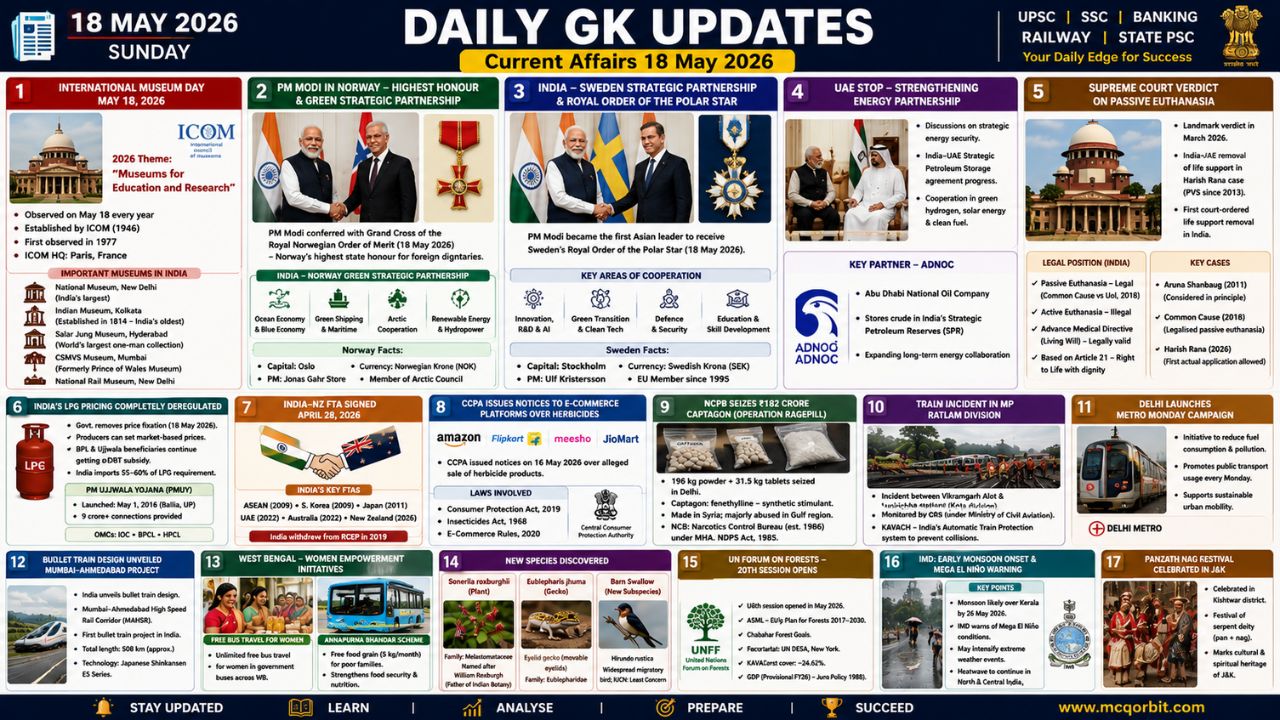
18 May 2026 Current Affairs is one of the most internationally rich editions of the month — with UPSC Prelims just 6 days away on May 24. The biggest stories of the day: PM Modi received Norway's Grand Cross of the Royal Norwegian Order of Merit in Oslo and India-Norway elevated ties to a Green Strategic Partnership. India and Sweden signed a Strategic Partnership — and PM Modi became the first Asian leader to receive Sweden's Royal Order of the Polar Star.
The President of India promulgated the Supreme Court (Number of Judges) Amendment Ordinance 2026 — increasing judges from 34 to 38. NCB made a second massive Captagon seizure — 196 kg powder + 31.5 kg tablets in Delhi. Delhi launched the Metro Monday campaign to cut fuel consumption. India unveiled the bullet train design for the Mumbai-Ahmedabad High Speed Rail project. West Bengal approved free bus travel for women and launched the Annapurna Bhandar Scheme. CIC ruled BCCI is not a public authority under RTI. International Museum Day was observed. IMD announced early monsoon onset over Kerala by May 26 — with a Mega El Niño warning. And the Panzath Nag festival was celebrated in J&K. Let's get into every story.
Important Day — International Museum Day, May 18
International Museum Day 2026 — "Museums for Education and Research"
May 18 is observed globally as International Museum Day — one of the most important days in the cultural heritage calendar.
Key facts:
Fact | Detail |
|---|---|
Observed on | May 18 every year |
Established by | International Council of Museums (ICOM) |
First observed | 1977 |
2026 Theme | "Museums for Education and Research" |
ICOM headquarters | Paris, France |
ICOM founded | 1946 |
Why museums matter for competitive exams: International Museum Day drives awareness of India's museum ecosystem — which is directly tested in culture and heritage questions:
National Museum, New Delhi: India's largest museum — houses artefacts spanning 5,000 years of Indian history. Under Ministry of Culture.
Indian Museum, Kolkata: India's oldest museum — established in 1814 by the Asiatic Society of Bengal under Nathaniel Wallich. Also called the "Jadu Ghar" (House of Magic).
Salar Jung Museum, Hyderabad: World's largest one-man collection — assembled by Mir Yusuf Ali Khan (Salar Jung III).
Chhatrapati Shivaji Maharaj Vastu Sangrahalaya (CSMVS), Mumbai: Formerly Prince of Wales Museum — one of India's finest art museums.
National Rail Museum, New Delhi: Celebrates India's railway heritage.
India's Museum Policy: India launched its National Museum Policy 2026 — updating the earlier 1985 policy — to modernise India's museum infrastructure, digitise collections, and make museums more accessible through Virtual Reality (VR) and Augmented Reality (AR) experiences.
International Museum Day = May 18. ICOM = est. 1946, HQ Paris. First observed 1977. 2026 Theme = "Museums for Education and Research." Indian Museum, Kolkata = India's oldest (1814, Asiatic Society). National Museum, New Delhi = India's largest. Salar Jung = world's largest one-man collection. National Museum Policy 2026 = updated policy.
International Affairs & Diplomacy
PM Modi in Norway — Grand Cross of Royal Norwegian Order of Merit + India-Norway Green Strategic Partnership
India and Norway elevated their bilateral relations to a Green Strategic Partnership on 18 May 2026 in Oslo during talks between Prime Minister Narendra Modi and Norwegian Prime Minister.
Prime Minister Narendra Modi was conferred with the Grand Cross of the Royal Norwegian Order of Merit in Oslo, Norway, on 18 May 2026. The award is the highest Norwegian state honour for foreign dignitaries.
India-Norway Green Strategic Partnership — key pillars:
1. Ocean Economy and Blue Economy: Norway is the world's 2nd largest seafood exporter and a global leader in offshore petroleum technology, maritime shipping, and ocean research. For India — with a 7,516 km coastline and vast EEZ — Norway's ocean expertise is invaluable. Key cooperation areas:
Deep-sea mining technology — India's National Institute of Ocean Technology (NIOT) has been exploring polymetallic nodules in the Indian Ocean; Norway's deep-sea expertise is directly applicable
Sustainable aquaculture — Norway's salmon aquaculture model can be adapted for India's coastal fisheries
Offshore wind energy — Norway's offshore platform technology applicable to India's offshore wind targets (30 GW by 2030)
2. Green Shipping: Norway manages approximately 10% of the world's merchant fleet and is leading the global transition to zero-emission shipping — through hydrogen, ammonia, and electric vessel technology. India-Norway cooperation on green shipping corridors and LNG bunkering infrastructure is a key outcome.
3. Arctic Cooperation: Norway is a leading Arctic nation — member of the Arctic Council (8 Arctic states: Canada, Denmark/Greenland, Finland, Iceland, Norway, Russia, Sweden, USA). India has Observer status on the Arctic Council (since 2013) — making Norway a critical partner for India's Arctic Policy (2022).
4. Renewable Energy: Norway generates approximately 90% of its electricity from hydropower — making it one of the cleanest energy systems in the world. Cooperation on hydropower technology, pumped storage, and green hydrogen production is central to the partnership.
Royal Norwegian Order of Merit — key facts:
Fact | Detail |
|---|---|
Full name | Royal Norwegian Order of Merit (Fortjenstordenen) |
Established | 1985 by King Olav V |
Classes | 5 classes (Grand Cross being highest) |
Purpose | Honour foreign nationals for services to Norway or international cooperation |
Significance | PM Modi receiving Grand Cross = recognition of India-Norway partnership depth |
Norway at a glance:
Capital: Oslo
Currency: Norwegian Krone (NOK)
Government: Constitutional Monarchy — King Harald V
PM: Jonas Gahr Støre (Labour Party)
Sovereign Wealth Fund: Government Pension Fund Global (GPFG) — world's largest sovereign wealth fund at approximately $1.7 trillion
Nobel Peace Prize: Awarded annually by the Norwegian Nobel Committee in Oslo (all other Nobel Prizes awarded in Stockholm, Sweden)
EFTA member (not EU member) — part of the EEA (European Economic Area)
India-Norway = Green Strategic Partnership (May 18, 2026). PM Modi received Grand Cross of Royal Norwegian Order of Merit. Norway's GPFG = world's largest sovereign wealth fund ($1.7 trillion). Nobel Peace Prize = Oslo (other Nobels = Stockholm). Norway = 90% hydro electricity. Arctic Council = 8 Arctic states; India = Observer since 2013. Norway = 2nd largest seafood exporter. Norway capital = Oslo. King = Harald V.
PM Modi in Sweden — Royal Order of Polar Star + India-Sweden Strategic Partnership
The Prime Minister of India receives Sweden's prestigious award Royal Order of the Polar Star. Context: PM Modi became the first Asian leader to receive the honour, highlighting India's rising global stature. The award coincided with India and Sweden elevating ties to a Strategic Partnership and expanding economic cooperation.
Royal Order of the Polar Star — complete profile:
The Royal Order of the Polar Star (Nordstjärneorden) is a prestigious Swedish order of chivalry. It is the premier state distinction used by the Scandinavian nation to honor foreign heads of government, royalty, and individuals for outstanding public service. The order was established on April 17, 1748, by King Fredrik I of Sweden.
Historic First: Prime Minister Modi became the first Asian leader to receive the honor, highlighting India's rising global stature.
India-Sweden Strategic Partnership — key pillars:
1. Defence and Innovation: Sweden is home to SAAB — maker of the Gripen fighter jet — one of the aircraft evaluated for India's Medium Multi-Role Combat Aircraft (MMRCA) programme (ultimately losing to Rafale in the current contract, but remaining a potential future partner). Swedish defence companies also specialise in submarines (A26 class), radar systems (Ericsson), and artillery (Bofors — now part of BAE Systems).
2. Clean Technology: Sweden is one of the world's most innovative clean technology nations — home to companies like Northvolt (EV batteries), H2 Green Steel (hydrogen-based green steel), and Climeworks-affiliated ventures. India's green transition can directly benefit from Swedish partnerships.
3. Digital and Telecom: Ericsson — Sweden's telecom giant — is a key 5G technology partner for India. Sweden's digital governance model (high e-government adoption, digital identity systems) also offers lessons for India's DPI expansion.
4. Pharmaceuticals and Life Sciences: AstraZeneca — Anglo-Swedish pharmaceutical company — was one of the key COVID-19 vaccine manufacturers (the Oxford-AstraZeneca vaccine was produced in India by Serum Institute of India as Covishield). Sweden-India pharma ties have deep roots.
Sweden at a glance:
Capital: Stockholm
Currency: Swedish Krona (SEK)
Government: Constitutional Monarchy — King Carl XVI Gustaf
PM: Ulf Kristersson (Moderate Party)
NATO member since March 7, 2024 — ending over 200 years of military non-alignment
EFTA member (formerly; left when joining EU in 1995)
EU member since 1995
PM Modi = first Asian to receive Royal Order of the Polar Star (Sweden). Order established 1748 by King Fredrik I. India-Sweden = Strategic Partnership (May 2026). SAAB = Gripen fighter. Ericsson = 5G partner. Northvolt = EV batteries. AstraZeneca = Anglo-Swedish pharma. Sweden = NATO member since March 7, 2024. Sweden PM = Ulf Kristersson. Capital = Stockholm.
India-Netherlands Strategic Roadmap 2026–2030 — Formally Adopted
Prime Minister of India and Dutch Prime Minister Rob Jetten met at The Hague, and agreed to elevate their bilateral relationship to a Strategic Partnership. To execute this, both nations formally adopted the Roadmap of India-Netherlands Strategic Partnership (2026–2030).
Key pillars of the India-Netherlands Strategic Roadmap 2026–2030:
The India-Netherlands Strategic Roadmap (2026–2030) marks a paradigm shift that lifts bilateral relations out of a standard commercial box. By anchoring India's manufacturing ambitions to Dutch high-tech mastery in semiconductors and green shipping, both nations have built a highly resilient supply chain independent of global geopolitical shocks.
1. Semiconductors — the ASML dimension:
Netherlands is home to ASML — holding near-monopoly on EUV (Extreme Ultraviolet) lithography machines
Without ASML machines, no country can manufacture advanced chips below 7nm
India's semiconductor mission requires ASML collaboration — the Roadmap creates a formal cooperation framework
ASML to open service and training centre in India — enabling Indian engineers to work with world's most advanced chip-manufacturing equipment
2. Green Hydrogen:
Cooperation on green hydrogen production, storage, and export
Netherlands has significant port infrastructure (Rotterdam) for hydrogen trade
3. Water Management: Kalpasar Project is proposed in Gujarat to create a large freshwater reservoir across the Gulf of Khambhat. The Netherlands is globally known for expertise in water engineering, horticulture, and dairy.
The Kalpasar Project — a proposed dam across the Gulf of Khambhat creating a massive freshwater lake — could benefit enormously from Dutch water management expertise. Netherlands' experience with the Delta Works (one of the world's greatest water infrastructure projects — protecting the Netherlands from North Sea flooding) is directly applicable.
4. Agricultural Technology: Netherlands is the world's 2nd largest food exporter (after USA) — despite being a small country — through precision agriculture, greenhouse technology, and agri-tech innovation. India-Netherlands cooperation on drip irrigation, greenhouse horticulture, and dairy technology (Dutch breed cattle are highly productive) can transform India's agricultural productivity.
5. Maritime and Green Shipping: Netherlands (Rotterdam) is Europe's largest port — expertise in port logistics, green shipping corridors, and clean maritime fuels.
Dutch PM — Rob Jetten: Rob Jetten serves as the Prime Minister of the Netherlands in 2026. He leads the D66 (Democrats 66) party — a progressive liberal party in Dutch politics.
India-Netherlands Strategic Roadmap = 2026–2030. Dutch PM = Rob Jetten. Elevate to Strategic Partnership. ASML = EUV lithography monopoly. Kalpasar Project = Gujarat dam across Gulf of Khambhat. Netherlands = 2nd largest food exporter. Rotterdam = Europe's largest port. Delta Works = Netherlands' flood protection infrastructure. RIVM = Dutch National Institute for Public Health.
Governance & Polity
SC Judges Ordinance Promulgated — President Uses Article 123 Power
President of India promulgated the Supreme Court (Number of Judges) Amendment Ordinance, 2026 under Article 123, increasing the number of Supreme Court judges from 33 to 37 (excluding the Chief Justice of India). With the ordinance, the total sanctioned strength of the Supreme Court of India rises from 34 to 38, including the Chief Justice of India. The move aims to address mounting pendency, which currently exceeds 93,000 cases.
Why an Ordinance instead of a Bill? The Union Cabinet approved the Supreme Court (Number of Judges) Amendment Bill, 2026 on May 5 — but Parliament was not in session at the time of the urgent need. The President therefore exercised Ordinance-making power under Article 123 to give immediate effect to the increase, pending Parliamentary ratification when the next session begins.
Article 123 — complete framework:
Constitutional provisions:
Article 123: President can promulgate ordinances when Parliament is not in session and when the President is satisfied that immediate action is necessary
An ordinance has the same force as an Act of Parliament
Must be laid before Parliament when it reassembles — lapses after 6 weeks of reassembly unless approved
Can be withdrawn by the President at any time
Cannot be issued to amend the Constitution (Article 368 applies)
Cannot be issued when only one House is in recess (Article 85 prorogation needed)
Key Supreme Court cases on Article 123:
D.C. Wadhwa vs State of Bihar (1987): SC ruled that repeated re-promulgation of ordinances without placing before legislature is constitutionally impermissible — a fraud on the Constitution
Krishna Kumar Singh vs State of Bihar (2017): SC (7-judge bench) reiterated that ordinance-making power is not absolute and is subject to judicial review
State equivalent: Article 213 — Governor can promulgate ordinances when State Legislature is not in session.
SC strength progression — updated:
Year | SC Strength (including CJI) |
|---|---|
1950 | 8 |
2019 | 34 (from 31) |
2026 (Ordinance) | 38 (from 34) |
SC (Number of Judges) Amendment Ordinance 2026 = promulgated by President under Article 123. SC strength = 34 → 38 (33 → 37 excluding CJI). SC pendency = 93,000+ cases. Article 123 = Presidential ordinance power when Parliament not in session. Lapses 6 weeks after Parliament reassembly. D.C. Wadhwa (1987) = repeated re-promulgation = constitutional fraud. Article 213 = Governor's ordinance power. State equivalent.
CIC Rules BCCI is NOT a Public Authority Under RTI
The Central Information Commission (CIC) ruled on 18 May 2026 that the Board of Control for Cricket in India (BCCI) is not a "public authority" under the Right to Information Act, 2005.
What is the CIC ruling's significance? This ruling has been a long-contested question in Indian information law — whether BCCI, which effectively controls cricket in India through an effective monopoly, is a public authority obligated to respond to RTI applications.
What makes an entity a "Public Authority" under RTI Act 2005? Under Section 2(h) of the RTI Act, 2005, a "public authority" includes:
Any authority or body or institution of self-government established by the Constitution
Established by any law made by Parliament or State Legislature
Established by notification issued or order made by the Central or State Government
Bodies substantially financed by government funds
BCCI's argument (upheld by CIC):
BCCI is a private society registered under the Tamil Nadu Societies Registration Act
It does not receive substantial government funding — it earns revenue through broadcasting rights, sponsorships, and match revenues
The government does not exercise substantial control over BCCI's operations or appointments
The counter-argument (not accepted):
BCCI effectively operates as a de facto monopoly over cricket in India
It manages national infrastructure (cricket stadiums, national team selection, BCCI-IPL)
It benefits from government land allotments and tax exemptions
Previous SC observation: The Supreme Court of India (in the BCCI Reforms case — led to the Lodha Committee Report 2016) had examined BCCI's governance but did not categorically declare it a public authority under RTI.
CIC — about: The Central Information Commission was established under the RTI Act, 2005 — it is the apex appellate body for RTI complaints at the central level. The Chief Information Commissioner heads the CIC.
CIC ruled BCCI = NOT public authority under RTI Act 2005. CIC = Central Information Commission = apex RTI appellate body. RTI Act 2005 = Section 2(h) defines public authority. BCCI = private society under TN Societies Registration Act. Lodha Committee 2016 = BCCI governance reforms. Chief Information Commissioner = heads CIC.
Supreme Court Notice to LG Saxena — Delhi Appointments Dispute
The Supreme Court issued notice to the office of Lieutenant Governor V.K. Saxena on 9 May 2026 in a plea filed by the Delhi Government over appointments to statutory bodies.
The Delhi governance dispute — constitutional context: The LG vs Delhi Government conflict is one of India's most significant constitutional disputes — centering on the division of powers between the elected Delhi government and the centrally-appointed Lieutenant Governor.
Key constitutional provisions for Delhi:
Article 239AA: Inserted by the 69th Constitutional Amendment Act, 1991 — gives Delhi a special status as an NCT (National Capital Territory) with a Legislative Assembly and Council of Ministers
Government of NCT of Delhi Act, 1991: Governs Delhi's administration
Constitution (Amendment) Act, 2021 (GNCTD Amendment): Amended the GNCTD Act to clarify that "government" in Delhi means the LG, not the elected government — a controversial change
SC ruling on Delhi governance (2023): The SC ruled that the elected government has executive power over services in Delhi (except land, public order, and police) — but this was subsequently overridden by a constitutional amendment
The appointment dispute: The current plea concerns appointments to statutory bodies and commissions in Delhi — where the LG and the elected government disagree on who has the authority to make appointments. This flows from the fundamental unresolved tension about Delhi's governance structure.
📌 SC notice to LG Saxena = May 9, 2026 (Delhi appointment dispute). Article 239AA = Delhi's special status (69th Amendment 1991). GNCTD Act 1991 = Delhi governance. GNCTD Amendment 2021 = "government" = LG (controversial). LG Saxena = Vinai Kumar Saxena (also LG Ladakh). Delhi = NCT = not a full state (land, public order, police with Centre).
West Bengal — Free Bus Travel for Women + Annapurna Bhandar Scheme
West Bengal approved free bus travel for women in state-run buses and the Annapurna Yojana, also called the Annapurna Bhandar Scheme, on 18 May 2026.
Free bus travel for women: The Suvendu Adhikari-led BJP government in West Bengal announced free travel for women in state-run buses — a welfare measure aimed at reducing the financial burden on women commuters and encouraging their mobility for work, education, and healthcare.
Annapurna Bhandar Scheme: The Annapurna Bhandar Scheme (meaning "granary of abundance") is a food security scheme — providing subsidised or free foodgrains to eligible households. It builds on the architecture of the National Food Security Act, 2013 and the existing NFSA PDS (Public Distribution System) framework.
National Food Security Act, 2013 — key facts:
Provides legal entitlement to subsidised foodgrains to 75% of rural and 50% of urban population
Priority Households: 5 kg per person per month at ₹3/kg (rice), ₹2/kg (wheat), ₹1/kg (coarse grains)
Antyodaya Anna Yojana (AAY) households: 35 kg per household per month at same subsidised rates
PM Garib Kalyan Anna Yojana (PMGKAY): Free foodgrains (merged with NFSA from January 2024)
WB free bus travel for women + Annapurna Bhandar Scheme = BJP government (Suvendu Adhikari), May 18, 2026. Annapurna Bhandar = food security scheme. NFSA 2013 = 75% rural + 50% urban legal entitlement. AAY = 35 kg/household. PMGKAY = free foodgrains (merged with NFSA January 2024).
Delhi Metro Monday Campaign — Fuel Conservation Push
Delhi launched the 'Metro Monday' campaign on 18 May 2026 to promote public transport use and fuel conservation. The campaign is linked to the 90-day 'Mera Bharat, Mera Irada' initiative.
What is Metro Monday? The Metro Monday campaign encourages Delhi residents to leave their private vehicles at home every Monday and use the Delhi Metro, buses, or cycling instead. It is directly linked to PM Modi's May 11 appeal to reduce fuel consumption amid India's widening trade deficit and West Asian energy crisis.
The 90-day 'Mera Bharat, Mera Irada' initiative: A government-led behavioural nudge campaign running for 90 days — encouraging voluntary lifestyle changes across India to reduce fossil fuel imports:
Metro Monday: Public transport every Monday
Cycling Thursdays: Cycling for short distances
Carpool Fridays: Carpooling to workplaces
Home-grown Sundays: Buying local SHG and farm produce
Delhi Metro facts:
India's largest metro network by ridership
Operational since December 2002 (Shahdara–Tis Hazari)
Network: approximately 390 km across 286 stations
Operator: Delhi Metro Rail Corporation (DMRC) — a joint venture of GoI (50%) and Government of Delhi (50%)
Daily ridership: approximately 60–65 lakh passengers
Delhi Metro runs on renewable energy — one of the world's largest metro systems powered significantly by solar
Metro Monday campaign = May 18, 2026. Linked to 90-day "Mera Bharat, Mera Irada" initiative. DMRC = GoI (50%) + Delhi Govt (50%) JV. Delhi Metro = operational since December 2002. Network = ~390 km, 286 stations. Daily ridership = 60–65 lakh. Renewable energy powered.
Infrastructure
India's Bullet Train Design Unveiled — Mumbai-Ahmedabad High Speed Rail
The design of India's first bullet train for the Mumbai-Ahmedabad High-Speed Rail project was unveiled on 18 May 2026 at the Ministry of Railways in New Delhi.
Mumbai-Ahmedabad High Speed Rail (MAHSR) — complete profile:
Parameter | Detail |
|---|---|
Route | Mumbai (Bandra-Kurla Complex) to Ahmedabad |
Length | 508 km |
Speed | 320 km/h (operating); 350 km/h (design) |
Technology | Japanese Shinkansen E5 series (modified for India) |
Japanese partner | JICA (Japan International Cooperation Agency) — financing |
Japanese loan | ₹88,000 crore at 0.1% interest for 50 years (highly concessional ODA) |
Implementing agency | NHSRCL (National High Speed Rail Corporation Limited) |
Stations | 12 stations including Mumbai, Thane, Virar, Boisar, Vapi, Bilimora, Surat, Bharuch, Vadodara, Anand/Nadiad, Ahmedabad, Sabarmati |
India's first underground station | Bandra-Kurla Complex (BKC), Mumbai |
Completion | Originally 2023 (delayed); revised 2026–2027 for partial section |
The bullet train design — what was unveiled: The design revealed on May 18 shows India's adaptation of the Japanese Shinkansen aesthetics for Indian conditions — featuring:
A distinctive nose design inspired by Indian cultural motifs
16-coach train sets capable of carrying approximately 750 passengers per train
Bi-level coaches for maximum passenger capacity
Maglev-ready track bed design for future speed upgrades
Shinkansen technology — quick background: Japan's Shinkansen (meaning "new trunk line") was the world's first high-speed rail system — inaugurated in 1964 (Tokyo–Osaka) coinciding with the 1964 Tokyo Olympics. It has operated for over 60 years without a single passenger fatality — the gold standard for rail safety globally.
India's choice of Shinkansen: India chose the Japanese system over competing proposals from France (TGV), Germany (ICE), and China (CRH) because:
Japan offered the most concessional financing (0.1% for 50 years)
Japan committed to technology transfer — enabling indigenous manufacturing of high-speed rolling stock
The Shinkansen's safety record is unmatched globally
Mumbai-Ahmedabad MAHSR = 508 km, 320 km/h, Shinkansen E5 technology. NHSRCL = implementing agency. JICA = Japanese financing (₹88,000 crore at 0.1% for 50 years). 12 stations. First underground station = BKC Mumbai. Shinkansen = world's first HSR (1964, Tokyo Olympics). Japan = zero passenger fatalities in 60+ years. Design unveiled May 18, 2026.
Environment & Monsoon
IMD Predicts Early Monsoon Onset Over Kerala — May 26, 2026 + Mega El Niño Warning
The 2026 onset over Kerala is expected around 26 May (±4 days), making it an early arrival compared with the climatological date of 1 June. The timing of onset reflects atmospheric conditions over the southern coast, but it does not reliably predict the spatial distribution or total rainfall during the full four-month season.
El Niño is the warm phase of the El Niño–Southern Oscillation (ENSO), characterized by unusually warm sea surface temperatures in the central and eastern equatorial Pacific Ocean. El Niño generally weakens the Walker Circulation and reduces moisture-bearing monsoon winds, increasing the probability of deficient rainfall and drought-like conditions. The National Oceanic and Atmospheric Administration estimated an 82% probability of El Niño development during May–July 2026 and a 96% probability of persistence through December 2026–February 2027.
India's Southwest Monsoon — complete exam framework:
The monsoon machine: Together they deliver rainfall to the Western Ghats, Indo-Gangetic Plains, northeastern states, and peninsular India.
The Southwest Monsoon operates through two branches:
Arabian Sea Branch: Hits Kerala coast first, moves northward — delivers rainfall to Western Ghats, Maharashtra, Gujarat, and then turns toward the Indo-Gangetic Plains
Bay of Bengal Branch: Moves up the eastern coast, bifurcates — one part goes to Northeast India (Assam, Meghalaya — Cherrapunji/Mawsynram), another goes west across the Indo-Gangetic Plains
Monsoon timeline:
Event | Normal Date |
|---|---|
Onset over Kerala | June 1 |
Reaches Mumbai | ~June 10 |
Covers all India | ~July 15 |
Withdrawal begins | ~September 1 |
Complete withdrawal | ~October 15 |
2026 forecast = May 26 onset over Kerala — approximately 5 days early compared to the June 1 normal.
El Niño vs La Niña — exam essentials:
Parameter | El Niño | La Niña |
|---|---|---|
Pacific SST | Warmer than normal (central/eastern Pacific) | Cooler than normal |
Walker Circulation | Weakened | Strengthened |
India monsoon | Weaker (drought risk) | Stronger (flood risk) |
Australian rainfall | Below normal | Above normal |
South American rainfall | Peru/Ecuador = excessive | Peru/Ecuador = deficient |
ENSO cycle: The El Niño-Southern Oscillation (ENSO) is the primary driver of year-to-year monsoon variability in India. Historically, approximately 60% of major Indian droughts are associated with El Niño years. The 2026 Mega El Niño warning — 96% probability persisting to February 2027 — is a serious concern for:
Kharif 2026 crop production (sown June-July, harvested September-October)
Rabi 2026-27 (sown October-November, harvested March-April) — if soil moisture is depleted
Reservoir levels and hydropower generation
Food inflation — poor monsoon = lower agricultural output = higher food prices
IMD — key facts:
India Meteorological Department = under Ministry of Earth Sciences
Established: 1875
HQ: New Delhi (with regional centres in Chennai, Mumbai, Kolkata, Nagpur)
India's nodal weather forecasting and climate monitoring agency
Monsoon onset over Kerala 2026 = May 26 (±4 days) = early vs June 1 normal. IMD = Ministry of Earth Sciences; est. 1875. El Niño = warm Pacific SST = weakens Walker Circulation = deficient India monsoon. NOAA = 82% El Niño probability (May-July 2026); 96% persistence to Feb 2027. La Niña = opposite effects. 60% major Indian droughts = El Niño years. ENSO = primary monsoon variability driver. Arabian Sea + Bay of Bengal = two monsoon branches.
Internal Security & Narcotics
NCB Second Captagon Seizure — 196 kg + 31.5 kg in Delhi Under Operation Ragepill
Acting on intelligence from a foreign law-enforcement agency, the NCB searched a residence in Neb Sarai, Delhi, and seized approximately 31.5 kg of Captagon tablets concealed within machinery components. Follow-up investigations led to the recovery of over 196 kg of Captagon powder concealed in a shipment declared as sheep wool and intended for onward export to Jeddah, Saudi Arabia.
The two-stage seizure — significance: This second major Captagon seizure (following the ₹182 crore seizure on May 16) reveals a sophisticated international trafficking network operating from Delhi:
Stage 1: 31.5 kg of Captagon tablets hidden inside machinery components at a residence in Neb Sarai, Delhi (acting on foreign intelligence)
Stage 2: 196 kg of Captagon powder hidden in a consignment declared as sheep wool — destined for Jeddah, Saudi Arabia
The sheep wool concealment technique: This is a classic narcotics trafficking method — hiding drugs inside legitimate commercial consignments. The choice of sheep wool is particularly interesting:
Sheep wool has a similar density and texture to Captagon powder in compressed form
Wool shipments from India to Gulf countries are common — making the consignment appear legitimate
The narcotics were likely to be reprocessed in Saudi Arabia before street distribution
India as a transit hub: The seizure pattern reveals India is being used as a transit point — Captagon manufactured in Syria moves to India (concealed in various goods) and is then re-exported to Gulf countries with high demand. This is more dangerous than simple end-consumer markets — India's transit role means it is embedded in the global Captagon supply chain.
NCB's multi-agency coordination: The Narcotics Control Bureau functions under the Ministry of Home Affairs. The NDPS Act, 1985 is India's principal anti-narcotics legislation. Directorate of Revenue Intelligence monitors high-value smuggling and customs fraud. Directorate of Enforcement investigates money laundering linked to narcotics. Indian Coast Guard and Central Board of Indirect Taxes and Customs strengthen maritime and port interdiction.
Article 47 connection: Article 47 directs the State to improve public health and prohibit harmful intoxicants. Article 47 is a Directive Principle of State Policy (DPSP) — it provides the constitutional mandate for India's anti-narcotics policy framework, including the NDPS Act 1985.
NCB Operation Ragepill second seizure: 31.5 kg tablets (Neb Sarai, Delhi, in machinery) + 196 kg powder (in sheep wool consignment for Jeddah). India = Captagon transit hub. NCB under MHA. NDPS Act 1985. DRI = monitors smuggling. ED = money laundering in narcotics. CBIC = port interdiction. Article 47 DPSP = constitutional basis for anti-narcotics policy.
Culture & Conservation
Panzath Nag Festival — Community-Led Conservation in J&K
The centuries-old community-led spring cleaning and fish-catching festival at Panzath Nag in Jammu and Kashmir's Anantnag district was recently observed with participation from thousands of villagers.
The Panzath Nag festival is a traditional community-driven ecological conservation practice in which villagers collectively clean a natural spring and surrounding water channels while participating in controlled traditional fish-catching activities.
About Panzath Nag:
Panzath Nag is a sacred natural spring in Anantnag district, South Kashmir
The spring feeds local agricultural water channels (irrigation nalas) — vital for farming in the region
"Nag" in Kashmiri/Sanskrit tradition refers to sacred water bodies/springs — many ancient temples across Kashmir are built near Nag springs
The festival represents ancient community-based water governance — where the community collectively maintains shared water resources without external institutional intervention
Why this is significant for exams: The Panzath Nag festival is a living example of the "Jal Chaupal" / community water governance model — directly relevant to:
GS Paper II: Community participation in governance and environmental management
GS Paper III: Water conservation, sustainable development, traditional ecological knowledge
Essay Paper: Topics on community vs state-led conservation
Traditional Ecological Knowledge (TEK): TEK refers to the accumulated body of knowledge, practices, and beliefs about the relationship between living beings — including humans — and their environment, evolved by adaptive processes and handed down through generations. The Convention on Biological Diversity (CBD) recognises the importance of TEK under Article 8(j) — requiring parties to respect, preserve, and maintain indigenous knowledge relevant to biodiversity conservation.
Panzath Nag festival = Anantnag, J&K. Sacred spring + community-led cleaning + controlled fish-catching. "Nag" = sacred water body in Kashmiri/Sanskrit tradition. TEK = Traditional Ecological Knowledge. CBD Article 8(j) = protects indigenous/traditional knowledge. Community water governance model = relevant for UPSC GS II + III.
Palamu Tiger Reserve — In News
Palamu Tiger Reserve was featured in current affairs discussions.
About Palamu Tiger Reserve:
Located in Latehar and Garhwa districts, Jharkhand — part of the Chotanagpur Plateau
One of India's original 9 Tiger Reserves — designated in 1973 under Project Tiger
Area: 1,026 sq km (core + buffer)
The reserve lies at the confluence of the North Koel and Betwa rivers — also home to the historic Palamu Fort (Chero dynasty ruins)
Wildlife: Tigers (critically low numbers), leopards, elephants, wolves, sloth bears, gaur (Indian bison), over 170 bird species
Vegetation: Dry deciduous forests dominated by Sal trees
Significance: One of India's most stressed tiger reserves — severely affected by Left Wing Extremism (LWE), poaching, and human-wildlife conflict
Betla National Park is located within the Palamu Tiger Reserve
📌 Palamu Tiger Reserve = Latehar + Garhwa, Jharkhand. Chotanagpur Plateau. One of original 9 Project Tiger reserves (1973). 1,026 sq km. Rivers = North Koel + Betwa. Contains Betla National Park. Dry deciduous (Sal trees). LWE affected = most stressed reserves.
International — Rockefeller Foundation Report
The Rockefeller Foundation released its 2025 Impact Report, titled "Big Bets, Real Results," on 18 May 2026.
About the Rockefeller Foundation:
One of the world's oldest and largest private philanthropic foundations
Founded in 1913 by John D. Rockefeller — America's first billionaire
Headquarters: New York, USA
Key focus areas: Food systems (agricultural innovation), health equity, energy access, digital inclusion
Famous for: Green Revolution funding — Rockefeller Foundation (along with Ford Foundation) funded Norman Borlaug's wheat research that led to the Green Revolution in the 1960s — directly impacting India's food security
Relevance for India: Rockefeller Foundation has been deeply involved in:
India's Green Revolution (1960s–70s) — funding research on high-yield wheat and rice varieties
CGIAR centres in India — particularly IRRI (International Rice Research Institute) and CIMMYT (International Maize and Wheat Improvement Centre) collaborations
Current work on climate-resilient agriculture and digital financial inclusion in India
Rockefeller Foundation = est. 1913 by John D. Rockefeller. HQ = New York. "Big Bets, Real Results" = 2025 Impact Report. Key: funded Green Revolution (Norman Borlaug's wheat research). Focus = food systems, health, energy, digital inclusion. CGIAR = global agricultural research network.
FAQs — 18 May 2026 Current Affairs
Q. What is the India-Norway Green Strategic Partnership and what does it cover?
India and Norway elevated bilateral ties to a Green Strategic Partnership on May 18, 2026, in Oslo. Key pillars: ocean economy and deep-sea technology, green shipping, Arctic cooperation (India has Observer status on the Arctic Council since 2013), renewable energy (Norway generates 90% electricity from hydropower), and sustainable aquaculture. PM Modi received the Grand Cross of the Royal Norwegian Order of Merit — Norway's highest honour for foreign dignitaries. Norway's Government Pension Fund Global is the world's largest sovereign wealth fund at ~$1.7 trillion.
Q. Why is PM Modi receiving the Royal Order of the Polar Star historically significant?
PM Modi became the first Asian leader to receive Sweden's Royal Order of the Polar Star — established on April 17, 1748 by King Fredrik I. The award coincided with India and Sweden elevating ties to a Strategic Partnership. Sweden is significant for India due to SAAB (defence), Ericsson (5G), Northvolt (EV batteries), and AstraZeneca (pharmaceuticals). Sweden joined NATO on March 7, 2024 — ending 200+ years of military non-alignment.
Q. Why did the President promulgate a SC judges ordinance using Article 123?
Parliament was not in session when urgent expansion of SC strength was needed. The President promulgated the Supreme Court (Number of Judges) Amendment Ordinance 2026 under Article 123 — raising SC strength from 34 to 38 (including CJI). The ordinance has the same force as a Parliamentary Act but lapses 6 weeks after Parliament reassembles unless ratified. SC pendency exceeds 93,000 cases. Key precedent: D.C. Wadhwa (1987) ruled repeated re-promulgation without parliamentary approval is constitutionally impermissible.
Q. What is the CIC ruling on BCCI and RTI?
The Central Information Commission ruled on May 18, 2026 that BCCI is NOT a "public authority" under the RTI Act 2005. Under Section 2(h) of the RTI Act, public authorities include bodies established by law or substantially financed by government. BCCI is a private society registered under the Tamil Nadu Societies Registration Act — it does not receive substantial government funding. The Lodha Committee (2016) had earlier examined BCCI's governance without categorically classifying it under RTI.
Q. What is the India-Netherlands Strategic Roadmap 2026–2030?
Formally adopted when PM Modi met Dutch PM Rob Jetten at The Hague, the roadmap elevates India-Netherlands relations to a Strategic Partnership across five pillars: semiconductors (ASML training centre in India), green hydrogen, water management (Kalpasar Project in Gujarat; Dutch Delta Works expertise), agricultural technology (Netherlands is world's 2nd largest food exporter), and green shipping. The Netherlands is India's largest EU trade partner with €15+ billion in bilateral trade.
Q. What does the El Niño warning mean for India's 2026 monsoon?
NOAA estimates 82% probability of El Niño developing during May-July 2026 and 96% probability of persistence to February 2027. El Niño — characterised by warmer-than-normal sea surface temperatures in the central/eastern Pacific — weakens the Walker Circulation and reduces moisture-bearing monsoon winds, increasing drought risk in India. Historically, ~60% of major Indian droughts are associated with El Niño years. However, IMD's 2026 monsoon onset prediction of May 26 over Kerala (5 days early) suggests some initial atmospheric conditions are favourable.
Q. What is the Panzath Nag festival and why does it matter for exam preparation?
Panzath Nag is a centuries-old community-led festival in Anantnag district, J&K — where thousands of villagers collectively clean a sacred natural spring and water channels while participating in controlled traditional fish-catching. It represents Traditional Ecological Knowledge (TEK) and community-based water governance. The Convention on Biological Diversity's Article 8(j) mandates respect and preservation of such indigenous ecological practices. The festival is a real-world example of community-driven sustainable resource management — relevant to multiple UPSC GS paper themes.
Q. What is the Mumbai-Ahmedabad High Speed Rail design unveiled on May 18?
India unveiled the bullet train design at the Ministry of Railways in New Delhi — based on Japan's Shinkansen E5 technology. The 508 km route between Mumbai (BKC) and Ahmedabad will operate at 320 km/h with 12 stations. NHSRCL is implementing the project with JICA financing of ₹88,000 crore at 0.1% interest for 50 years. Japan's Shinkansen began in 1964 (Tokyo Olympics) and has operated for 60+ years without a single passenger fatality.
Written by
Koti Deva
Digital Marketing Specialist
Koti is a Digital Marketing Specialist with over 10 years of experience and the co-founder of MCQ Orbit — a free exam prep platform built for Indian competitive exam aspirants.
With strong personal knowledge in Quantitative Aptitude, Logical Reasoning, and Mathematics, Koti has a deep understanding of what it takes to crack exams like SSC CGL, IBPS PO, SBI Clerk, UPSC Prelims, NEET, and JEE. Having followed these exams closely for years, he understands the exact topics, patterns, and shortcuts that matter most.
MCQ Orbit was born from a simple desire — to build a platform where every aspirant in India can practice quality MCQs, read reliable current affairs, and prepare confidently, without paying a rupee. Koti combines his digital expertise with his passion for competitive exams to create content that is accurate, practical, and genuinely useful for students.
His mission is straightforward: if the right guidance had been freely available earlier, more students would have cracked their dream exams. MCQ Orbit is his way of making that happen.
Comments
No comments yet.