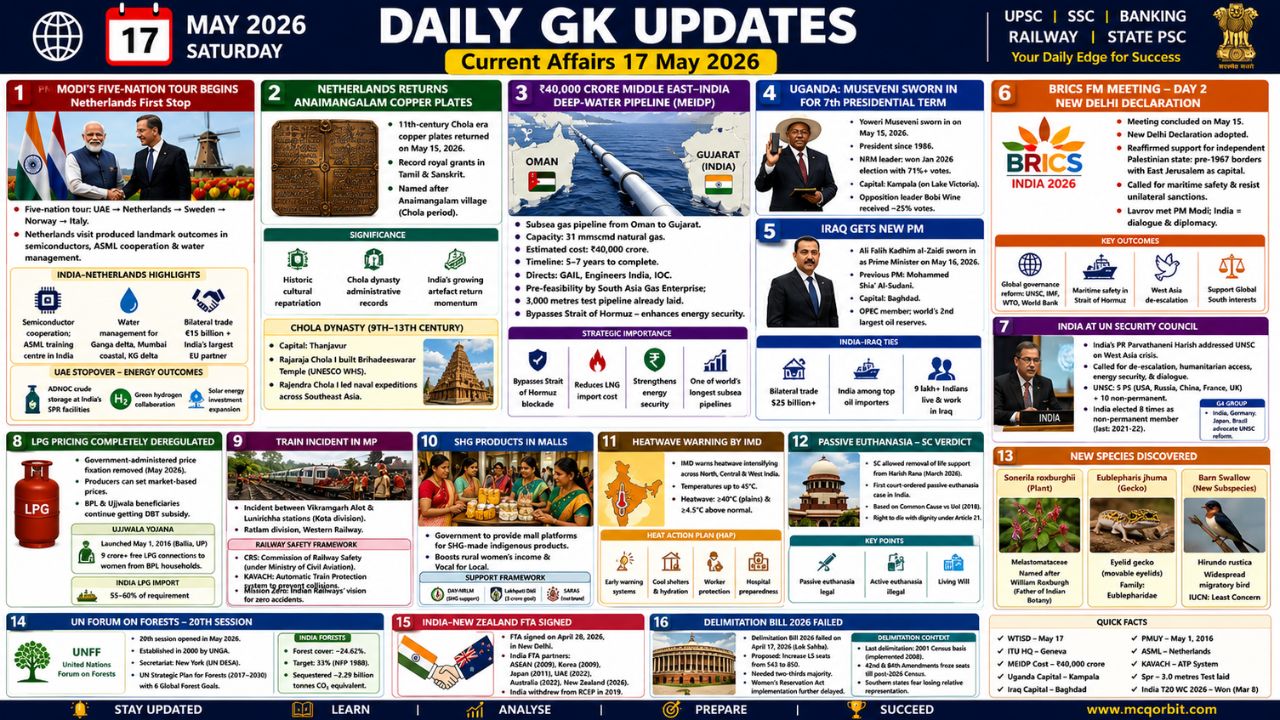
17 May 2026 Current Affairs is headlined by PM Modi's Netherlands visit producing landmark outcomes — including the historic India-Netherlands Joint Statement on semiconductors and ASML cooperation — while also completing a UAE stopover that added significant energy diplomacy outcomes. India's LPG pricing was completely deregulated — a landmark economic reform removing government-administered price fixation.
The Supreme Court delivered a verdict on passive euthanasia in March 2026 that continues to generate legal discourse. New species discovered — Sonerila roxburghii (plant), Eublepharis jhuma (gecko), and a new Barn Swallow subspecies. The United Nations Forum on Forests 20th session opened. India's Committee on Empowerment of Women tabled a significant report. A train derailment occurred in Madhya Pradesh's Ratlam division. Kerala's new CM V.D. Satheesan assumed office. IMD warned of intensifying heatwaves across North and Central India. India's Permanent Representative to the UN addressed the West Asia crisis at the Security Council. Let's break it all down.
Important Day — World Telecommunication and Information Society Day, May 17
World Telecommunication and Information Society Day 2026 — "Digital Innovation for Sustainable Development"
May 17 is observed globally as World Telecommunication and Information Society Day (WTISD) — one of the oldest UN observances in the technology space.
Key facts:
Fact | Detail |
|---|---|
Observed on | May 17 every year |
Established by | International Telecommunication Union (ITU) |
Commemorates | May 17, 1865 — founding of the ITU and signing of the first International Telegraph Convention |
2026 Theme | "Digital Innovation for Sustainable Development" |
ITU headquarters | Geneva, Switzerland |
ITU established | 1865 — world's oldest intergovernmental organisation |
UN Specialised Agency | Since 1947 |
Why May 17, 1865? On May 17, 1865, twenty European nations signed the first International Telegraph Convention in Paris and established the International Telegraph Union — which later became the International Telecommunication Union (ITU). This made the ITU the world's oldest intergovernmental organisation — older than the UN (1945), the League of Nations (1920), and the Universal Postal Union (1874).
ITU's current role:
Manages the global radio frequency spectrum — allocating bandwidth to countries and services (mobile, satellite, broadcasting, aviation, maritime)
Sets international telecommunication standards — including those for 5G, IoT, and broadband
Bridges the digital divide — promoting connectivity in developing nations
India is an ITU member and has been elected to the ITU Council multiple times
India's telecom landscape:
India has approximately 1.17 billion wireless subscribers — the world's 2nd largest telecom market
JIO disrupted the market in 2016 — triggering a price war that made India's mobile data one of the cheapest in the world
India's 5G rollout began in October 2022 and has since reached hundreds of cities
BharatNet — the flagship rural broadband programme — aims to connect all 2.5 lakh Gram Panchayats with high-speed optical fibre
TRAI (Telecom Regulatory Authority of India) — established under the TRAI Act 1997 — is India's telecom regulator
📌 WTISD = May 17. ITU founded = May 17, 1865 (International Telegraph Convention, Paris). World's oldest intergovernmental organisation. HQ = Geneva. UN Specialised Agency since 1947. 2026 Theme = "Digital Innovation for Sustainable Development." India = world's 2nd largest telecom market (~1.17 billion subscribers). BharatNet = rural broadband (2.5 lakh GPs). TRAI = TRAI Act 1997.
International Affairs & Diplomacy
PM Modi's Five-Nation Tour — Netherlands Visit Produces Semiconductor Landmark
PM Modi arrived in the Netherlands — after a brief stopover in the UAE — on the second leg of his five-nation tour that also includes Sweden, Norway, and Italy.
The five-nation tour — complete itinerary:
Stop | Country | Key Focus |
|---|---|---|
1 | UAE (stopover) | Energy security, petroleum storage, bilateral trade |
2 | Netherlands | Semiconductors, ASML, water management, trade |
3 | Sweden | Clean technology, defence, green innovation |
4 | Norway | Maritime, ocean economy, renewable energy |
5 | Italy | G7 engagement, Italy-India bilateral, Mediterranean connectivity |
India-Netherlands Joint Statement — key outcomes:
Semiconductors and ASML: The centerpiece of the Netherlands visit was India's engagement with ASML — the Dutch company that holds a virtual monopoly on Extreme Ultraviolet (EUV) lithography machines — the equipment essential for manufacturing chips at 7nm and below. Key outcomes:
India and the Netherlands committed to a semiconductor cooperation framework — covering technology transfer, joint research, and India's access to ASML's ecosystem
ASML to open a service and training centre in India — enabling Indian engineers to be trained on the world's most advanced chip-manufacturing equipment
Cooperation with IMEC (Belgium-based semiconductor research centre) also discussed in the broader Benelux semiconductor context
Water management partnership:
The Netherlands is the world's foremost authority on delta management, flood control, and coastal protection
India signed agreements for Dutch expertise to be applied to the Ganga delta, Mumbai coastal flooding, and the Krishna-Godavari delta
Relevant given India's increasing exposure to cyclones, sea-level rise, and urban flooding
India-Netherlands trade:
Bilateral trade exceeds €15 billion annually
The Netherlands is India's largest trade partner within the EU (largely due to Rotterdam port's role as Europe's entry point)
Key Indian exports: pharmaceuticals, textiles, chemicals
Key Dutch exports: machinery, electronics, chemicals, agricultural products
UAE Stopover — energy outcomes: The UAE stopover — en route from New Delhi to Amsterdam — produced several energy-focused outcomes building on the India-UAE Strategic Petroleum Storage Agreement signed on May 15. India and UAE discussed:
ADNOC's expanded crude storage at India's SPR facilities
Green hydrogen collaboration — UAE's ADNOC Green has significant hydrogen ambitions aligning with India's National Green Hydrogen Mission
Renewable energy investment — UAE's sovereign wealth fund (ADIA) expanding investments in India's solar sector
PM Modi five-nation tour: UAE (stopover) → Netherlands → Sweden → Norway → Italy. ASML = Dutch company, near-monopoly on EUV lithography for advanced chips. ASML training centre to open in India. Netherlands = India's largest EU trade partner. Bilateral = €15 billion+. Water management = Ganga delta + Mumbai coastal + KG delta. UAE stopover = energy (SPR storage + green hydrogen + solar investment). ADNOC = Abu Dhabi National Oil Company. National Green Hydrogen Mission = India's H₂ policy framework.
India at UN Security Council — Parvathaneni Harish Addresses West Asia Crisis
India's Permanent Representative to the UN, Parvathaneni Harish, addressed the UN Security Council on the West Asia crisis, stating that "a combination of short-term and structural measures alongside international cooperation are essential to respond to the crisis."
India's position at the UNSC: India's statement at the UNSC reflects its carefully calibrated strategic autonomy on West Asia:
Calling for immediate de-escalation without directly naming any party
Emphasising humanitarian access and civilian protection in Gaza and conflict zones
Stressing energy security — implicitly referencing the Strait of Hormuz blockade
Advocating for dialogue and diplomacy — consistent with India's position across the Russia-Ukraine and West Asia conflicts
Pushing for UNSC reform — India has long advocated for permanent membership and greater representation for the Global South
About the UN Security Council:
The UNSC is the UN organ with primary responsibility for international peace and security
5 Permanent Members (P5): USA, Russia, China, France, UK — with veto power
10 Non-Permanent Members: Elected by UNGA for 2-year terms — 5 elected each year
India has been elected as a non-permanent UNSC member 8 times — most recently for 2021-22
India's demand: A permanent UNSC seat — backed by the G4 group (India, Germany, Japan, Brazil)
Parvathaneni Harish: India's current Permanent Representative (PR) to the United Nations — based in New York. The PR to the UN holds the rank of Ambassador and represents India's foreign policy positions at all UN bodies.
India's UN PR = Parvathaneni Harish. Addressed UNSC on West Asia crisis. India's UNSC position = de-escalation + humanitarian access + dialogue. UNSC = 5 P5 (veto) + 10 non-permanent (2-year terms). India = non-permanent member 8 times (last 2021-22). G4 = India + Germany + Japan + Brazil (UNSC reform advocates). India demands permanent UNSC seat.
Kerala — V.D. Satheesan Elected New Chief Minister
V.D. Satheesan was elected as the Chief Minister of Kerala on 14 May 2026 — following the 2026 Kerala Assembly elections.
About V.D. Satheesan:
Veena Davis Satheesan — popularly known as V.D. Satheesan — is a senior leader of the Indian National Congress (INC)
He served as the Leader of Opposition in the Kerala Legislative Assembly from 2021 onwards, following the LDF's victory
A lawyer by profession — known for his articulate floor management and aggressive opposition tactics against the Pinarayi Vijayan-led LDF government
His election as CM follows a UDF (United Democratic Front) — Congress-led victory in the 2026 Kerala elections — replacing the LDF (Left Democratic Front) government
Kerala at a glance:
140-member Legislative Assembly
Capital: Thiruvananthapuram
Known for: Kerala Model of Development — high Human Development Index (HDI), near-100% literacy, strong public health system
Alternate power structure: Kerala traditionally alternates between UDF (Congress + allies) and LDF (CPI-M + allies) governments every 5 years — the 2026 election continues this pattern
Kerala's governance significance for exams:
Kerala Model: High social indicators despite moderate per capita income — often cited in debates about development vs GDP growth
Kudumbashree: Kerala's flagship women's SHG network — one of the world's largest poverty alleviation programmes
KIIFB (Kerala Infrastructure Investment Fund Board): Off-budget infrastructure financing mechanism — subject of CAG scrutiny
V.D. Satheesan = new Kerala CM (elected May 14, 2026). INC leader. Former Leader of Opposition. UDF victory in 2026 Kerala elections. Kerala = 140-member assembly. Capital = Thiruvananthapuram. Kerala Model = high HDI + literacy + public health. Kudumbashree = women's SHG network. Kerala alternates UDF-LDF every 5 years.
West Bengal — Suvendu Adhikari as BJP CM Inaugurated May 9
The BJP's Suvendu Adhikari was inaugurated as Chief Minister of West Bengal on 9 May 2026 — following BJP's victory in the 2026 West Bengal Legislative Assembly elections (held April 23–29).
About Suvendu Adhikari:
A senior BJP leader from West Bengal — previously a TMC leader who switched to BJP before the 2021 elections
Represents Nandigram constituency — where he had a historic contest against Mamata Banerjee in 2021 (which he won narrowly)
His swearing-in marks a historic political shift — the first BJP Chief Minister of West Bengal
The significance of BJP winning West Bengal: West Bengal had been dominated by the Left Front (1977–2011) and then by TMC under Mamata Banerjee (2011–2026). BJP winning the state is a watershed moment in Indian politics — reflecting the transformation of West Bengal's political landscape and the gradual decline of TMC's dominance.
West Bengal at a glance:
294-member Legislative Assembly
Capital: Kolkata
West Bengal sends 42 MPs to Lok Sabha — making it crucial in national politics
Known for: Cultural heritage (Rabindranath Tagore, Nobel laureates), tea (Darjeeling), jute, Sundarbans
Suvendu Adhikari = first BJP CM of West Bengal (inaugurated May 9, 2026). BJP won 2026 WB elections. WB = 294-member assembly, 42 Lok Sabha seats. Capital = Kolkata. TMC under Mamata ruled 2011–2026. Left Front ruled 1977–2011. Historic political shift for WB.
Economy & Policy
LPG Pricing Completely Deregulated — Government Removes Price Fixation
Under the new policy, the government-administered price fixation has been completely deregulated for LPG, and product placement within slabs has been left to the producers.
What this means — the LPG deregulation story: For decades, LPG (Liquefied Petroleum Gas) — the primary cooking fuel for hundreds of millions of Indian households — was a subsidised, government-controlled product. The government:
Set the retail price (often below market cost)
Provided a Direct Benefit Transfer (DBT) subsidy to BPL households
Mandated that OMCs (Oil Marketing Companies — IOC, BPCL, HPCL) sell at the administered price
Under the new deregulation:
Government-administered price fixation = completely removed
OMCs can set their own prices based on market conditions
Product placement within slabs (different cylinder sizes and categories) left to producers
DBT subsidies for BPL households continue — but market pricing applies for non-subsidised consumers
Why deregulate now?
West Asian energy crisis has made global LPG prices highly volatile — an administered price becomes fiscally unsustainable when import costs spike
India imports approximately 55–60% of its LPG requirement — primarily from Gulf countries
Deregulation allows prices to reflect actual import costs — reducing the fiscal burden on the government and OMCs
Aligns with the broader fuel pricing liberalisation trajectory (petrol deregulated in 2010, diesel in 2014, LPG now deregulated in 2026)
The subsidy protection: Despite deregulation, the Ujjwala Yojana beneficiaries and BPL households will continue receiving targeted LPG subsidies through DBT (Direct Benefit Transfer) — ensuring the poor are protected from market price volatility.
Pradhan Mantri Ujjwala Yojana (PMUY):
Launched: May 1, 2016 (Ballia, UP)
Objective: Provide free LPG connections to women from BPL households
Target: Initially 5 crore connections (achieved); expanded to 9 crore+ connections
Ujjwala 2.0: Extended to migrant workers and homeless households (launched August 2021)
LPG pricing completely deregulated (May 2026). Government-administered price fixation removed. Producers can set prices. BPL/Ujjwala beneficiaries continue getting DBT subsidies. India imports 55–60% of LPG. Petrol deregulated 2010, diesel 2014, LPG 2026. PMUY = PM Ujjwala Yojana; launched May 1, 2016; 9 crore+ connections. DBT = Direct Benefit Transfer. OMCs = IOC, BPCL, HPCL.
Train Derailment — Ratlam Division, MP
A train incident occurred between Vikramgarh Alot and Lunirichha stations under the Kota division of the railways — reported by PRO Mukesh Kumar of the Ratlam division.
India's railway safety framework: Train derailments and accidents are monitored and investigated by the Commission of Railway Safety (CRS) — an independent statutory body under the Ministry of Civil Aviation (not Railways — for independence). Key institutional framework:
CRS: Investigates accidents, inspects new lines before commissioning, and submits reports to Parliament
RDSO (Research Designs and Standards Organisation): Based in Lucknow; develops and certifies railway equipment standards
KAVACH system: India's indigenous Automatic Train Protection (ATP) system — designed to prevent collisions by automatically applying brakes when signals are violated. Currently being rolled out progressively across the network
Indian Railways' Mission Zero: Vision of eliminating train accidents — with KAVACH as the primary technological solution
Ratlam Division: Part of the Western Railway Zone — headquartered in Mumbai. The Ratlam division covers central MP and connects major cities in the region.
Train incident = Vikramgarh Alot-Lunirichha, Kota division, MP. CRS = Commission of Railway Safety = under Ministry of Civil Aviation (independent of Railways). KAVACH = Automatic Train Protection (ATP) system = prevents collisions. RDSO = Research Designs and Standards Organisation, Lucknow. Mission Zero = Indian Railways' accident elimination vision.
SHG Products in Malls — Urban Market Access for Rural Women
The government will provide platforms in malls and large shopping complexes across the city to help indigenous products made by women self-help groups (SHGs) reach a wider market.
India's SHG ecosystem: India has the world's largest network of women's Self-Help Groups (SHGs) — approximately 90 lakh SHGs connected through:
DAY-NRLM (Deen Dayal Antyodaya Yojana — National Rural Livelihoods Mission): The flagship government programme supporting SHGs — with 9 crore+ women members
Lakhpati Didi initiative: PM Modi's goal to make 3 crore rural women annual earners of ₹1 lakh+ through SHG-linked enterprises
SARAS (Social Artisans Retailing of Skills): NRLM's national brand for SHG products
Mall-based retail for SHG products — why it matters: SHGs produce a vast range of products — handicrafts, textiles, food products, agarbatti (incense), pickles, papads, organic produce. The challenge has always been market access — SHG products struggle to compete with branded products on mainstream retail shelves. Mall-based display platforms:
Give SHG products premium urban visibility
Connect rural producers directly to urban consumers
Build the Vocal for Local movement with concrete infrastructure
Enable premium pricing for authentic handmade products
Kudumbashree model: Kerala's Kudumbashree programme — often cited as India's most successful SHG network — provides a template for how SHG products can achieve mainstream market presence, with dedicated retail outlets in Kerala's cities.
SHG mall platforms = government initiative for urban market access for rural women's products. India = ~90 lakh SHGs. DAY-NRLM = Deen Dayal Antyodaya Yojana-NRLM = flagship SHG support. Lakhpati Didi = 3 crore women earning ₹1 lakh+/year. SARAS = NRLM's national SHG product brand. Vocal for Local. Kudumbashree = Kerala's SHG model.
Heatwave Warning — IMD Issues Alert for North, Central and West India
IMD warned of intensifying heatwave across North, Central and West India with temperatures rising up to 45°C, while other regions brace for thunderstorms, gusty winds and rain.
IMD's heatwave criteria — recap:
Heatwave: Maximum temperature ≥ 40°C in plains (37°C in hilly regions) AND either:
≥ 4.5°C above normal; OR
≥ 45°C in absolute terms
Severe Heatwave: ≥ 6.4°C above normal or ≥ 47°C
Why May 2026 heatwave is particularly intense: The West Asian conflict and Strait of Hormuz blockade has reduced LNG availability for cooling — power cuts are more common in some states, amplifying heat stress. The pre-monsoon season (April–June) is India's hottest period — and climate change is extending both the duration and geographic spread of heatwaves.
Heat Action Plans (HAPs): Several Indian states have adopted Heat Action Plans following the 2010 Ahmedabad heatwave (which killed 1,300+ people) — a pioneering case study in urban heat emergency response:
Early warning systems via IMD
Cool shelters (schools, government buildings opened as rest points)
Rescheduling outdoor activities to early morning or evening
Hydration campaigns for construction workers and street vendors
Hospital preparedness protocols
NDMA Heat Guidelines: The National Disaster Management Authority (NDMA) has published national guidelines for heatwave management — making heatwaves a formally recognised disaster under India's disaster management framework.
IMD heatwave warning = May 17, 2026. Temperatures up to 45°C in North, Central, West India. Heatwave = ≥40°C (plains) + ≥4.5°C above normal. Severe Heatwave = ≥6.4°C above normal or ≥47°C. 2010 Ahmedabad heatwave = pioneer case for HAPs. NDMA = manages heatwave as recognised disaster. Climate change = extending heatwave duration and spread.
Environment, Biodiversity & Science
New Species Discovered — Sonerila roxburghii, Eublepharis jhuma, New Barn Swallow
New species recently discovered and making news on May 17 include: Sonerila roxburghii (plant), Eublepharis jhuma (gecko), Barn Swallow subspecies, and the United Nations Forum on Forests 20th session opened.
1. Sonerila roxburghii — New Plant Species
About Sonerila roxburghii:
A new species of Sonerila — a genus of flowering plants belonging to the family Melastomataceae
Named after William Roxburgh (1751–1815) — the Scottish botanist and surgeon who served as superintendent of the Calcutta Botanical Garden (now Acharya Jagadish Chandra Bose Indian Botanic Garden) — considered the "Father of Indian Botany"
Likely discovered in the Western Ghats or Northeast India — India's primary hotspots for Sonerila diversity
The Sonerila genus has over 200 species globally — primarily found in tropical Asia
About the Melastomataceae family: A large family of flowering plants — mostly tropical — known for their distinctive leaf venation (prominent parallel veins) and often colourful flowers. Common members include Tibouchina (glory bush) and Melastoma malabathricum (Malabar melastome — a common Indian species).
2. Eublepharis jhuma — New Gecko Species
About Eublepharis jhuma:
A new species of eyelid gecko belonging to the genus Eublepharis — family Eublepharidae
The genus Eublepharis is significant because unlike most geckos, Eublepharis geckos have movable eyelids — a distinctive feature (most geckos have transparent, immovable scales covering their eyes)
India's most famous Eublepharis species is the Indian Leopard Gecko (Eublepharis macularius) — one of the most popular reptile pets globally
Eublepharis jhuma likely represents a new species from India's northeastern or peninsular region — expanding the known diversity of this scientifically important genus
Named using a local or tribal name — reflecting India's growing practice of honouring indigenous ecological knowledge in scientific nomenclature
3. Barn Swallow — New Subspecies
About the Barn Swallow (Hirundo rustica):
One of the world's most widespread and well-studied migratory birds — found on every continent except Antarctica
Famous for its long-distance migration — breeding in the Northern Hemisphere (Europe, Asia, North America) and wintering in the Southern Hemisphere (Africa, South Asia, South America)
India is a critical wintering ground for Barn Swallows from Central Asia and Siberia
The new subspecies represents cryptic diversity — genetically and morphologically distinct populations that were previously lumped under the same subspecies
IUCN Status: Least Concern (overall species) — but subspecific status is important for targeted conservation
Barn Swallow — India context: The Pacific Swallow (Hirundo tahitica) and Barn Swallow are common visitors to India. Their population trends serve as indicator species for insect abundance — declining swallow populations signal collapsing insect populations (often linked to pesticide use and habitat loss).
Sonerila roxburghii = new plant; family Melastomataceae; named after William Roxburgh ("Father of Indian Botany"). Eublepharis jhuma = new eyelid gecko; family Eublepharidae; Eublepharis = movable eyelids (unlike most geckos). Barn Swallow = Hirundo rustica; new subspecies; widespread migratory bird. IUCN = Least Concern. India = wintering ground for Barn Swallows from Central Asia.
United Nations Forum on Forests — 20th Session Opens
The United Nations Forum on Forests (UNFF) 20th session opened in May 2026.
About UNFF:
Fact | Detail |
|---|---|
Full name | United Nations Forum on Forests |
Established | 2000 by UNGA resolution |
Secretariat | New York (part of UN Department of Economic and Social Affairs — DESA) |
Mandate | Promote management, conservation, and sustainable development of all types of forests |
Membership | All UN member states |
Key framework | UN Strategic Plan for Forests 2017–2030 |
UN Strategic Plan for Forests 2017–2030: The plan has 6 Global Forest Goals (GFGs):
Reverse deforestation and increase forested area by 3% globally by 2030
Enhance forest-based economic, social, and environmental benefits
Increase protected forests and sustainably managed forests
Mobilise financing for sustainable forest management
Promote governance frameworks for sustainable forest management
Enhance cooperation, science-policy interface, and cross-sectoral coordination
India's forest cover:
India's total forest and tree cover: approximately 24.62% of geographical area (State of Forest Report 2023)
India's target: Achieve 33% forest cover — mandated under the National Forest Policy 1988
India sequestered approximately 2.29 billion tonnes of CO₂ equivalent through its forests — a key part of India's NDC (Nationally Determined Contribution) under the Paris Agreement
Key Indian forest legislation:
Indian Forest Act, 1927 — the primary forest governance law (colonial-era, still operative)
Forest Conservation Act, 1980 (now Van Sanrakshan Evam Janpadiya Parivesh Adhiniyam, 2023) — regulates diversion of forest land for non-forest purposes
Forest Rights Act, 2006 — recognises tribal and forest dwellers' rights
UNFF = UN Forum on Forests. Est. 2000 by UNGA. Secretariat = New York (UN DESA). 20th session = May 2026. UN Strategic Plan for Forests = 2017–2030. 6 Global Forest Goals. India forest cover = ~24.62%. Target = 33% (National Forest Policy 1988). India carbon sequestration = ~2.29 billion tonnes CO₂ eq. Forest Rights Act 2006. Forest Conservation Act 1980 (now Van Sanrakshan Act 2023).
Rottnest Island — Geographic Feature in Focus
Rottnest Island appeared in current affairs discussions.
About Rottnest Island:
Located approximately 27 km west of Perth, in Western Australia
Famous for being home to the Quokka — a small marsupial often called the "world's happiest animal" due to its naturally smiling expression
Name origin: Dutch explorer Willem de Vlamingh named it "Rotte Nest" (Rat's Nest) in 1696 — mistaking Quokkas for large rats
The island is a popular tourist destination and marine park
Quokka (Setonix brachyurus): Small wallaby-like marsupial; IUCN status = Vulnerable; found almost exclusively on Rottnest Island and Bald Island
The "Quokka selfie" trend — where tourists photograph themselves with the friendly Quokkas — became a global social media phenomenon
Australia-India context: The Rottnest Island geography is relevant for mapping-based questions in competitive exams, and the Quokka is a commonly tested species in wildlife/biodiversity sections — particularly for its IUCN status and unique geographic distribution.
Rottnest Island = 27 km west of Perth, Western Australia. Famous for Quokka (Setonix brachyurus). Name = "Rat's Nest" (Dutch, 1696) — mistook Quokkas for rats. Quokka IUCN = Vulnerable. "World's happiest animal." Willem de Vlamingh = Dutch explorer who named it.
Committee on Empowerment of Women — Parliamentary Committee Report
The Committee on Empowerment of Women tabled a significant report in Parliament.
About the Committee on Empowerment of Women: The Parliamentary Committee on Empowerment of Women is a Joint Committee of Parliament — comprising members from both the Lok Sabha and Rajya Sabha. It was constituted in 1997. Its mandate includes:
Examining legislation and policies related to women's welfare, safety, and empowerment
Reviewing the functioning of the Ministry of Women and Child Development (MoWCD)
Scrutinising the implementation of schemes for women including Beti Bachao Beti Padhao, Mission Shakti, Ujjwala Yojana
Examining issues of women's representation in Parliament, state legislatures, and local bodies
Key women's empowerment data for exams:
Women's literacy rate: ~71.5% (Census 2011) — significantly lower than men (~84.7%)
Female Labour Force Participation Rate (LFPR): Approximately 33% (PLFS 2023-24) — below global average but showing improvement
Women in Parliament: Following the Nari Shakti Vandan Adhiniyam (Women's Reservation Act, 2023) — 33% reservation for women in Lok Sabha and State Assemblies (to be implemented after delimitation)
Sex Ratio at Birth: Improving — from 918 (2012) to approximately 934 girls per 1,000 boys (recent data)
Nari Shakti Vandan Adhiniyam (Constitution 106th Amendment Act, 2023): The Women's Reservation Act was passed in September 2023 — a landmark legislation reserving 33% of seats in the Lok Sabha, state legislative assemblies, and Delhi Assembly for women. However, implementation is tied to the next delimitation exercise — which will follow Census 2027, meaning the reservation will likely be first effective from 2029 elections onwards.
Parliamentary Committee on Empowerment of Women = Joint Committee of Parliament, constituted 1997. Reviews MoWCD + women's schemes. Women's Reservation Act = Constitution 106th Amendment, 2023 = 33% seats in Lok Sabha + state assemblies. Implementation = after delimitation (post-Census 2027) = likely 2029 elections. Female LFPR = ~33% (improving). Nari Shakti Vandan Adhiniyam.
Passive Euthanasia — Supreme Court's Landmark Ruling (March 2026) Remains in Discourse
The Supreme Court ruled in favor of removing life support from Harish Rana, who had been in a vegetative state following a fall in 2013 — marking the first time that passive euthanasia has been allowed by an Indian court on application.
The legal framework for euthanasia in India:
Types of Euthanasia:
Active Euthanasia: Deliberately administering a lethal substance to end life — illegal in India (constitutes murder under BNS)
Passive Euthanasia: Withdrawal of life support allowing natural death — legalised in India by the Supreme Court in the Common Cause vs Union of India (2018) judgment
Common Cause vs Union of India (2018) — landmark ruling: The SC's 5-judge Constitution Bench ruled that:
Passive euthanasia is legal in India
Advance Medical Directives (Living Wills) — written instructions about end-of-life care — are legally valid and enforceable
The right to die with dignity is part of Article 21 (Right to Life)
The Harish Rana case (March 2026): This is the first individual case where a court has specifically ordered removal of life support — translating the 2018 Constitution Bench ruling into concrete judicial action. Harish Rana had been in a Permanent Vegetative State (PVS) since 2013 — 13 years. The case sets a precedent for how family petitions seeking passive euthanasia will be adjudicated.
Key precedents:
Aruna Shanbaug case (2011): SC first considered passive euthanasia in India — rejected in that specific case but acknowledged its legality in principle
Common Cause (2018): Legally validated advance directives and passive euthanasia
Harish Rana (2026): First actual court-ordered life support removal
Passive euthanasia = legal in India (Common Cause vs UoI, 2018 SC ruling). Active euthanasia = illegal. Article 21 (Right to Life) = includes right to die with dignity. Advance Medical Directive (Living Will) = legally valid. Harish Rana case (March 2026) = first court-ordered life support removal. PVS = Permanent Vegetative State. Aruna Shanbaug (2011) = earlier SC consideration.
New Zealand-India FTA — Signed April 28, 2026
The New Zealand–India Free Trade Agreement was signed in New Delhi on April 28, 2026.
India's FTA landscape: India has been actively expanding its FTA network — a significant shift from its earlier cautious approach to trade agreements. Key India FTAs:
Partner | FTA Name | Year |
|---|---|---|
ASEAN | India-ASEAN CECA | 2009 |
South Korea | India-Korea CEPA | 2009 |
Japan | India-Japan CEPA | 2011 |
UAE | India-UAE CEPA | 2022 |
Australia | India-Australia ECTA | 2022 |
New Zealand | India-NZ FTA | 2026 |
Why India-New Zealand FTA matters:
New Zealand is a major dairy, meat, and agricultural exporter — India's dairy sector will be closely watching tariff concessions
New Zealand's high-value horticulture (kiwifruit, apples) and wool are potential import items
India's pharmaceutical, IT, and textile exports to New Zealand will benefit from reduced tariffs
New Zealand is a Five Eyes member and AUKUS-adjacent strategically — the FTA has geopolitical dimensions beyond trade
India's FTA caution: India withdrew from RCEP (Regional Comprehensive Economic Partnership) in 2019 — citing concerns about Chinese goods flooding India's market through RCEP members. India's selective FTA strategy focuses on partners who are geopolitically aligned and where trade complementarity (rather than competition) is stronger.
India-NZ FTA signed = April 28, 2026, New Delhi. India's FTA network: ASEAN (2009), South Korea (2009), Japan (2011), UAE (2022), Australia (2022), New Zealand (2026). India withdrew from RCEP in 2019. NZ = Five Eyes member. Dairy + agriculture = key NZ export sensitivity. India pharma + IT + textiles = India's FTA gains.
India Men Won T20 World Cup 2026 — March 8, 2026
India beat New Zealand in the final match and won the 2026 Men's T20 World Cup in cricket on March 8, 2026.
T20 World Cup 2026 — key facts:
Fact | Detail |
|---|---|
Tournament | ICC Men's T20 World Cup 2026 |
Host | To be confirmed (early 2026 editions varied) |
Final — result | India beat New Zealand |
Final date | March 8, 2026 |
India's T20 WC wins | 2007 (inaugural), 2024, 2026 |
India's cricket history with T20 World Cup:
2007: India won the inaugural T20 WC under MS Dhoni — defeating Pakistan in the final in Johannesburg
2024: India won the T20 WC under Rohit Sharma — defeating South Africa in Barbados
2026: India won again — defeating New Zealand in the final
ICC — key facts:
ICC (International Cricket Council) — global cricket governing body
Headquarters: Dubai, UAE
Founded: 1909 (as Imperial Cricket Conference; renamed ICC in 1989)
Members: 108 (12 full members, 96 associate/affiliate members)
India won T20 World Cup 2026 on March 8, defeating New Zealand in final. India's T20 WC titles: 2007 (Dhoni), 2024 (Rohit Sharma), 2026. ICC = International Cricket Council, HQ Dubai, founded 1909.
Delimitation Bill 2026 Failed — Lok Sabha Seats Not Increased
The Delimitation Bill 2026 and the Constitution (131st Amendment) Bill 2026 proposing the increase in Lok Sabha seats from 543 to 850 to implement the Women's Reservation Bill failed to pass in Parliament due to a lack of a two-thirds majority in the Lok Sabha on April 17, 2026.
Why this is constitutionally significant: The Women's Reservation Act (Constitution 106th Amendment, 2023) stipulated that 33% reservation for women in Lok Sabha would be implemented only after delimitation. The Delimitation Bill 2026 proposed to expand Lok Sabha from 543 to 850 seats as part of that delimitation exercise. Its failure means:
Women's reservation implementation is further delayed
The current 543-seat Lok Sabha continues without the expanded 850-seat structure
A two-thirds majority (special majority) is required for constitutional amendments — the NDA government apparently fell short
Delimitation background:
India's last delimitation was done based on the 2001 Census — implemented in 2008
Lok Sabha seat freeze: The 42nd Amendment Act (1976) and 84th Amendment Act (2002) froze the number of Lok Sabha seats based on 1971 Census until after the first Census post-2026
Census 2027 will trigger a new delimitation — potentially changing seat allocation among states
Political sensitivity: The increase to 850 seats particularly concerns southern states — which have managed population growth better than northern states. Under delimitation, northern states (UP, Bihar, MP, Rajasthan) would gain more seats proportionally, while southern states (Tamil Nadu, Kerala, Karnataka, AP, Telangana) could lose relative representation — a profound centre-south political tension.
Delimitation Bill 2026 = failed in Lok Sabha (April 17, 2026). Proposed 543 → 850 Lok Sabha seats. Needed two-thirds majority (constitutional amendment). Women's Reservation Act (2023) = 33% seats; implementation tied to delimitation. Last delimitation = 2001 Census basis (2008). 42nd + 84th Amendments = froze seats until post-2026 Census. Southern states fear losing relative representation. Census 2027 = will trigger new delimitation.
FAQs — 17 May 2026 Current Affairs
Q. Why is May 17 observed as World Telecommunication and Information Society Day?
May 17 commemorates the founding of the International Telecommunication Union (ITU) on May 17, 1865 — when 20 European nations signed the first International Telegraph Convention in Paris. ITU is the world's oldest intergovernmental organisation, headquartered in Geneva, and became a UN Specialised Agency in 1947. The 2026 theme is "Digital Innovation for Sustainable Development."
Q. What are the key outcomes of PM Modi's Netherlands visit?
The Netherlands visit produced a semiconductor cooperation framework — including ASML opening a service and training centre in India (critical as ASML holds a near-monopoly on EUV lithography machines for advanced chips). India and the Netherlands signed agreements on water management cooperation for the Ganga delta, Mumbai coastal flooding, and KG delta. Bilateral trade stands at €15 billion — the Netherlands is India's largest EU trade partner. The UAE stopover produced energy outcomes including expanded ADNOC crude storage at India's SPR facilities and green hydrogen cooperation.
Q. What is the significance of LPG pricing deregulation in 2026?
LPG pricing has been completely deregulated — government-administered price fixation is removed and producers can set prices based on market conditions. This follows petrol deregulation in 2010 and diesel in 2014. India imports 55–60% of its LPG. BPL and Ujjwala Yojana beneficiaries continue receiving subsidies through DBT. PMUY was launched May 1, 2016, and has provided 9 crore+ connections. Deregulation is driven by West Asian energy price volatility making administered pricing fiscally unsustainable.
Q. What are the new species discovered as of May 17, 2026?
Three new species: (1) Sonerila roxburghii — a new plant of the Melastomataceae family, named after William Roxburgh ("Father of Indian Botany" who headed the Calcutta Botanical Garden); (2) Eublepharis jhuma — a new eyelid gecko of the Eublepharidae family, notable for having movable eyelids unlike most geckos; and (3) a new Barn Swallow (Hirundo rustica) subspecies — the Barn Swallow is a widespread migratory bird that winters in India from Central Asian breeding grounds.
Q. What is the UN Forum on Forests and what is its significance?
UNFF was established by UNGA in 2000 and its Secretariat is in New York (UN DESA). Its 20th session opened in May 2026. It promotes sustainable forest management under the UN Strategic Plan for Forests 2017–2030 which has 6 Global Forest Goals including reversing deforestation and increasing global forested area by 3% by 2030. India's forest cover is ~24.62% against a target of 33% (National Forest Policy 1988). India's forests sequester ~2.29 billion tonnes of CO₂ equivalent — a key part of India's NDC.
Q. What is the Harish Rana case and how does it relate to passive euthanasia law?
The SC ruled in the Harish Rana case (March 2026) to allow removal of life support from Harish Rana — in a permanent vegetative state since 2013. This is the first time an Indian court has specifically ordered life support removal — translating the landmark Common Cause vs Union of India (2018) Constitution Bench ruling into concrete judicial practice. The 2018 ruling established that passive euthanasia is legal in India, Advance Medical Directives (Living Wills) are valid, and the right to die with dignity is part of Article 21.
Q. Why did the Delimitation Bill 2026 fail and what are its implications?
The Delimitation Bill 2026 — proposing expansion of Lok Sabha from 543 to 850 seats — failed in Parliament on April 17, 2026, due to the NDA government lacking the two-thirds majority required for constitutional amendments. Its failure delays implementation of the Women's Reservation Act (2023), which mandated 33% seats for women only after delimitation. The bill's failure also reflects the deep political sensitivity around delimitation — with southern states concerned about losing relative representation to faster-growing northern states.
Q. What is India's FTA strategy and where does the New Zealand FTA fit?
India-New Zealand FTA was signed on April 28, 2026, expanding India's FTA network which includes ASEAN (2009), South Korea (2009), Japan (2011), UAE (2022), and Australia (2022). India withdrew from RCEP in 2019 citing Chinese goods concerns. The NZ FTA involves sensitive sectors — NZ's dairy and agriculture exports to India's protected market, while India's pharma, IT, and textiles gain preferential access. New Zealand is a Five Eyes member, giving the FTA geopolitical significance beyond trade.
Written by
Koti Deva
Digital Marketing Specialist
Koti is a Digital Marketing Specialist with over 10 years of experience and the co-founder of MCQ Orbit — a free exam prep platform built for Indian competitive exam aspirants.
With strong personal knowledge in Quantitative Aptitude, Logical Reasoning, and Mathematics, Koti has a deep understanding of what it takes to crack exams like SSC CGL, IBPS PO, SBI Clerk, UPSC Prelims, NEET, and JEE. Having followed these exams closely for years, he understands the exact topics, patterns, and shortcuts that matter most.
MCQ Orbit was born from a simple desire — to build a platform where every aspirant in India can practice quality MCQs, read reliable current affairs, and prepare confidently, without paying a rupee. Koti combines his digital expertise with his passion for competitive exams to create content that is accurate, practical, and genuinely useful for students.
His mission is straightforward: if the right guidance had been freely available earlier, more students would have cracked their dream exams. MCQ Orbit is his way of making that happen.
Comments
No comments yet.