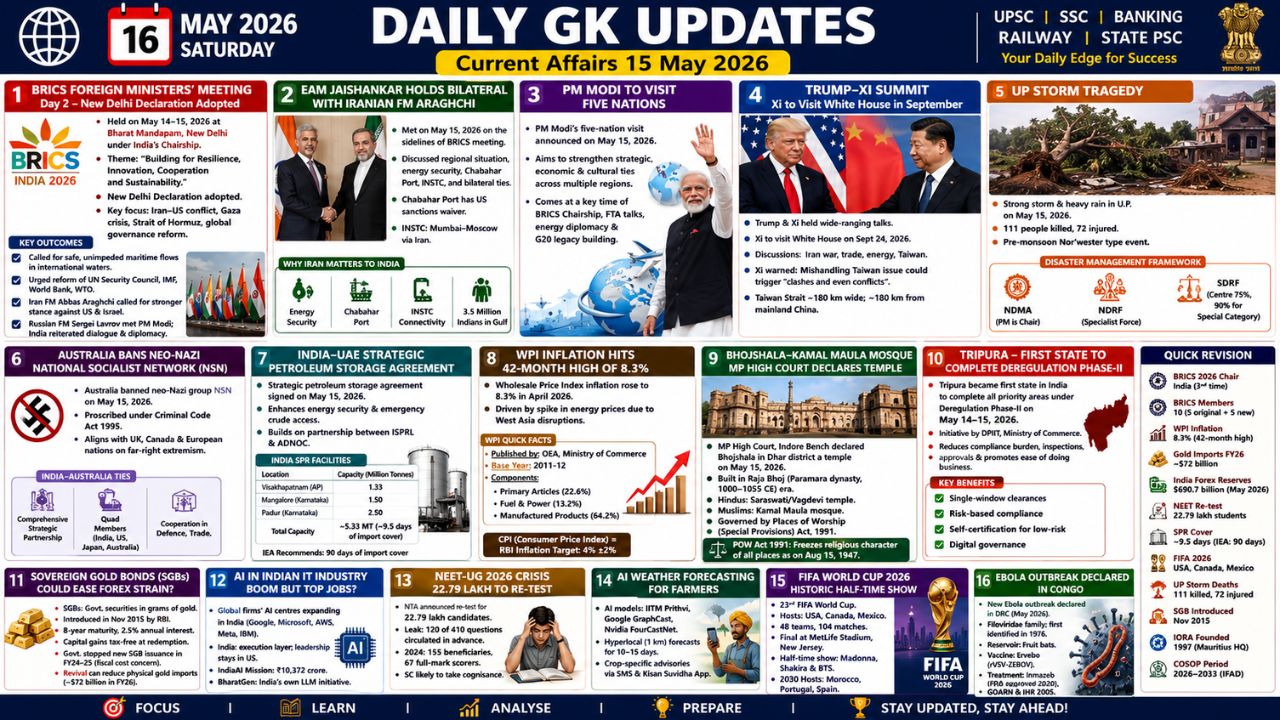
15 May 2026 Current Affairs is arguably the most news-dense edition of the month — with UPSC Prelims just 9 days away. The biggest stories of the day: BRICS Foreign Ministers' Meeting concluded with a historic New Delhi Declaration — calling for maritime safety, global governance reform, and West Asia de-escalation. EAM Jaishankar held a landmark bilateral with Iranian FM Araghchi on the meeting sidelines. WPI inflation surged to a 42-month high of 8.3% — driven by West Asia energy disruptions. 111 people were killed in a devastating UP storm.
India's WholeSale Price Index was closely linked to Strait of Hormuz disruptions. MP High Court declared Bhojshala-Kamal Maula Mosque a temple. Australia banned the neo-Nazi National Socialist Network. Tripura became India's first state to complete Deregulation Phase-II. India-UAE signed a strategic petroleum storage agreement. PM Modi announced a five-nation diplomatic visit. Lavrov met PM Modi. And International Day of Families was observed. A landmark day — let's break it all down.
Important Day — International Day of Families, May 15
International Day of Families 2026 — "Families and Climate Action"
May 15 is celebrated globally to highlight the importance of families and social well-being.
International Day of Families — key facts:
Fact | Detail |
|---|---|
Observed on | May 15 every year |
Established by | UN General Assembly |
Proclaimed in | 1993 (first observed 1994) |
2026 Theme | "Families and Climate Action" |
Purpose | Highlight the role of families in social, economic, and environmental sustainability |
Why "Families and Climate Action" in 2026? The theme recognises that climate change disproportionately affects families — particularly in developing nations. Heatwaves, floods, droughts, and food insecurity directly disrupt family livelihoods, health, and stability. Simultaneously, families are the primary unit of behavioural change — household decisions about energy use, food consumption, and travel collectively determine a significant portion of global carbon footprints. The theme aligns with the Paris Agreement commitments and SDG 13 (Climate Action).
Relevant Indian context: India's family welfare initiatives are governed primarily through the Ministry of Women and Child Development (MoWCD) and the National Health Mission (NHM). The Mission Shakti scheme (umbrella scheme for women's safety and empowerment), Beti Bachao Beti Padhao, and Poshan Abhiyaan (nutrition) all operate at the family level — recognising the family as the unit of development intervention.
International Day of Families = May 15. Proclaimed by UNGA 1993; first observed 1994. 2026 Theme = "Families and Climate Action." SDG 13 = Climate Action. SDG 3 = Good Health and Well-being. India family-level schemes = Mission Shakti, BBBP, Poshan Abhiyaan.
International Affairs
BRICS Foreign Ministers' Meeting Day 2 — New Delhi Declaration Adopted
The Day 2 of the BRICS Foreign Ministers' Meeting concluded with key highlights and outcomes — including adoption of the New Delhi Declaration by BRICS foreign ministers.
Key outcomes of the BRICS FM Meeting (May 14–15):
1. On West Asia and Strait of Hormuz: India flagged grave concerns over the West Asia crisis and its impact on energy supplies and maritime stability in the Strait of Hormuz — urging BRICS nations to develop "practical ways" to navigate "unprecedented" geopolitical and economic uncertainty as well as "unilateral coercive" sanctions.
2. On Global Governance Reform: The New Delhi Declaration called for reform of multilateral institutions — including the UN Security Council, IMF, World Bank, and WTO — to better reflect the realities of a multipolar world. India pushed for permanent UNSC membership for developing nations — reflecting India's long-standing demand for a P5+1 or expanded Security Council.
3. Iran's position: Iranian FM Abbas Araghchi called on BRICS member states to take a stronger stand against what he described as violations of international law by the United States and Israel, calling for a more balanced and just global order.
4. On Russia-Ukraine: Russian FM Sergei Lavrov met PM Modi — they exchanged views on various regional and global issues of mutual interest, including the situation in Ukraine and West Asia. PM Modi reiterated India's position favouring dialogue and diplomacy over military escalation.
The New Delhi Declaration — significance: The New Delhi Declaration is the formal outcome document of the BRICS FM meeting — setting the thematic and policy agenda for the 18th BRICS Leaders' Summit in September 2026. It represents the first major declaratory output under India's BRICS 2026 Chairship.
India's strategic positioning at BRICS: India's masterstroke at this meeting was maintaining absolute balance:
Calling for maritime safety (implicitly pressuring Iran) without condemning Iran
Meeting bilaterally with Iranian FM Araghchi (strengthening energy diplomacy)
Hosting Russian FM Lavrov while maintaining the Ukraine dialogue-diplomacy stance
Keeping China engaged despite Wang Yi's absence
All while championing Global South governance reform
This is India's "strategic autonomy" doctrine in its most visible recent expression.
BRICS FM Meeting concluded May 15. New Delhi Declaration adopted = first major outcome under India's BRICS 2026 Chairship. India = called for maritime safety + unilateral sanction resistance. Iran FM = called for BRICS condemnation of US/Israel. Lavrov met PM Modi = Ukraine + West Asia discussed. PM Modi = dialogue and diplomacy. Strategic autonomy = India's equidistance from competing blocs.
EAM Jaishankar — Bilateral with Iranian FM Araghchi on BRICS Sidelines
External Affairs Minister S. Jaishankar held a bilateral meeting with Iranian Foreign Minister Seyyed Abbas Araghchi in New Delhi on 15 May 2026 on the sidelines of the BRICS Foreign Ministers' Meeting.
Why this bilateral is significant: India-Iran relations are one of the most strategically complex bilateral relationships in India's foreign policy matrix:
Energy: Iran was historically India's 3rd largest oil supplier before US sanctions tightened post-2019. With the Strait of Hormuz under blockade, restoring Iranian oil supply through a diplomatic pathway is critical for India's energy security
Chabahar Port: India has invested in the development of Chabahar Port in Iran's Sistan-Baluchestan Province — India's only overseas port project and the gateway for India's connectivity to Afghanistan, Central Asia, and Russia bypassing Pakistan. The US granted a specific waiver for Chabahar from Iran sanctions — recognising its humanitarian and regional connectivity importance
INSTC: The International North-South Transport Corridor (INSTC) — connecting Mumbai to Moscow via Iran — runs through Iranian territory. Iran's stability directly determines INSTC viability
India's diaspora in the Gulf: Any military escalation involving Iran would directly endanger India's 3.5 million-strong Gulf diaspora
India's Iran policy — the balancing act: India has maintained diplomatic relations with Iran despite Western pressure — calling for dialogue while not endorsing Iranian nuclear ambitions. The bilateral with Araghchi on BRICS sidelines sends a clear signal: India will not abandon its Iran engagement despite US pressure.
Jaishankar-Araghchi bilateral = May 15, 2026, New Delhi, BRICS sidelines. India-Iran = energy (historical oil supplier) + Chabahar Port + INSTC connectivity. Chabahar = India's only overseas port project. US gave Chabahar a specific sanctions waiver. INSTC = Mumbai-Moscow via Iran. India's Gulf diaspora = 3.5 million.
PM Modi to Visit Five Nations — Strengthening India's Global Partnerships
A Prime Minister's Visit to Five Nations was announced — aimed at strengthening India's global partnerships across multiple regions.
Strategic context: PM Modi's five-nation visit — details of which were being finalised — comes at a pivotal moment:
India holds BRICS Chairship (September 2026 Summit approaching)
India is negotiating Free Trade Agreements with multiple partners
The West Asian crisis has created urgent need for energy diversification diplomacy
India's G20 legacy (2023) needs to be built upon through continued engagement
This tour reflects India's proactive multilateral diplomacy — positioning India not just as a regional power but as an indispensable voice in shaping the multipolar international order.
PM Modi five-nation visit announced = May 15, 2026. Context = BRICS Chairship + FTA negotiations + energy diplomacy + G20 legacy. Reflects India's proactive multilateral diplomacy.
Trump-Xi Summit — Xi Warns on Taiwan, Xi to Visit White House in September
US President Donald Trump announced that Chinese President Xi Jinping would make a reciprocal visit to the White House on September 24. Meanwhile, Xi warned Trump that mishandling the Taiwan issue could trigger "clashes and even conflicts" between the two countries as the leaders held wide-ranging talks on the Iran war, energy security, and trade.
What was discussed at Trump-Xi Summit:
Iran war: Trump sought Chinese pressure on Tehran to end the Strait of Hormuz blockade
Trade: Tariff negotiations and supply chain decoupling concerns
Taiwan: Xi issued a sharp warning against any US support for Taiwanese independence
Energy security: Both discussed stabilising global energy markets
India's strategic interest in Trump-Xi dynamics: Any US-China trade deal or strategic understanding directly affects India — as India positions itself as the alternative manufacturing hub in the China+1 strategy. A Trump-Xi detente could reduce the pace of supply chain diversification away from China — potentially affecting India's manufacturing attractiveness.
The Taiwan Strait — quick geography: Taiwan (officially Republic of China, ROC) is a self-governing island located approximately 180 km off the southeastern coast of mainland China. The Taiwan Strait is approximately 180 km wide at its narrowest point. China claims Taiwan under its "One China Policy" — the most sensitive flashpoint in US-China relations.
Xi to visit White House = September 24, 2026. Xi warned Trump on Taiwan. Discussed Iran war, trade, energy. Taiwan Strait = ~180 km wide; ~180 km from mainland China. One China Policy = China's claim over Taiwan. China+1 = supply chain diversification to India and others.
UP Storm Kills 111 — Natural Disaster Response
At least 111 people were killed and 72 injured after a strong storm and heavy rain pounded several districts of Uttar Pradesh, uprooting trees and damaging houses.
Disaster management context: The UP storm — occurring during the pre-monsoon heatwave season — is a characteristic Nor'wester (Kalbaishakhi) type event — severe convective storms that form in North India between March and June when hot dry air from the northwest collides with moist air from the Bay of Bengal.
India's disaster management framework:
NDMA (National Disaster Management Authority): The apex body under the DM Act, 2005 — chaired by the Prime Minister
NDRF (National Disaster Response Force): Specialist response teams deployed for major disasters
SDMA (State Disaster Management Authority): State-level body — chaired by the Chief Minister
SDRF (State Disaster Response Fund): Primary fund for state-level disaster relief — Centre contributes 75% (90% for special category states)
NDRF (National Disaster Response Fund): For disasters exceeding state capacity
Constitutional basis: Disaster management falls under the Concurrent List — both Centre and States have jurisdiction. The DM Act 2005 created the current institutional structure following the 2004 Indian Ocean Tsunami.
UP storm = 111 killed, 72 injured (May 15, 2026). Pre-monsoon Nor'wester type event. NDMA = apex body, DM Act 2005, PM as Chair. NDRF = specialist response force. SDMA = state body, CM as Chair. SDRF = primary state relief fund (Centre 75%, 90% for special category). DM Act 2005 = post-2004 Tsunami legislation.
Australia Bans Neo-Nazi National Socialist Network
Australia banned the neo-Nazi National Socialist Network (NSN) on 15 May 2026 under new anti-hate legislation. The ban took effect at midnight on May 15, 2026.
About the National Socialist Network (NSN): The NSN is an Australian neo-Nazi organisation — inspired by the ideology of Adolf Hitler's National Socialism — that has been linked to public demonstrations, harassment of minority communities, and online extremist content promotion. Australia's ban reflects a growing global trend of using counter-terrorism and hate speech legislation to proscribe far-right extremist organisations.
Australia's legal framework: The ban was enacted under Australia's Criminal Code Act 1995 — which has been progressively amended to include provisions against designated terrorist organisations and, more recently, violent extremist groups. The move aligns Australia with the UK (which banned National Action in 2016 — the first UK far-right proscription), Canada, and several European nations in formally designating neo-Nazi organisations as terrorist or extremist entities.
India-Australia context: The Australia-India relationship is a Comprehensive Strategic Partnership — with defence, trade, and education as key pillars. Australia and India are both Quad members (with the US and Japan) — making Australia's domestic security and governance decisions of tangential relevance to India's strategic partnerships.
Australia banned National Socialist Network (NSN) = neo-Nazi group. Banned under Criminal Code Act 1995. Effective May 15, 2026. Australia-India = Comprehensive Strategic Partnership. Quad members = India, USA, Japan, Australia. UK banned first far-right group (National Action) in 2016.
India-UAE Strategic Petroleum Storage Agreement
India and the UAE signed a strategic petroleum storage agreement — covering storage of crude oil reserves for mutual energy security benefit.
India's Strategic Petroleum Reserves (SPR) programme: India maintains Strategic Petroleum Reserves — emergency crude oil stockpiles — at three underground facilities:
Visakhapatnam (Andhra Pradesh): 1.33 million tonnes
Mangalore (Karnataka): 1.5 million tonnes
Padur (Karnataka): 2.5 million tonnes
Total Phase 1 capacity: ~5.33 million tonnes (approximately 9.5 days of import cover)
Phase 2 expansion: India is expanding its SPR programme — with sites at Chandikhol (Odisha) and Padur (expansion) under development. The India-UAE agreement likely involves:
UAE storing crude oil in India's SPR facilities (generating revenue for India)
India gaining assured access to UAE crude in emergency scenarios
Joint management of storage and drawdown protocols
Why this matters now: The Strait of Hormuz blockade has made India's vulnerability to supply disruptions starkly visible. India's SPR covers only 9.5 days of imports — far short of the IEA (International Energy Agency) recommended 90-day strategic reserve standard. The UAE agreement is a step toward building emergency energy resilience.
ADNOC partnership: The storage arrangement builds on an existing partnership between India's Indian Strategic Petroleum Reserves Ltd (ISPRL) and ADNOC (Abu Dhabi National Oil Company) — which has had crude oil stored in India's Mangalore cavern since 2018.
India-UAE Strategic Petroleum Storage Agreement = signed May 15, 2026. India SPR = 3 facilities: Visakhapatnam (1.33 MT), Mangalore (1.5 MT), Padur (2.5 MT). Total = ~5.33 MT = ~9.5 days import cover. IEA recommends 90 days. ISPRL = Indian Strategic Petroleum Reserves Ltd. ADNOC = Abu Dhabi National Oil Company. Context = Strait of Hormuz blockade.
Governance & Economy
WPI Inflation Hits 42-Month High of 8.3% — West Asia Energy Shock
Wholesale price inflation shot up to a 42-month high of 8.3% on the back of a spike in energy prices that followed the disruptions caused by the West Asia conflict.
WPI vs CPI — the essential distinction for every exam:
Parameter | WPI | CPI |
|---|---|---|
Full form | Wholesale Price Index | Consumer Price Index |
Measures | Price changes at factory/wholesale level | Price changes at retail/consumer level |
Published by | Office of Economic Adviser (OEA), Ministry of Commerce | NSO (National Statistical Office), MoSPI |
Base year | 2011–12 | 2012 |
Frequency | Monthly | Monthly |
Used for | Industrial pricing, inflation monitoring | RBI's primary inflation target |
Includes services? | No (only goods) | Yes (goods + services) |
Three components | Primary Articles (22.6%) + Fuel & Power (13.2%) + Manufactured Products (64.2%) | Food + Housing + Fuel + Misc. |
Why WPI hit 8.3%: The Strait of Hormuz blockade has disrupted global oil supply — pushing Brent crude prices significantly higher. WPI's Fuel and Power component — comprising 13.2% of the index — has spiked, dragging up the overall WPI. Additionally:
Manufactured goods: Rising input costs (energy-intensive industries) passed through to wholesale prices
Primary articles: Food prices elevated by heatwave-driven supply disruptions
WPI-CPI divergence: When WPI rises sharply but CPI remains relatively stable (as often happens initially), it signals a cost-push inflationary pressure building in the production pipeline — which will eventually feed through to consumer prices with a lag of 6–12 weeks.
RBI's monetary policy response: Inflation rising sharply has implications for India's monetary policy stance — the RBI's primary mandate is CPI inflation targeting at 4% (±2% tolerance band). With WPI surging, RBI faces a classic dilemma: raise rates to contain inflation (risking growth slowdown) or hold rates to support growth (risking inflation entrenchment).
WPI = 8.3% (42-month high, May 2026). WPI published by OEA, Ministry of Commerce. Base year = 2011-12. WPI components: Primary Articles (22.6%) + Fuel & Power (13.2%) + Manufactured Products (64.2%). CPI = RBI's primary inflation target (4% ±2%). CPI published by NSO/MoSPI. WPI surge = Strait of Hormuz energy shock. Cost-push inflation = supply-side driven.
Bhojshala-Kamal Maula Mosque — MP High Court Declares It a Temple
The Madhya Pradesh High Court, Indore Bench, declared the Bhojshala-Kamal Maula Mosque complex in Dhar district a temple on 15 May 2026.
About Bhojshala:
Located in Dhar district, Madhya Pradesh
A medieval structure built during the era of Raja Bhoj (1000–1055 CE) of the Paramara dynasty
Hindu groups believe it is a Saraswati temple (Vagdevi mandir) — constructed by the scholar-king Raja Bhoja as a centre of Sanskrit learning
Muslim groups claim the adjacent structure is the Kamal Maula mosque — incorporating material from earlier Hindu structures — and use it for Friday prayers
The Archaeological Survey of India (ASI) manages the site
The dispute has led to weekly tensions — Hindus claim Tuesday worship rights, Muslims claim Friday prayer rights under ASI-managed arrangements
The legal framework: The Places of Worship (Special Provisions) Act, 1991 — a landmark legislation enacted by the Narasimha Rao government — freezes the religious character of all places of worship as they existed on August 15, 1947, prohibiting conversion of any place of worship. The only explicit exception made was for the Ram Janmabhoomi-Babri Masjid dispute (which was already in litigation). The MP HC ruling will inevitably face scrutiny against this Act.
Constitutional angle:
Article 25: Freedom of conscience and right to profess, practise, and propagate religion
Article 26: Freedom to manage religious affairs
Article 29 and 30: Cultural and educational rights of minorities
Places of Worship Act 1991 — a legislative attempt to give finality to religious site disputes and prevent communal mobilisation
The Gyanvapi-Mathura-Bhojshala pattern: The Bhojshala ruling comes after the Gyanvapi mosque (Varanasi) and Shahi Eidgah mosque (Mathura) disputes — where ASI surveys were ordered. Each case tests the Places of Worship Act 1991 against arguments that it cannot extinguish pre-existing legal rights.
Bhojshala = Dhar district, MP. Built during Raja Bhoj's era (Paramara dynasty, 1000–1055 CE). Hindu claim = Saraswati/Vagdevi temple. Muslim claim = Kamal Maula mosque. MP HC declared it a temple = May 15, 2026. Places of Worship Act 1991 = freezes religious character as of August 15, 1947. Only exception = Ram Janmabhoomi. Article 25 = freedom of religion. ASI manages Bhojshala.
Tripura — First State to Complete Deregulation Phase-II
Tripura became the first state in India to complete all priority areas under Deregulation Phase-II of the national Compliance Reduction and Deregulation initiative on 14–15 May 2026.
What is the Compliance Reduction and Deregulation initiative? This is a central government initiative — coordinated by the Department for Promotion of Industry and Internal Trade (DPIIT) under the Ministry of Commerce and Industry — designed to:
Eliminate unnecessary regulatory compliance burdens on businesses
Reduce the number of inspections, filings, and approvals required
Move toward risk-based compliance (only high-risk entities get detailed scrutiny)
Enable self-certification for low-risk activities
Create a more business-friendly regulatory environment aligned with India's Ease of Doing Business (EoDB) goals
Phase II specific focus: Deregulation Phase-II covers state-level compliances — particularly in labour laws, environmental clearances, building permissions, and land use regulations. States must:
Identify redundant regulations
Digitise remaining compliances
Create single-window clearance systems
Eliminate duplicated central-state requirements
Tripura's achievement: Tripura being the first state to complete Phase-II across all priority areas is a significant governance achievement for a small northeastern state — demonstrating that reform momentum is not limited to large industrial states like Gujarat or Maharashtra.
Tripura = first state to complete Deregulation Phase-II (May 14–15, 2026). Compliance Reduction initiative = coordinated by DPIIT under Ministry of Commerce. Aim = reduce regulatory burden, improve Ease of Doing Business. Phase-II = state-level compliances. Tripura = NE state under Category III special provisions.
Sovereign Gold Bonds (SGBs) — Could They Have Eased Forex Reserve Strain?
"Could Sovereign Gold Bonds have eased strain on forex reserves?" — a major policy analysis emerged.
What are Sovereign Gold Bonds (SGBs)? Sovereign Gold Bonds are government securities denominated in grams of gold — issued by the Reserve Bank of India on behalf of the Government of India. They were introduced in November 2015 as an alternative to physical gold purchasing.
How SGBs work:
Investors buy SGBs instead of physical gold
They receive 2.5% annual interest on the initial investment (on top of any gold price appreciation)
At maturity (8 years), they receive the market price of gold at that time
Capital gains on SGB redemption are tax-free (unlike physical gold)
Why SGBs are relevant to India's forex reserve concern: If more Indians had invested in SGBs rather than physical gold, India would have imported less physical gold — reducing the pressure on foreign exchange reserves. Gold imports of ~$72 billion in FY26 significantly widened India's trade deficit and current account deficit.
The SGB supply problem: The government abruptly stopped issuing new SGBs in FY2024–25 — citing fiscal cost (the 2.5% interest + gold price appreciation made SGBs expensive for the government). This created a void — investors wanting gold exposure returned to physical gold imports, worsening the CAD.
Policy recommendation: Resuming SGB issuance — ideally with a revised structure that makes it fiscally manageable (lower coupon, partial physical gold backing) — could channel domestic gold demand into a domestically circulating instrument rather than depleting forex reserves through imports.
SGB = Sovereign Gold Bonds. RBI issues on behalf of GoI. Introduced November 2015. 8-year maturity. 2.5% annual interest. Capital gains tax-free at redemption. Government stopped new SGB issuance in FY25 (fiscal cost concern). SGB revival = could reduce physical gold imports (~$72 billion FY26). Relevant to forex reserve management.
Global AI Centres Reshaping Indian IT Industry — But Who Has Top Jobs?
Global firms' AI centres are reshaping the Indian IT industry — but questions are being raised about who holds the top jobs and decision-making roles.
The AI centre boom in India: Global technology companies — including Google (Hyderabad, Bengaluru), Microsoft (Hyderabad, Noida), Amazon Web Services (Hyderabad), Meta (Bengaluru), and IBM (Bengaluru) — have been rapidly expanding their AI research and development centres in India. India's advantages:
Deep talent pool: India produces approximately 1.5 million engineering graduates annually
Cost advantage: AI research costs in India are 30–40% lower than in the US
Time zone: India's IST (UTC+5:30) enables near-24-hour global AI development cycles
English proficiency: Critical for AI training data annotation and model fine-tuning
The "top jobs" problem: Despite India hosting world-class AI centres, a pattern has emerged where:
Leadership and strategy roles remain concentrated at global headquarters (US, Europe)
India-based AI centres primarily handle execution, data annotation, model training, and testing — not core research and architectural innovation
Salary gap: AI researchers at US headquarters earn 5–8x their Indian counterparts for comparable work
India's response:
IndiaAI Mission (₹10,372 crore): Building domestic AI research capacity
BharatGen: India's own large language model initiative
National AI Portal: Centralising AI resources and research
Skill India + AICTE partnerships for AI curriculum integration
Global AI centres in India = Google, Microsoft, Amazon, Meta, IBM (Bengaluru, Hyderabad, Noida). India = 1.5 million engineering graduates/year. "Top jobs" concern = strategy/leadership stays in US; India gets execution. IndiaAI Mission = ₹10,372 crore. BharatGen = India's LLM initiative. This debate = relevant for GS Paper III (Economy, Technology) and Essay.
Education
Delhi Students Protest Against NEET-UG Cancellation
Students and organisations in Delhi intensified protests against the cancellation of the NEET-UG examination over the alleged paper leak — demanding accountability, NTA reform, and a transparent re-test process.
The student protest dimension: The NEET-UG protests highlight a deeper structural tension in India's examination governance:
22.79 lakh aspirants — many of whom had prepared for 2–3 years — face uncertainty
Many students from rural and semi-urban areas bear disproportionate costs of re-testing (travel, accommodation, re-preparation)
The psychological burden on aspirants — including mental health implications — is severe
Protests are demanding: NTA dissolution or complete overhaul, independent examination governance body, end-to-end digital question paper management, and criminal prosecution of those who orchestrated the leak
The NTA reform debate: Two competing proposals have emerged:
Reform NTA: Keep the centralised model but create an autonomous, fully digital examination authority with blockchain-secured paper distribution and strict criminal liability for leaks
Decentralise: Allow states to conduct their own medical entrance tests — reducing single-point-of-failure risk — with central merit normalisation for AIIMS and central colleges
Supreme Court's role: The Supreme Court of India was expected to take suo motu cognisance of the NEET 2026 paper leak — following its 2024 NEET intervention which mandated a comprehensive overhaul. Any SC order on NTA reform will have constitutional implications under Article 21 (Right to Life) — which courts have interpreted to include the right to a fair and transparent educational examination process.
Delhi protests = NEET-UG 2026 paper leak. 22.79 lakh affected. Demands = NTA reform/dissolution, transparent re-test, criminal prosecution. SC expected to take cognisance (Article 21 = right to fair examination). NTA = 2017 under MoE. Rural students disproportionately affected. Key governance failure debate for UPSC GS Paper II.
Science & Technology
AI-Based Weather Forecasting for Farmers — Kisan-Centric Agriculture
An AI-based weather forecasting system for farmer-centric agriculture was highlighted — representing a new era for agricultural planning in India.
India's agricultural weather challenge: India's agriculture is still approximately 52% rain-fed — making it extraordinarily vulnerable to monsoon variability, unseasonal rains, and extreme weather events. The India Meteorological Department (IMD) provides weather forecasts — but traditional forecasting has three limitations for farmers:
Geographic resolution: District-level forecasts don't capture village-level variations
Lead time: Short-range forecasts (1–3 days) give insufficient planning time
Accessibility: Forecasts in technical language, inaccessible to rural farmers
AI-based farm weather systems: Modern AI weather models — including Google's GraphCast, Nvidia's FourCastNet, and India's own IITM (Indian Institute of Tropical Meteorology) Prithvi model — use deep learning to:
Generate hyperlocal forecasts (1 km resolution) rather than district-level averages
Provide 10–15 day extended forecasts with higher accuracy than traditional numerical models
Deliver crop-specific advisories — not just weather data but action recommendations (when to sow, irrigate, apply pesticide, harvest)
Send alerts via SMS in local languages and through the Kisan Suvidha app
Kisan Suvidha app: Launched by the Ministry of Agriculture and Farmers Welfare, Kisan Suvidha provides farmers with weather, market prices, agri-inputs, pest/disease advisories, and government scheme information — in 11 regional languages.
India = 52% rain-fed agriculture. IMD = India Meteorological Department. AI weather models: Google's GraphCast, Nvidia's FourCastNet, IITM's Prithvi. Hyperlocal = 1 km resolution. 10–15 day AI forecasts more accurate than traditional models. Kisan Suvidha app = Ministry of Agriculture, 11 languages. AI agriculture = GS Paper III (Science + Economy intersection).
Sports
Vaibhav Sooryavanshi Selected for India 'A' Sri Lanka Tri-Series
Prodigious batsman Vaibhav Sooryavanshi has been selected for India's 15-member 'A' squad for the upcoming one-day tri-series in Sri Lanka, scheduled for June 2026. The team will compete against the 'A' squads of Afghanistan and the host nation Sri Lanka, captained by Tilak Varma with Riyan Parag as vice-captain.
About Vaibhav Sooryavanshi:
Indian cricketing prodigy — made headlines at an extremely young age
Represented India in junior cricket before earning the India 'A' call-up
Known for his aggressive batting style in the top order
The Sri Lanka tri-series represents a critical step in his development pathway toward full senior international representation
India 'A' cricket — significance: India 'A' tours serve as the primary pathway for domestic cricketers transitioning toward the senior national team. They play against the 'A' sides of Test-playing nations — providing high-quality opposition without the full pressure of international cricket. The National Cricket Academy (NCA) in Bengaluru supports India 'A' preparation.
Vaibhav Sooryavanshi = India 'A' squad for Sri Lanka tri-series (June 2026). India 'A' captain = Tilak Varma. Vice-captain = Riyan Parag. Opponents = Afghanistan 'A' + Sri Lanka 'A'. India 'A' = pathway to senior team. NCA = National Cricket Academy, Bengaluru.
FIFA World Cup 2026 — BTS, Madonna, Shakira for Historic Half-Time Show
FIFA confirmed that a Super Bowl-style musical spectacle will debut at the World Cup final, with global icons Madonna, Shakira, and K-pop giants BTS leading the historic lineup.
FIFA World Cup 2026 — key facts:
Fact | Detail |
|---|---|
Edition | 23rd FIFA World Cup |
Host nations | USA, Canada, Mexico — first three-nation host |
Teams | 48 teams (expanded from 32 in 2022) |
Matches | 104 matches (up from 64 in 2022) |
Final venue | MetLife Stadium, East Rutherford, New Jersey, USA |
Tournament period | June–July 2026 |
Previous host | Qatar 2022 |
Next host | Morocco, Portugal, Spain (2030 — centenary edition) |
BTS relevance: BTS — a South Korean K-pop group — performing at the FIFA World Cup final represents the global mainstreaming of Korean pop culture, continuing the Hallyu (Korean Wave) phenomenon. BTS previously performed at the UN General Assembly in 2021, illustrating K-pop's transcendence from entertainment to soft power diplomacy.
FIFA World Cup 2026 = USA + Canada + Mexico. 48 teams, 104 matches. Final = MetLife Stadium, New Jersey. Half-time = Madonna + Shakira + BTS (first Super Bowl-style FIFA final show). 2030 = Morocco + Portugal + Spain (centenary). BTS = K-pop soft power. Hallyu = Korean Wave cultural export.
Environment
Ebola Virus Disease — New Outbreak Declared in Congo
A new Ebola outbreak was declared in Congo — raising global health surveillance concerns.
About Ebola Virus Disease (EVD):
Ebola is a severe, often fatal viral illness caused by the Ebola virus — belonging to the Filoviridae family
First identified in 1976 near the Ebola River in the Democratic Republic of Congo (DRC)
Transmission: Through direct contact with blood, secretions, organs, or other bodily fluids of infected people or animals (primarily fruit bats) — not airborne
Case fatality rate: 25–90% depending on outbreak strain and healthcare response
Symptoms: Fever, fatigue, muscle pain, headache, vomiting, diarrhoea, internal and external bleeding
Treatment: No fully licensed cure; Inmazeb (atoltivimab, maftivimab, odesivimab) is the first FDA-approved treatment (2020). rVSV-ZEBOV (Ervebo) = WHO-approved vaccine
Natural reservoir: Fruit bats (particularly Rousettus aegyptiacus — Egyptian fruit bat)
Congo's Ebola history: The Democratic Republic of Congo (DRC) — formerly Zaire — has had more Ebola outbreaks than any other country. The 2018–2020 DRC outbreak (North Kivu) was the world's second-largest ever — with over 3,400 cases and 2,264 deaths. The 2026 outbreak represents a new episode in this recurring public health emergency.
WHO's role: WHO classifies Ebola outbreaks and coordinates international response through:
GOARN (Global Outbreak Alert and Response Network)
IHR (International Health Regulations, 2005) — the binding international framework for health emergency reporting
PHEIC (Public Health Emergency of International Concern) — the highest WHO alert level
Ebola = Filoviridae family. First identified 1976 near Ebola River, DRC. Reservoir = fruit bats. Transmission = direct contact with bodily fluids (NOT airborne). CFR = 25–90%. Vaccine = Ervebo (rVSV-ZEBOV). Treatment = Inmazeb (FDA approved 2020). New outbreak = DRC, May 2026. WHO response via GOARN + IHR 2005. PHEIC = highest WHO alert.
UP River Rejuvenation — Community-Based Ecological Restoration
Uttar Pradesh expanded river rejuvenation work under community-based restoration projects linked to rural sustainability and ecological resilience.
India's river rejuvenation framework: River rejuvenation in India operates under multiple overlapping frameworks:
Namami Gange Programme: India's flagship integrated conservation mission for the Ganga River — with a budget of ₹20,000 crore (now expanded under Ganga Rejuvenation Mission)
National River Conservation Plan (NRCP): Covers rivers beyond Ganga — includes treatment of sewage and industrial effluents
AMRUT 2.0: Urban water supply and wastewater management — contributes to river health in urban areas
River Basin Management Scheme: Extended to 2030–31 (covered in April 2026 current affairs)
Community-based restoration — what makes it different: Traditional engineering-based river restoration (constructing check dams, sewage treatment plants) is supply-side. Community-based restoration adds demand-side behavioural change — local communities become custodians of river health through:
River parliaments (Nadi Sansads): Village-level committees managing riverbank activities
Jal Chaupal: Community water governance discussions
Eco-sensitive zone protection through community voluntary compliance
UP river rejuvenation = community-based restoration. Namami Gange = flagship Ganga conservation (₹20,000 crore). NRCP = National River Conservation Plan (non-Ganga rivers). River Basin Management Scheme extended to 2030-31. Community restoration = Nadi Sansad + Jal Chaupal models. SDG 6 = Clean Water and Sanitation.
FAQs — 15 May 2026 Current Affairs
Q. What was the outcome of the BRICS Foreign Ministers' Meeting on May 14–15?
The two-day meeting concluded with the adoption of the New Delhi Declaration — the first major outcome document under India's BRICS 2026 Chairship. India called for safe maritime flows through the Strait of Hormuz and resistance to unilateral coercive sanctions. Iran's FM called for BRICS condemnation of US-Israel actions. Russian FM Lavrov met PM Modi — India reiterated its dialogue-diplomacy position on Ukraine. The Declaration sets the agenda for the 18th BRICS Leaders' Summit in September 2026.
Q. Why is the Jaishankar-Araghchi bilateral significant?
India's bilateral with Iranian FM Araghchi on BRICS sidelines signals continued engagement despite the US-Iran conflict — protecting India's core interests: restoring Iranian oil supply, advancing Chabahar Port development (India's only overseas port, which has a US sanctions waiver), maintaining INSTC connectivity (Mumbai-Moscow via Iran), and safeguarding 3.5 million Indians in the Gulf from potential military escalation.
Q. What does WPI at 8.3% mean and why has it hit a 42-month high?
WPI (Wholesale Price Index) measures price changes at the factory/wholesale level — published by the Office of Economic Adviser, Ministry of Commerce, with base year 2011-12. The 8.3% reading is a 42-month high driven by the Strait of Hormuz blockade causing an energy price spike — particularly in the Fuel and Power component (13.2% of WPI). This cost-push inflation will gradually feed through to consumer prices measured by CPI — which is RBI's primary 4% target.
Q. What is India's Strategic Petroleum Reserve and what does the India-UAE deal add?
India has SPR facilities at Visakhapatnam (1.33 MT), Mangalore (1.5 MT), and Padur (2.5 MT) — totalling ~5.33 million tonnes or ~9.5 days of import cover. The India-UAE agreement — signed May 15, 2026 — adds a strategic storage dimension: UAE's ADNOC stores crude in India's facilities (generating revenue) while India gains assured emergency access. This builds energy resilience in the context of the Strait of Hormuz blockade, while India's cover remains far short of the IEA-recommended 90-day standard.
Q. What is the significance of the Bhojshala-Kamal Maula Mosque HC ruling?
The MP High Court's Indore Bench declared the Bhojshala complex in Dhar district — a medieval structure from Raja Bhoj's Paramara dynasty era — a temple on May 15, 2026. The ruling will face scrutiny against the Places of Worship (Special Provisions) Act, 1991, which freezes the religious character of all worship sites as of August 15, 1947 — with the only exception being the Ram Janmabhoomi dispute. Articles 25 (freedom of religion) and 26 (manage religious affairs) are the key constitutional provisions at stake.
Q. What is the Sovereign Gold Bond and why is its absence worsening India's forex situation?
SGBs are government securities in gold denominations — introduced in November 2015 by RBI. They offer 2.5% annual interest + gold price appreciation + tax-free capital gains at maturity, making them superior to physical gold. The government stopped issuing new SGBs in FY25 due to fiscal cost concerns. This sent gold demand back to physical imports — contributing to India's ~$72 billion gold import bill in FY26, worsening the trade deficit and forex reserve drain.
Q. What are the key facts about the FIFA World Cup 2026?
The 23rd FIFA World Cup is hosted by USA, Canada, and Mexico — the first three-nation co-host. 48 teams will play 104 matches, with the final at MetLife Stadium, East Rutherford, New Jersey. For the first time, a Super Bowl-style half-time show (Madonna, Shakira, BTS) has been announced for the final. The next World Cup (2030) will be hosted by Morocco, Portugal, and Spain as the centenary edition.
Q. What is the new Ebola outbreak in Congo and why is it a concern?
A new Ebola Virus Disease outbreak was declared in the Democratic Republic of Congo (DRC) in May 2026. Ebola (Filoviridae family) was first identified in 1976 near the Ebola River, DRC. It is transmitted through direct bodily fluid contact — not airborne. The natural reservoir is fruit bats. The approved vaccine is Ervebo (rVSV-ZEBOV) and the FDA-approved treatment is Inmazeb (2020). DRC has experienced more Ebola outbreaks than any other country. WHO responds through GOARN and the IHR 2005 framework.
Q. What is International Day of Families and what is the 2026 theme?
International Day of Families is observed on May 15 — proclaimed by the UN General Assembly in 1993 (first observed 1994). The 2026 theme is "Families and Climate Action" — recognising that climate change disproportionately affects families and that household decisions collectively shape a significant portion of global carbon emissions. The theme aligns with SDG 13 (Climate Action) and SDG 3 (Good Health and Well-being).
Written by
Koti Deva
Digital Marketing Specialist
Koti is a Digital Marketing Specialist with over 10 years of experience and the co-founder of MCQ Orbit — a free exam prep platform built for Indian competitive exam aspirants.
With strong personal knowledge in Quantitative Aptitude, Logical Reasoning, and Mathematics, Koti has a deep understanding of what it takes to crack exams like SSC CGL, IBPS PO, SBI Clerk, UPSC Prelims, NEET, and JEE. Having followed these exams closely for years, he understands the exact topics, patterns, and shortcuts that matter most.
MCQ Orbit was born from a simple desire — to build a platform where every aspirant in India can practice quality MCQs, read reliable current affairs, and prepare confidently, without paying a rupee. Koti combines his digital expertise with his passion for competitive exams to create content that is accurate, practical, and genuinely useful for students.
His mission is straightforward: if the right guidance had been freely available earlier, more students would have cracked their dream exams. MCQ Orbit is his way of making that happen.
Comments
No comments yet.